Course Outcomes:
At theend of this course, students will be able to:
Compare and contrast the various CSM models.
Understand the principle of software engineering.
Examine the lifecycle phases, artifacts of the process and model-based software
architectures.
Compare various work flow process models.
Evaluate different software product metrics.
3.
UNIT I
Conventional SoftwareManagement:
The waterfall model, conventional software Management performance.
Evolution of Software Economics: Software Economics, pragmatic software cost
estimation.
4.
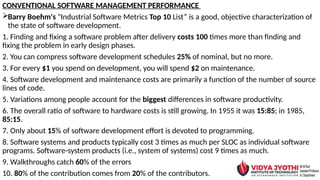
CONVENTIONAL SOFTWARE MANAGEMENTPERFORMANCE
Barry Boehm's "Industrial Software Metrics Top 10 List” is a good, objective characterization of
the state of software development.
1. Finding and fixing a software problem after delivery costs 100 times more than finding and
fixing the problem in early design phases.
2. You can compress software development schedules 25% of nominal, but no more.
3. For every $1 you spend on development, you will spend $2 on maintenance.
4. Software development and maintenance costs are primarily a function of the number of source
lines of code.
5. Variations among people account for the biggest differences in software productivity.
6. The overall ratio of software to hardware costs is still growing. In 1955 it was 15:85; in 1985,
85:15.
7. Only about 15% of software development effort is devoted to programming.
8. Software systems and products typically cost 3 times as much per SLOC as individual software
programs. Software-system products (i.e., system of systems) cost 9 times as much.
9. Walkthroughs catch 60% of the errors
10. 80% of the contribution comes from 20% of the contributors.
5.
Evolution of SoftwareEconomics
SOFTWARE ECONOMICS :
Most software cost models can be abstracted into a function of five basic parameters:
size, process, personnel, environment, and required quality.
1. The size of the end product (in human-generated components), which is typically
quantified in terms of the number of source instructions or the number of function
points required to develop the required functionality
2. The process used to produce the end product, in particular the ability of the process
to avoid non-value-adding activities (rework, bureaucratic delays, communications
overhead)
3. The capabilities of software engineering personnel, and particularly their experience
with the computer science issues and the applications domain issues of the project
4. The environment, which is made up of the tools and techniques available to support
efficient software development and to automate the process
5. The required quality of the product, including its features, performance, reliability,
and adaptability
6.
The relationships amongthese parameters and the estimated cost can be written
as follows: Effort = (Personnel) (Environment) (Quality) ( Sizeprocess
)
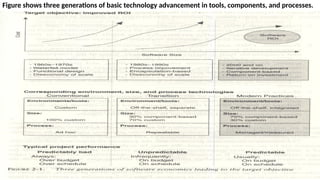
The three generations of software development are defined as follows:
1) Conventional: 1960s and 1970s, craftsmanship. Organizations used custom
tools, custom processes, and virtually all custom components built in primitive
languages. Project performance was highly predictable in that cost, schedule, and
quality objectives were almost always underachieved.
2) Transition: 1980s and 1990s, software engineering. Organizations used more-
repeatable processes and off-the-shelf tools, and mostly (>70%) custom
components built in higher level languages. Some of the components (<30%) were
available as commercial products, including the operating system, database
management system, networking, and graphical user interface.
3) Modern practices: 2000 and later, software production.
7.
Figure shows threegenerations of basic technology advancement in tools, components, and processes.
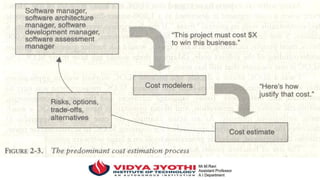
PRAGMATIC SOFTWARE COSTESTIMATION
• There are several popular cost estimation models (such as COCOMO,
CHECKPOINT, ESTIMACS, Knowledge Plan, Price-S, ProQMS, SEER, SLIM,
SOFTCOST, and SPQR/20), CO COMO is also one of the 10 most open and well-
documented cost estimation models.
A good software cost estimate has the following attributes:
It is conceived and supported by the project manager, architecture team,
development team, and test team accountable for performing the work.
It is accepted by all stakeholders as ambitious but realizable.
It is based on a well-defined software cost model with a credible basis.
It is based on a database of relevant project experience that includes similar
processes, similar technologies, similar environments, similar quality
requirements, and similar people.
It is defined in enough detail so that its key risk areas are understood and the
probability of success is objectively assessed.