how much youknow about the
Escherichia coli
or
E.coli bacteria....?
3.
Introduction of E.coli
Escherichiacoli was isolated in 1885
from a fecal sample of an infant.
Normally present in the large
intestine of humans and animals
4.
Most stains ofE.coli are harmless
and beneficial, playing an important
role in digestion, maintaining gut
health and synthesizing vitamin k.
However, some strains are pathogenic
and can cause a wide range of infections.
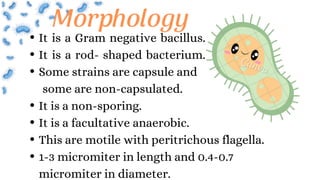
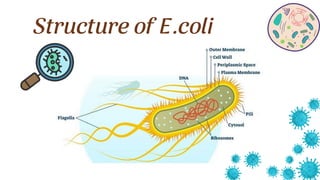
It is aGram negative bacillus.
It is a rod- shaped bacterium.
Some strains are capsule and
some are non-capsulated.
It is a non-sporing.
It is a facultative anaerobic.
This are motile with peritrichous flagella.
1-3 micromiter in length and 0.4-0.7
micromiter in diameter.
Morphology
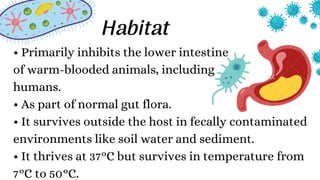
• Primarily inhibitsthe lower intestine
of warm-blooded animals, including
humans.
• As part of normal gut flora.
• It survives outside the host in fecally contaminated
environments like soil water and sediment.
• It thrives at 37°C but survives in temperature from
7°C to 50°C.
Habitat
9.
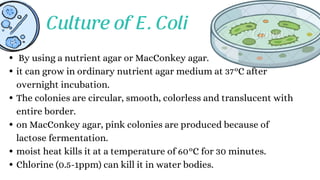
By using anutrient agar or MacConkey agar.
it can grow in ordinary nutrient agar medium at 37°C after
overnight incubation.
The colonies are circular, smooth, colorless and translucent with
entire border.
on MacConkey agar, pink colonies are produced because of
lactose fermentation.
moist heat kills it at a temperature of 60°C for 30 minutes.
Chlorine (0.5-1ppm) can kill it in water bodies.
Culture of E. Coli
a. Enteropathic E.coli(EPEC)
b. Enterotoxigeic E.coli (ETEC)
c. Enteroinvasive E.coli (EIEC)
d. Enterohemorrhagic E.coli (EHEC)
e. Enteroaggregative E.coli (EAEC)
1. Diarrhea and dysentery / Gastrointestinal
infection
14.
Urinary tract infections
E.coliisthemost common causativeorganism
of urinary tract infections in community as
well as in hospital.
Mostly bacteria from fecal flora get colonized
in the periurethral region and reach urinary
tract through blood or during sexual
intercourse.
15.
Female have morerisk of getting UTI
than male because of short urethra. They
develop honeymoon cystitis during
sexual intercourse.
Pregnant female are exposed to UTIs
because of hormonal changes and infrequent
voiding due to pressure on the urinary tract.
16.
Burning sensation
cloudy urine
strongsmell of urine
pressure on the urinary tract
flank or back pain
vaginal discharge
painful ejaculation
testicular pain
penile pain and
penile discharge
pain in the abdomen.
Symptoms
In newborns
Poor feeding
bed-wetting
hypothermia
jaundice
diarrhea
17.
The bacteria invadethe bloodstream from
urinary tract and release lipopolysaccharides (
endotoxins) in the blood. This leads to
disseminated intravascular coagulation,
systemic inflammatory response syndrome
(SIRS).
It is also known as septic shock.
Septicemia (blood infection)
18.
1. Entry intothe body
2. Adhesion (Attachment)
3. Multiplication
4. Toxin production
5. Tissue damage
6. Clinical effects
Pathogenesis
 Most read