Evaluating literary texts
ENLIT-I-2Analyze the maxims, universal truths, and philosophies
presented in the literary text as a means of valuing other people and
their various circumstances in life.
• Prepared by: Mr. Sandy N.
Navergas
2.
Understanding the meaningand
message given: maxims, general
truths, and philosophies convey.
Objective:
a. Identify the meaning and message the given maxims,
general truths, and philosophies convey.
b. Relate the identified message of the maxims, general
truths, and philosophies to real-life situations.
3.
Activity 1 A:You
Complete Me!
Directions: Complete the following statements.
1. Kung ano ang itinanim,
______________________________________________.
2. Ang tunay na kaibigan, hindi nang-iiwan sa oras
ng___________________.
3. Ang ayaw mong gawin sa iyo
_________________________________________.
4. Habang may buhay,
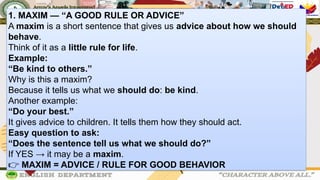
1. MAXIM —“A GOOD RULE OR ADVICE”
A maxim is a short sentence that gives us advice about how we should
behave.
Think of it as a little rule for life.
Example:
“Be kind to others.”
Why is this a maxim?
Because it tells us what we should do: be kind.
Another example:
“Do your best.”
It gives advice to children. It tells them how they should act.
Easy question to ask:
“Does the sentence tell us what we should do?”
If YES → it may be a maxim.
👉 MAXIM = ADVICE / RULE FOR GOOD BEHAVIOR
6.
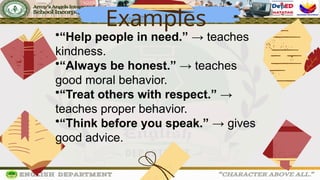
Examples
•“Help people inneed.” → teaches
kindness.
•“Always be honest.” → teaches
good moral behavior.
•“Treat others with respect.” →
teaches proper behavior.
•“Think before you speak.” → gives
good advice.
7.
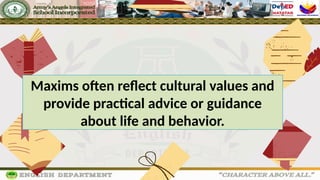
Maxims often reflectcultural values and
provide practical advice or guidance
about life and behavior.
8.
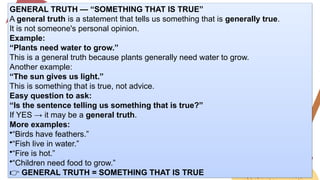
GENERAL TRUTH —“SOMETHING THAT IS TRUE”
A general truth is a statement that tells us something that is generally true.
It is not someone's personal opinion.
Example:
“Plants need water to grow.”
This is a general truth because plants generally need water to grow.
Another example:
“The sun gives us light.”
This is something that is true, not advice.
Easy question to ask:
“Is the sentence telling us something that is true?”
If YES → it may be a general truth.
More examples:
•“Birds have feathers.”
•“Fish live in water.”
•“Fire is hot.”
•“Children need food to grow.”
👉 GENERAL TRUTH = SOMETHING THAT IS TRUE
9.
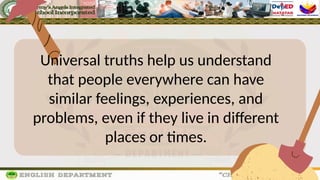
Universal truths helpus understand
that people everywhere can have
similar feelings, experiences, and
problems, even if they live in different
places or times.
10.
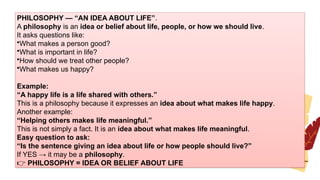
PHILOSOPHY — “ANIDEA ABOUT LIFE”.
A philosophy is an idea or belief about life, people, or how we should live.
It asks questions like:
•What makes a person good?
•What is important in life?
•How should we treat other people?
•What makes us happy?
Example:
“A happy life is a life shared with others.”
This is a philosophy because it expresses an idea about what makes life happy.
Another example:
“Helping others makes life meaningful.”
This is not simply a fact. It is an idea about what makes life meaningful.
Easy question to ask:
“Is the sentence giving an idea about life or how people should live?”
If YES → it may be a philosophy.
👉 PHILOSOPHY = IDEA OR BELIEF ABOUT LIFE
11.
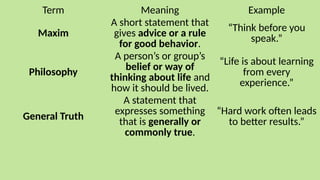
Term Meaning Example
Maxim
Ashort statement that
gives advice or a rule
for good behavior.
“Think before you
speak.”
Philosophy
A person’s or group’s
belief or way of
thinking about life and
how it should be lived.
“Life is about learning
from every
experience.”
General Truth
A statement that
expresses something
that is generally or
commonly true.
“Hard work often leads
to better results.”
12.
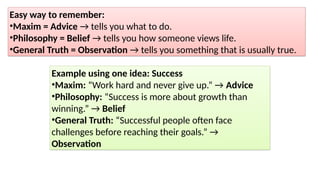
Easy way toremember:
•Maxim = Advice → tells you what to do.
•Philosophy = Belief → tells you how someone views life.
•General Truth = Observation → tells you something that is usually true.
Example using one idea: Success
•Maxim: “Work hard and never give up.” → Advice
•Philosophy: “Success is more about growth than
winning.” → Belief
•General Truth: “Successful people often face
challenges before reaching their goals.” →
Observation
13.
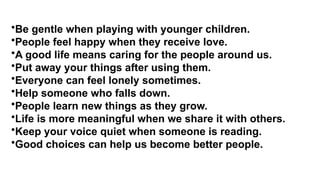
•Be gentle whenplaying with younger children.
•People feel happy when they receive love.
•A good life means caring for the people around us.
•Put away your things after using them.
•Everyone can feel lonely sometimes.
•Help someone who falls down.
•People learn new things as they grow.
•Life is more meaningful when we share it with others.
•Keep your voice quiet when someone is reading.
•Good choices can help us become better people.
14.
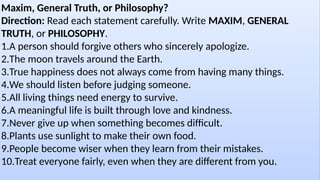
Maxim, General Truth,or Philosophy?
Direction: Read each statement carefully. Write MAXIM, GENERAL
TRUTH, or PHILOSOPHY.
1.A person should forgive others who sincerely apologize.
2.The moon travels around the Earth.
3.True happiness does not always come from having many things.
4.We should listen before judging someone.
5.All living things need energy to survive.
6.A meaningful life is built through love and kindness.
7.Never give up when something becomes difficult.
8.Plants use sunlight to make their own food.
9.People become wiser when they learn from their mistakes.
10.Treat everyone fairly, even when they are different from you.
15.
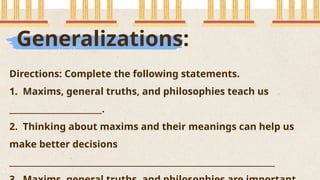
Generalizations:
Directions: Complete thefollowing statements.
1. Maxims, general truths, and philosophies teach us
_______________________.
2. Thinking about maxims and their meanings can help us
make better decisions
__________________________________________________________________
#6 "Actions speak louder than words."
This maxim means that what people do is more significant than what they say, emphasizing that deeds are a better indicator of character than promises or claims.
"Honesty is the best policy."
It suggests that being truthful is the most effective and moral approach in any situation.
"You reap what you sow."
This conveys the idea that actions have consequences, and people will experience the results of their behavior, whether good or bad.
"Practice makes perfect."
This maxim emphasizes that repeated practice is the key to mastering a skill.
"The early bird catches the worm."
It means that those who take the initiative or act promptly are more likely to succeed.
"A penny saved is a penny earned."
This encourages saving money, suggesting that saved money is as valuable as money earned through work.
"Better late than never."
This means that it's preferable to do something late than not do it at all.
"Where there's a will, there's a way."
This maxim expresses that determination can overcome obstacles and lead to success.
#7 "Actions speak louder than words."
This maxim means that what people do is more significant than what they say, emphasizing that deeds are a better indicator of character than promises or claims.
"Honesty is the best policy."
It suggests that being truthful is the most effective and moral approach in any situation.
"You reap what you sow."
This conveys the idea that actions have consequences, and people will experience the results of their behavior, whether good or bad.
"Practice makes perfect."
This maxim emphasizes that repeated practice is the key to mastering a skill.
"The early bird catches the worm."
It means that those who take the initiative or act promptly are more likely to succeed.
"A penny saved is a penny earned."
This encourages saving money, suggesting that saved money is as valuable as money earned through work.
"Better late than never."
This means that it's preferable to do something late than not do it at all.
"Where there's a will, there's a way."
This maxim expresses that determination can overcome obstacles and lead to success.
#9 Universal truths are statements or themes that apply broadly across different cultures, times, and experiences, resonating with people regardless of their background. Here are some examples of universal truths:
Love is a powerful force.
Love, in its various forms (romantic, familial, friendship), is universally understood as a strong, transformative emotion that shapes human behavior and relationships.
Change is inevitable.
Life is constantly changing, and nothing remains the same forever. People across all cultures experience growth, loss, and transition as part of being human.
Everyone experiences suffering and joy.
Every person will face both happiness and hardship at some point in life, regardless of their circumstances.
Life is precious and fleeting.
The concept of life being short and needing to be valued is common across many societies, leading people to cherish important moments.
Courage is not the absence of fear, but the ability to act despite it.
This truth resonates universally, showing that true bravery comes from facing and overcoming fears, not from being fearless.
Humans crave connection and belonging.
People everywhere have a need for connection, whether with family, friends, or community. This is a fundamental aspect of human nature.
Greed leads to downfall.
Throughout history and literature, the consequences of unchecked greed often lead to destruction, which is a truth widely recognized.
Kindness transcends all boundaries.
Acts of kindness have a universal impact, demonstrating the power of compassion and empathy in bridging differences.
Power can corrupt.
Throughout cultures and time, the tendency for power to lead to corrupt behavior is a well-acknowledged truth in many societal contexts.
Truth will eventually come to light.
This conveys that even if the truth is hidden for a time, it will ultimately be revealed. It speaks to the enduring pursuit of honesty.