Discover how LTIMindtree leverages technology to foster diversity, equity, and inclusion (DEI) in the workplace. Explore strategies, frameworks, and digital solutions driving impactful DEI outcomes.
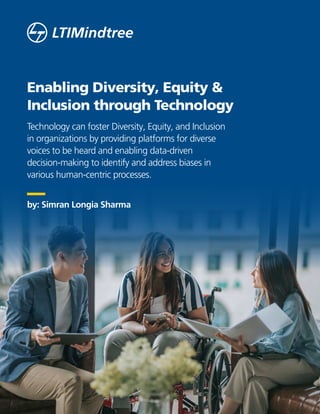
Enabling Diversity, Equity&
Inclusion through Technology
Technology can foster Diversity, Equity, and Inclusion
in organizations by providing platforms for diverse
voices to be heard and enabling data-driven
decision-making to identify and address biases in
various human-centric processes.
by: Simran Longia Sharma
2.
Executive Summary 3
Introduction4
Why is Diversity, Equity & Inclusion substantial to elevate employee experience? 5
What makes it difficult for DEI to become a company culture? 8
Understanding the DEI stages of an organization 10
Using technology to achieve DEI goals 11
Conclusion 15
References 16
About the author 17
Table of content
3.
Executive Summary
Diversity, equity,and inclusion (DEI) in organizations are crucial to creating an inclusive environment and
harnessing a diverse workforce's benefits. The new workforce considers equity and inclusivity as the
fundamental parameters while choosing their workplace. By gauging the organization’s DEI maturity
level, processes should be adjusted to infuse DEI objectives and technology to gain a competitive
advantage by amplifying diverse voices, facilitating a hybrid work environment and accessibility, and
employing data-driven approaches to address biases in various human-centric processes.
Minimizing unconscious biases at the workplace when dealing with employees, external partners, and
the community requires a shift in thought. Technology plays a vital role in enhancing DEI through inclusive
design practices, which acknowledge that everyone has different capabilities and limitations and aim to
remove barriers and promote equal opportunities, such as building accessible digital interfaces and tools.
Moreover, it enables virtual collaboration, breaks down geographical barriers, and allows diverse
perspectives to be seamlessly integrated into decision-making processes.
This whitepaper focuses on why DEI is vital and has become a boardroom discussion topic, how it plays a
critical role in enhancing the employee experience, and how to strategically infuse technology in DEI
efforts to strengthen organizational culture, promote equal opportunities, and foster innovation and
productivity.
03
4.
Introduction
Every organization aspiresto have a diverse workforce that has equitable opportunities and feels inclusive.
It is a psychological need to be respected and feel that you belong in your workplace. The concept
of "Diversity in the workplace" dates to the 1960s in corporate America because of the anti-
discrimination legislation–the Equal Pay Act of 1963, Title VII of the Civil Rights Act of 1964, and the Age
Discrimination in the Employment Act of 1967.1
It led to the start of diversity conversations in boardrooms across industries. Over the years, the depth of
diversity has incorporated parameters beyond gender and ethnicity, such as race, demographics,
socio-economic status, sexual orientation, religion, etc., which mirrors the global customer base.
Companies across the globe have been indulging in various initiatives to increase their diversity, equity,
and inclusion (DEI) metrics to benefit from its results.
For example, at the Walt Disney Company, DEI initiatives concerning people, culture, content, and
community are in progress. Further, they are exploring additional ways to report DEI analyses and
are committed to disclosing quantitative metrics for hiring, promotion, and retention by gender, race,
and ethnicity by calendar year-end 2024.2
Quoted by Latondra Newton, Senior Vice President, Chief Diversity Officer, The Walt Disney
Company, “At Disney, we amplify underrepresented voices and untold stories and champion a
multitude of perspectives, recognizing that we are all greater than a single story and we
all deserve to feel seen, heard and understood."
When working to enhance DEI offerings, it is imperative to understand that one size doesn't fit all. The
systemic challenges of pay equity, leadership representation, equal work opportunities, and day-to-day
discriminatory experiences demand ongoing focus. The companies must ask if today's approaches and
interventions are tapping into the diverse sets of needs that influence outcomes across their workforce,
mainly consisting of millennials and Gen Z, which will comprise 75 percent of the workforce by 2025.14
It is established based on various research findings that engaged employees deliver better results. “Gallup's
Q12® engagement framework” results show that only 15% of employees worldwide fall in the
"engaged" category.3
People want purpose and meaning from their work and need to know what makes
them valuable and unique. They want a relationship with their manager who can mentor them to the next
level. Equity and inclusion factors have become increasingly critical for today's workforce to feel engaged
in an organization.
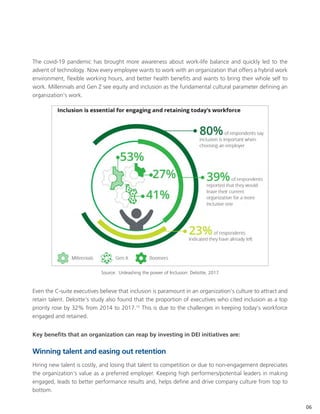
Deloitte conducted a survey4
–"Unleashing the Power of Inclusion," which covered more than 1300
full-time employees in the U.S. It was found that more than 80% of respondents indicated that inclusion
was an important factor when choosing an employer. 39% mentioned they would leave their current
company for a more inclusive one, and 25% said they've already left an organization for a more
inclusive one—30% of those being millennial workers.
04
5.
05
DEI is linkedto enhancing the employee experience, business revenues, innovations, and technology acting
as a catalyst to expedite the implementation of DEI initiatives. Technology-enabled tools that are easy to
implement and accelerate the reach of DEI initiatives to the workforce and beyond are the need of the hour.
To further deep dive, we need first to understand the importance of DEI and what challenges are faced by
the organizations in today's scenario to achieve the DEI goals.
Why is Diversity, Equity & Inclusion substantial
to elevate employee experience?
It is a fact that organizations that perform better than others in their industry also rank high on DEI. With
the dynamic economic and social scenarios, the length and breadth of DEI goals have also changed,
making it more challenging for the organization.
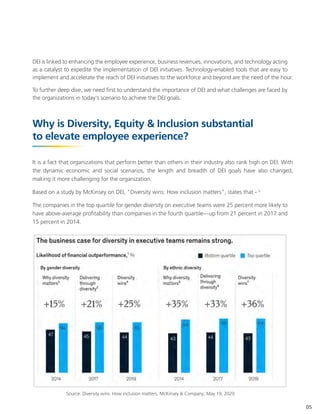
Based on a study by McKinsey on DEI, "Diversity wins: How inclusion matters", states that - 5
The companies in the top quartile for gender diversity on executive teams were 25 percent more likely to
have above-average profitability than companies in the fourth quartile—up from 21 percent in 2017 and
15 percent in 2014.
Source: Diversity wins: How inclusion matters, McKinsey & Company, May 19, 2020
6.
06
The covid-19 pandemichas brought more awareness about work-life balance and quickly led to the
advent of technology. Now every employee wants to work with an organization that offers a hybrid work
environment, flexible working hours, and better health benefits and wants to bring their whole self to
work. Millennials and Gen Z see equity and inclusion as the fundamental cultural parameter defining an
organization's work.
Source: Unleashing the power of Inclusion: Deloitte, 2017
Even the C-suite executives believe that inclusion is paramount in an organization's culture to attract and
retain talent. Deloitte's study also found that the proportion of executives who cited inclusion as a top
priority rose by 32% from 2014 to 2017.15
This is due to the challenges in keeping today's workforce
engaged and retained.
Key benefits that an organization can reap by investing in DEI initiatives are:
Winning talent and easing out retention
Hiring new talent is costly, and losing that talent to competition or due to non-engagement depreciates
the organization's value as a preferred employer. Keeping high performers/potential leaders in making
engaged, leads to better performance results and, helps define and drive company culture from top to
bottom.
7.
Research done by"Great Places to Work" shows that when employees trust that they, and their
colleagues, will be treated regardless of race, gender, sexual orientation, or age and they are:6
• 9.8 times more likely to look forward to going to work
• 6.3 times more likely to have pride in their work
• 5.4 times more likely to want to stay a long time at their company
More efficient decision-making
Bringing in people from different demographics in the leadership teams fosters innovation and creativity
through a greater variety of problem-solving approaches, perspectives, and ideas.
Strengthens customer orientation
Diverse C-suite executive teams strengthen customer orientation as every customer is unique and requires
a personal perspective to ensure their long-term commitment to the organization. This is making the
companies head towards hyper-personalization to provide a unique experience to every customer.
Higher work satisfaction
Encouraging every employee to share their opinions and ideas during critical discussions and assignments
gives a sense of inclusivity and belongingness. Creating avenues to share and own their ideas will lead
to higher productivity and job satisfaction. For example, at Swan Vesta, a match manufacturing
company, a factory worker proposed the idea to put sandpaper strike only on one of the matchboxes
rather than on both sides. Upon implementing this, the company benefitted by cutting down on
manufacturing costs.16
This case study depicts providing equal opportunities among employees will
provide a sense of security and encourage them to take ownership of work to deliver results.
Increases employee value proposition
The way of working has seen a paradigm shift after COVID-19, where home responsibilities, personal
interests, and hobbies have become equally important as work. Companies that strive to build a culture
of care and support to promote personal and professional growth by keeping people at the core, boost
their organization's employee value proposition.
07
8.
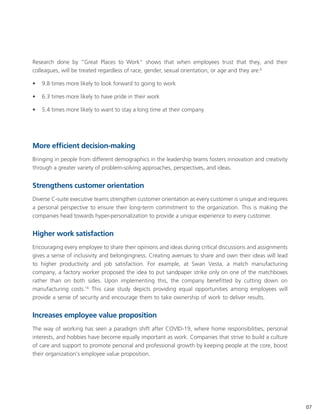
Ideal place towork
What makes it difficult for DEI to become
a company culture?
Approaching it as “good to have” rather than “must have”
Most organizations start with DEI initiatives due to regulatory or compliance needs, and then it is left at
that. A focused approach to making DEI the organization's driving force is not considered. Equity and
inclusion are crucial components in defining the culture, but no concrete and long-term commitment to
these areas pave the way to unconscious bias, which influences decisions and actions.
Millennials and Gen Z workforce's behavior and commitment to an organization are driven by how much
they are valued for their work, whether they can bring their whole self, i.e., unique and individual
attributes, to work, they are given the flexibility to work and is their work making an impact in the overall
strategy of the organization.
Behavioral bias
Human traits, behavior, and cognitive bias are a few crucial reasons for the lack of diversity, equity and
inclusion in the workplace, leading to implicit biases. Unhealthy sociological behavior patterns lead
to forming groups and environments with favoritism, affecting decision-making.
Based on the report published by McKinsey, "Why Diversity Matters, 2015", the most relevant reasons
for DEI are:7
08
Equity Diversity
Inclusion
9.
Ingroup favoritism: apreference for people like us so that an individual might choose to work with
someone of the same nationality, gender, and race.
Outgroup homogeneity bias: the tendency for an individual to think that the group of people they belong
to (their "ingroup") is more diverse. In contrast, their "outgroup" is more homogeneous, with members
who appear alike or interchangeable.
Proximity bias
Post COVID-19 pandemic, many organizations are working on the "Return to Work" strategy by
enabling a hybrid work environment, providing remote work opportunities, and making it the new
"Normal." But this may also lead to inequities between in-office and remote employees, ultimately
exacerbating inequities regarding race and gender. Thus, a term coined for this inequality is "proximity
bias."8
It can create unease among those who work remotely than those who are physically in the office
and face-to-face with decision-makers and leaders. They are to be seen more favorably and
advance quickly, regardless of overall performance. In a new world of remote work policies,
flexible, and hybrid work schedules, the burning question for leaders will be whether results are
more valuable than physical face time.
Lack of performance linked work culture
Organizations strive to cultivate a culture where performance is supported by quantitative data
for performance appraisals and retention strategies. Line managers must be equipped with the right
tools and training to promote a performance-based work culture to conduct dialogue with
their subordinates. Continuous feedback sessions throughout the performance cycle should become a
default activity as part of their role. The absence of relevant and equal opportunities across all
the team members leads to job dissatisfaction.
In a survey conducted by a top recruitment agency,9
62% of employees were keen on switching jobs
post the appraisal season. Out of these, 64% of employees gave unsatisfactory appraisals as the
reason for wanting to change their careers.
09
10.
Understanding the DEIstages of an organization
In this paper, "The Five Stage Maturity model" for DEI defined by professor and organizational
psychologist Ella F. Washington in her book, "The Necessary Journey: Making Real Progress on Equity
and Inclusion" is referred to draw actionable technical solutions at each stage. Knowing the DEI
maturity stage of your organization will assist in including DEI goals in its processes, policies, and
practices, making it part of its culture.
But first, let's briefly understand the five stages of maturity.
Awareness
Awareness is the first or the starting point of the DEI journey for an organization. Here, the leaders
consider including DEI initiatives in the organization's culture. A DEI vision for the organization begins to
formulate based on what goal they choose to accomplish or focus on. Internal DEI maturity levels are
accessed to decide on the way forward. The primary reason could be compliance or statutory regulations,
which leads to this initiation.
Complaint
Here, DEI initiatives are undertaken to meet compliance needs. Generally, the leaders believe that
DEI initiatives are good and that minimal actions will provide results.
Tactical
This stage is reached when organizations start to make a difference in the culture as C-suite leaders look
at devising organizational-level strategies that are standardized across all departments and functions.
They emphasize that mid-level executives own DEI initiatives and equip them to lead and be responsible
for driving the initiatives, resulting in quantifiable outcomes.
10
11.
11
The disruption fromthe pandemic and social injustices at the workplace
has raised employee expectations regarding DEI. CIOs have an enormous
opportunity to use their position as digital business leaders to support
marginalized groups and meet executive commitments with action.
Rob O'Donohue
Senior research director at Gartner
Integrated
At this stage, the organizational culture is fully integrated with DEI aspects among internal and external
stakeholders. Top-down and bottom-up efforts are connected, considering the impact of DEI on all
stakeholders. DEI is integrated into the organization's decision-making process and culture considering it
as a way of working.
Sustainable
The sustainable stage is reached when DEI is fully integrated with the culture and operations of an
organization. It is no longer perceived as a separate initiative. Areas to improve are identified, even by
the bottom layer. Corporate-level initiatives are just one driving force for DEI. The organization is
committed to ongoing learning and improvement and recognizes that DEI is a continuous process.
Thus, creating a truly inclusive culture.
Using technology to achieve DEI goals
To achieve the DEI goals of an organization, the thought needs to be driven by the top leaders of the
organization, which percolate downward as strategies and action plans. These action plans will change
organizational policies, processes and philosophy, and be supported by technology for quantifiable
changes.
The pandemic has changed the outlook of today's workforce regarding "What to expect from
their workplace." To meet their expectations, CEOs, and CHROs are now working in tandem with
CIOs/CTOs of their organization to implement actionable changes in policies, processes, and
technology to bring cultural change in making it more equitable and inclusive. Rob O'Donohue,
Senior research director, Gartner, quoted about the changed work environment that-10
12.
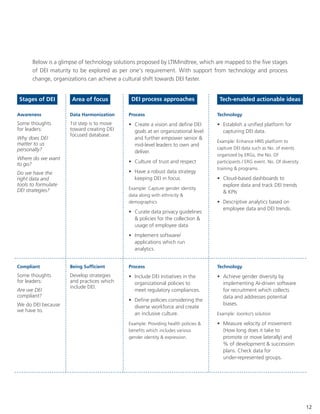
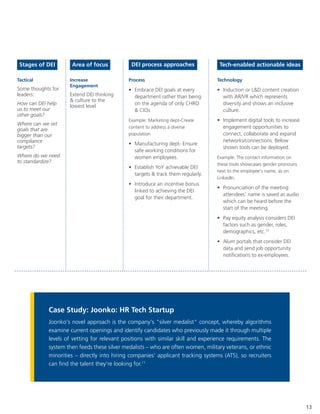
Below is aglimpse of technology solutions proposed by LTIMindtree, which are mapped to the five stages
of DEI maturity to be explored as per one's requirement. With support from technology and process
change, organizations can achieve a cultural shift towards DEI faster.
Awareness
Some thoughts
for leaders:
Why does DEI
matter to us
personally?
Where do we want
to go?
Do we have the
right data and
tools to formulate
DEI strategies?
Data Harmonization
1st step is to move
toward creating DEI
focused database.
Process
• Create a vision and define DEI
goals at an organizational level
and further empower senior &
mid-level leaders to own and
deliver.
• Culture of trust and respect
• Have a robust data strategy
keeping DEI in focus
Example: Capture gender identity
data along with ethnicity &
demographics
• Curate data privacy guidelines
& policies for the collection &
usage of employee data
• Implement software/
applications which run
analytics.
Technology
• Establish a unified platform for
capturing DEI data.
Example: Enhance HRIS platform to
capture DEI data such as No. of events
organized by ERGs, the No. Of
participants / ERG event. No. Of diversity
training & programs.
• Cloud-based dashboards to
explore data and track DEI trends
& KPIs
• Descriptive analytics based on
employee data and DEI trends.
Compliant
Some thoughts
for leaders:
Are we DEI
compliant?
We do DEI because
we have to.
Being Sufficient
Develop strategies
and practices which
include DEI.
Process
• Include DEI initiatives in the
organizational policies to
meet regulatory compliances.
• Define policies considering the
diverse workforce and create
an inclusive culture.
Example: Providing health policies &
benefits which includes various
gender identity & expression.
Technology
• Achieve gender diversity by
implementing AI-driven software
for recruitment which collects
data and addresses potential
biases.
Example: Joonko’s solution
• Measure velocity of movement
(How long does it take to
promote or move laterally) and
% of development & succession
plans. Check data for
under-represented groups.
Stages of DEI Area of focus DEI process approaches Tech-enabled actionable ideas
12
13.
Tactical
Some thoughts for
leaders:
Howcan DEI help
us to meet our
other goals?
Where can we set
goals that are
bigger than our
compliance
targets?
Where do we need
to standardize?
Increase
Engagement
Extend DEI thinking
& culture to the
lowest level
Process
• Embrace DEI goals at every
department rather than being
on the agenda of only CHRO
& CIOs
Example: Marketing dept-Create
content to address a diverse
population
• Manufacturing dept- Ensure
safe working conditions for
women employees.
• Establish YoY achievable DEI
targets & track them regularly.
• Introduce an incentive bonus
linked to achieving the DEI
goal for their department.
Technology
• Induction or L&D content creation
with AR/VR which represents
diversity and shows an inclusive
culture.
• Implement digital tools to increase
engagement opportunities to
connect, collaborate and expand
networks/connections. Below
shown tools can be deployed.
Example: The contact information on
these tools showcases gender pronouns
next to the employee's name, as on
LinkedIn.
• Pronunciation of the meeting
attendees' name is saved as audio
which can be heard before the
start of the meeting.
• Pay equity analysis considers DEI
factors such as gender, roles,
demographics, etc.13
• Alum portals that consider DEI
data and send job opportunity
notifications to ex-employees.
Stages of DEI Area of focus DEI process approaches Tech-enabled actionable ideas
Case Study: Joonko: HR Tech Startup
Joonko's novel approach is the company's "silver medalist" concept, whereby algorithms
examine current openings and identify candidates who previously made it through multiple
levels of vetting for relevant positions with similar skill and experience requirements. The
system then feeds these silver medalists – who are often women, military veterans, or ethnic
minorities – directly into hiring companies' applicant tracking systems (ATS), so recruiters
can find the talent they're looking for.11
13
14.
Case Study: Lattice:Engagement calculation platform
Lattice has developed a platform that integrates employee performance metrics with employee engagement
data to measure a company’s employee experience score based on the concept of Net Promoter Score (NPS),
pioneered by Bain & Company and Fred Reichheld. Based on the feedback, respondents are grouped into one
of three categories: “promoters," “detractors," and "passives ."Subtracting your percentage of detractors
from your percentage of promoters will yield your company’s eNPS. The Lattice software does this.12
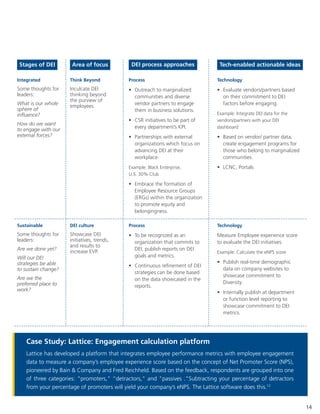
Integrated
Some thoughts for
leaders:
What is our whole
sphere of
influence?
How do we want
to engage with our
external forces?
Think Beyond
Inculcate DEI
thinking beyond
the purview of
employees.
Process
• Outreach to marginalized
communities and diverse
vendor partners to engage
them in business solutions.
• CSR initiatives to be part of
every department’s KPI.
• Partnerships with external
organizations which focus on
advancing DEI at their
workplace.
Example: Black Enterprise,
U.S. 30% Club
• Embrace the formation of
Employee Resource Groups
(ERGs) within the organization
to promote equity and
belongingness.
Technology
• Evaluate vendors/partners based
on their commitment to DEI
factors before engaging.
Example: Integrate DEI data for the
vendors/partners with your DEI
dashboard
• Based on vendor/ partner data,
create engagement programs for
those who belong to marginalized
communities.
• LCNC, Portals
Sustainable
Some thoughts for
leaders:
Are we done yet?
Will our DEI
strategies be able
to sustain change?
Are we the
preferred place to
work?
DEI culture
Showcase DEI
initiatives, trends,
and results to
increase EVP.
Process
• To be recognized as an
organization that commits to
DEI, publish reports on DEI
goals and metrics.
• Continuous refinement of DEI
strategies can be done based
on the data showcased in the
reports.
Technology
Measure Employee experience score
to evaluate the DEI initiatives.
Example: Calculate the eNPS score
• Publish real-time demographic
data on company websites to
showcase commitment to
Diversity.
• Internally publish at department
or function level reporting to
showcase commitment to DEI
metrics.
Stages of DEI Area of focus DEI process approaches Tech-enabled actionable ideas
14
15.
Conclusion
Diversity, equity, andinclusion are critical components for engaging and retaining
today's workforce. The employees expect equity and inclusion to be a way of day-to-day
working and interactions among their peers and leaders rather than just running
programs for DEI. Most of the workforce seek to be respected, feel purposeful for the
work that they do, and be themselves when at work.
Every organization can be diverse and still provide equitable and inclusive culture to
become a preferred workplace. For this, reinforcement needs to be driven from the top to
every level and function of the organization. Technology can assist at every stage of DEI to
smoothly implement the changes in the organization's philosophy, processes, and policies,
which brings in an inclusive culture.
Based on the research done and solutions provided in this whitepaper, the organizations
can plan to assess at what stage they are in their DEI journey and what process and
technological changes they would want to bring to their workplace. It is essential to be
aware of the need and be prepared to reexamine the approaches to diversity, equity, and
inclusion, which are vital for building an "ideal place to work" among the existing
talent and attracting prospective talent. Never the least to be prepared for the coming
changes in work culture as every generation will come with its own set of
expectations from a workplace.
15
16.
References
1. Evolution ofDiversity in the Workplace, Stacey Williams LinkedIn Feb25, 2020:
https://www.linkedin.com/pulse/evolution-diversity-workplace-stacey-williams
2. Diversity & Inclusion, Disney: https://impact.disney.com/diversity-inclusion/
3. What Is Employee Engagement, and How Do You Improve It? Gallup:
https://www.gallup.com/workplace/285674/improve-employee-engagement-workplace.aspx#ite-357638
4. Unleashing the power of Inclusion | Attracting and engaging the evolving workforce, Deloitte 2017:
https://www2.deloitte.com/content/dam/Deloitte/us/Documents/about-deloitte/us-about-deloitte-unleashing-power-of-incl
usion.pdf
5. Diversity wins: How inclusion matters, McKinsey & Company, May 19, 2020:
https://www.mckinsey.com/featured-insights/diversity-and-inclusion/diversity-wins-how-inclusion-matters
6. Why Is Diversity & Inclusion in the Workplace Important? Great Place to Work Apr12,2021:
https://www.greatplacetowork.com/resources/blog/why-is-diversity-inclusion-in-the-workplace-important
7. Why Diversity Matters, McKinsey Jan1, 2015 :
https://www.mckinsey.com/capabilities/people-and-organizational-performance/our-insights/why-diversity-matters
8. What Does Your Return-To-Office Strategy Have To Do With DEI? Forbes May20, 2022 :
https://www.forbes.com/sites/forbesbusinesscouncil/2022/05/20/what-does-your-return-to-office-strategy-have-to-do-with
-dei/?sh=63a535d31e5a
9. How To Manage Attrition Rates Post-Appraisal Blues?, Kredily, Apr9, 2019 :
https://kredily.com/hrm/manage-attrition-rates-post-appraisal-blues/
10. Gartner Identifies Four Actions for CIOs to Take an Active Role in Advancing Diversity, Equity and Inclusion, Gartner
Jul7,2021:
https://www.gartner.com/en/newsroom/press-releases/2021-07-07-gartner-identifies-four-actions-for-cios-to-take-an-active
-role-in-advancing-diversity-equity-and-inclusion
11. AI-Enabled Recruitment process, Joonko : https://joonko.co/
12. How to Calculate Employee Net Promoter Score (eNPS), Lattice:
https://lattice.com/library/what-is-employee-net-promoter-score-enps
13. Exploring tech-enabled DEI solutions, Deloitte Insights Nov3, 2021 :
https://www2.deloitte.com/us/en/insights/topics/value-of-diversity-and-inclusion/diversity-and-inclusion-in-tech/technology-
dei-workplace.html
14. Developing employees into Leaders, LinkedIn Learning:
https://learning.linkedin.com/elearning-solutions-guides/developing-employees-into-leaders
15. Diversity and inclusion: The reality gap, Deloitte Feb28, 2017:
https://www2.deloitte.com/us/en/insights/focus/human-capital-trends/2017/diversity-and-inclusion-at-the-workplace.html
16
17.
About the author
LTIMindtreeis a global technology consulting and digital solutions company that enables enterprises across industries
to reimagine business models, accelerate innovation, and maximize growth by harnessing digital technologies. As a
digital transformation partner to more than 700 clients, LTIMindtree brings extensive domain and technology expertise
to help drive superior competitive differentiation, customer experiences, and business outcomes in a converging world.
Powered by 81,000+ talented and entrepreneurial professionals across more than 30 countries, LTIMindtree — a Larsen
& Toubro Group company — combines the industry-acclaimed strengths of erstwhile Larsen and Toubro Infotech and
Mindtree in solving the most complex business challenges and delivering transformation at scale. For more information,
please visit www.ltimindtree.com.
Simran Longia Sharma
Senior Specialist, LTIMindtree
Simran Longia Sharma is a Senior Specialist with Interactive Practice at
LTIMindtree. She comes with over 12 years of extensive experience in the
HR IT domain and has successfully led and implemented various
technology-driven initiatives to streamline H.R. processes to enhance
organizational efficiency. She is proficient in Agile methodology and has
a proven track record of delivering projects on time. She has spearheaded
various client engagements and business process improvements across
geographies.
Currently, Simran is focused on creating technology-driven solutions to
improve the employee experience. She aims to enhance collaboration,
communication, and productivity among employees with the intersection
between H.R. and technology, thus creating meaningful and engaging
workplace environments. She holds an MBA in Human Resource
Management from the Welingkar Institute of Management and Research
and brings a strong foundation of knowledge and expertise to her work.
Overall, a result-oriented professional with a people-centric approach to
driving organizational success.