Electricity: Magnetic and
Heating Effects
Discover the fascinating relationship between electricity, magnetism, and heat. This
presentation explores how electric currents create magnetic fields, how
electromagnets work, and how electricity generates heat in conductors. We'll also
examine different types of cells and batteries that power our world.
By : K Sandeep Swamy(M.Sc,B.Ed)
For Online Classes (IITJEE & NEET foundation and academics) contact :
9491878325
Subscribe Samyans Eduhub youtube channel
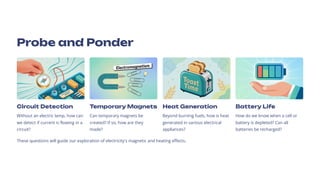
Probe and Ponder
Circuit Detection
Without an electric lamp, how can
we detect if current is flowing in a
circuit?
Temporary Magnets
Can temporary magnets be
created? If so, how are they
made?
Heat Generation
Beyond burning fuels, how is heat
generated in various electrical
appliances?
Battery Life
How do we know when a cell or
battery is depleted? Can all
batteries be recharged?
These questions will guide our exploration of electricity's magnetic and heating effects.
The Science Exhibition
Discovery
It was the day of the science exhibition, and the school was buzzing with energy.
Mohini and Aakarsh, along with their friends, went from one exhibit to another,
eagerly exploring different models, asking questions and taking notes.
One simple model truly fascinated them. It was a working model of a lifting
electromagnet, displayed by their senior, Sumana. Instead of a typical crane hook,
this model featured an iron nail wrapped with a wire, connected to a battery.
When Sumana closed the circuit, the nail astonishingly picked up iron paper clips,
acting just like a magnet. Even more surprisingly, when she opened the circuit, the
clips immediately fell off. Mohini and Aakarsh were amazed 3 there was no
permanent magnet, only an electric circuit at play!
Does an Electric Current Have a Magnetic
Effect?
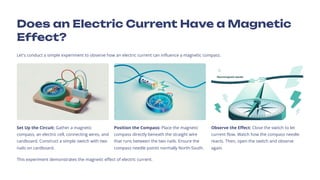
Let's conduct a simple experiment to observe how an electric current can influence a magnetic compass.
Set Up the Circuit: Gather a magnetic
compass, an electric cell, connecting wires, and
cardboard. Construct a simple switch with two
nails on cardboard.
Position the Compass: Place the magnetic
compass directly beneath the straight wire
that runs between the two nails. Ensure the
compass needle points normally North-South.
Observe the Effect: Close the switch to let
current flow. Watch how the compass needle
reacts. Then, open the switch and observe
again.
This experiment demonstrates the magnetic effect of electric current.
The Magnetic Effect of Electric Current
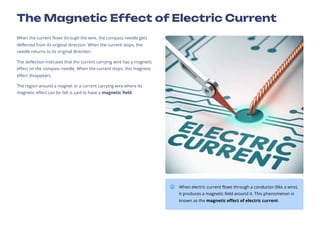
When the current flows through the wire, the compass needle gets
deflected from its original direction. When the current stops, the
needle returns to its original direction.
The deflection indicates that the current carrying wire has a magnetic
effect on the compass needle. When the current stops, this magnetic
effect disappears.
The region around a magnet or a current carrying wire where its
magnetic effect can be felt is said to have a magnetic field.
When electric current flows through a conductor (like a wire),
it produces a magnetic field around it. This phenomenon is
known as the magnetic effect of electric current.
Hans Christian Oersted's Discovery
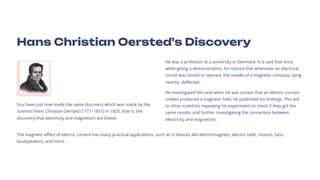
You have just now made the same discovery which was made by the
scientist Hans Christian Oersted (177731851) in 1820, that is, the
discovery that electricity and magnetism are linked.
He was a professor at a university in Denmark. It is said that once
while giving a demonstration, he noticed that whenever an electrical
circuit was closed or opened, the needle of a magnetic compass, lying
nearby, deflected.
He investigated this and when he was certain that an electric current
indeed produced a magnetic field, he published his findings. This led
to other scientists repeating his experiment to check if they got the
same results, and further investigating the connection between
electricity and magnetism.
The magnetic effect of electric current has many practical applications, such as in devices like electromagnets, electric bells, motors, fans,
loudspeakers, and more.
Electromagnets: Using Current to Make
Magnets
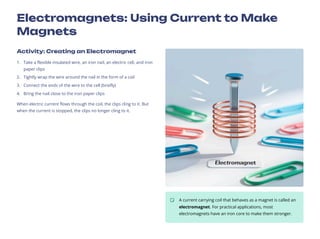
Activity: Creating an Electromagnet
Take a flexible insulated wire, an iron nail, an electric cell, and iron
paper clips
1.
Tightly wrap the wire around the nail in the form of a coil
2.
Connect the ends of the wire to the cell (briefly)
3.
Bring the nail close to the iron paper clips
4.
When electric current flows through the coil, the clips cling to it. But
when the current is stopped, the clips no longer cling to it.
A current carrying coil that behaves as a magnet is called an
electromagnet. For practical applications, most
electromagnets have an iron core to make them stronger.
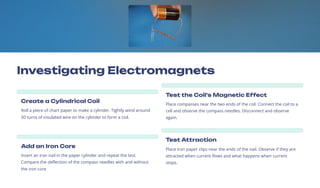
Investigating Electromagnets
Create a Cylindrical Coil
Roll a piece of chart paper to make a cylinder. Tightly wind around
50 turns of insulated wire on the cylinder to form a coil.
Test the Coil's Magnetic Effect
Place compasses near the two ends of the coil. Connect the coil to a
cell and observe the compass needles. Disconnect and observe
again.
Add an Iron Core
Insert an iron nail in the paper cylinder and repeat the test.
Compare the deflection of the compass needles with and without
the iron core.
Test Attraction
Place iron paper clips near the ends of the nail. Observe if they are
attracted when current flows and what happens when current
stops.
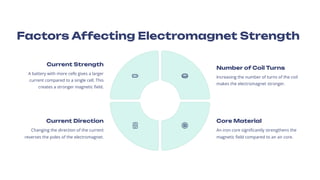
Factors Affecting Electromagnet Strength
Current Strength
A battery with more cells gives a larger
current compared to a single cell. This
creates a stronger magnetic field.
Number of Coil Turns
Increasing the number of turns of the coil
makes the electromagnet stronger.
Core Material
An iron core significantly strengthens the
magnetic field compared to an air core.
Current Direction
Changing the direction of the current
reverses the poles of the electromagnet.
Poles of an Electromagnet
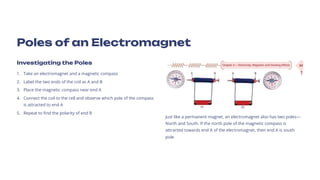
Investigating the Poles
Take an electromagnet and a magnetic compass
1.
Label the two ends of the coil as A and B
2.
Place the magnetic compass near end A
3.
Connect the coil to the cell and observe which pole of the compass
is attracted to end A
4.
Repeat to find the polarity of end B
5.
Just like a permanent magnet, an electromagnet also has two poles4
North and South. If the north pole of the magnetic compass is
attracted towards end A of the electromagnet, then end A is south
pole.
Earth's Magnetic Field
A Giant Magnet
Our Earth acts like a massive magnet. Deep
inside, the movement of liquid iron in the core
generates electric currents, creating a strong
magnetic field.
Animal Navigation
Many migratory birds, fish, and animals use
Earth's magnetic field to navigate, guiding
them across vast continents and oceans
during their journeys.
Protective Shield
This magnetic field also functions as a vital
shield, blocking harmful particles from space
and safeguarding life on Earth from cosmic
radiation.
Lifting Electromagnets: Real-World
Application
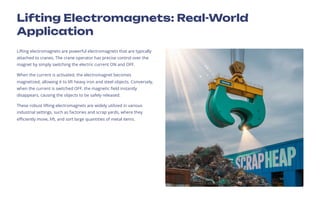
Lifting electromagnets are powerful electromagnets that are typically
attached to cranes. The crane operator has precise control over the
magnet by simply switching the electric current ON and OFF.
When the current is activated, the electromagnet becomes
magnetized, allowing it to lift heavy iron and steel objects. Conversely,
when the current is switched OFF, the magnetic field instantly
disappears, causing the objects to be safely released.
These robust lifting electromagnets are widely utilized in various
industrial settings, such as factories and scrap yards, where they
efficiently move, lift, and sort large quantities of metal items.
Does a Current Carrying
Wire Get Hot?
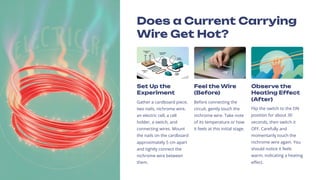
Set Up the
Experiment
Gather a cardboard piece,
two nails, nichrome wire,
an electric cell, a cell
holder, a switch, and
connecting wires. Mount
the nails on the cardboard
approximately 5 cm apart
and tightly connect the
nichrome wire between
them.
Feel the Wire
(Before)
Before connecting the
circuit, gently touch the
nichrome wire. Take note
of its temperature or how
it feels at this initial stage.
Observe the
Heating Effect
(After)
Flip the switch to the ON
position for about 30
seconds, then switch it
OFF. Carefully and
momentarily touch the
nichrome wire again. You
should notice it feels
warm, indicating a heating
effect.
The Heating Effect of Electric Current
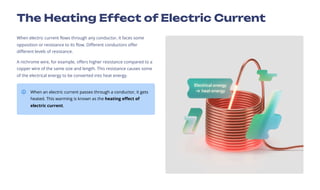
When electric current flows through any conductor, it faces some
opposition or resistance to its flow. Different conductors offer
different levels of resistance.
A nichrome wire, for example, offers higher resistance compared to a
copper wire of the same size and length. This resistance causes some
of the electrical energy to be converted into heat energy.
When an electric current passes through a conductor, it gets
heated. This warming is known as the heating effect of
electric current.
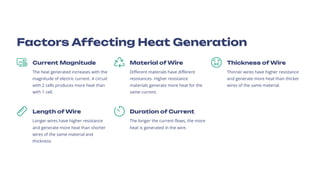
Factors Affecting Heat Generation
Current Magnitude
The heat generated increases with the
magnitude of electric current. A circuit
with 2 cells produces more heat than
with 1 cell.
Material of Wire
Different materials have different
resistances. Higher resistance
materials generate more heat for the
same current.
Thickness of Wire
Thinner wires have higher resistance
and generate more heat than thicker
wires of the same material.
Length of Wire
Longer wires have higher resistance
and generate more heat than shorter
wires of the same material and
thickness.
Duration of Current
The longer the current flows, the more
heat is generated in the wire.
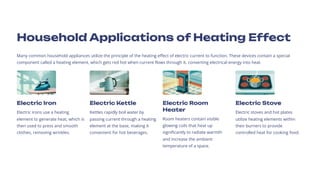
Household Applications of Heating Effect
Many common household appliances utilize the principle of the heating effect of electric current to function. These devices contain a special
component called a heating element, which gets red hot when current flows through it, converting electrical energy into heat.
Electric Iron
Electric irons use a heating
element to generate heat, which is
then used to press and smooth
clothes, removing wrinkles.
Electric Kettle
Kettles rapidly boil water by
passing current through a heating
element at the base, making it
convenient for hot beverages.
Electric Room
Heater
Room heaters contain visible
glowing coils that heat up
significantly to radiate warmth
and increase the ambient
temperature of a space.
Electric Stove
Electric stoves and hot plates
utilize heating elements within
their burners to provide
controlled heat for cooking food.
Industrial Applications
and Safety
Industrial Uses
Beyond household use, heating effect
of electric current has several industrial
applications. One notable example is in
steel manufacturing industries, where a
specially designed high-temperature
furnace uses electric current to
produce heat.
This is used to melt and recycle scrap
steel, converting it into usable steel.
Safety Considerations
To prevent unnecessary heating in
household switchboards, it is important
to use appropriate wires, plugs, and
sockets that are rated for the specified
electric current.
Overheating in appliances may cause
damage to plugs and sockets where
plastic parts may melt, or even lead to
fires. In household circuits, there are
safety devices placed in the circuit to
minimise such incidents.
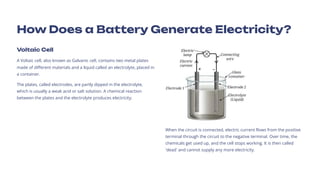
How Does a Battery Generate Electricity?
Voltaic Cell
A Voltaic cell, also known as Galvanic cell, contains two metal plates
made of different materials and a liquid called an electrolyte, placed in
a container.
The plates, called electrodes, are partly dipped in the electrolyte,
which is usually a weak acid or salt solution. A chemical reaction
between the plates and the electrolyte produces electricity.
When the circuit is connected, electric current flows from the positive
terminal through the circuit to the negative terminal. Over time, the
chemicals get used up, and the cell stops working. It is then called
'dead' and cannot supply any more electricity.
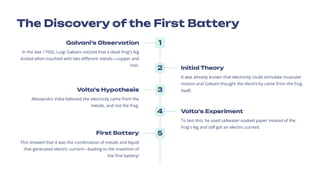
The Discovery of the First Battery
1
Galvani's Observation
In the late 1700s, Luigi Galvani noticed that a dead frog's leg
kicked when touched with two different metals4copper and
iron.
2 Initial Theory
It was already known that electricity could stimulate muscular
motion and Galvani thought the electricity came from the frog
itself.
3
Volta's Hypothesis
Alessandro Volta believed the electricity came from the
metals, and not the frog.
4 Volta's Experiment
To test this, he used saltwater-soaked paper instead of the
frog's leg and still got an electric current.
5
First Battery
This showed that it was the combination of metals and liquid
that generated electric current4leading to the invention of
the first battery!
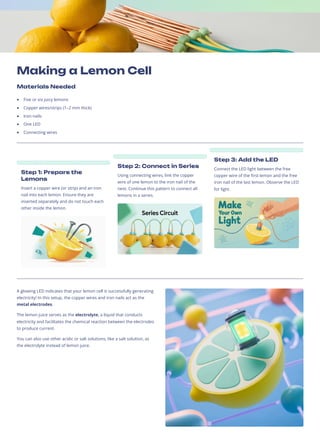
Making a Lemon Cell
Materials Needed
Five or six juicy lemons
Copper wires/strips (132 mm thick)
Iron nails
One LED
Connecting wires
Step 1: Prepare the
Lemons
Insert a copper wire (or strip) and an iron
nail into each lemon. Ensure they are
inserted separately and do not touch each
other inside the lemon.
Step 2: Connect in Series
Using connecting wires, link the copper
wire of one lemon to the iron nail of the
next. Continue this pattern to connect all
lemons in a series.
Step 3: Add the LED
Connect the LED light between the free
copper wire of the first lemon and the free
iron nail of the last lemon. Observe the LED
for light.
A glowing LED indicates that your lemon cell is successfully generating
electricity! In this setup, the copper wires and iron nails act as the
metal electrodes.
The lemon juice serves as the electrolyte, a liquid that conducts
electricity and facilitates the chemical reaction between the electrodes
to produce current.
You can also use other acidic or salt solutions, like a salt solution, as
the electrolyte instead of lemon juice.
Dry Cells: Everyday Portable Power
Voltaic cells were an important discovery, but they are not convenient
for everyday use. Instead, dry cells are one of the most widely used
electric cells today.
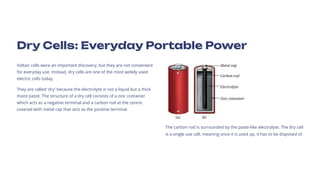
They are called 'dry' because the electrolyte is not a liquid but a thick
moist paste. The structure of a dry cell consists of a zinc container
which acts as a negative terminal and a carbon rod at the centre
covered with metal cap that acts as the positive terminal.
The carbon rod is surrounded by the paste-like electrolyte. The dry cell
is a single use cell, meaning once it is used up, it has to be disposed of.
Rechargeable Batteries
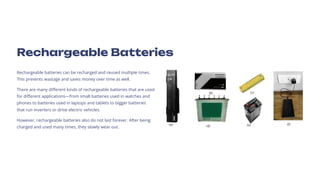
Rechargeable batteries can be recharged and reused multiple times.
This prevents wastage and saves money over time as well.
There are many different kinds of rechargeable batteries that are used
for different applications4from small batteries used in watches and
phones to batteries used in laptops and tablets to bigger batteries
that run inverters or drive electric vehicles.
However, rechargeable batteries also do not last forever. After being
charged and used many times, they slowly wear out.
The Future of Battery Technology
Current Technology
Today, the lithium-ion (Li-ion) battery is the most common type of
rechargeable battery, found in almost all devices that use batteries.
Resource Challenges
These batteries rely on special metals like lithium and cobalt, which
are mined and processed in limited parts of the world. Countries are
racing to secure supplies.
Sustainability Efforts
Recycling old batteries and developing new technologies are
becoming increasingly important.
Next Generation
Scientists are working on solid-state batteries, which replace liquid
or paste-like electrolytes with solid materials for safer, faster-
charging, longer-lasting batteries.
Improved rechargeable batteries are very important as the world moves to developing environmentally friendly sources of electrical power.
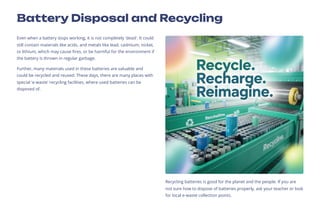
Battery Disposal and Recycling
Even when a battery stops working, it is not completely 'dead'. It could
still contain materials like acids, and metals like lead, cadmium, nickel,
or lithium, which may cause fires, or be harmful for the environment if
the battery is thrown in regular garbage.
Further, many materials used in these batteries are valuable and
could be recycled and reused. These days, there are many places with
special 'e-waste' recycling facilities, where used batteries can be
disposed of.
Recycling batteries is good for the planet and the people. If you are
not sure how to dispose of batteries properly, ask your teacher or look
for local e-waste collection points.
Key Takeaways
Magnetic Effect
When electric current flows through a conductor, it produces a
magnetic field around it. This is the magnetic effect of electric
current.
Electromagnets
A current carrying coil that behaves as a magnet is called an
electromagnet. Most practical electromagnets have an iron core to
make them stronger.
Heating Effect
Generation of heat in conductors due to flow of electric current is
known as the heating effect of electric current.
Cells & Batteries
A cell or a battery is a device that generates electric current
because of chemical reactions taking place inside it. Rechargeable
batteries can be recharged and reused multiple times.
These principles form the foundation of many electrical devices we use every day, from simple electromagnets to complex rechargeable batteries.