EDI Cost
Savings
Report
Cutting costs and
paper with electronic
transactions in the
supply chain
A report prepared by GS1 UK in
conjunction with Cranfield School
of Management
September 2010
Cutting costs and paper with electronic transactions in the supply chainPage 2
Contents
1.	 Executive Summary
2.	 Background
3.	 Results of the Study
4.	 Opportunities
5.	 Overview of EDI
6.	 Next Steps
£650m
UK grocery sector
cost savings per year
using EDI
£200m
Potential savings per
year for UK grocery
sector if EDI despatch
advices are fully adopted
81%
Companies still using
manual, paper-based
processes
* GS1 UK Annual Survey 2009
available at www.gs1uk.org
In today’s challenging and competitive
economy, many companies struggle to
survive and grow using paper-based
and manual processes such as phones,
faxes, emails and post to do business.
These methods affect the efficiency
of the business, not to mention the
challenges they pose for record keeping
and reconciliation. Supply chains also rely
on a large number of documents being
exchanged when goods are manufactured,
ordered, delivered, received and sold.
Millions of trading documents such as
purchase orders, invoices and despatch
advices, also known as Advanced Shipping
Notices (ASNs), are exchanged daily
between trading partners.
In the UK alone, about 27 million orders
are made every year in the grocery retail
sector according to GS1 research. As such,
it is no wonder that the UK’s grocery sector
has been at the forefront of automating
their processes using Electronic Data
Interchange (EDI) technology. More than
30 years ago, the sector started replacing
its manual, paper-based processes with
standardised electronic business messages
to benefit from a more efficient and cost-
effective supply chain.
The sector has significantly benefited from
adopting EDI – speeding up transactions,
delivery, invoicing and payment as well as
improving the visibility of goods within
the supply chain. It has managed to speed
up stock replenishment cycles, enhance
data accuracy, improve operational
efficiencies, lower costs and reduce paper
consumption. This ultimately improves the
customer’s shopping experience through
improved on-shelf availability and lower
prices.
Realising the extent to which the UK
grocery sector has adopted EDI technology
ahead of other sectors such as apparel,
utility, public administration (government)
and healthcare, GS1 UK set out to quantify
the scale of implementation and the cost
benefits of using the technology over
manual, paper-based methods.
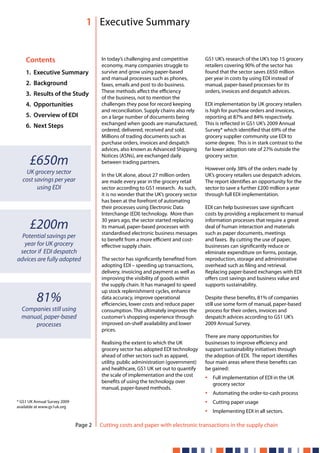
GS1 UK’s research of the UK’s top 15 grocery
retailers covering 90% of the sector has
found that the sector saves £650 million
per year in costs by using EDI instead of
manual, paper-based processes for its
orders, invoices and despatch advices.
EDI implementation by UK grocery retailers
is high for purchase orders and invoices,
reporting at 87% and 84% respectively.
This is reflected in GS1 UK’s 2009 Annual
Survey* which identified that 69% of the
grocery supplier community use EDI to
some degree. This is in stark contrast to the
far lower adoption rate of 27% outside the
grocery sector.
However only 38% of the orders made by
UK’s grocery retailers use despatch advices.
The report identifies an opportunity for the
sector to save a further £200 million a year
through full EDI implementation.
EDI can help businesses save significant
costs by providing a replacement to manual
information processes that require a great
deal of human interaction and materials
such as paper documents, meetings
and faxes. By cutting the use of paper,
businesses can significantly reduce or
eliminate expenditure on forms, postage,
reproduction, storage and administrative
overhead such as filing and retrieval.
Replacing paper-based exchanges with EDI
offers cost savings and business value and
supports sustainability.
Despite these benefits, 81% of companies
still use some form of manual, paper-based
process for their orders, invoices and
despatch advices according to GS1 UK’s
2009 Annual Survey.
There are many opportunities for
businesses to improve efficiency and
support sustainability initiatives through
the adoption of EDI. The report identifies
four main areas where these benefits can
be gained:
•	Full implementation of EDI in the UK
grocery sector
•	 Automating the order-to-cash process
•	 Cutting paper usage
•	 Implementing EDI in all sectors.
1 Executive Summary
Cutting costs and paper with electronic transactions in the supply chainPage 3
Electronic Data
Interchange (EDI)
is the computer-to-
computer exchange of
standard electronic
business documents
Benefits of EDI
1.	 It’s faster
2.	 Data is more accurate
3.	Improved process
efficiencies
4.	 Cost savings
5.	 Eliminates paper
2 Background
Electronic Data Interchange (EDI) can
help businesses save costs and improve
efficiency by replacing manual and
time consuming processes that require
human intervention and materials such
as paper documents, meetings and faxes.
Expenditure on forms, postage, storage
and administrative overhead can be
reduced or even eliminated by simply
cutting the use of paper. This move of
replacing paper-based processes with EDI
not only offers cost savings and business
efficiency but also supports sustainability
and corporate social responsibility (CSR)
initiatives.
With any human intervention there
is an increased risk of error. Any error
resulting from illegible handwriting and
manual data entry can have a detrimental
impact on business – resulting in delays,
disputes and inconsistent data – ultimately
affecting trading relationships. Legislation
and financial regulation make it even more
crucial for businesses to ensure that their
business documents such as invoices are
accurate and recorded effectively.
The UK Retail Grocery sector has been at
the forefront of implementing technology
such as EDI to maintain a lean supply
chain and improve efficiency. More than
30 years ago the sector started replacing
its manual, paper-based processes with
EDI based documents when trading with
suppliers to cut costs, eliminate paper and
improve efficiency.
Today the vast majority of UK’s leading
grocers have rolled out EDI with their
suppliers for purchase orders and invoices.
A growing number have even extended its
use to improve their planning, forecasting
and reporting by collaborating with
suppliers and sharing data.
There has been increased momentum in
the use of despatch advices or Advanced
Shipping Notices (ASNs) in the sector over
the past few years. Leading UK grocery
retailers such as Tesco and Sainsbury’s
have started implementing ASNs with their
suppliers and many others are currently
planning their roll out programmes.
The number of suppliers using GS1 Serial
Shipping Container Codes (SSCCs), which is
usually included in an Advanced Shipping
Notice (ASN) to identify pallets being
delivered, has increased two fold over the
last year (GS1 UK Annual Survey 2009).
The UK grocery sector has improved its
supply chain visibility and significantly
benefited from faster and more accurate
transactions, deliveries and payments by
using EDI. The technology has also enabled
retailers to replenish their stock quicker and
track trading documents more effectively.
Retailers know what is being delivered to
warehouse or store in advance when they
receive an Advanced Shipping Notice (ASN)
message from the supplier. Once delivered,
they are able to check-in the stock easily by
scanning the bar coded pallets to ensure
it matches the information in the ASN
message received.
Suppliers are able to invoice their buyers
quickly once the buyer sends a receipt
advice message and payment is processed
faster due to the reduction in the amount
of paperwork and reconciliation involved.
Despite the significant benefits experienced
by the grocery sector, many businesses in
the UK have not taken advantage of EDI
and continue to process orders manually.
GS1 UK’s 2009 Annual Survey found that
81% of companies still use some form of
manual, paper-based process.
In a tough economic climate, cash is
king. Accurate and punctual payment is a
qualifying business process. Businesses
today cannot afford to deal with late
payments and poor trading relationships in
a volatile environment – running the risk of
going out of business.
Cutting costs and paper with electronic transactions in the supply chainPage 4
3 Results of the Study
GS1 UK surveyed the top 15 UK grocery
retailers to find out the extent to which
the sector is using EDI for purchase
order, despatch advice and invoice
documentation and to identify any
opportunities and further benefits that
can be gained.
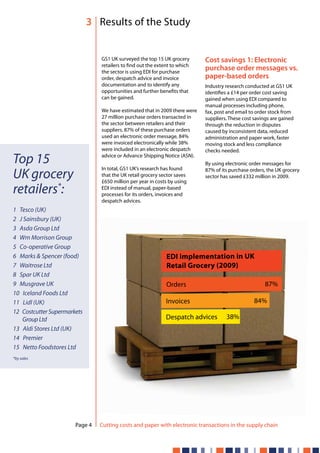
We have estimated that in 2009 there were
27 million purchase orders transacted in
the sector between retailers and their
suppliers. 87% of these purchase orders
used an electronic order message, 84%
were invoiced electronically while 38%
were included in an electronic despatch
advice or Advance Shipping Notice (ASN).
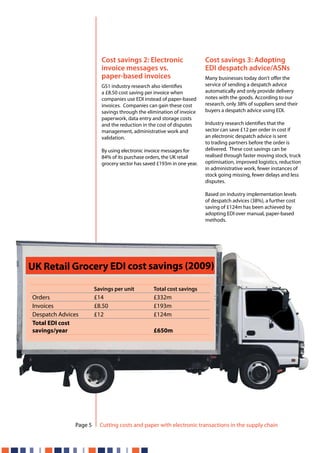
In total, GS1 UK’s research has found
that the UK retail grocery sector saves
£650 million per year in costs by using
EDI instead of manual, paper-based
processes for its orders, invoices and
despatch advices.
Top 15
UK grocery
retailers*
:
1 Tesco (UK)
2 J Sainsbury (UK)
3 Asda Group Ltd
4 Wm Morrison Group
5 Co-operative Group
6 Marks  Spencer (food)
7 Waitrose Ltd
8 Spar UK Ltd
9 Musgrave UK
10 Iceland Foods Ltd
11 Lidl (UK)
12 CostcutterSupermarkets 	
GroupLtd
13 Aldi Stores Ltd (UK)
14 Premier
15 Netto Foodstores Ltd
*by sales
Orders		 87%
EDI implementation in UK
Retail Grocery (2009)
Invoices		 84%
Despatch advices 38%
Cost savings 1: Electronic
purchase order messages vs.
paper-based orders
Industry research conducted at GS1 UK
identifies a £14 per order cost saving
gained when using EDI compared to
manual processes including phone,
fax, post and email to order stock from
suppliers. These cost savings are gained
through the reduction in disputes
caused by inconsistent data, reduced
administration and paper work, faster
moving stock and less compliance
checks needed.
By using electronic order messages for
87% of its purchase orders, the UK grocery
sector has saved £332 million in 2009.
Cutting costs and paper with electronic transactions in the supply chainPage 5
Cost savings 2: Electronic
invoice messages vs. 	
paper-based invoices
GS1 industry research also identifies
a £8.50 cost saving per invoice when
companies use EDI instead of paper-based
invoices. Companies can gain these cost
savings through the elimination of invoice
paperwork, data entry and storage costs
and the reduction in the cost of disputes
management, administrative work and
validation.
By using electronic invoice messages for
84% of its purchase orders, the UK retail
grocery sector has saved £193m in one year.
Cost savings 3: Adopting 	
EDI despatch advice/ASNs
Many businesses today don’t offer the
service of sending a despatch advice
automatically and only provide delivery
notes with the goods. According to our
research, only 38% of suppliers send their
buyers a despatch advice using EDI.
Industry research identifies that the
sector can save £12 per order in cost if
an electronic despatch advice is sent
to trading partners before the order is
delivered. These cost savings can be
realised through faster moving stock, truck
optimisation, improved logistics, reduction
in administrative work, fewer instances of
stock going missing, fewer delays and less
disputes.
Based on industry implementation levels
of despatch advices (38%), a further cost
saving of £124m has been achieved by
adopting EDI over manual, paper-based
methods.
UK Retail Grocery EDI cost savings (2009)
Savings per unit Total cost savings
Orders £14 £332m
Invoices £8.50 £193m
Despatch Advices £12 £124m
Total EDI cost
savings/year £650m
Cutting costs and paper with electronic transactions in the supply chainPage 6
4 Opportunities
Full implementation of EDI in	
grocery retail sector
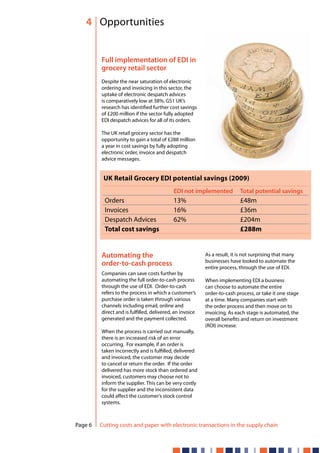
Despite the near saturation of electronic
ordering and invoicing in this sector, the
uptake of electronic despatch advices
is comparatively low at 38%. GS1 UK’s
research has identified further cost savings
of £200 million if the sector fully adopted
EDI despatch advices for all of its orders.
The UK retail grocery sector has the
opportunity to gain a total of £288 million
a year in cost savings by fully adopting
electronic order, invoice and despatch
advice messages.
Automating the 	
order-to-cash process
Companies can save costs further by
automating the full order-to-cash process
through the use of EDI. Order-to-cash
refers to the process in which a customer’s
purchase order is taken through various
channels including email, online and
direct and is fulfilled, delivered, an invoice
generated and the payment collected.
When the process is carried out manually,
there is an increased risk of an error
occurring. For example, if an order is
taken incorrectly and is fulfilled, delivered
and invoiced, the customer may decide
to cancel or return the order. If the order
delivered has more stock than ordered and
invoiced, customers may choose not to
inform the supplier. This can be very costly
for the supplier and the inconsistent data
could affect the customer’s stock control
systems.
As a result, it is not surprising that many
businesses have looked to automate the
entire process, through the use of EDI.
When implementing EDI a business
can choose to automate the entire
order-to-cash process, or take it one stage
at a time. Many companies start with
the order process and then move on to
invoicing. As each stage is automated, the
overall benefits and return on investment
(ROI) increase.
EDI not implemented Total potential savings
Orders 13% £48m
Invoices 16% £36m
Despatch Advices 62% £204m
Total cost savings £288m
UK Retail Grocery EDI potential savings (2009)
Cutting costs and paper with electronic transactions in the supply chainPage 7
Cutting paper usage – 	
save costs, improve efficiency
and be sustainable
GS1 industry research shows that
significant cost savings can be made by
eliminating the use of paper documents
and replacing them with EDI messages.
Businesses that rely on paper-based
processes have to cover the cost of
printing forms, postage, administrative
overhead such as filing and retrieval,
data entry and the manual validation
of information. There is also the added
headache of dealing with purchase
order or payment disputes and invoice
reconciliation due to errors such as illegible
handwriting and manual data entry.
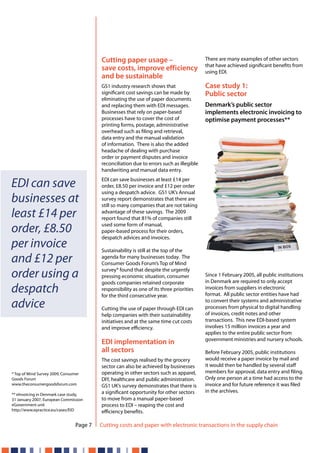
EDI can save businesses at least £14 per
order, £8.50 per invoice and £12 per order
using a despatch advice. GS1 UK’s Annual
survey report demonstrates that there are
still so many companies that are not taking
advantage of these savings. The 2009
report found that 81% of companies still
used some form of manual,
paper-based process for their orders,
despatch advices and invoices.
Sustainability is still at the top of the
agenda for many businesses today. The
Consumer Goods Forum’s Top of Mind
survey* found that despite the urgently
pressing economic situation, consumer
goods companies retained corporate
responsibility as one of its three priorities
for the third consecutive year.
Cutting the use of paper through EDI can
help companies with their sustainability
initiatives and at the same time cut costs
and improve efficiency.
EDI implementation in 	
all sectors
The cost savings realised by the grocery
sector can also be achieved by businesses
operating in other sectors such as apparel,
DIY, healthcare and public administration.
GS1 UK’s survey demonstrates that there is
a significant opportunity for other sectors
to move from a manual paper-based
process to EDI – reaping the cost and
efficiency benefits.
There are many examples of other sectors
that have achieved significant benefits from
using EDI.
Case study 1: 	
Public sector
Denmark’s public sector
implements electronic invoicing to
optimise payment processes**
Since 1 February 2005, all public institutions
in Denmark are required to only accept
invoices from suppliers in electronic
format. All public sector entities have had
to convert their systems and administrative
processes from physical to digital handling
of invoices, credit notes and other
transactions. This new EDI-based system
involves 15 million invoices a year and
applies to the entire public sector from
government ministries and nursery schools.
Before February 2005, public institutions
would receive a paper invoice by mail and
it would then be handled by several staff
members for approval, data entry and filing.
Only one person at a time had access to the
invoice and for future reference it was filed
in the archives.
EDI can save
businesses at
least £14 per
order, £8.50
per invoice
and £12 per
order using a
despatch
advice
* Top of Mind Survey 2009, Consumer
Goods Forum
www.theconsumergoodsforum.com
** eInvoicing in Denmark case study,
31 January 2007, European Commission
eGovernment unit
http://www.epractice.eu/cases/EID
Cutting costs and paper with electronic transactions in the supply chainPage 8
Mitchells  Butlers is the UK’s leading pub
and pub restaurant operator with over 2,000
businesses in prime locations around the
country. For the operator, visibility of stock
across the business and good quality data is
vital.
To serve its customers better and improve
supply chain efficiency, the company
decided to replace its old and disparate
systems with a centralised order and receipt
system. The new system uses GS1 standards
and EDI for its purchase orders and despatch
advices or ASNs.
The solution allows pub managers to
raise their orders electronically with the
company’s food and drink suppliers. Within
half an hour of the order being made,
an acknowledgement note is sent to the
ordering system electronically. The supplier
will then send Mitchells  Butlers an ASN
(Advanced Shipping Notice) with the delivery
details including the product codes or GTINs
(Global Trade Item Numbers) before the
delivery is made.
When the goods arrive at the pub, the
manager will compare the ASN with the
delivery note and confirm receipt of the
goods on the system. The goods are
accepted and the stock levels are adjusted on
the centralised system automatically.
The new system provides full visibility of
all orders and receipts. When an invoice is
received, it is linked to the ASN and matched
before any payment is processed. If they
don’t match, the system will produce an
alert to check for any errors by linking the
user with a scanned copy of the delivery
note from the supplier. If the supplier is at
fault, they are issued with a request for credit
within five days almost immediately.
Mitchells  Butlers’EDI based order and
receipt system has produced tremendous
value, including improved visibility of stock,
better reallocation of stock, reduced stock
waste, more accurate forecasting, less
administration and a reduction in invoicing
and delivery errors. The company has
achieved its aim of improving supply chain
efficiency and ultimately providing better
customer service.
Today, the invoice arrives directly in the
electronic accounting system and is
subsequently approved online by staff –
a process that involves no paper and takes
only a few seconds. Furthermore, the
invoice can later be retrieved in a matter
of seconds. This considerably reduces
the processing time for Denmark’s
public institutions.
The electronic invoice is a bill converted
into an EDI-based format that can be
read by the public sector accounting
system. All invoices must include a GS1
Global Location Number (GLN), order or
requisition number, personal or other
reference and internal accounting number.
It is estimated that each minute saved in
invoice handling of the public sectors’15
million invoices equals 12 million Euros
saved a year. A conservative estimate
is that 10 minutes can be saved in the
handling of each invoice when they are
received electronically – resulting in total
savings of 120 million Euros per year. This
is equivalent to potential savings of more
than 2,000 man-years of work per year.
Case study 2: 	
Food Service sector
Mitchells  Butlers improves
stock visibility and efficiency with
electronic despatch advices*
10 minutes
can be saved
in the
handling of
each invoice
when they
are received
electronically
- resulting in
total savings
of120million
Euros per
year
* Mitchells  Butlers case study 2009,
GS1 UK www.gs1uk.org /news
Cutting costs and paper with electronic transactions in the supply chainPage 9
5 Overview of EDI
Electronic Data Interchange
(EDI) – What is it?
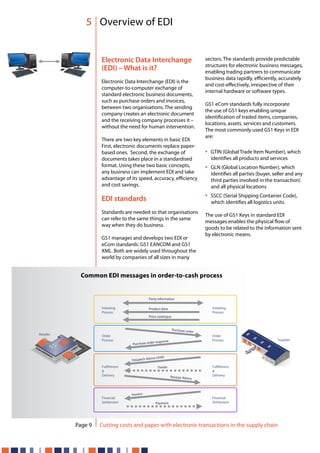
Electronic Data Interchange (EDI) is the
computer-to-computer exchange of
standard electronic business documents,
such as purchase orders and invoices,
between two organisations. The sending
company creates an electronic document
and the receiving company processes it –
without the need for human intervention.
There are two key elements in basic EDI.
First, electronic documents replace paper-
based ones. Second, the exchange of
documents takes place in a standardised
format. Using these two basic concepts,
any business can implement EDI and take
advantage of its speed, accuracy, efficiency
and cost savings.
EDI standards
Standards are needed so that organisations
can refer to the same things in the same
way when they do business.
GS1 manages and develops two EDI or
eCom standards: GS1 EANCOM and GS1
XML. Both are widely used throughout the
world by companies of all sizes in many
Supplier
Initiating
Process

Delivery

Delivery
Initiating
Process
Order
Process
Order
Process
Financial
Settlement
Financial
Settlement
Party information
Product data
Price catalogue
Purchase order response
Receipt Advice
Purchase order
Despatch Advice (ASN)
Invoice
Goods
Payment
Retailer
Common EDI messages in order-to-cash process
sectors. The standards provide predictable
structures for electronic business messages,
enabling trading partners to communicate
business data rapidly, efficiently, accurately
and cost-effectively, irrespective of their
internal hardware or software types.
GS1 eCom standards fully incorporate
the use of GS1 keys enabling unique
identification of traded items, companies,
locations, assets, services and customers.
The most commonly used GS1 Keys in EDI
are:
• GTIN (Global Trade Item Number), which 	
identifies all products and services
• GLN (Global Location Number), which 		
identifies all parties (buyer, seller and any	
third parties involved in the transaction) 		
and all physical locations
• SSCC (Serial Shipping Container Code), 		
which identifies all logistics units.
The use of GS1 Keys in standard EDI
messages enables the physical flow of
goods to be related to the information sent
by electronic means.
Cutting costs and paper with electronic transactions in the supply chainPage 10
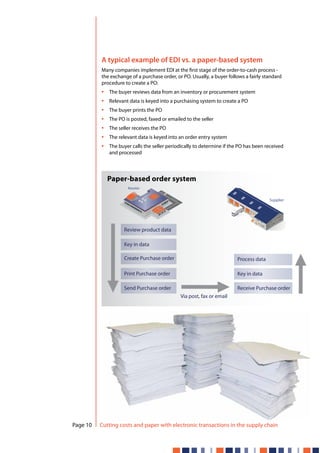
A typical example of EDI vs. a paper-based system
Many companies implement EDI at the first stage of the order-to-cash process -
the exchange of a purchase order, or PO. Usually, a buyer follows a fairly standard
procedure to create a PO:
•	The buyer reviews data from an inventory or procurement system
•	Relevant data is keyed into a purchasing system to create a PO
•	 The buyer prints the PO
•	The PO is posted, faxed or emailed to the seller
•	 The seller receives the PO
•	The relevant data is keyed into an order entry system
•	The buyer calls the seller periodically to determine if the PO has been received
and processed
Review product data
Create Purchase order
Key in data
Print Purchase order
Send Purchase order Receive Purchase order
Process data
Key in data
Via post, fax or email
Supplier
Retailer
Paper-based order system
Cutting costs and paper with electronic transactions in the supply chainPage 11
If you add up the time taken by the buyer
and seller to follow this procedure and the
time taken by the post, it can typically take
between 3 to 5 days. This also depends
on the buyer and seller handling the PO
quickly and without any data entry errors.
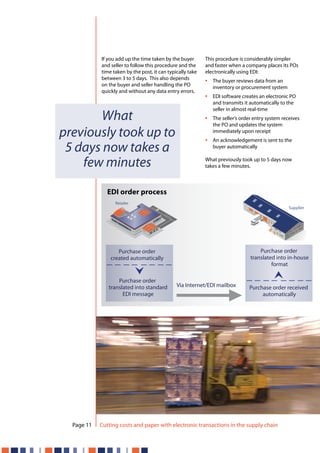
This procedure is considerably simpler
and faster when a company places its POs
electronically using EDI:
•	The buyer reviews data from an
inventory or procurement system
•	EDI software creates an electronic PO
and transmits it automatically to the
seller in almost real-time
•	The seller’s order entry system receives
the PO and updates the system
immediately upon receipt
•	An acknowledgement is sent to the
buyer automatically
What previously took up to 5 days now
takes a few minutes.
What
previously took up to
5 days now takes a
few minutes
Purchase order
created automatically
Purchase order received
automatically
Via Internet/EDI mailbox
Supplier
Retailer
Purchase order
translated into standard
EDI message
Purchase order
translated into in-house
format
EDI order process
Cutting costs and paper with electronic transactions in the supply chainPage 12
Benefits of EDI
EDI enables companies to exchange
trading documents faster with enhanced
data accuracy, improved efficiencies and
lower costs. Here are the top 5 reasons
why businesses adopt EDI:
1. It’s faster
EDI provides significant increases in the
speed that documents are transferred from
one company to another, reducing lead
times and speeding up payments.
2. Data is more accurate
Electronic transfer of trading documents
between computers increases data
accuracy.
3. Improved process 	
efficiencies
EDI positively impacts process efficiencies
and relationships with trading partners.
4. Cost savings
Costs are reduced – through savings and
avoidance – as a result of implementing EDI.
5. Eliminates paper
Paper-based trading processes are costly,
inefficient and not sustainable.
The benefits above show that it is no
accident that the leading UK retailers all
rely on EDI for placing orders and receiving
invoices – they know the benefits they get
and the costs that can be saved.
Cutting costs and paper with electronic transactions in the supply chainPage 13
It is important to determine which areas
of a supply chain would benefit most from
process automation and EDI.
The GS1 UK Professional Services team can
help provide expert and impartial business
analysis and recommendations by:
•	Reviewing existing business processes
to determine the areas where an
EDI implementation can maximise
efficiencies and deliver the highest cost
savings
•	Recommending specific EDI
implementations, for example,
automating particular process flows
such as ordering or invoicing and
receiving or despatching goods
•	Working with or alongside service
providers to ensure trading partners
correctly implement a standardised
approach to EDI.
Visit the GS1 UK website www.gs1uk.org
to find a solution provider specialising in
EDI to identify the best solution for your
company.
6 Next Steps
Maximise
efficiencies
and deliver
the highest
cost savings
Cutting costs and paper with electronic transactions in the supply chainPage 14
Contact GS1 UK
GS1 UK
Staple Court
11 Staple Inn Buildings
London
WC1V 7QH
T 	 +44 (0)20 7092 3500
F 	 +44 (0)20 7681 2290
E 	 info@gs1uk.org
W 	www.gs1uk.org
Service Team (Freefone) 0808 178 8799
About GS1 UK
GS1 UK has driven innovation in the supply
chain for over thirty years. It is part of the
global GS1 organisation, dedicated to
the development and implementation of
global data standards and solutions for
the supply chain. The GS1 System is the
most widely used supply chain standards
system in the world. GS1 UK helps industry
to implement these data standards
through the use of bar codes, Radio
Frequency Identification (RFID), Global
Data Synchronisation (GDS) and electronic
business messaging.
Cutting costs and paper with electronic transactions in the supply chainPage 15
Acknowledgements
We would like to thank the supply chain
executives from the UK retail sector who
shared their time and knowledge with us
for the EDI cost savings report. We would
also like to acknowledge the contributions
of the GS1 UK team (Malcolm Bowden,
Tom Beston, Tim Brown and Shan Welch)
that worked on the report.
This report was made possible by the
Knowledge Transfer Partnership (KTP)
between GS1 UK and Cranfield School
of Management under the guidance of
Professor Richard Wilding.
Report authors: Suraya Adnan-Ariffin 
Oliver Coussins
Published by GS1 UK (London, WC1V 7QH)
and Cranfield School of Management
(Bedford, MK43 0AL)
ISBN 978-1-907413-02-5
Copyright GS1 UK 2010
GS1 UK
Staple Court
11 Staple Inn Buildings
London
WC1V 7QH
T +44 (0)20 7092 3500
F +44 (0)20 7681 2290
E info@gs1uk.org
W www.gs1uk.org