An Introduction toPedagogical
Approach's: Jean Piaget's Cognitive
Constructivism
2.
Investigating various
pedagogical
approaches andtheir
relevance in diverse
learning environments
Analyzing the impact
of pedagogical
approaches on
students' cognitive
development
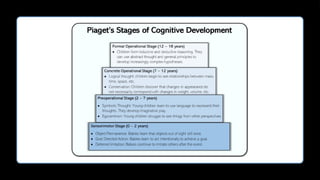
Introducing Piaget’s
Cognitive
constructivism.
3.
INTRODUCTION
In the dynamiclandscape of education, teachers play a pivotal role in
shaping the minds of the future generation. The art and science of teaching
involve a profound understanding of pedagogical approaches that cater to
the diverse needs of learners. This introduction aims to explore key
pedagogical methodologies, emphasizing their significance in creating
effective learning environments. One such influential theory that has
significantly impacted the field of education is Jean Piaget's Cognitive
Constructivism. As we delve into the realm of pedagogy, we will unravel the
principles and applications of Piaget's theory, shedding light on its relevance
for educators striving to enhance the learning experiences of their students.
4.
Difference Between APedagogical Approach
And Pedagogical Techniques
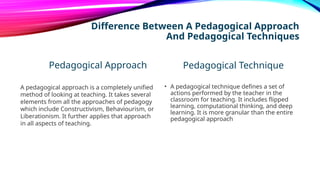
Pedagogical Approach
A pedagogical approach is a completely unified
method of looking at teaching. It takes several
elements from all the approaches of pedagogy
which include Constructivism, Behaviourism, or
Liberationism. It further applies that approach
in all aspects of teaching.
Pedagogical Technique
• A pedagogical technique defines a set of
actions performed by the teacher in the
classroom for teaching. It includes flipped
learning, computational thinking, and deep
learning. It is more granular than the entire
pedagogical approach
5.
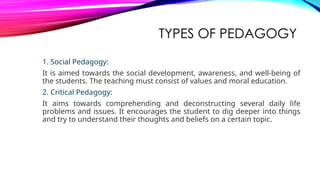
TYPES OF PEDAGOGY
1.Social Pedagogy:
It is aimed towards the social development, awareness, and well-being of
the students. The teaching must consist of values and moral education.
2. Critical Pedagogy:
It aims towards comprehending and deconstructing several daily life
problems and issues. It encourages the student to dig deeper into things
and try to understand their thoughts and beliefs on a certain topic.
6.
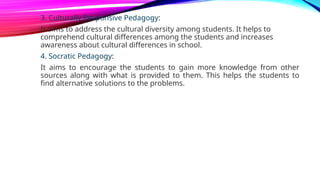
3. Culturally ResponsivePedagogy:
It aims to address the cultural diversity among students. It helps to
comprehend cultural differences among the students and increases
awareness about cultural differences in school.
4. Socratic Pedagogy:
It aims to encourage the students to gain more knowledge from other
sources along with what is provided to them. This helps the students to
find alternative solutions to the problems.
7.
REFLECTION QUESTIONS
• Q:Have you used this type of pedagogy in your
classroom practices ?
• Q: How can we use this type of pedagogy/s to
Islamize curricular?
8.
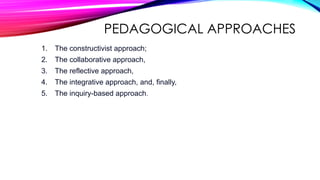
PEDAGOGICAL APPROACHES
1. Theconstructivist approach;
2. The collaborative approach,
3. The reflective approach,
4. The integrative approach, and, finally,
5. The inquiry-based approach.
9.
THE CONSTRUCTIVIST APPROACH
•In this approach, the students are allowed to be present in the process of
understanding and gaining knowledge rather than just passively
receiving information. This encourages critical thinking among the
students and gives a learning environment in which they can connect
with what they are hearing
• Constructivist pedagogical approaches, such as problem-based learning and
inquiry-based learning, encourage students to actively construct their own
knowledge through hands-on experiences and interactions. This approach
promotes critical thinking, problem-solving skills, and the ability to analyze
and synthesize information. It also fosters a deeper understanding of
concepts as students actively engage with the material.
12.
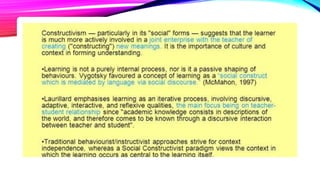
WHAT IS CONSTRUCTIVISM?
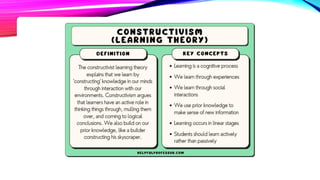
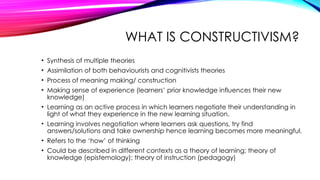
•Synthesis of multiple theories
• Assimilation of both behaviourists and cognitivists theories
• Process of meaning making/ construction
• Making sense of experience (learners’ prior knowledge influences their new
knowledge)
• Learning as an active process in which learners negotiate their understanding in
light of what they experience in the new learning situation.
• Learning involves negotiation where learners ask questions, try find
answers/solutions and take ownership hence learning becomes more meaningful.
• Refers to the ‘how’ of thinking
• Could be described in different contexts as a theory of learning; theory of
knowledge (epistemology); theory of instruction (pedagogy)
13.
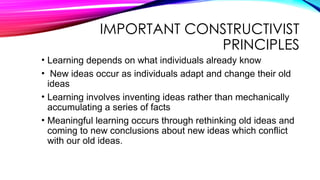
IMPORTANT CONSTRUCTIVIST
PRINCIPLES
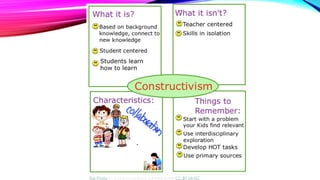
• Learningdepends on what individuals already know
• New ideas occur as individuals adapt and change their old
ideas
• Learning involves inventing ideas rather than mechanically
accumulating a series of facts
• Meaningful learning occurs through rethinking old ideas and
coming to new conclusions about new ideas which conflict
with our old ideas.
15.
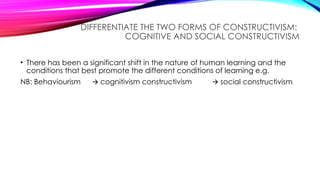
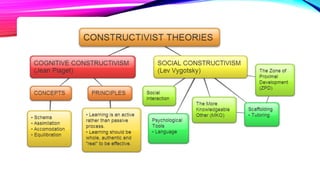
DIFFERENTIATE THE TWOFORMS OF CONSTRUCTIVISM:
COGNITIVE AND SOCIAL CONSTRUCTIVISM
• There has been a significant shift in the nature of human learning and the
conditions that best promote the different conditions of learning e.g.
NB: Behaviourism cognitivism constructivism
🡪 social constructivism
🡪
16.
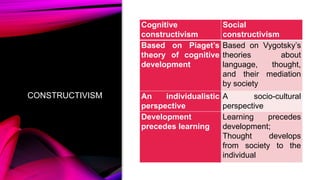
CONSTRUCTIVISM
Cognitive
constructivism
Social
constructivism
Based on Piaget’s
theoryof cognitive
development
Based on Vygotsky’s
theories about
language, thought,
and their mediation
by society
An individualistic
perspective
A socio-cultural
perspective
Development
precedes learning
Learning precedes
development;
Thought develops
from society to the
individual
19.
THE COLLABORATIVE APPROACH
•Here, the students form groups of learners that learn together and
work to solve a problem, build strategies, ideas, create products or
complete a task. This is a joint intellectual effort by the students
among themselves or with the help of the teachers.
20.
SOCIO-CULTURAL APPROACHES
• Socio-culturalpedagogical approaches emphasize the importance of social
interactions and cultural context in learning. Collaborative learning and group
activities are often used to promote cognitive development by encouraging students
to explain their thinking to others, negotiate meaning, and learn from their peers.
This approach enhances communication skills, perspective-taking, and the ability to
consider multiple viewpoints.
21.
THE REFLECTIVE APPROACH
•As per the reflective approach, the students are expected to evaluate
themselves. It means observing the activities of the teachers and other
students in the classroom and analyzing why they do it and how it works.
22.
THE INQUIRY-BASED APPROACH.
•In the inquiry-based learning method, the educators are expected to not just
answer the queries of the students, but also build a culture where their ideas
are explored, challenged, improved, and refined. It aims to take the students
from the position of wondering about a question to understanding the answer
and then questioning it further.
23.
THE INTEGRATIVE APPROACH
•For the integrative approach, the students are given a learning
environment that helps them in connecting with their learning across the
syllabus. The four objectives of integration include-
1. Understanding the process of learning
2. Differentiating issues by relevance
3. Making use of the lessons in practical scenarios
4. Associating the concepts in regular lives
24.
COGNITIVE LOAD THEORY:
•Pedagogical approaches informed by cognitive load theory focus on managing the
cognitive load placed on students' working memory. By presenting information in a
way that reduces cognitive overload, such as breaking complex tasks into smaller
steps or using visual aids, students can better process and retain information. This
approach supports effective learning and cognitive development by optimizing the
way information is presented.
25.
METACOGNITIVE STRATEGIES:
• Pedagogicalapproaches that incorporate metacognitive strategies help students
become aware of their own thinking processes and learning strategies. By teaching
students how to set goals, monitor their progress, and adjust their strategies as
needed, educators enable them to become more independent and effective
learners. This self-regulation fosters higher-order cognitive skills and a deeper
understanding of how to approach different tasks.
26.
DIFFERENTIATED INSTRUCTION:
• Differentiatedinstruction tailors teaching methods to match students' individual
needs, interests, and learning styles. This approach acknowledges that students
have varying levels of cognitive development and readiness. By providing
appropriate challenges and support, educators can scaffold students' learning
experiences and promote cognitive growth at their own pace.
27.
EXPERIENTIAL LEARNING:
• Experientiallearning approaches, such as project-based learning and field trips,
enable students to learn through direct experiences. These approaches encourage
active engagement, critical thinking, and the application of knowledge in real-world
contexts. Such hands-on experiences can enhance cognitive development by
connecting theoretical concepts to practical situations.
28.
REFLECTION QUESTIONS
• Whatis your view on experiential
learning?
• How can learning by doing support
learning?
29.
SITUATED LEARNING
• Situatedlearning is when one is learning from a classroom to
gain more knowledge on the skill and have a career an
example is that of a doctor.
ROLE OF PEDAGOGYIN EFFECTIVE LEARNING
1. Improves Teaching Quality
• It enhances student participation in learning and makes them more
receptive to what is being taught.
2. Encourages Different Learning Styles
• The main focus is given on the outcomes of courses and the students
are free to learn in their styles.
32.
3. Enables LearningFor Students With Special Needs
• It encourages the students with special needs to be a part of the
mainstream teaching ways and engage with other students.
4. Clarifies Learning Objectives
• The student studies a particular subject with a clear objective of
outcomes such as gaining skills and knowledge of the subject.
33.
PEDAGOGICAL APPROACHES &ITS
INFLUENCE STUDENTS' COGNITIVE
DEVELOPMENT
Cognitive development refers to the growth and maturation of a person's thinking,
problem-solving, reasoning, and memory abilities. Different pedagogical
approaches can impact cognitive development in various ways.
34.
ISLAMIZING PEDAGOGY FOR21ST
CENTURY TEACHING
• "Islamizing" pedagogy refers to integrating Islamic principles, values, and
perspectives into the teaching and learning process. It's about creating an
educational environment that aligns with Islamic beliefs and practices while
promoting effective learning. Here are some ways teachers can Islamize their
pedagogy:
35.
❖Incorporate Islamic Values:Infuse Islamic values such as compassion,
justice, honesty, and humility into classroom discussions, assignments, and
interactions. Encourage students to reflect on how these values apply to
their studies and daily lives.
❖Use Islamic Examples: Incorporate examples from Islamic history,
literature, and teachings to illustrate concepts and principles across various
subjects. This can help students see the relevance of their studies within an
Islamic context.
❖Integrate Quranic Verses and Hadiths: Incorporate relevant verses from
the Quran and teachings from Hadiths that relate to the subject matter being
taught. This can help students understand how Islamic teachings are
intertwined with various fields of knowledge.
36.
❖Encourage Critical Thinkingfrom an Islamic Perspective: Encourage
students to analyze and discuss various topics from an Islamic perspective.
This promotes critical thinking while allowing students to consider how
Islamic values and principles can guide their analysis.
❖Foster Ethical Decision-Making: Discuss ethical dilemmas and decision-
making processes from an Islamic ethical standpoint. Help students
understand how Islamic principles can guide them in making ethical choices
in their studies and personal lives.
❖Promote Inclusivity: Create an inclusive classroom environment that
respects and values diversity, just as Islam teaches. Celebrate cultural and
linguistic diversity among students, while emphasizing the common human
values shared by different cultures.
37.
❖Teach Holistically: Recognizethe interconnectedness of knowledge and
emphasize the holistic approach to education that Islam promotes.
Show students how different subjects are interconnected and how
understanding one subject can enrich their understanding of others.
❖Emphasize Moral and Spiritual Development: Besides intellectual growth,
focus on nurturing students' moral and spiritual development. Encourage
them to cultivate qualities like humility, gratitude, and empathy.
❖Practical Application of Knowledge: Encourage students to apply their
knowledge in practical ways that contribute positively to their
communities and society at large. Emphasize the importance of service
and making a positive impact.
38.
1.Open Dialogue: Createan open and respectful space for students to discuss
the intersection of their faith and education. Encourage them to ask
questions, share insights, and engage in thoughtful discussions.
2.Teach with Patience and Compassion: Emulate the qualities of patience
and compassion that are emphasized in Islam. Show understanding and
support to students as they navigate their learning journeys.
3.Continuous Self-Reflection: As a teacher, engage in continuous self-
reflection on your teaching methods and how they align with Islamic
principles. Seek ways to improve and better integrate Islamic values into your
pedagogy.
39.
CONCLUSION
• Pedagogical approacheshave a profound impact on students' cognitive
development. By selecting and implementing appropriate methods, educators can
create environments that foster critical thinking, problem-solving, metacognition,
and other cognitive skills essential for lifelong learning and success. The key is to
tailor the approach to the specific needs of the students and the learning objectives
of the curriculum.
40.
CONCLUSION
• Pedagogical approacheshave a profound impact on
students' cognitive development. By selecting and
implementing appropriate methods, educators can create
environments that foster critical thinking, problem-solving,
metacognition, and other cognitive skills essential for lifelong
learning and success. The key is to tailor the approach to
the specific needs of the students and the learning
objectives of the curriculum.
41.
CONCLUSION
In conclusion, therealm of pedagogical approaches is a multifaceted
landscape that requires a nuanced understanding to foster meaningful
learning experiences. Throughout this exploration, we have touched upon
various methodologies that educators employ to engage and nurture their
students. Among these, Jean Piaget's Cognitive Constructivism stands out
as a cornerstone in the foundation of educational theory. Its emphasis on
the active role of learners in constructing their knowledge provides a
valuable framework for teachers seeking to facilitate optimal learning
environments. As we navigate the ever-evolving landscape of education,
it is crucial for teachers to continually adapt and integrate effective
pedagogical approaches, ensuring that the journey of knowledge
acquisition remains both enriching and transformative for students.
42.
INTERESTING READINGS
• Backus,J. (2012). Islam in the school curriculum: symbolic pedagogy and cultural claims.
• Latif, Y. F., Sarwi, S., Marwoto, P., & Susilaningsih, E. (2024). Student Perceptions of Science
Learning at Tahfidz Boarding School. Pegem Journal of Education and Instruction, 14(1), 296-302.
• Muniandy, T., & Abdullah, N. (2023). A Comprehensive Review: An Innovative Pedagogy for Future
Education. International Journal of Online Pedagogy and Course Design (IJOPCD), 13(1), 1-15.
• Li, W., Liu, X., Zhang, Q., Zhou, B., & Wang, B. (2023). VR-Enhanced Cognitive Learning: Method,
Framework, and Application. Applied Sciences, 13(8), 4756.
• Dhurumraj, T., & Broadhurst, J. L. (2023). Investigating the classroom teaching practices of life
sciences teachers in Gauteng. International Journal of Research in Business and Social Science
(2147-4478), 12(2), 393-406.
• Dhurumraj, T., & Moola, Z. (2023). Exploring teacher improvisation and its influence on learner
performance in an under-resourced Grade 11 Life Science class. International Journal of Research
in Business and Social Science (2147-4478), 12(2), 384-392.
43.
REFERENC
ES
Referencing allows youto acknowledge the
contribution of other writers and researcher in your
work.
Any university assignments that draw on the ideas,
words or research of other writers must contain
citations.
Referencing is also a way to give credit to the
writers from whom you have borrowed words and
ideas.
By citing the work of a particular scholar you
acknowledge and respect the intellectual property
rights of that researcher.
Source: https://student.unsw.edu.au/why-referenci
ng-important
44.
Referencing is away to provide evidence to support the assertions and
claims in your own assignments.
By citing experts in your field, you are showing your marker that you are
aware of the field in which you are operating.
Your citations map the space of your discipline, and allow you to navigate
your way through your chosen field of study, in the same way that sailors
steer by the stars.
Source: https://student.unsw.edu.au/why-referencing-important
45.
APA
APA (American PsychologicalAssociation) style is
most frequently used within the social sciences, in
order to cite various sources.
To learn any referencing style you need to make an
appointment with the librarian or attend workshops.
Some examples of APA:
http://student.ucol.ac.nz/library/onlineresources/Do
cuments/APA_Guide_2017.pdf