Economical Importance Of
Bryophyte

        By:
              MARYAM SHAKEEL
Bryophytes are used in a variety of industrial
 applications. Different species of mosses
 are used as furniture stuffing, as soil
 conditioner, as cushioning, and as material
 used to absorb oil after spills.
Most economically important bryophyte is
 Peat moss SPHAGNUM.it has specialised
 hyaline cells to store water.so its used as
 storage material and also as absorbent.
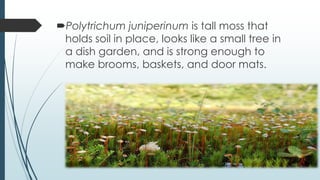
Polytrichum juniperinum is tall moss that
 holds soil in place, looks like a small tree in
 a dish garden, and is strong enough to
 make brooms, baskets, and door mats.
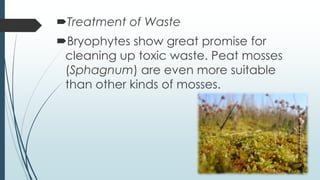
Treatment of Waste
Bryophytes show great promise for
 cleaning up toxic waste. Peat mosses
 (Sphagnum) are even more suitable
 than other kinds of mosses.
Peat has been considered a possible
 material for filtering water for reuse in space
 travel.
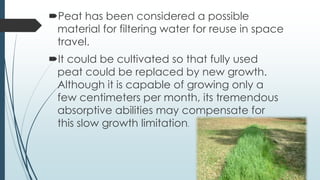
It could be cultivated so that fully used
 peat could be replaced by new growth.
 Although it is capable of growing only a
 few centimeters per month, its tremendous
 absorptive abilities may compensate for
 this slow growth limitation.
Decorative horticultural uses include
 making baskets and covering flower pots
 and containers for floral arrangements ,
 and one company advertises a birch-bark
 pedestal topped by a moss globe.
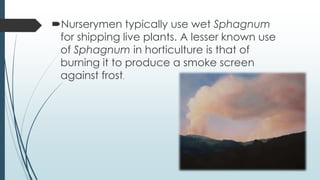
Nurserymen typically use wet Sphagnum
 for shipping live plants. A lesser known use
 of Sphagnum in horticulture is that of
 burning it to produce a smoke screen
 against frost.
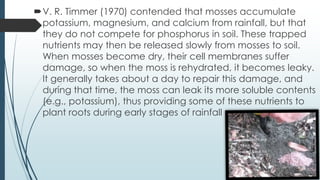
V. R. Timmer (1970) contended that mosses accumulate
 potassium, magnesium, and calcium from rainfall, but that
 they do not compete for phosphorus in soil. These trapped
 nutrients may then be released slowly from mosses to soil.
 When mosses become dry, their cell membranes suffer
 damage, so when the moss is rehydrated, it becomes leaky.
 It generally takes about a day to repair this damage, and
 during that time, the moss can leak its more soluble contents
 (e.g., potassium), thus providing some of these nutrients to
 plant roots during early stages of rainfall
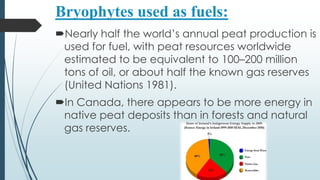
Bryophytes used as fuels:
Nearly half the world’s annual peat production is
 used for fuel, with peat resources worldwide
 estimated to be equivalent to 100–200 million
 tons of oil, or about half the known gas reserves
 (United Nations 1981).
In Canada, there appears to be more energy in
 native peat deposits than in forests and natural
 gas reserves.
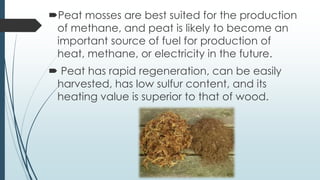
Peat mosses are best suited for the production
 of methane, and peat is likely to become an
 important source of fuel for production of
 heat, methane, or electricity in the future.
 Peat has rapid regeneration, can be easily
 harvested, has low sulfur content, and its
 heating value is superior to that of wood.
Bryophytes are used in pharmaceutical
 products, in horticulture ,for household
 purposes, and are also ecologically
 important. Uses and applications of the
 bryophyte flora are being increasingly
 recognized around the world. Their
 potential in the biomapping of
 atmospheric precipitation is also
 enormous.
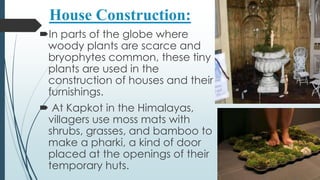
House Construction:
In parts of the globe where
 woody plants are scarce and
 bryophytes common, these tiny
 plants are used in the
 construction of houses and their
 furnishings.
 At Kapkot in the Himalayas,
 villagers use moss mats with
 shrubs, grasses, and bamboo to
 make a pharki, a kind of door
 placed at the openings of their
 temporary huts.
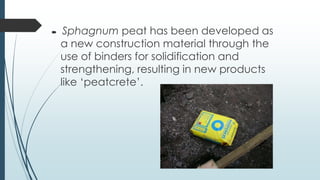
    Sphagnum peat has been developed as
    a new construction material through the
    use of binders for solidification and
    strengthening, resulting in new products
    like ‘peatcrete’.
Household Uses:
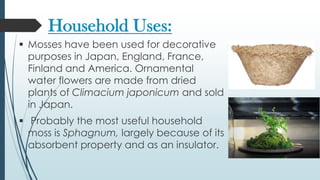
 Mosses have been used for decorative
  purposes in Japan, England, France,
  Finland and America. Ornamental
  water flowers are made from dried
  plants of Climacium japonicum and sold
  in Japan.
 Probably the most useful household
  moss is Sphagnum, largely because of its
  absorbent property and as an insulator.
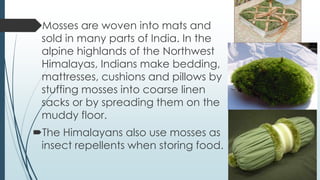
Mosses are woven into mats and
 sold in many parts of India. In the
 alpine highlands of the Northwest
 Himalayas, Indians make bedding,
 mattresses, cushions and pillows by
 stuffing mosses into coarse linen
 sacks or by spreading them on the
 muddy floor.
The Himalayans also use mosses as
 insect repellents when storing food.
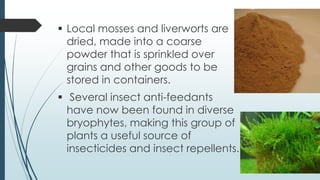
 Local mosses and liverworts are
  dried, made into a coarse
  powder that is sprinkled over
  grains and other goods to be
  stored in containers.
 Several insect anti-feedants
  have now been found in diverse
  bryophytes, making this group of
  plants a useful source of
  insecticides and insect repellents.
Medicinal Uses:
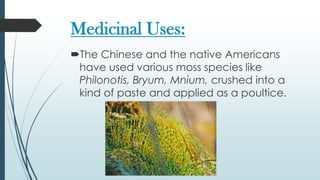
The Chinese and the native Americans
 have used various moss species like
 Philonotis, Bryum, Mnium, crushed into a
 kind of paste and applied as a poultice.
In India, the burned ash of mosses mixed with fat
 and honey is used as an ointment for cuts, burns
 and wounds in the Himalayan region.
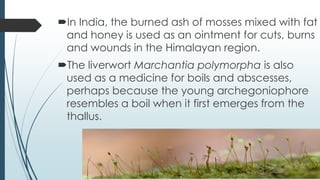
The liverwort Marchantia polymorpha is also
 used as a medicine for boils and abscesses,
 perhaps because the young archegoniophore
 resembles a boil when it first emerges from the
 thallus.
Bryophytes are also use for Decorative
purposes:
Thank You