Economic Activities Around
Us
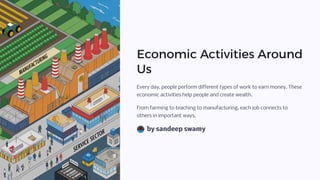
Every day, people perform different types of work to earn money. These
economic activities help people and create wealth.
From farming to teaching to manufacturing, each job connects to
others in important ways.
by sandeep swamy
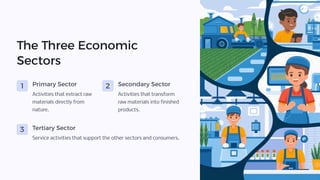
The Three Economic
Sectors
1 Primary Sector
Activities that extract raw
materials directly from
nature.
2 Secondary Sector
Activities that transform
raw materials into finished
products.
3 Tertiary Sector
Service activities that support the other sectors and consumers.
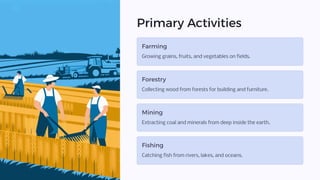
Primary Activities
Farming
Growing grains, fruits, and vegetables on fields.
Forestry
Collecting wood from forests for building and furniture.
Mining
Extracting coal and minerals from deep inside the earth.
Fishing
Catching fish from rivers, lakes, and oceans.
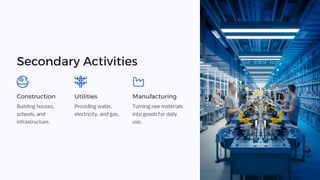
Secondary Activities
Construction
Building houses,
schools, and
infrastructure.
Utilities
Providing water,
electricity, and gas.
Manufacturing
Turning raw materials
into goods for daily
use.
Secondary Sector Examples
Food Processing
Turning grains from farms into flour
in mills.
Textile Production
Converting cotton into fabric to make
clothes.
Automobile Manufacturing
Transforming iron ore into steel to
make cars and trucks.
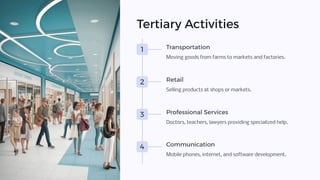
Tertiary Activities
1 Transportation
Moving goods from farms to markets and factories.
2 Retail
Selling products at shops or markets.
3 Professional Services
Doctors, teachers, lawyers providing specialized help.
4 Communication
Mobile phones, internet, and software development.
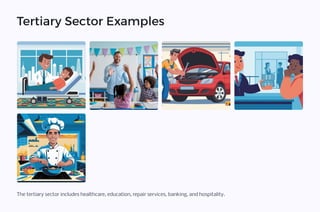
Tertiary Sector Examples
The tertiary sector includes healthcare, education, repair services, banking, and hospitality.
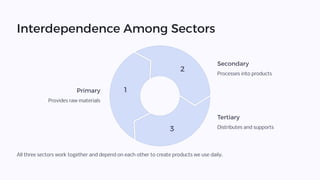
Interdependence Among Sectors
1
2
3
All three sectors work together and depend on each other to create products we use daily.
Primary
Provides raw materials
Secondary
Processes into products
Tertiary
Distributes and supports
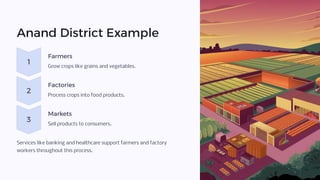
Anand District Example
1
Farmers
Grow crops like grains and vegetables.
2
Factories
Process crops into food products.
3
Markets
Sell products to consumers.
Services like banking and healthcare support farmers and factory
workers throughout this process.
Dairy Farming: Daily
Routine
Morning Milking
Farmers start their day by milking their cows.
Milk Collection
Farmers sell their milk to a nearby dairy.
Payment
At month-end, farmers get paid based on quantity and
quality.
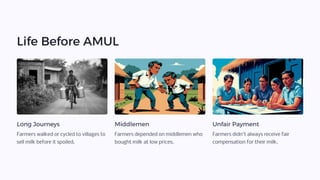
Life Before AMUL
Long Journeys
Farmers walked or cycled to villages to
sell milk before it spoiled.
Middlemen
Farmers depended on middlemen who
bought milk at low prices.
Unfair Payment
Farmers didn't always receive fair
compensation for their milk.
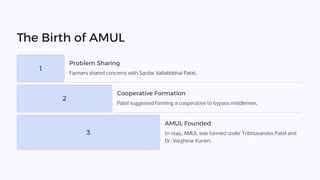
The Birth of AMUL
1
Problem Sharing
Farmers shared concerns with Sardar Vallabhbhai Patel.
2
Cooperative Formation
Patel suggested forming a cooperative to bypass middlemen.
3
AMUL Founded
In 1946, AMUL was formed under Tribhuvandas Patel and
Dr. Varghese Kurien.
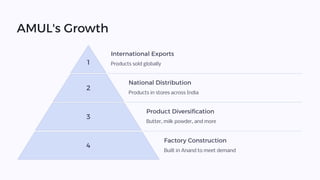
AMUL's Growth
1
International Exports
Products sold globally
2
National Distribution
Products in stores across India
3
Product Diversification
Butter, milk powder, and more
4
Factory Construction
Built in Anand to meet demand
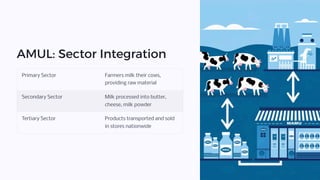
AMUL: Sector Integration
Primary Sector Farmers milk their cows,
providing raw material
Secondary Sector Milk processed into butter,
cheese, milk powder
Tertiary Sector Products transported and sold
in stores nationwide
What is a Cooperative?
1
2 3
4
Shared Ownership
Members own the
cooperative together.
Collective Decision-
Making
Decisions taken by members
as a group.
Common Goals
Working together to achieve
what individuals couldn't
alone.
Fair Distribution
Benefits shared equitably
among members.
Benefits of Cooperatives
0
Middlemen
Cooperatives eliminate
middlemen, allowing direct sales.
±
Fair Prices
Members earn more for their
products.
±
Control
Members have more control over
production and sales.
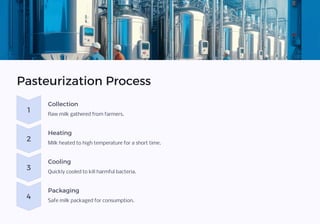
Pasteurization Process
1
Collection
Raw milk gathered from farmers.
2
Heating
Milk heated to high temperature for a short time.
3
Cooling
Quickly cooled to kill harmful bacteria.
4
Packaging
Safe milk packaged for consumption.
Milk Cooperatives Across India
These cooperatives help farmers, people with disabilities, and women work together to improve their lives and earn more
money.
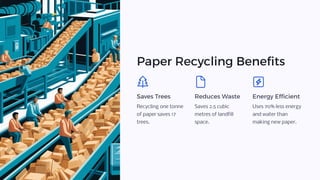
Paper Recycling Benefits
Saves Trees
Recycling one tonne
of paper saves 17
trees.
Reduces Waste
Saves 2.5 cubic
metres of landfill
space.
Energy Efficient
Uses 70% less energy
and water than
making new paper.
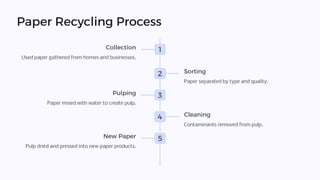
Paper Recycling Process
1
Collection
Used paper gathered from homes and businesses.
2 Sorting
Paper separated by type and quality.
3
Pulping
Paper mixed with water to create pulp.
4 Cleaning
Contaminants removed from pulp.
5
New Paper
Pulp dried and pressed into new paper products.
Economic Quiz
Question 1
Which sector involves directly working with nature to produce
goods?
Primary Activities
Secondary Activities
Tertiary Activities
Quaternary Activities
Question 2
What is the primary sector of economic activity?
Manufacturing automobiles
Growing crops on a farm
Building houses
Operating retail stores
Key Economic Terms
Monetary Value
Value measured in terms of money.
Economic Sectors
Broad groups of activities contributing to national
prosperity.
Warehouses
Buildings for storing products before sale or distribution.
Dairy
Place where milk is collected and stored.
Middlemen
Persons who buy from producers and sell to consumers.
Factory
Building where goods are manufactured or assembled.
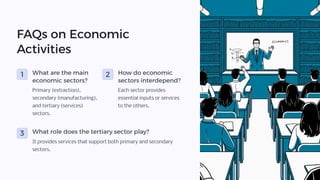
FAQs on Economic
Activities
1 What are the main
economic sectors?
Primary (extraction),
secondary (manufacturing),
and tertiary (services)
sectors.
2 How do economic
sectors interdepend?
Each sector provides
essential inputs or services
to the others.
3 What role does the tertiary sector play?
It provides services that support both primary and secondary
sectors.
Economic Activities in Our Daily Lives
Food Production
Farmers grow the food we eat every
day.
Manufacturing
Workers transform raw materials into
the products we use.
Services
Professionals provide essential services
that improve our lives.
The Perfect Recipe for a Strong Economy
1
2
3
4
Just like every ingredient in a recipe is important, every job helps the economy grow and thrive.
Next time you enjoy something, remember how all these sectors worked together to make it happen!
Raw Materials
Primary sector provides essential
ingredients
Processing
Secondary sector transforms into
useful products
Delivery
Tertiary sector brings products to
consumers
Growth
All sectors contribute to economic
development