Ecology and Homeostasis: Understanding Ecosystem Balance and Sustainability
Explore basic concepts of ecology, ecological interactions, homeostasis, and their importance in maintaining ecosystem balance and promoting conservation and sustainability.
Content
1.Introductiom
2. Ecology
3. Ecologicalinteraction
4. Concept of ecological balance
5. Homeostasis
6. Importance of homeostasis in ecology
7. Distribution of homeostasis
8. Conservation and sustainability of ecosystem
9. Conclusion
10. Reference
3.
• Life onEarth does not exist in isolation.
• Organisms continuously interact with each other and
with the environment.
• Ecology explains these interactions.
• Homeostasis helps maintain balance in living
Introduction
4.
• Ecology isthe branch of biology that studies the relationships and
interactions between living organisms and their environment. It explains
how organisms depend on each other and on physical factors such as light,
water, air, soil, and temperature for survival.
• The term ecology was coined by Ernst Haeckel in 1866 and is derived from
Greek words:
•Oikos = house
•Logos = study
Thus, ecology means the study of the natural home of
organisms.
Ecology helps us understand the structure and functioning of ecosystems,
the flow of energy, cycling of nutrients, and the balance between nature
and organisms.
5.
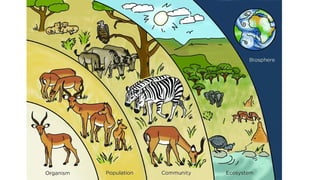
Scope of Ecology
Ecologydeals with the study of:
Organisms
Populations
Communities
Ecosystems
Biosphere
It helps us understand how nature functions as a
whole
7.
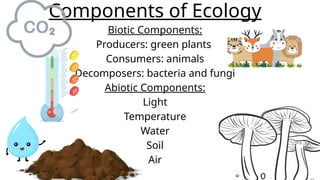
Components of Ecology
BioticComponents:
Producers: green plants
Consumers: animals
Decomposers: bacteria and fungi
Abiotic Components:
Light
Temperature
Water
Soil
Air
8.
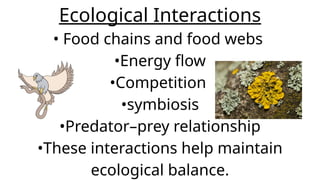
Ecological Interactions
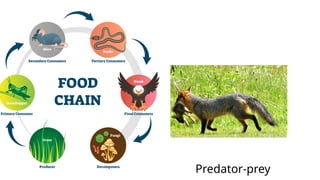
• Foodchains and food webs
•Energy flow
•Competition
•symbiosis
•Predator–prey relationship
•These interactions help maintain
ecological balance.
Concept of EcologicalBalance
Ecosystems remain stable despite
environmental changes.
Stability is maintained naturally through
interactions.
This balance leads to the concept of
homeostasis.
11.
In ecology, theterm homeostasis applies to the
tendency for a biological system to resist changes.
Ecosystems can maintain their state of equilibrium.
They can regulate their own species structure and
functional processes.
This capacity of the ecosystem of self-regulation is
known as homeostasis.
Homeostasis
12.
In a grasslandecosystem, if the population of Deer
increases, they consume a large quantity of the Grass.
and as a result, food would become scarce for deers.
When the number of deers is reduced because of
starvation, the grass population start increasing.
After some time, the population size of deer also
increases, and this process continues at all the trophic
levels of the food chain.
for example:
13.
In a homeostaticsystem, negative feedback
mechanism induced by the limiting resource
(here its scarcity of food) is responsible for
maintaining stability in an ecosystem.
However, the homeostatic capacity of
ecosystems is not unlimited as well as not
everything in an ecosystem is always well
regulated.
•Protection of biodiversityand natural habitats
•Prevention of overuse of natural resources
•Maintenance of ecological balance and
homeostasis
•••Sustainable use of resources for future
generations
•Use of renewable energy and eco-friendly
practices
Conservation and Sustainability of
Ecosystem
17.
Ecology helps usunderstand how living
organisms interact with their environment.
These interactions maintain balance in nature
through homeostasis, which ensures stability
at both organism and ecosystem levels.
Understanding these concepts is essential for
conserving ecosystems and achieving a
sustainable future.
Conclusion