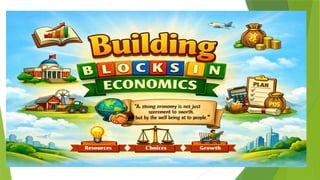
ECO.9TH-Building Blocks in Economics.pptx class ninth cbse
2.
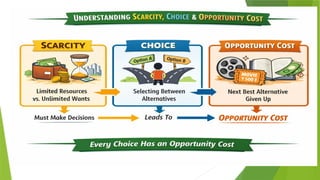
🌱 Scarcity
Scarcitymeans that resources (like money, time, land, or raw materials) are
limited while human wants are unlimited.
Everyday example: You may want to buy both a new phone and a laptop, but
your budget only allows one.
In economics, scarcity forces individuals, businesses, and governments to
prioritize how resources are used.
3.
🔄 Choice
Becauseof scarcity, people must make choices about what to use their
resources for.
Everyday example: Choosing to spend your evening studying instead of
watching a movie.
In economic decision-making, choice involves selecting between alternative
uses of scarce resources.
4.
⚖️Opportunity Cost
Opportunitycost is the value of the next best alternative that you give up
when making a choice.
Everyday example: If you spend 500 on a book, the opportunity cost might
₹
be the movie ticket you could have bought instead.
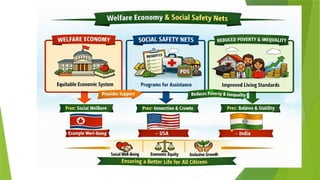
In economics, opportunity cost helps in evaluating whether a decision is
efficient and whether resources are being used in the best possible way.
6.
🏫
What EconomistsDo
•Economists are social scientists who study how
people, businesses, and governments make
decisions about resources.
•They analyze problems like scarcity, inflation,
unemployment, and economic growth.
•Their role is to observe, collect data, build
models, and suggest policies that improve welfare.
7.
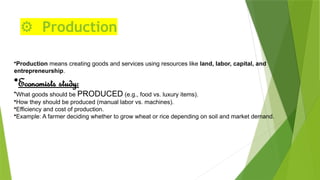
⚙️ Production
•Production meanscreating goods and services using resources like land, labor, capital, and
entrepreneurship.
•Economists study:
•What goods should be PRODUCED (e.g., food vs. luxury items).
•How they should be produced (manual labor vs. machines).
•Efficiency and cost of production.
•Example: A farmer deciding whether to grow wheat or rice depending on soil and market demand.
8.
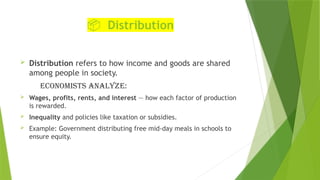
📦 Distribution
Distributionrefers to how income and goods are shared
among people in society.
Economists analyze:
Wages, profits, rents, and interest — how each factor of production
is rewarded.
Inequality and policies like taxation or subsidies.
Example: Government distributing free mid-day meals in schools to
ensure equity.
9.
️
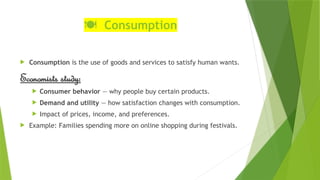
🍽️ Consumption
Consumptionis the use of goods and services to satisfy human wants.
Economists study:
Consumer behavior — why people buy certain products.
Demand and utility — how satisfaction changes with consumption.
Impact of prices, income, and preferences.
Example: Families spending more on online shopping during festivals.
10.
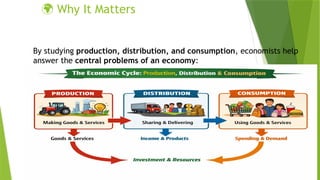
🌍 Why ItMatters
By studying production, distribution, and consumption, economists help
answer the central problems of an economy:
12.
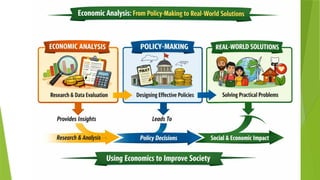
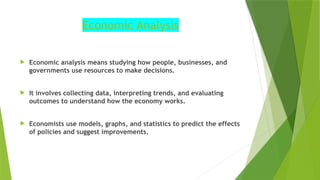
Economic Analysis
Economicanalysis means studying how people, businesses, and
governments use resources to make decisions.
It involves collecting data, interpreting trends, and evaluating
outcomes to understand how the economy works.
Economists use models, graphs, and statistics to predict the effects
of policies and suggest improvements.
13.
️
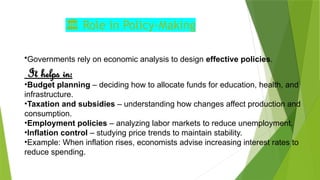
🏛️Role in Policy‑Making
•Governmentsrely on economic analysis to design effective policies.
It helps in:
•Budget planning – deciding how to allocate funds for education, health, and
infrastructure.
•Taxation and subsidies – understanding how changes affect production and
consumption.
•Employment policies – analyzing labor markets to reduce unemployment.
•Inflation control – studying price trends to maintain stability.
•Example: When inflation rises, economists advise increasing interest rates to
reduce spending.
14.
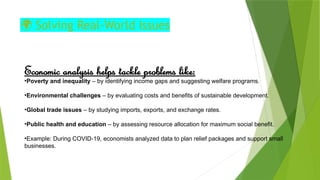
🌍 Solving Real‑WorldIssues
Economic analysis helps tackle problems like:
•Poverty and inequality – by identifying income gaps and suggesting welfare programs.
•Environmental challenges – by evaluating costs and benefits of sustainable development.
•Global trade issues – by studying imports, exports, and exchange rates.
•Public health and education – by assessing resource allocation for maximum social benefit.
•Example: During COVID 19, economists analyzed data to plan relief packages and support small
‑
businesses.
15.
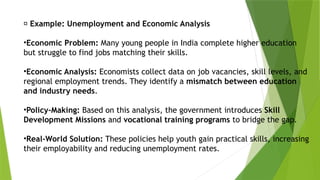
💼 Example: Unemploymentand Economic Analysis
•Economic Problem: Many young people in India complete higher education
but struggle to find jobs matching their skills.
•Economic Analysis: Economists collect data on job vacancies, skill levels, and
regional employment trends. They identify a mismatch between education
and industry needs.
•Policy-Making: Based on this analysis, the government introduces Skill
Development Missions and vocational training programs to bridge the gap.
•Real-World Solution: These policies help youth gain practical skills, increasing
their employability and reducing unemployment rates.
16.
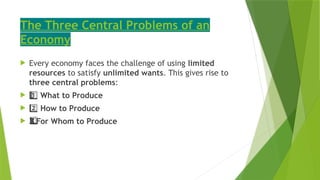
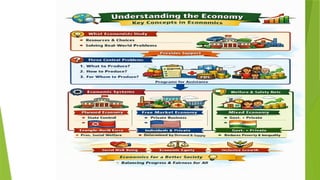
The Three CentralProblems of an
Economy
Every economy faces the challenge of using limited
resources to satisfy unlimited wants. This gives rise to
three central problems:
1 ️
1️⃣What to Produce
2️⃣How to Produce
For Whom to Produce
3️
3️
⃣
17.
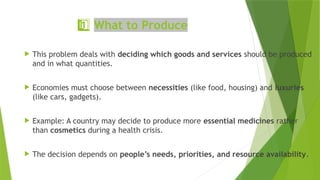
1 ️
1️⃣What toProduce
This problem deals with deciding which goods and services should be produced
and in what quantities.
Economies must choose between necessities (like food, housing) and luxuries
(like cars, gadgets).
Example: A country may decide to produce more essential medicines rather
than cosmetics during a health crisis.
The decision depends on people’s needs, priorities, and resource availability.
18.
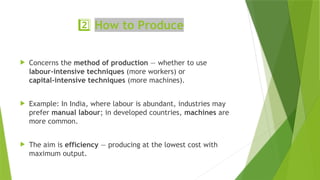
2️⃣How to Produce
Concerns the method of production — whether to use
labour‑intensive techniques (more workers) or
capital‑intensive techniques (more machines).
Example: In India, where labour is abundant, industries may
prefer manual labour; in developed countries, machines are
more common.
The aim is efficiency — producing at the lowest cost with
maximum output.
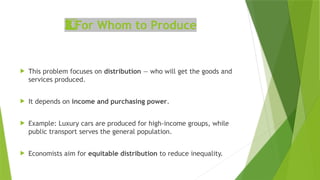
19.
For Whom toProduce
3️
3️
⃣
This problem focuses on distribution — who will get the goods and
services produced.
It depends on income and purchasing power.
Example: Luxury cars are produced for high‑income groups, while
public transport serves the general population.
Economists aim for equitable distribution to reduce inequality.
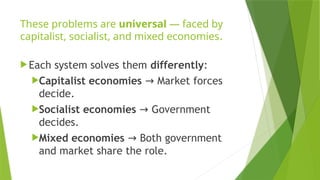
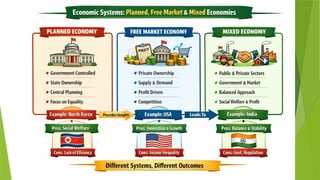
20.
These problems areuniversal — faced by
capitalist, socialist, and mixed economies.
Each system solves them differently:
Capitalist economies Market forces
→
decide.
Socialist economies Government
→
decides.
Mixed economies Both government
→
and market share the role.
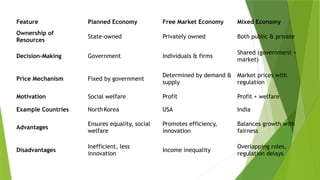
22.
Feature Planned EconomyFree Market Economy Mixed Economy
Ownership of
Resources
State‑owned Privately owned Both public & private
Decision‑Making Government Individuals & firms
Shared (government +
market)
Price Mechanism Fixed by government
Determined by demand &
supply
Market prices with
regulation
Motivation Social welfare Profit Profit + welfare
Example Countries North Korea USA India
Advantages
Ensures equality, social
welfare
Promotes efficiency,
innovation
Balances growth with
fairness
Disadvantages
Inefficient, less
innovation
Income inequality
Overlapping roles,
regulation delays
24.
📘 Welfare Economy
A welfare economy is an economic system where the primary goal is social
welfare rather than just profit or growth.
It emphasizes equitable distribution of resources, ensuring that all citizens
have access to basic needs like food, healthcare, education, and housing.
The government plays a central role in regulating markets, providing
subsidies, and creating policies to reduce inequality.
Example: Scandinavian countries (like Sweden, Norway) are often cited as
welfare economies because they combine economic growth with strong
social support.
25.
️
🛡️Social Safety Nets
•Socialsafety nets are programs and policies designed to protect individuals from
economic hardships.
•They act as a cushion against poverty, unemployment, illness, or old age.
Common examples include:
•Public healthcare (free or subsidized medical services).
•Unemployment benefits (financial support when jobs are lost).
•Pensions (income for the elderly).
•Food security schemes (ration cards, mid day meals in schools).
‑
•In India, schemes like MGNREGA (employment guarantee), Public Distribution
System (PDS), and Ayushman Bharat (healthcare) are part of social safety nets.
26.
🌍 Importance
•Reduces povertyand inequality by supporting vulnerable groups.
•Promotes social justice and ensures everyone has a fair chance at a
decent life.
•Stabilizes the economy during crises (e.g., pandemics, recessions).
•Encourages human capital development by investing in health and
education.
•Builds trust in government and strengthens democracy.
27.
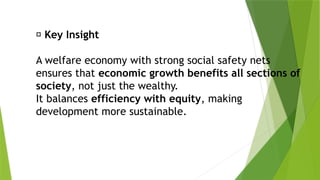
💡 Key Insight
Awelfare economy with strong social safety nets
ensures that economic growth benefits all sections of
society, not just the wealthy.
It balances efficiency with equity, making
development more sustainable.
 Most read
 Most read
 Most read