UNIT : V
EASTASIAN MARKETS: CHINA & SOUTH KOREA
Drug Registration and Post-Approval Compliance
Sarojini Naidu Vanita Pharmacy Maha
Vidyalaya
(Sponsored by the Exhibition Society) Affiliated to Osmania University, Approved by AICTE &
PCI
Pothuganti Anjali [1704-25-867-011]
M.Pharmacy (RA) 1 Year 2 Semester.
Regulatory Aspects of Drugs and
Cosmetics.
2.
Content
Objectives
China– Regulatory Authority
China – Basic Principles of Registration
China – Pre-Submission Regulatory Planning
China – Clinical Trial & Development Pathway
China – Post-Approval Compliance
South Korea – Regulatory Authority
South Korea – Pre-Submission Regulatory Planning
South Korea – New Drug Registration Requirements
South Korea – Application & Review Process
South Korea – Post-Approval Compliance
Conclusion
3.
Objectives
Regulatory system fordrug registration in China.
Regulatory system for drug registration in South Korea.
Post-approval compliance and change management.
Present China and South Korea as two independent regulatory sections.
4.
China – RegulatoryAuthority
NMPA – National Medical Products Administration: National authority
responsible for drug regulation.
CDE – Center for Drug Evaluation: Performs technical/scientific evaluation of
drug registration applications.
MAH – Marketing Authorization Holder: Responsible for lifecycle
management after approval.
5.
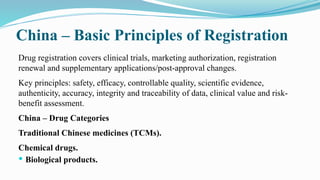
China – BasicPrinciples of Registration
Drug registration covers clinical trials, marketing authorization, registration
renewal and supplementary applications/post-approval changes.
Key principles: safety, efficacy, controllable quality, scientific evidence,
authenticity, accuracy, integrity and traceability of data, clinical value and risk-
benefit assessment.
China – Drug Categories
Traditional Chinese medicines (TCMs).
Chemical drugs.
Biological products.
6.
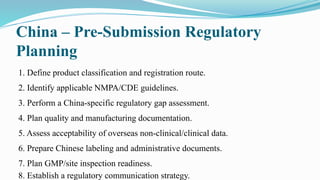
China – Pre-SubmissionRegulatory
Planning
1. Define product classification and registration route.
2. Identify applicable NMPA/CDE guidelines.
3. Perform a China-specific regulatory gap assessment.
4. Plan quality and manufacturing documentation.
5. Assess acceptability of overseas non-clinical/clinical data.
6. Prepare Chinese labeling and administrative documents.
7. Plan GMP/site inspection readiness.
8. Establish a regulatory communication strategy.
7.
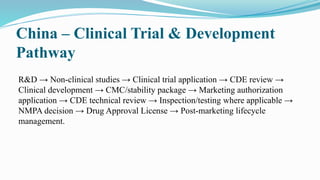
China – ClinicalTrial & Development
Pathway
R&D → Non-clinical studies → Clinical trial application → CDE review →
Clinical development → CMC/stability package → Marketing authorization
application → CDE technical review → Inspection/testing where applicable →
NMPA decision → Drug Approval License → Post-marketing lifecycle
management.
8.
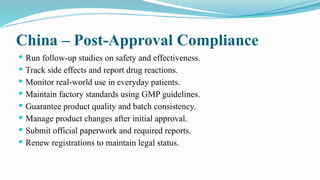
China – Post-ApprovalCompliance
Run follow-up studies on safety and effectiveness.
Track side effects and report drug reactions.
Monitor real-world use in everyday patients.
Maintain factory standards using GMP guidelines.
Guarantee product quality and batch consistency.
Manage product changes after initial approval.
Submit official paperwork and required reports.
Renew registrations to maintain legal status.
9.
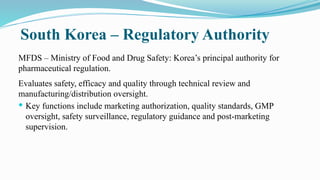
South Korea –Regulatory Authority
MFDS – Ministry of Food and Drug Safety: Korea’s principal authority for
pharmaceutical regulation.
Evaluates safety, efficacy and quality through technical review and
manufacturing/distribution oversight.
Key functions include marketing authorization, quality standards, GMP
oversight, safety surveillance, regulatory guidance and post-marketing
supervision.
10.
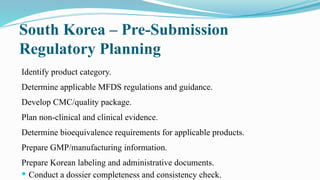
South Korea –Pre-Submission
Regulatory Planning
Identify product category.
Determine applicable MFDS regulations and guidance.
Develop CMC/quality package.
Plan non-clinical and clinical evidence.
Determine bioequivalence requirements for applicable products.
Prepare GMP/manufacturing information.
Prepare Korean labeling and administrative documents.
Conduct a dossier completeness and consistency check.
11.
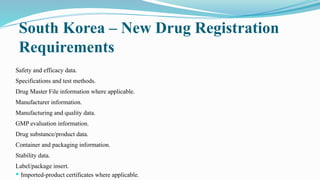
South Korea –New Drug Registration
Requirements
Safety and efficacy data.
Specifications and test methods.
Drug Master File information where applicable.
Manufacturer information.
Manufacturing and quality data.
GMP evaluation information.
Drug substance/product data.
Container and packaging information.
Stability data.
Label/package insert.
Imported-product certificates where applicable.
12.
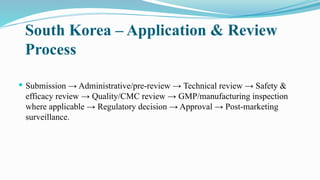
South Korea –Application & Review
Process
Submission → Administrative/pre-review → Technical review → Safety &
efficacy review → Quality/CMC review → GMP/manufacturing inspection
where applicable → Regulatory decision → Approval → Post-marketing
surveillance.
13.
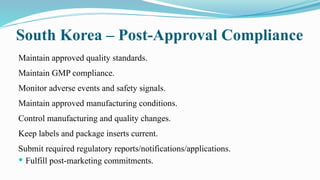
South Korea –Post-Approval Compliance
Maintain approved quality standards.
Maintain GMP compliance.
Monitor adverse events and safety signals.
Maintain approved manufacturing conditions.
Control manufacturing and quality changes.
Keep labels and package inserts current.
Submit required regulatory reports/notifications/applications.
Fulfill post-marketing commitments.
14.
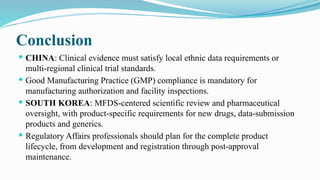
Conclusion
CHINA: Clinicalevidence must satisfy local ethnic data requirements or
multi-regional clinical trial standards.
Good Manufacturing Practice (GMP) compliance is mandatory for
manufacturing authorization and facility inspections.
SOUTH KOREA: MFDS-centered scientific review and pharmaceutical
oversight, with product-specific requirements for new drugs, data-submission
products and generics.
Regulatory Affairs professionals should plan for the complete product
lifecycle, from development and registration through post-approval
maintenance.