E-commerce Marketing
Table of contents
• Table of Content
• Introduction to E-commerce Marketing
• Importance of E-commerce Marketing
• Key Elements of E-commerce Marketing
• E-commerce Marketing Channels
• E-commerce Marketing Strategies
• Mobile E-commerce Marketing
• E-commerce Marketing Analytics
• Conclusion
Introduction
E-commerce marketing is the practice of promoting and selling products or services online.
It involves various digital marketing strategies to attract and engage customers.
E-commerce marketing plays a crucial role in driving sales and revenue for online businesses.
Importance of E-commerce Marketing
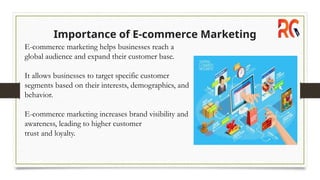
E-commerce marketing helps businesses reach a
global audience and expand their customer base.
It allows businesses to target specific customer
segments based on their interests, demographics, and
behavior.
E-commerce marketing increases brand visibility and
awareness, leading to higher customer
trust and loyalty.
Search Engine Optimization (SEO) helps improve website visibility on search
engines and drive organic traffic.
Pay-per-click (PPC) advertising enables businesses to display targeted ads and
pay only when users click on them.
Email marketing is an effective way to reach out to customers, build
relationships, and promote products or offers.
Key Elements Of E-commerce Marketing
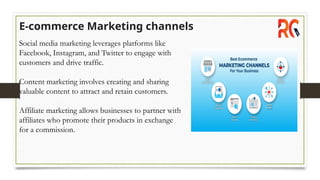
E-commerce Marketing channels
Social media marketing leverages platforms like
Facebook, Instagram, and Twitter to engage with
customers and drive traffic.
Content marketing involves creating and sharing
valuable content to attract and retain customers.
Affiliate marketing allows businesses to partner with
affiliates who promote their products in exchange
for a commission.
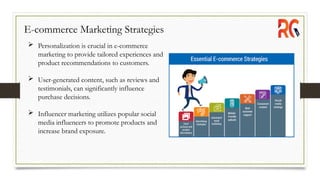
 Personalization is crucial in e-commerce
marketing to provide tailored experiences and
product recommendations to customers.
 User-generated content, such as reviews and
testimonials, can significantly influence
purchase decisions.
 Influencer marketing utilizes popular social
media influencers to promote products and
increase brand exposure.
E-commerce Marketing Strategies
Mobile E-commerce Marketing
Mobile optimization is crucial as more
consumers are shopping on smartphones
and tablets.
Mobile-friendly websites and apps provide
a seamless user experience and increase
conversion rates.
Mobile marketing strategies such as SMS
marketing and push notifications can
engage customers and drive sales.
 Analyzing website traffic, conversion rates, and
customer behavior provides valuable insights for
optimizing marketing strategies.
 Key performance indicators (KPIs) such as customer
acquisition cost (CAC) and return on ad spend
(ROAS) help measure marketing effectiveness.
 A/B testing and multivariate testing help identify the
most effective marketing tactics.
E-commerce Marketing Analytics
Conclusion
 E-commerce marketing is essential for online businesses to attract, engage,
and convert customers.
 It involves various strategies and channels to drive traffic, increase brand
visibility, and optimize conversions.
 Constantly analyzing and optimizing marketing efforts is crucial for long-
term success in e-commerce.
Thank you
Email :devofficemail03@gmail.com
Website address: www.3ZenX.com