DRAFTING, PLEADING &
CONVEYANCING
PLEADINGS
Order VI- Rule 1 defines pleadings- plaint and WS
Order VI Rule 2: “Every pleading shall contain, and contain only a statement in
a concise form of the material facts on which the party pleading relies for his
claim or defence, as the case may be, but not the evidence by which they are
to be proved.”
“material facts” means all facts upon which the plaintiff’s cause of action or
the defendant’s defence depends, or in other words, all those facts which must
be proved in order to establish the plaintiff’s right to relief claimed in the
plaint or the defendant’s defence in the written statement.
Udhav Singh v. Madhav Rao Scindia, the Supreme Court said that the term
material fact means “All the primary facts which must be proved at the trial by
a party to establish the existence of a cause of action or his defence are
material facts.”
PLAINT- PRINCIPLES- O.6 R.2 OF C.P.C
(1) Pleadings should state facts and not law;
(2) The facts stated in pleadings should be material facts;
(3) Pleadings should not state the evidence; and
(4) The facts in pleadings should be stated in a concise form.
Facta probanda are the facts required to be proved
Facta probantia are the facts by means of which facta probanda are to be proved
Rule 4: In all cases in which the party pleading relies on any misrepresentation, fraud,
breach of trust, wilful default, or undue influence, and in all other cases in which
particulars may be necessary beyond such as are exemplified in the forms aforesaid,
particulars (with dates and items if necessary) shall be stated in the pleading.
Rule 6: Any condition precedent, the performance or occurrence of which is intended to
be contested, shall be distinctly specified in his pleading by the plaintiff or defendant, as
the case may be; and, subject thereto, an averment of the performance or occurrence of
all conditions precedent necessary for the case of the plaintiff or defendant shall be
implied in his pleading.
Rule 7: No pleading shall, except by way of amendment, raise any new ground of claim
or contain any allegation of fact inconsistent with the previous pleadings of the party
pleading the same.
It shall be sufficient to state or allege such particulars as stated below as a
fact, without setting the whole part thereof (in case of document), or without
setting out the circumstances from which such provisions are to be inferred:
 Wherever the contents of any document are material (Rule 9);
 Wherever it is material to allege malice, fraudulent intention or other condition of the mind
of any person (Rule 10);
 Wherever it is material to allege notice to any person of any fact, matter or thing (Rule 11);
 Wherever any contract or any relation between any person is to be implied from a series of
letters or conversations or otherwise from a number of circumstances (Rule 12).
 Pleading is to be signed by party and his pleader/any authorised person (Rule 14).
 Pleadings are to be verified by party/one of the parties/some other person proved to the satisfaction
of court to be acquainted with the facts of the case. The verifying shall also furnish an affidavit. (Rule
15)
 The Court may at any stage of the proceedings order to be struck out or amended any matter in any
pleading— (a) which may be unnecessary, scandalous, frivolous or vexatious, of (b) which may tend to
prejudice, embarrass or delay the fair trail of the suit, or (c) which is otherwise an abuse of the process
of the Court (Rule 16)
 The Court may at any stage of the proceedings allow either party to alter or amend his pleadings in
such manner and on such terms as may be just, and all such amendments shall be made as may be
necessary for the purpose of determining the real questions in controversy between the parties (Rule 17)
ORDER 7 RULE 1- PARTICULARS OF PLAINT
(a) the name of the Court in which the suit is brought;
(b) the name, description and place of residence of the plaintiff;
(c) the name, description and place of residence of the defendant, so far as they can be ascertained;
(d) where the plaintiff or the defendant is a minor or a person of unsound mind, a statement to that effect;
(e) the facts constituting the cause of action and when it arose;
(f) the facts showing that the Court has jurisdiction;
(g) the relief which the plaintiff claims;
(h) where the plaintiff has allowed a set-off or relinquished a portion of his claim, the amount so allowed, or
relinquished; and
(i) a statement of the value of the subject-matter of the suit for the purposes of jurisdiction and of court-fees, so
far as the case admits
 In cases of money suits, state the precise amount claimed. (if sues for mesne profits, shall state
approximate value sued for) (Rule 2)
 In cases of immovable property being the subject-matter of the suit, contain description of the
property, boundaries and numbers with which property can be identified. (Rule 3)
 In cases of representative suits, show that he has an actual existing interest in the subject
matter and that he has taken the steps necessary to enable him to institute a suit covering it.
(Rule 4)
 Show the interest and liability of the defendant in relation to the subject matter. (Rule 5)
 State specifically the relief which the plaintiff claims either simply or in the alternative. (Rule 7)
 Where the plaintiff seeks relief in respect of several distinct claims or causes of action founded
upon separate and distinct grounds, they shall be stated as far as may be separately and
distinctly (Rule 8)
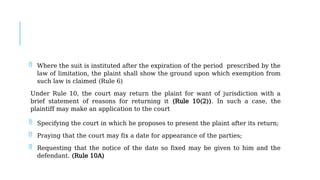
 Where the suit is instituted after the expiration of the period prescribed by the
law of limitation, the plaint shall show the ground upon which exemption from
such law is claimed (Rule 6)
Under Rule 10, the court may return the plaint for want of jurisdiction with a
brief statement of reasons for returning it (Rule 10(2)). In such a case, the
plaintiff may make an application to the court
 Specifying the court in which he proposes to present the plaint after its return;
 Praying that the court may fix a date for appearance of the parties;
 Requesting that the notice of the date so fixed may be given to him and the
defendant. (Rule 10A)
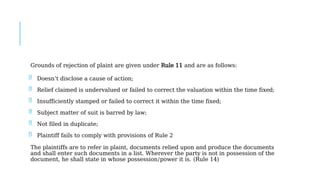
Grounds of rejection of plaint are given under Rule 11 and are as follows:
 Doesn’t disclose a cause of action;
 Relief claimed is undervalued or failed to correct the valuation within the time fixed;
 Insufficiently stamped or failed to correct it within the time fixed;
 Subject matter of suit is barred by law;
 Not filed in duplicate;
 Plaintiff fails to comply with provisions of Rule 2
The plaintiffs are to refer in plaint, documents relied upon and produce the documents
and shall enter such documents in a list. Wherever the party is not in possession of the
document, he shall state in whose possession/power it is. (Rule 14)
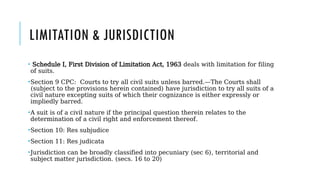
LIMITATION & JURISDICTION
• Schedule I, First Division of Limitation Act, 1963 deals with limitation for filing
of suits.
•Section 9 CPC: Courts to try all civil suits unless barred.—The Courts shall
(subject to the provisions herein contained) have jurisdiction to try all suits of a
civil nature excepting suits of which their cognizance is either expressly or
impliedly barred.
•A suit is of a civil nature if the principal question therein relates to the
determination of a civil right and enforcement thereof.
•Section 10: Res subjudice
•Section 11: Res judicata
•Jurisdiction can be broadly classified into pecuniary (sec 6), territorial and
subject matter jurisdiction. (secs. 16 to 20)