Draft note on guidelines for coastal land leasing policy for fisheries-1.pdf
Draft guidelines on coastal land and water leasing policy for small scale traditional Fishers and aqua farmers for promotion of inshore Mariculture and sustainable coastal AquaFarming.
Draft note on guidelines for coastal land leasing policy for fisheries-1.pdf
1.
B. BHASKAR
Fisheries
Draft guidelinesfor Coastal Land Leasing Policy for welfare of
traditional fishers and promotion of Fisheries and Aquaculture
activities along Indian Coastal State/UT’s for fisheries
2.
1 B@ Indianfisheries
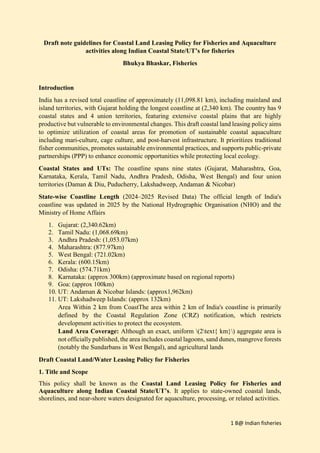
Draft note guidelines for Coastal Land Leasing Policy for Fisheries and Aquaculture
activities along Indian Coastal State/UT’s for fisheries
Bhukya Bhaskar, Fisheries
Introduction
India has a revised total coastline of approximately (11,098.81 km), including mainland and
island territories, with Gujarat holding the longest coastline at (2,340 km). The country has 9
coastal states and 4 union territories, featuring extensive coastal plains that are highly
productive but vulnerable to environmental changes. This draft coastal land leasing policy aims
to optimize utilization of coastal areas for promotion of sustainable coastal aquaculture
including mari-culture, cage culture, and post-harvest infrastructure. It prioritizes traditional
fisher communities, promotes sustainable environmental practices, and supports public-private
partnerships (PPP) to enhance economic opportunities while protecting local ecology.
Coastal States and UTs: The coastline spans nine states (Gujarat, Maharashtra, Goa,
Karnataka, Kerala, Tamil Nadu, Andhra Pradesh, Odisha, West Bengal) and four union
territories (Daman & Diu, Puducherry, Lakshadweep, Andaman & Nicobar)
State-wise Coastline Length (2024–2025 Revised Data) The official length of India's
coastline was updated in 2025 by the National Hydrographic Organisation (NHO) and the
Ministry of Home Affairs
1. Gujarat: (2,340.62km)
2. Tamil Nadu: (1,068.69km)
3. Andhra Pradesh: (1,053.07km)
4. Maharashtra: (877.97km)
5. West Bengal: (721.02km)
6. Kerala: (600.15km)
7. Odisha: (574.71km)
8. Karnataka: (approx 300km) (approximate based on regional reports)
9. Goa: (approx 100km)
10. UT: Andaman & Nicobar Islands: (approx1,962km)
11. UT: Lakshadweep Islands: (approx 132km)
Area Within 2 km from CoastThe area within 2 km of India's coastline is primarily
defined by the Coastal Regulation Zone (CRZ) notification, which restricts
development activities to protect the ecosystem.
Land Area Coverage: Although an exact, uniform (2text{ km}) aggregate area is
not officially published, the area includes coastal lagoons, sand dunes, mangrove forests
(notably the Sundarbans in West Bengal), and agricultural lands
Draft Coastal Land/Water Leasing Policy for Fisheries
1. Title and Scope
This policy shall be known as the Coastal Land Leasing Policy for Fisheries and
Aquaculture along Indian Coastal State/UT’s. It applies to state-owned coastal lands,
shorelines, and near-shore waters designated for aquaculture, processing, or related activities.
3.
2 B@ Indianfisheries
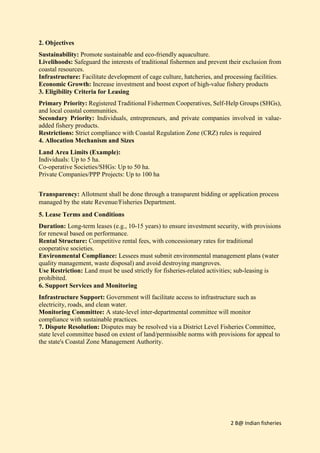
2. Objectives
Sustainability: Promote sustainable and eco-friendly aquaculture.
Livelihoods: Safeguard the interests of traditional fishermen and prevent their exclusion from
coastal resources.
Infrastructure: Facilitate development of cage culture, hatcheries, and processing facilities.
Economic Growth: Increase investment and boost export of high-value fishery products
3. Eligibility Criteria for Leasing
Primary Priority: Registered Traditional Fishermen Cooperatives, Self-Help Groups (SHGs),
and local coastal communities.
Secondary Priority: Individuals, entrepreneurs, and private companies involved in value-
added fishery products.
Restrictions: Strict compliance with Coastal Regulation Zone (CRZ) rules is required
4. Allocation Mechanism and Sizes
Land Area Limits (Example):
Individuals: Up to 5 ha.
Co-operative Societies/SHGs: Up to 50 ha.
Private Companies/PPP Projects: Up to 100 ha
Transparency: Allotment shall be done through a transparent bidding or application process
managed by the state Revenue/Fisheries Department.
5. Lease Terms and Conditions
Duration: Long-term leases (e.g., 10-15 years) to ensure investment security, with provisions
for renewal based on performance.
Rental Structure: Competitive rental fees, with concessionary rates for traditional
cooperative societies.
Environmental Compliance: Lessees must submit environmental management plans (water
quality management, waste disposal) and avoid destroying mangroves.
Use Restriction: Land must be used strictly for fisheries-related activities; sub-leasing is
prohibited.
6. Support Services and Monitoring
Infrastructure Support: Government will facilitate access to infrastructure such as
electricity, roads, and clean water.
Monitoring Committee: A state-level inter-departmental committee will monitor
compliance with sustainable practices.
7. Dispute Resolution: Disputes may be resolved via a District Level Fisheries Committee,
state level committee based on extent of land/permissible norms with provisions for appeal to
the state's Coastal Zone Management Authority.
4.
3 B@ Indianfisheries
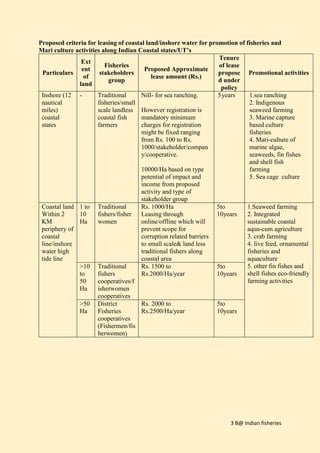
Proposed criteria for leasing of coastal land/inshore water for promotion of fisheries and
Mari culture activities along Indian Coastal states/UT’s
Particulars
Ext
ent
of
land
Fisheries
stakeholders
group
Proposed Approximate
lease amount (Rs.)
Tenure
of lease
propose
d under
policy
Promotional activities
Inshore (12
nautical
miles)
coastal
states
- Traditional
fisheries/small
scale landless
coastal fish
farmers
Nill- for sea ranching.
However registration is
mandatory minimum
charges for registration
might be fixed ranging
from Rs. 100 to Rs.
1000/stakeholder/compan
y/cooperative.
10000/Ha based on type
potential of impact and
income from proposed
activity and type of
stakeholder group
5years 1.sea ranching
2. Indigenous
seaweed farming
3. Marine capture
based culture
fisheries
4. Mari-culture of
marine algae,
seaweeds, fin fishes
and shell fish
farming
5. Sea cage culture
Coastal land
Within 2
KM
periphery of
coastal
line/inshore
water high
tide line
1 to
10
Ha
Traditional
fishers/fisher
women
Rs. 1000/Ha
Leasing through
online/offline which will
prevent scope for
corruption related barriers
to small scale& land less
traditional fishers along
coastal area
5to
10years
1.Seaweed farming
2. Integrated
sustainable coastal
aqua-cum agriculture
3. crab farming
4. live feed, ornamental
fisheries and
aquaculture
5. other fin fishes and
shell fishes eco-friendly
farming activities
>10
to
50
Ha
Traditional
fishers
cooperatives/f
isherwomen
cooperatives
Rs. 1500 to
Rs.2000/Ha/year
5to
10years
>50
Ha
District
Fisheries
cooperatives
(Fishermen/fis
herwomen)
Rs. 2000 to
Rs.2500/Ha/year
5to
10years