PLEADINGS
• Order VIof the CPC, 1908 pertains to Pleadings Generally
• What are Pleadings?
According to Rule 1 Pleadings shall mean plaint or written statement.
Pleadings are plaint filed by the plaintiff and written statement filed by
defendant.
The dictionary meaning of the term ‘plead’ means ‘to state and argue a case’.
Therefore, pleading comprises of respective contentions of the parties in a
dispute, which are reduced into writing.
Pleading are statements in writing drawn up and filed by each party to a case,
stating what his contentions will be at the trail and giving all such details as his
opponent needs to know in order to prepare his case in answer.
Generally there are two pleadings in a suit, namely:
The Plaint- A statement of claim in which the plaintiff sets out his cause of
action with all necessary particular and
The written statement- A defence in which the defendant deals with every
material facts alleged by the plaintiff in his statement of claim (plaint), and
also states any new facts which tell in his favour.
4.
Cont.
• Pleading isthe beginning stage of a lawsuit in which parties
formally submit their claims and defences.
• In Civil proceedings the plaintiff submits a plaint stating the cause
of action -- the issue or issues in controversy.
• The defendant submits an answer- the reply- the written
statement- stating his or her defences and denials. In other words
it is nothing but the formal presentation of claims and defences
by parties to a lawsuit.
5.
FUNCTIONS & OBJECTOF
PLEADINGS
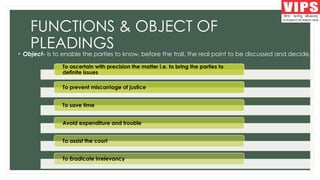
• Object- Is to enable the parties to know, before the trail, the real point to be discussed and decide.
To ascertain with precision the matter i.e. to bring the parties to
definite issues
To prevent miscarriage of justice
To save time
Avoid expenditure and trouble
To assist the court
To Eradicate Irrelevancy
6.
Fundamental Rules ofPleadings
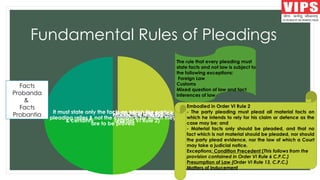
Every pleading must state facts and not law
It must state all material facts & material
facts only
It must state such facts concisely, but with precision
& certainty (Order VI Rule 2)
It must state only the facts on which the party’s
pleading relies & not the evidence by which they
are to be proved
Facts
Probanda
&
Facts
Probantia
The rule that every pleading must
state facts and not law is subject to
the following exceptions:
Foreign Law
Customs
Mixed question of law and fact
Inferences of law
Embodied in Order VI Rule 2
- The party pleading must plead all material facts on
which he intends to rely for his claim or defence as the
case may be; and
- Material facts only should be pleaded, and that no
fact which is not material should be pleaded, nor should
the party plead evidence, nor the law of which a Court
may take a judicial notice.
Exceptions: Condition Precedent (This follows from the
provision contained in Order VI Rule 6 C.P.C.)
Presumption of Law (Order VI Rule 13, C.P.C.)
Matters of Inducement
7.
Cont… Facts notEvidence
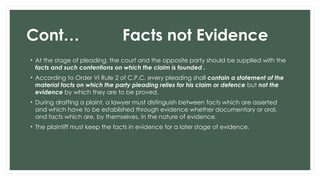
• At the stage of pleading, the court and the opposite party should be supplied with the
facts and such contentions on which the claim is founded .
• According to Order VI Rule 2 of C.P.C. every pleading shall contain a statement of the
material facts on which the party pleading relies for his claim or defence but not the
evidence by which they are to be proved.
• During drafting a plaint, a lawyer must distinguish between facts which are asserted
and which have to be established through evidence whether documentary or oral,
and facts which are, by themselves, in the nature of evidence.
• The plaintiff must keep the facts in evidence for a later stage of evidence.
8.
Cont… Fourth ruleof Pleading
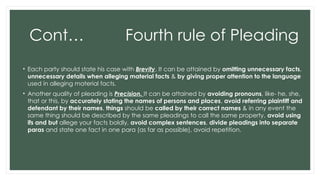
• Each party should state his case with Brevity. It can be attained by omitting unnecessary facts,
unnecessary details when alleging material facts & by giving proper attention to the language
used in alleging material facts.
• Another quality of pleading is Precision. It can be attained by avoiding pronouns, like- he, she,
that or this, by accurately stating the names of persons and places, avoid referring plaintiff and
defendant by their names, things should be called by their correct names & in any event the
same thing should be described by the same pleadings to call the same property, avoid using
ifs and but allege your facts boldly, avoid complex sentences, divide pleadings into separate
paras and state one fact in one para (as far as possible), avoid repetition.
9.
PLEADING GENERALLY
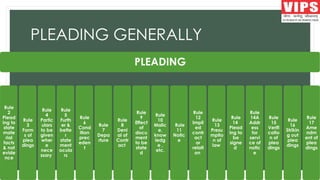
PLEADING
Rule
2
Plead
ing to
state
mate
rial
facts
¬
evide
nce
Rule
3
Form
s of
plea
dings
Rule
4
Partic
ulars
to be
given
wher
e
nece
ssary
Rule
5
Furth
er &
bette
r
state
ment
ocula
rs
Rule
6
Cond
ition
prec
eden
t
Rule
7
Depa
rture
Rule
8
Deni
al of
Contr
act
Rule
9
Effect
of
docu
ment
to be
state
d
Rule
10
Malic
e,
know
ledg
e ,
etc.
Rule
11
Notic
e
Rule
12
Impli
ed
contr
act
or
relati
on
Rule
13
Presu
mptio
n of
law
Rule
14
Plead
ing to
be
signe
d
Rule
14A
Addr
ess
for
servi
ce of
notic
e
Rule
15
Verifi
catio
n of
plea
dings
Rule
16
Strikin
g out
plea
dings
Rule
17
Ame
ndm
ent of
plea
dings
10.
Amendment of Pleadings
•When can pleading be amended?
• How can pleading be amended?
• Objective of allowing amendments?
• Kinds of Amendments?
11.
Cont…
Compulsory Amendment
• Atthe instance of Court, or opposite party.
• If pleadings happens to be defective or incomplete (subjected to exceptions)
• The Court may struck or amend matter in any pleading (R-16 O-VI)
• Reject the plaint
Voluntary Amendment
- By amending one’s own pleading with the leave of the Court
12.
CONVEYANCING
• The dictionarymeaning of the ‘Conveyance’ is ‘an act by which property is conveyed or
voluntarily transferred from one person to another by means of a written statement and other
formalities’.
• It also means ‘instrument’ itself.
• Therefore, the term conveyancing does not apply to the Court proceedings, rather it is
applicable to the instrument, which have been documented not for the purpose of Court
proceedings, rather for the purpose of creating evidence of a particular transaction, which
may be used before the Court in case of any dispute.
• Broadly one can say that the pleading and conveyancing may be distinguished by simply
stating that while the pleadings are applicable to Court proceedings and conveyancing is
applicable to the documentation done outside the Court and not meant for the Court
proceedings particularly, though they may be used in the Court proceeding, in order to
substantiate a particular contention, claim or submission.
13.
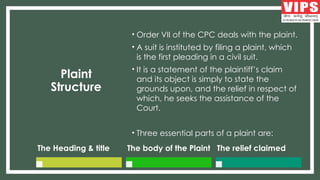
Plaint
Structure
• Order VIIof the CPC deals with the plaint.
• A suit is instituted by filing a plaint, which
is the first pleading in a civil suit.
• It is a statement of the plaintiff’s claim
and its object is simply to state the
grounds upon, and the relief in respect of
which, he seeks the assistance of the
Court.
• Three essential parts of a plaint are:
The Heading & title The body of the Plaint The relief claimed
14.
The Heading &Title
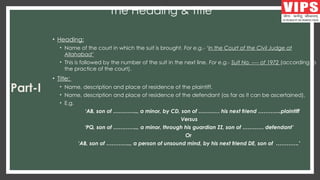
• Heading:
• Name of the court in which the suit is brought. For e.g.- ‘In the Court of the Civil Judge at
Allahabad’
• This is followed by the number of the suit in the next line. For e.g.- Suit No. ---- of 1972 (according to
the practice of the court).
• Title:
• Name, description and place of residence of the plaintiff.
• Name, description and place of residence of the defendant (as far as it can be ascertained).
• E.g.
‘AB, son of ………….., a minor, by CD, son of ………… his next friend ………….plaintiff
Versus
‘PQ, son of ………….., a minor, through his guardian ZZ, son of ………… defendant’
Or
‘AB, son of ………….., a person of unsound mind, by his next friend DE, son of ………….’
Part-I
15.
Cont.
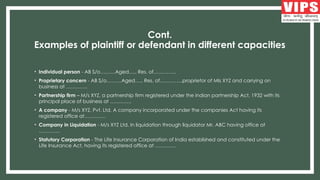
Examples of plaintiffor defendant in different capacities
• Individual person - AB S/o………Aged….. Res. of…………..
• Proprietary concern - AB S/o………Aged….. Res. of…………..proprietor of MIs XYZ and carrying on
business at ………….
• Partnership firm – M/s XYZ, a partnership firm registered under the Indian partnership Act, 1932 with its
principal place of business at ………….
• A company - M/s XYZ, Pvt. Ltd. A company incorporated under the companies Act having its
registered office at………….
• Company in Liquidation - M/s XYZ Ltd. In liquidation through liquidator Mr. ABC having office at
………….
• Statutory Corporation - The Life Insurance Corporation of India established and constituted under the
Life Insurance Act, having its registered office at ………….
16.
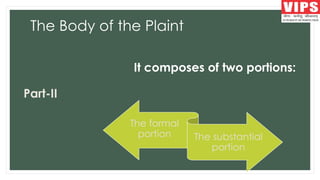
The Body ofthe Plaint
It composes of two portions:
Part-II
The formal
portion The substantial
portion
17.
Cont.
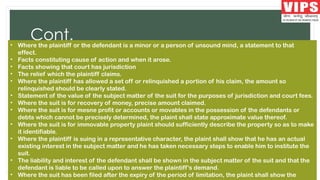
• Where theplaintiff or the defendant is a minor or a person of unsound mind, a statement to that
effect.
• Facts constituting cause of action and when it arose.
• Facts showing that court has jurisdiction
• The relief which the plaintiff claims.
• Where the plaintiff has allowed a set off or relinquished a portion of his claim, the amount so
relinquished should be clearly stated.
• Statement of the value of the subject matter of the suit for the purposes of jurisdiction and court fees.
• Where the suit is for recovery of money, precise amount claimed.
• Where the suit is for mesne profit or accounts or movables in the possession of the defendants or
debts which cannot be precisely determined, the plaint shall state approximate value thereof.
• Where the suit is for immovable property plaint should sufficiently describe the property so as to make
it identifiable.
• Where the plaintiff is suing in a representative character, the plaint shall show that he has an actual
existing interest in the subject matter and he has taken necessary steps to enable him to institute the
suit.
• The liability and interest of the defendant shall be shown in the subject matter of the suit and that the
defendant is liable to be called upon to answer the plaintiff’s demand.
• Where the suit has been filed after the expiry of the period of limitation, the plaint shall show the
18.
The Relief Claimed
Therelief sought should be claimed either
simply or in the alternative.
Where the relief is founded upon separate and
distinct ground, each ground should be
stated, as far as possible, distinctly and
separately
Part-III
19.
Cont.
• Signature andVerification: The plaint must be signed by the plaintiff through advocate. But if the
plaintiff is, by reason of absence or for other good cause, unable to sign the plaint, it must be
signed by any person duly authorized by him to sign the same. The verification is done by the
plaintiff himself.
Verification
I…….. (Name), S/o Sri................... (Father’s name), the aforesaid plaintiff do hereby verify that the
contents of paragraphs …… to …. of the above plaint are true and correct within my personal
knowledge and that the contents of paras………..to ……. (mention the paras by their number in
the pleading) I believed to be true on information received.
Signed and verified this at ……….(Place) on this ………….. (Date) day of
month/years.
Sd/- (Plaintiff)
20.
Exercise- Draft aPlaint
• Suit for Ejectment and Arrears of Rent
• Property situated in Delhi
• Rent amount Rs. 26,000/- PM
• Verbal agreement between P and D was made on………. For a monthly tenant to the
plaintiff in respect to the house
21.
Exercise- Draft aPlaint
• Suit for dower after dissolution of marriage
• The Plaintiff married to the Defendant on July 20, 1981.
• At the time of marriage the guardian of both Plaintiff and Defendant (who were minor at that
time) had a verbal agreement that the plaintiff’s dower should be Rs.8,000/- (prompt and
deferred).
• The defendant divorced the plaintiff at her father’s house on August 3, 1984 by uttering words
‘I divorce you’ three times before the plaintiff.
• The defendant has not paid the said some of Rs. 8000/- or any part thereof.
• Moreover, the plaintiff never made any demand of her prompt dower during the
continuance of marriage.
22.
Exercise
Mr. A borrowedRs. 1,00,000/- from Mr. B on 1.1.2001 and agreed to
repay the loan on demand (or within six months) with interest at 12
%pa. Mr. B demanded repayment of the loan on 1.3.2001, 1.4.2001,
1.5.2001. Mr A has not made any payment.
Draft preliminary objections for a written statement in a suit for
money lent.
23.
Written
Statement
• Written statementis the statement or defence of the defendant by
which he either admits the claim of the plaintiff or denies the
allegations or averments made by the plaintiff in his plaint.
• The written statement must specifically deal with each allegation
of fact in the plaint and when a defendant denies any fact, he
must not do so evasively but answer the same in substance.
• If any particulars are wanting, he should apply that the plaintiff be
required to furnish them before the defendant files his written
statement.
• If he cannot make a proper defence without going through such
particulars and/or such documents referred to in the plaint, he
may apply for discovery of documents.
• If he thinks any allegation/allegations in the plaint are
embarrassing or scandalous, he should apply to have it struck out,
so that he may not be required to plead those allegations.
• If there are several defendants, they may file a joint defence, if
they have the same defence to the claim. If their defences are
different, they should file separate written statements, and if the
defences are not only different but also conflicting, it is not proper
for the same pleader to file the different written statements.
24.
Parts of WrittenStatement
Formal Portion
of Written
Statement
Body of the
Written
Statement
25.
How to Drafta Written Statement
• Denials: A defendant is said to take the defence of denial when he totally and categorically, denies the allegations
contained in the plaint. It is also called ‘traverse’.
[Rules as to denials: a. Denials must be specific, b. Denials must not be evasive]
- Dilatory pleas: Pleas which merely delay the trial of a suit on merits have been characterized as ‘dilatory pleas’. They
simply raise formal objections to the proceedings and do not give any substantial reply to the merits of the case, e.g., the
plea that the court-fee paid by the plaintiff is not sufficient. Such pleas should be raised at the earliest opportunity.
• Objections to point of law: By such an objection the defendant means to say that even if the allegations of fact (made
in the plaint) be supposed to be correct, still the legal inference which the plaintiff claims to draw in his favour from
those facts is not permissible.
• Special defence (confession and avoidance): Special defence is more appropriately called the plea of confession
and avoidance. It is a plea whereby the defendant admits the allegations made in the plaint but seeks to destroy their
effect by alleging affirmatively certain facts of his own, showing some justification or excuse of the matter charged
against him or some discharge or release from it.
• Set off and counter-claim
26.
Affidavits
• An affidavitis a sworn statement in writing made specially under oath before an
authorized officer.
• Affidavit shall contain only such facts as the deponent is able of his own knowledge to
prove.
• Need for verification of affidavits is to test genuineness and authenticity of allegations
and also to make the deponent responsible for allegation made.
• Affidavit, which is not properly verified, is no affidavit at all.
27.
Application under Section5 of the Limitation Act
• The Heading & Title
• Tile of application Under Section 5 Of The Limitation Act, 1963 For Condonation Of
Delay Of Ten Weeks In Filing Reply To Application Under Section….On Behalf Of
Defendant No.
• Body (stating grounds for condonation)
• Pray
• Signatures, Date and Place.
28.
Writ Petition
The Supremecourt issues Writ to enforce FRs.
They are right of Constitutional remedies given to citizens.
It works as guarantor for all other fundamental rights in the Indian
Constitution.
• Hebeas Corpus
• Mandamus
• Prohibition
• Certiorari
• Quo Warranto
There are five types of Writ Petitions that can be filed before the HC or
SC. They are:
29.
Writ Petitions
A writmeans an order
that is issued under an
authority.
Part III of the Constitution
includes right to
Constitutional Remedies.
It safeguards and
protects FRs.
Article 32 and Article 226
of the Indian Constitution
provides remedies and
enforcement of rights
mentioned under Part III.
Article 32- WP filed in the
SC to safeguard FRs.
Article 226- WP filed in
the HC & has wider
ambit.
30.
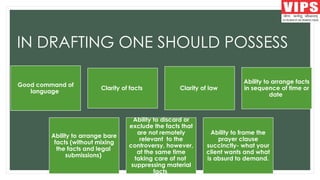
IN DRAFTING ONESHOULD POSSESS
Good command of
language
Clarity of facts Clarity of law
Ability to arrange facts
in sequence of time or
date
Ability to arrange bare
facts (without mixing
the facts and legal
submissions)
Ability to discard or
exclude the facts that
are not remotely
relevant to the
controversy, however,
at the same time
taking care of not
suppressing material
facts
Ability to frame the
prayer clause
succinctly- what your
client wants and what
is absurd to demand.
31.
Difference
between
Plaint &
Petition
• CivilProcedure Code does not apply to
petition under Article 226/227 of the
Constitution of India.
• Civil Procedure code serves as a guide
• Pleading and Plaint are governed by Order
VI and Order VII of the Code of Civil
Procedure.
• Your petition must also be in tune with these
rules not strictly but as far as possible.
• In the petition before high court you are
entitled to quote the relevant statutory
provision, extract from relevant part.
32.
Types of Writ
•Habeas Corpus Writ Petition-The literal meaning of the term Habeas
Corpus means, ‘you may have the body of.’ It is filed when a person
is illegally detained. Meaning, if the court finds out that the person is
illegally detained, then it can order for the release of that person.
• Writ of Mandamus- Mandamus is a Latin word meaning ‘we
command’. Mandamus is a court writ whereby the higher courts
orders the lower court, tribunal, forum or any other public authority to
do any act which otherwise also falls under the purview of their duty.
33.
Cont.
• Prohibition-In thiswrit the Supreme Court or High Court to prohibits the lower
courts including the tribunals, forums or any public authority do something
which exceeds their jurisdiction, the Supreme Court or High Court prohibits
them by issuing the writ of prohibition.
• Quo Warranto is by what warrant. A writ which shows on what warrant the
particular person is holding the public office.
• Certiorari means to ‘to inform’. When the Court is of the opinion that a lower
court or a tribunal has passed an order which is beyond its powers or
committed an error of law then, through the writ of certiorari, it may transfer
the case to itself or quash the order passed by the lower court or tribunal.
34.
Exercise-I: Writ Petition
•The petitioner was arrested by Sub- Inspector of Police Station Maurice Nagar on September 1,
2000.
• A day later the police produced the petitioner before the judicial magistrate Tis Hazari District
Court without relevant papers. Like the copy of FIR, case diary or general diary entries.
• The said magistrate remanded the petitioner to police custody for 7 days without applying his
mind to the matter and without questioning the police about relevant details.
• On September 9, 2000 the petitioner was again produced before the magistrate by the police,
again case dairy was not produced and the magistrate mechanically and without applying
mind remanded the petitioner to judicial custody till Oct 8, 2000.
• Draft a writ for the production of the petitioner.
35.
Exercise-II: Writ Petition
•The Lucknow University constituted under the original Lucknow University Act, 1921 is governed by
the UP State University Act 1973.
• The P. was a student of KG Medical College Lucknow, a constituent college of the University. He
appeared in th examination of Bachelor of Medicine and Surgery (Final year) conducted by the
University in 1998 bearing roll no. 35.
• The prospectus of the University for the year 1974 mention 4 subjects provided for MBBS (final year),
one being surgery.
• As per the rules in order to pass the MBBS (final year) examination a candidate must pass in all
subjects by obtaining atleast 30% marks in theoretical paper & 40% in practical's. The candidate
obtaining 45% to 60% in the theoretical paper are placed in Second Division. The petitioner secured
51 in one paper and 28 in paper 2, these two papers are to be calculated together. Therefore, the
petitioner secured 30% marks. However, his name was not announced in successful candidates list.
• Write a petition for a writ seeking direction and order University to pass the petitioner in the second
division.
#7 The reason behind the rule stating evidence is that if the evidence were also allowed to be stated in the pleading that there shall remain no limit of details and the chief object of the pleading would disappear.
#8 in the case of writ-petitions and election-petitions it is necessary to state matters of evidence in support of the allegations made therein. Exception of third rule of pleadings will apply in this case.
#14 When the plaint is accepted the court would issue notice to the defendant and the summons are ordered to be served on the defendants. The plaintiff is required to present as many copies of the plaint as there are defendants within 7 days from the date of order along with requisite fee for service of summons.