Who Comes Next?
We solved what to share. We solved how fast to share it.
We did not solve who comes next.
Elbsides 2026
BRIAN & TZEEJAY
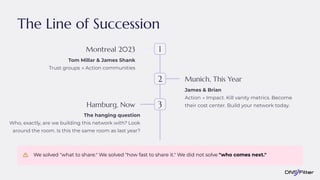
The Line of Succession
1
Montreal 2023
Tom Millar & James Shank
Trust groups → Action communities
2 Munich, This Year
James & Brian
Action → Impact. Kill vanity metrics. Become
their cost center. Build your network today.
3
Hamburg, Now
The hanging question
Who, exactly, are we building this network with? Look
around the room. Is this the same room as last year?
We solved "what to share." We solved "how fast to share it." We did not solve "who comes next."
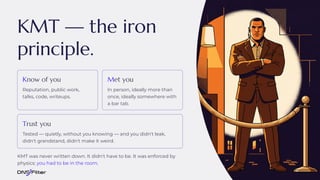
KMT — the iron
principle.
Know of you
Reputation, public work,
talks, code, writeups.
Met you
In person, ideally more than
once, ideally somewhere with
a bar tab.
Trust you
Tested — quietly, without you knowing — and you didn't leak,
didn't grandstand, didn't make it weird.
KMT was never written down. It didn't have to be. It was enforced by
physics: you had to be in the room.
KMT Is a Moat —
Around the Wrong Thing
KMT was designed to keep adversaries out. It now keeps the next
generation out, too.
The adversary's
workaround
They figured out long ago
they don't need to be in
our trust groups. They just
need us to keep recruiting
from a shrinking pool.
The real problem
Static KMT is the enemy.
We need to manufacture
KMT at scale — on purpose,
with intent — instead of
waiting for it to happen by
accident at a conference
dinner.
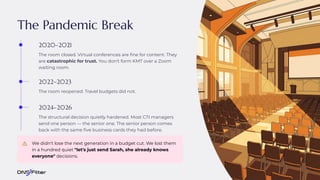
The Pandemic Break
2020–2021
The room closed. Virtual conferences are fine for content. They
are catastrophic for trust. You don't form KMT over a Zoom
waiting room.
2022–2023
The room reopened. Travel budgets did not.
2024–2026
The structural decision quietly hardened. Most CTI managers
send one person — the senior one. The senior person comes
back with the same five business cards they had before.
We didn't lose the next generation in a budget cut. We lost them
in a hundred quiet "let's just send Sarah, she already knows
everyone" decisions.
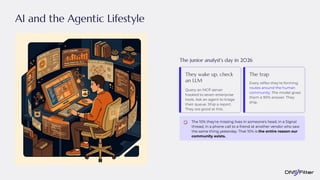
AI and the Agentic Lifestyle
The junior analyst's day in 2026
They wake up, check
an LLM
Query an MCP server
hooked to seven enterprise
tools. Ask an agent to triage
their queue. Ship a report.
They are good at this.
The trap
Every reflex they're forming
routes around the human
community. The model gives
them a 90% answer. They
ship.
The 10% they're missing lives in someone's head, in a Signal
thread, in a phone call to a friend at another vendor who saw
the same thing yesterday. That 10% is the entire reason our
community exists.
Agentic tools will
give them every
answer except one.
Who do I call?
We are raising a generation of analysts who are excellent operators
of intelligence — and have no muscle for the social fabric that
produced it.
What Emotet Actually Taught Us
A key lesson
Disorganization was a feature. Brian was on vacation.
Someone else's kid was sick. The adversary couldn't
outmaneuver an ad-hoc team because it didn't have a
predictable shape.
That story only works if there's a bench.
The uncomfortable truth
Emotet succeeded
because…
When one person
stepped out, somebody
else stepped in. That
somebody else had
KMT. They didn't need a
30-minute onboarding
to be useful. They were a
peer.
The single point of
failure
If the next Emotet-sized
event hits, and the only
qualified people are the
same 5 exhausted seniors
who took it down last
time, we have a single
point of failure dressed
up as a community.
Count how many people in this room you would trust to take your seat in a takedown call tomorrow morning. For most of us, the
number is small. And it isn't growing.
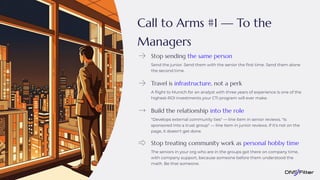
Call to Arms #1 — To the
Managers
Stop sending the same person
Send the junior. Send them with the senior the first time. Send them alone
the second time.
Travel is infrastructure, not a perk
A flight to Munich for an analyst with three years of experience is one of the
highest-ROI investments your CTI program will ever make.
Build the relationship into the role
"Develops external community ties" — line item in senior reviews. "Is
sponsored into a trust group" — line item in junior reviews. If it's not on the
page, it doesn't get done.
Stop treating community work as personal hobby time
The seniors in your org who are in the groups got there on company time,
with company support, because someone before them understood the
math. Be that someone.
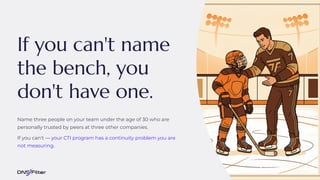
If you can't name
the bench, you
don't have one.
Name three people on your team under the age of 30 who are
personally trusted by peers at three other companies.
If you can't — your CTI program has a continuity problem you are
not measuring.
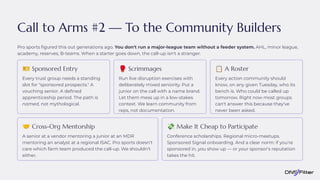
Call to Arms #2 — To the Community Builders
Pro sports figured this out generations ago. You don't run a major-league team without a feeder system. AHL, minor league,
academy, reserves, B-teams. When a starter goes down, the call-up isn't a stranger.
🎫 Sponsored Entry
Every trust group needs a standing
slot for "sponsored prospects." A
vouching senior. A defined
apprenticeship period. The path is
named, not mythological.
🥊 Scrimmages
Run live disruption exercises with
deliberately mixed seniority. Put a
junior on the call with a name brand.
Let them mess up in a low-stakes
context. We learn community from
reps, not documentation.
📋 A Roster
Every action community should
know, on any given Tuesday, who its
bench is. Who could be called up
tomorrow. Right now most groups
can't answer this because they've
never been asked.
🤝 Cross-Org Mentorship
A senior at a vendor mentoring a junior at an MDR
mentoring an analyst at a regional ISAC. Pro sports doesn't
care which farm team produced the call-up. We shouldn't
either.
💸 Make It Cheap to Participate
Conference scholarships. Regional micro-meetups.
Sponsored Signal onboarding. And a clear norm: if you're
sponsored in, you show up — or your sponsor's reputation
takes the hit.
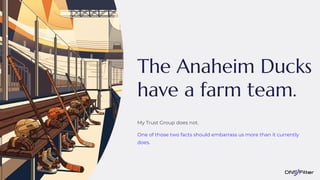
The Anaheim Ducks
have a farm team.
My Trust Group does not.
One of those two facts should embarrass us more than it currently
does.
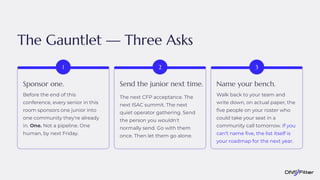
The Gauntlet — Three Asks
1
Sponsor one.
Before the end of this
conference, every senior in this
room sponsors one junior into
one community they're already
in. One. Not a pipeline. One
human, by next Friday.
2
Send the junior next time.
The next CFP acceptance. The
next ISAC summit. The next
quiet operator gathering. Send
the person you wouldn't
normally send. Go with them
once. Then let them go alone.
3
Name your bench.
Walk back to your team and
write down, on actual paper, the
five people on your roster who
could take your seat in a
community call tomorrow. If you
can’t name five, the list itself is
your roadmap for the next year.
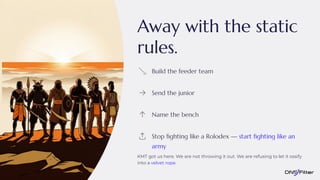
Away with the static
rules.
Build the feeder team
Send the junior
Name the bench
Stop fighting like a Rolodex — start fighting like an
army
KMT got us here. We are not throwing it out. We are refusing to let it ossify
into a velvet rope.