TOPIC: DIVERSITY AND THE WORKFORCE,
CHALLENGES OF DIVERSITY.
Presented by: Syed Saleem Shahid, 22202041-008
Rana Muhammad Usman, 22202041-005
Presented to: Dr. Nosheen Rafi
1
Allah Almighty says in Quran: “O, mankind! Surely we have created
you of a male and female and make you tribes and families that you
know each other, surely the noblest among you unto Allah is one who
fears him Behold! Allah is Knower Aware” [Quran, Al-Hujurat (49.13)]
2
Diversity
- identity-based difference among and between two or more people.
Diversity Management
A managerial approach to create and maintain a positive work environment where the similarities
and differences of individual are valued, so that all the can reach their potential and maximize their
contribution to an organization’s strategic goals and objectives.
3
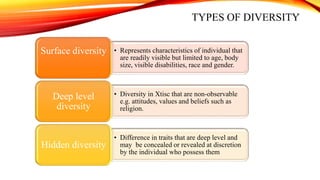
TYPES OF DIVERSITY
• Represents characteristics of individual that
are readily visible but limited to age, body
size, visible disabilities, race and gender.
Surface diversity
• Diversity in Xtisc that are non-observable
e.g. attitudes, values and beliefs such as
religion.
Deep level
diversity
• Difference in traits that are deep level and
may be concealed or revealed at discretion
by the individual who possess them
Hidden diversity
4
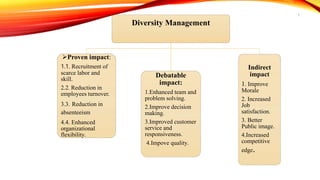
Diversity Management
Proven impact:
1.1. Recruitment of
scarce labor and
skill.
2.2. Reduction in
employees turnover.
3.3. Reduction in
absenteeism
4.4. Enhanced
organizational
flexibility.
Debatable
impact:
1.Enhanced team and
problem solving.
2.Improve decision
making.
3.Improved customer
service and
responsiveness.
4.Impove quality.
Indirect
impact
1. Improve
Morale
2. Increased
Job
satisfaction.
3. Better
Public image.
4.Increased
competitive
edge.
5
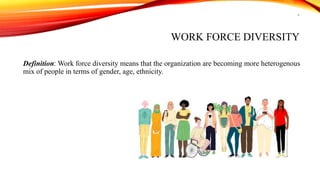
WORK FORCE DIVERSITY
Definition: Work force diversity means that the organization are becoming more heterogenous
mix of people in terms of gender, age, ethnicity.
6
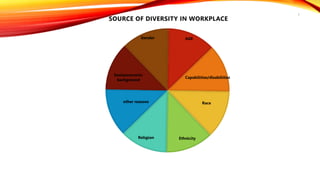
AGE
Capabilities/disabilities
Race
Ethnicity
Religion
other reasons
Socioeconomic
background
Gender
SOURCE OF DIVERSITY IN WORKPLACE
7
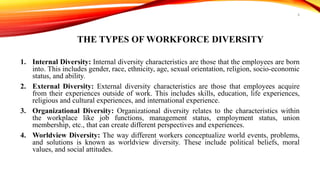
THE TYPES OF WORKFORCE DIVERSITY
1. Internal Diversity: Internal diversity characteristics are those that the employees are born
into. This includes gender, race, ethnicity, age, sexual orientation, religion, socio-economic
status, and ability.
2. External Diversity: External diversity characteristics are those that employees acquire
from their experiences outside of work. This includes skills, education, life experiences,
religious and cultural experiences, and international experience.
3. Organizational Diversity: Organizational diversity relates to the characteristics within
the workplace like job functions, management status, employment status, union
membership, etc., that can create different perspectives and experiences.
4. Worldview Diversity: The way different workers conceptualize world events, problems,
and solutions is known as worldview diversity. These include political beliefs, moral
values, and social attitudes.
8
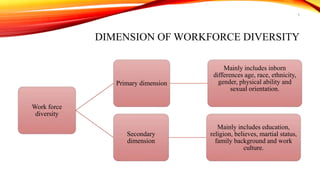
DIMENSION OF WORKFORCE DIVERSITY
Work force
diversity
Primary dimension
Mainly includes inborn
differences age, race, ethnicity,
gender, physical ability and
sexual orientation.
Secondary
dimension
Mainly includes education,
religion, believes, martial status,
family background and work
culture.
9
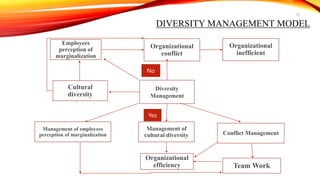
DIVERSITY MANAGEMENT MODEL
Diversity
Management
Team Work
Organizational
efficiency
Conflict Management
Cultural
diversity
Management of employees
perception of marginalization
Organizational
inefficient
Organizational
conflict
Employees
perception of
marginalization
Management of
cultural diversity
No
Yes
10
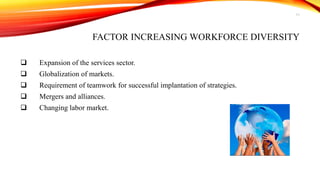
FACTOR INCREASING WORKFORCE DIVERSITY
 Expansion of the services sector.
 Globalization of markets.
 Requirement of teamwork for successful implantation of strategies.
 Mergers and alliances.
 Changing labor market.
11
REASONS FOR GROWING INTEREST IN WORKFORCE DIVERSITY BY THE MODERN
ORGANIZATION.
 Growth of service economy.
 Globalization of market.
 Increasing role of team work.
 Mergers and strategic alliances.
 Changing composition of workforce.
 Managing labour market
 Legal requirement.
12
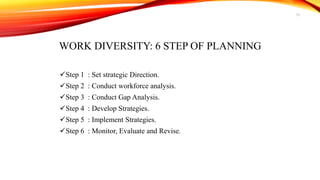
WORK DIVERSITY: 6 STEP OF PLANNING
Step 1 : Set strategic Direction.
Step 2 : Conduct workforce analysis.
Step 3 : Conduct Gap Analysis.
Step 4 : Develop Strategies.
Step 5 : Implement Strategies.
Step 6 : Monitor, Evaluate and Revise.
13
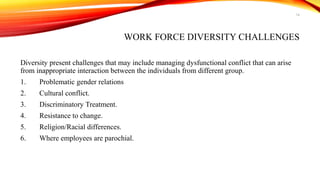
WORK FORCE DIVERSITY CHALLENGES
Diversity present challenges that may include managing dysfunctional conflict that can arise
from inappropriate interaction between the individuals from different group.
1. Problematic gender relations
2. Cultural conflict.
3. Discriminatory Treatment.
4. Resistance to change.
5. Religion/Racial differences.
6. Where employees are parochial.
14
CONTINUED
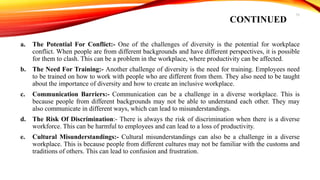
a. The Potential For Conflict:- One of the challenges of diversity is the potential for workplace
conflict. When people are from different backgrounds and have different perspectives, it is possible
for them to clash. This can be a problem in the workplace, where productivity can be affected.
b. The Need For Training:- Another challenge of diversity is the need for training. Employees need
to be trained on how to work with people who are different from them. They also need to be taught
about the importance of diversity and how to create an inclusive workplace.
c. Communication Barriers:- Communication can be a challenge in a diverse workplace. This is
because people from different backgrounds may not be able to understand each other. They may
also communicate in different ways, which can lead to misunderstandings.
d. The Risk Of Discrimination:- There is always the risk of discrimination when there is a diverse
workforce. This can be harmful to employees and can lead to a loss of productivity.
e. Cultural Misunderstandings:- Cultural misunderstandings can also be a challenge in a diverse
workplace. This is because people from different cultures may not be familiar with the customs and
traditions of others. This can lead to confusion and frustration.
15
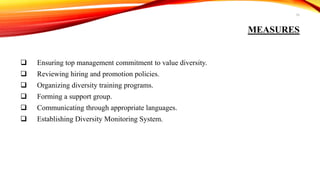
MEASURES
 Ensuring top management commitment to value diversity.
 Reviewing hiring and promotion policies.
 Organizing diversity training programs.
 Forming a support group.
 Communicating through appropriate languages.
 Establishing Diversity Monitoring System.
16
WORKFORCE DIVERSITY IN PAKISTAN
Gender diversity
 Racial diversity,
 Multi generational diversity,
 Diversity based on sexual concentrated
 Diversity linked to foreign public and private sector organizations.
17
Gender Diversity
In Pakistan, there is also a lack of gender diversity in workplaces due to cultural and social
forces that promote conformity to traditional gender roles.
This leaves many women and gender non-conforming people without opportunities to advance
their careers, limiting their access to resources. However, there has been increased awareness
of the importance of gender diversity in recent years, and employers are starting to make
changes to improve the situation for women in Pakistan.
18
CONTINUED
Disability Diversity
There are an estimated 2 million people with disabilities in the country. This number is
expected to grow by 2024 when it is estimated that 5% of the population will have a disability.
Despite this growing population, there is little understanding or appreciation of disability
diversity in Pakistani workplaces
According to the Disabled Persons (Employment and Rehabilitation) Ordinance, 1981, a 2%
hiring quota for people with disabilities in public and private sectors exists in Sindh,
Baluchistan, and Khyber Pakhtunkhwa provinces, as well as in the city of Islamabad.
The quota is 3% in Punjab province. But few audits are conducted, and therefore it is widely
believed that people with disabilities continue to be discriminated against in the hiring
process.
19
WORKPLACE DIVERSITY CHALLENGES AND SOLUTIONS IN PAKISTAN
Pakistani laws do not mandate employer diversity efforts, so many companies do not
embrace the benefits of inclusion. To overcome these challenges, businesses must first
understand the meaning and importance of diversity and then make an effort to create
an inclusive workplace for all employees.
20
CONTINUED
Inclusive workplace policies and practices can help reduce discrimination faced by
employees with disabilities.
Such policies can include reasonable accommodations for employees with disabilities, equal
opportunity employment statements, and diversity training for managers and staff.
 Inclusive practices can also include providing accessible workspaces and equipment,
flexible work arrangements, and support for employee rehabilitation programs.
Implementing these policies and procedures can help create a more inclusive workplace
environment that is fair and respectful of all employees.
21
REFERENCES
1. Workplace Diversity in Pakistan - Accountability Lab.html
2. Workforce Diversity: A Key to Improve Productivity https://doi.org/10.1016/S2212-
5671(14)00178-6
3. What Is Workforce Diversity_ - Types, Importance, & Challenges _ Feedough.html
4. Workforce Diversity_ Meaning, Definition, Dimensions, Steps & Challenges.html
5. What Is Workforce Diversity and How Should You Define It_.html
6. What is Workforce Diversity_ - Human Resources Degrees.html
22
QUESTIONS?
23