Discharge of theclient from
hospital
Submitted by
Adersh.B
1st Sem Bsc Nursing
Cape College of Nursing
Aranmula
2.
Definition:
Hospital discharge refersto the stage in which the hospital care of
the client ends and is relieved from the admitted hospital, with
ongoing care transferred to other primary, community or domestic
environments.
The hospital discharge is not an end but it is a transition to another
environment of care facility.
3.
PURPOSE
• Client onthe recovery of the illness and does not need a
further stay in hospital.
• Initial management at the hospital might have concluded and
the client can be managed at home with regular follow up
visits in future. This will reduce hospital expenses and avoid
chances of other infections.
4.
• Another personwith a high level of requirement for care can
be accommodated when a client is discharged, thereby making
the medical care accessible to everyone.
• When the client requires care from a different health care
facility due to lack of infrastructure or expertise in the current
hospital.
5.
• When aclient or family insist for discharge against medical
advice due to varied reasons such as poor financial status, lack
of satisfaction with care received, the lack of a proper
caregiver to stay with client in hospital etc.
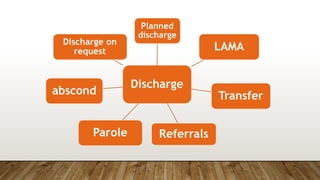
(i)Planned/ Formal discharge
Inplanned discharge, the client completes the initial treatment
in the hospital and the physician decides to relieve the client as he
or she does not require direct supervised care of the hospital.
9.
The planned dischargewill have the following steps:
• written order by the treating doctor for discharge of the client
• discharge summary
• information to other departments
• completion of hospital bill settlement
• return of hospital items by the client
• return of personal belongings of the client
• maintenance of all documents pertaining to the client
10.
(ii)Discharge/ Leave againstMedical
Advice(DAMA/LAMA)
• It is an act whereby a client takes his/her discharge contrary to
the recommendation or the will of the attending physician.
• The client or family may have many reasons for the same such
as financial incapacity, to seek care from another health care
facility, loss of trust in treating doctor etc.
11.
The steps involvedin LAMA are:
• a written statement from the client/authorized relative and duly
signed with name and date to be obtained.
• the documents of the client to be kept under safe custody of
the Unit Manager or authorized person.
• the procedures related to the discharge of a client to be
followed
12.
An example ofthe statement in LAMA FORMAT
“I am leaving the hospital ward against medical advice.
Doctor explained me about my discharge condition and ill
effects of discharge against medical advice. Doctors, hospital
and staff will not be responsible for any ill effects happening
to me after my departure.”
13.
(iii)Transfer:
The client maybe shifted to another department within the hospital(eg.
from the medical unit to an intensive care unit) or outside health care
facility for a next level or specialized care at the request of the client or
family or sometimes at the discretion of the doctor when facilities are
lacking whereas expert care is required for the client.
14.
(iv)Referral :
Referral resultin discharge when a client from one level of care is
referred by the hospital to a higher level of care, due to lack of
infrastructure or other facilities in the hospital to treat the disease
condition.
15.
Eg. A clientwith acute asthma attending a health centre is referred to a
general hospital for further investigation and care. The client will be
discharged from the health centre.
16.
(v)Parole:
• Parole isused in psychiatric hospitals.
• The patient can be sent to home for 2-3 or 4 days by the
approval of psychiatrist in charge.
• If patient does not return after the parole, the discharge process
should be done according to the hospital protocol and policy.
17.
(vi)Abscond:
An admitted clientis referred to ‘abscond’ when he or she leaves
the hospital without the knowledge or prior information of the
treating doctor or hospital staff.
• If it is a medicolegal case, it has to be informed immediately to
the police.
18.
• Any belongingsof the client if left in hospital should be kept
under safe custody or handed to the police.
• An incidental report to be maintained in the unit.
‘IDEAL’ – Dischargeplanning
The ‘IDEAL’ discharge planning approach focus on the key points
of involving the patient and family members in discharge process.
21.
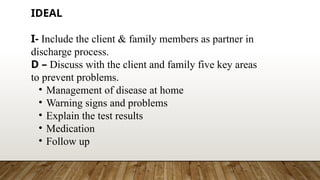
IDEAL
I- Include theclient & family members as partner in
discharge process.
D – Discuss with the client and family five key areas
to prevent problems.
• Management of disease at home
• Warning signs and problems
• Explain the test results
• Medication
• Follow up
22.
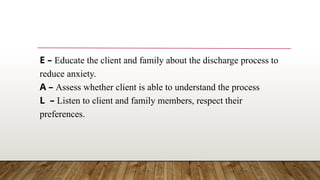
E – Educatethe client and family about the discharge process to
reduce anxiety.
A – Assess whether client is able to understand the process
L – Listen to client and family members, respect their
preferences.
23.
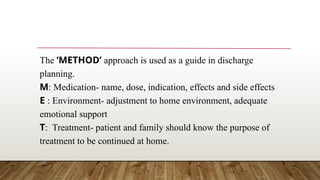
The ‘METHOD’ approachis used as a guide in discharge
planning.
M: Medication- name, dose, indication, effects and side effects
E : Environment- adjustment to home environment, adequate
emotional support
T: Treatment- patient and family should know the purpose of
treatment to be continued at home.
24.
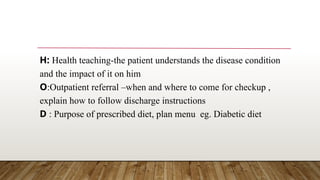
H: Health teaching-thepatient understands the disease condition
and the impact of it on him
O:Outpatient referral –when and where to come for checkup ,
explain how to follow discharge instructions
D : Purpose of prescribed diet, plan menu eg. Diabetic diet
25.
DISCHARGE PROCEDURE
The experienceof hospital, whether for a brief or prolonged
period is one that makes a lasting impression on the patient. The
nurses play an important role to establish a good relationship with
the client and his/ her relatives from the time of admission till
his/her discharge.
26.
• Review doctor'sorder for discharge. It should be in the written
form. The treating consultant will confirm the discharge.
• Preparation of the cumulative hospital charges for the patient.
• The nurse will return the extra medications to the pharmacy.
• Final cumulative billing sheet of the patient sent to the cashier.
• Preparation and processing of the final bill.
27.
• Inform allhospital departments, cashier, dietician regarding
discharge planning.
• Complete treatment, procedures, investigations prior to
discharge
• Provide adequate discharge teaching to patient and family
regarding the treatment, medicines, diet and exercises.
28.
• Patient settlesthe bill and receive payment slip.
• Patient or family members goes to the respective wards and
collect the discharge summary or physician prescription.
• ■ Patient comes to the nurse's unit where physician
or staff nurse explains the medication and follow-up
date.
29.
• In follow-up,advice the patient, for regular follow-up as advised by
the physician.
• ■ Remove the lines and tubings if patient have. Cut off the identity
bracelet.
• Ask the patient to change the hospital dress and wear his/her own
dress.
• ■ Transfer the patient to hospital lobby in a wheelchair.
• ■ Document the return process of the patient in progress
notes.
30.
• Inform thehousekeeping to clean the room.
• Check all the documents of the patient and send to the medical
record department.
• • Change the status of the inpatient room.
• After inpatient room is cleaned, the nurse will change the
room status and the room to be ready for the next patient
arrival.
31.
• In thesituation, when there is delay in the discharge process,
due to unavoidable circumstances such as patient waiting for
the family members, to pick up or arranging insurance, etc.,
the patient will be transferred to the transit room that is
holding area.
32.
Before going home,the patient must know:
• When and whom to follow up?
• What symptoms to be observed for at home?
• How to take the prescribed medication?
• Which side effects of medication to watch for?
MEDICOLEGAL ISSUES RELATEDTO DISCHARGE
During discharge procedure, nurses must keep the following
medicolegal issues under consideration, so that they can safeguard
themselves and the health care institution.
• Transfer of the patient from one ward to another ward or
hospital must be carefully entered and signed in the ward
records as well as duly recorded in the patient’s file.
35.
• Patient’s recordsshould not be handed over to police or legal
authority without a written permission of the treating
physician.
• Physician and nurse should inform the chief medical officer
about any special condition of discharge of patient such as
LAMA or death. The patient must be handed over all the
records and discharge notes.
36.
• Name andaddress of the relative or a person should be entered
in hospital record with whom the patient has left the hospital.
• On discharge, each patient has full right to seek his or her
medical records, including investigation reports.
• Discharge note should be kept under lock and key until handed
over to the concerned patient and department.
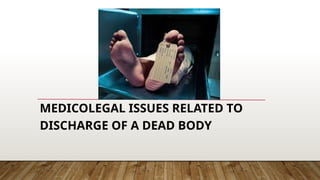
In case ofdeath of the patient in hospital, the following issues
must be kept under consideration:
• In case of death of the patient in hospital, physician should
inform the chief medical officer or medical director and ensure
that the body is appropriately kept in mortuary for the
postmortem examination as per the institutional policy.
39.
• A writtenorder should be obtained by the nurse before
handing over the body to the mortuary staff/relatives/police
officer with complete name, address, identification proof and
signature of the person receiving the body.
• Before handing over the articles belonging to the patient to the
relatives, it should be ensured that a complete list of items is
prepared and duly signed by the person receiving it.
40.
• Ensure anappropriate privacy and dignity of the dead body during last
office care.
Unclaimed dead body must be handed over to police after the due
permission from the chief medical officer.
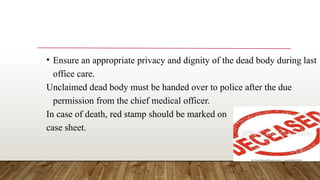
In case of death, red stamp should be marked on
case sheet.
41.
ROLES AND RESPOSIBILITIESOF THE NURSE
• Inform the patient and relatives a day/ two before discharge
• Get the discharge slip prepared after checking the vital signs
and examining the patient.
• The nurse should see the patient’s personal hygiene is
maintained, he is dressed in home clothes and has taken meals.
42.
• Hand overthe patient’s belongings and any valuables which
have been kept safely to patient or the relatives under proper
receipt.
• Complete the discharge register, case sheet & other records.
43.
• Inform thehospital authorities about the discharge of patient, if
it is a medico-legal case.
• Health teaching includes:
• Medications =Drug name, time, duration, actions & side effects
• Procedures = self administration of insulin, BP checking
• Diet = Type of food, quality, time & benefits
• Self care = personal hygiene
• Exercises = Frequency , Demonstration
44.
• Follow up
•Health status = Assess the health status of patient in home
• All teaching should be documented in patient record and the
discharge summary
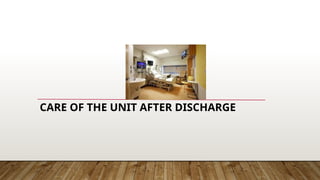
• The roomor unit must be cleaned or decontaminated as per
the hospital policy.
• Change all the linen and send them to laundry as per the
protocol. Mattress, pillows, blankets should be cleaned and
exposed to sunlight.
47.
• The bed,furniture, doors and windows should be cleaned and
decontaminated using disinfectant as per the hospital policy.
• All articles used for patient care should be cleaned, washed,
disinfected or sterilized and send to utility room.
• All disposable items such as used tubing, cotton, dressing
must be discarded as per the hospital biomedical waste
management.
48.
• Prepare theroom or unit for receiving the next patient, such as
ventilate the room properly and prepare admission bed.
• If the patient had any contagious disease, then room or unit
must be decontaminated or fumigated as per the hospital
policy.