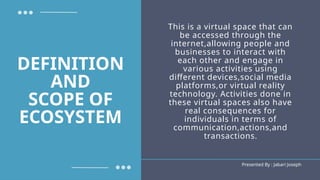
This is avirtual space that can
be accessed through the
internet,allowing people and
businesses to interact with
each other and engage in
various activities using
different devices,social media
platforms,or virtual reality
technology. Activities done in
these virtual spaces also have
real consequences for
individuals in terms of
communication,actions,and
transactions.
Presented By : Jabari Joseph
DEFINITION
AND
SCOPE OF
ECOSYSTEM
3.
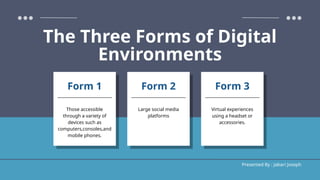
The Three Formsof Digital
Environments
Those accessible
through a variety of
devices such as
computers,consoles,and
mobile phones.
Large social media
platforms
Virtual experiences
using a headset or
accessories.
Form 1 Form 2 Form 3
Presented By : Jabari Joseph
1
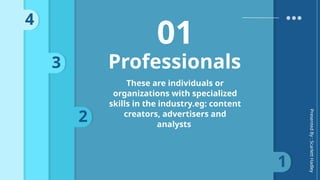
01
Professionals
These are individualsor
organizations with specialized
skills in the industry.eg: content
creators, advertisers and
analysts
2
3
4
Presented
By
:
Scarlett
Hadley
6.
1
01
Professionals
These are individualsor
organizations with specialized
skills in the industry.eg: content
creators, advertisers and
analysts
2
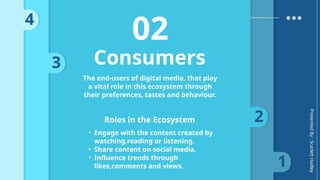
02
Consumers
The end-users of digital media, that play
a vital role in this ecosystem through
their preferences, tastes and behaviour.
• Engage with the content created by
watching,reading or listening.
• Share content on social media.
• Influence trends through
likes,comments and views.
Roles in the Ecosystem
3
4
Presented
By
:
Scarlett
Hadley
7.
1
01
Professionals
These are individualsor
organizations with specialized
skills in the industry.eg: content
creators, advertisers and
analysts
2
02
Consumers
The end-users of digital media, that play
a vital role in this ecosystem through
their preferences, tastes and behaviour.
• Engage with the content created by
watching,reading or listening.
• Share content on social media.
• Influence trends through
likes,comments and views.
Roles in the Ecosystem
3
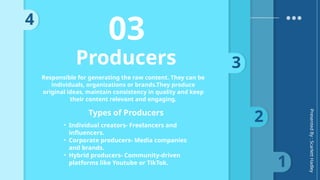
03
Producers
Responsible for generating the raw content. They can be
individuals, organizations or brands.They produce
original ideas, maintain consistency in quality and keep
their content relevant and engaging.
• Individual creators- Freelancers and
influencers.
• Corporate producers- Media companies
and brands.
• Hybrid producers- Community-driven
platforms like Youtube or TikTok.
Types of Producers
4
Presented
By
:
Scarlett
Hadley
8.
1
01
Professionals
These are individualsor
organizations with specialized
skills in the industry.eg: content
creators, advertisers and
analysts
2
02
Consumers
The end-users of digital media, that play
a vital role in this ecosystem through
their preferences, tastes and behaviour.
• Engage with the content created by
watching,reading or listening.
• Share content on social media.
• Influence trends through
likes,comments and views.
Roles in the Ecosystem
3
03
Producers
Responsible for generating the raw content. They can be
individuals, organizations or brands.They produce
original ideas, maintain consistency in quality and keep
their content relevant and engaging.
• Individual creators- Freelancers and
influencers.
• Corporate producers- Media companies
and brands.
• Hybrid producers- Community-driven
platforms like Youtube or TikTok.
Types of Producers
4
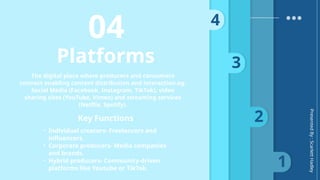
04
Platforms
The digital place where producers and consumers
connect enabling content distribution and interaction.eg:
Social Media (Facebook, Instagram, TikTok), video
sharing sites (YouTube, Vimeo) and streaming services
(Netflix, Spotify).
• Individual creators- Freelancers and
influencers.
• Corporate producers- Media companies
and brands.
• Hybrid producers- Community-driven
platforms like Youtube or TikTok.
Key Functions
Presented
By
:
Scarlett
Hadley
9.
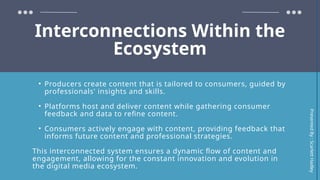
Interconnections Within the
Ecosystem
•Producers create content that is tailored to consumers, guided by
professionals' insights and skills.
• Platforms host and deliver content while gathering consumer
feedback and data to refine content.
• Consumers actively engage with content, providing feedback that
informs future content and professional strategies.
This interconnected system ensures a dynamic flow of content and
engagement, allowing for the constant innovation and evolution in
the digital media ecosystem.
Presented
By
:
Scarlett
Hadley
10.
Presented By :Zemano Gaymes
TYPES OF MEDIA IN
DIGITAL MEDIA
11.
Presented By :Zemano Gaymes
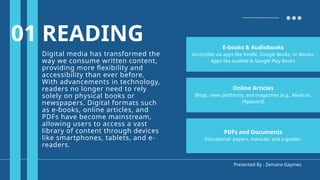
READING
Digital media has transformed the
way we consume written content,
providing more flexibility and
accessibility than ever before.
With advancements in technology,
readers no longer need to rely
solely on physical books or
newspapers. Digital formats such
as e-books, online articles, and
PDFs have become mainstream,
allowing users to access a vast
library of content through devices
like smartphones, tablets, and e-
readers.
PDFs and Documents
Educational papers, manuals, and e-guides.
01
Online Articles
Blogs, news platforms, and magazines (e.g., Medium,
Flipboard)
E-books & Audiobooks
Accessible via apps like Kindle, Google Books, or iBooks.
Apps like Audible & Google Play Books
12.
Presented By :Zemano Gaymes
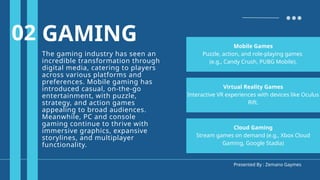
GAMING
The gaming industry has seen an
incredible transformation through
digital media, catering to players
across various platforms and
preferences. Mobile gaming has
introduced casual, on-the-go
entertainment, with puzzle,
strategy, and action games
appealing to broad audiences.
Meanwhile, PC and console
gaming continue to thrive with
immersive graphics, expansive
storylines, and multiplayer
functionality.
Cloud Gaming
Stream games on demand (e.g., Xbox Cloud
Gaming, Google Stadia)
02
Virtual Reality Games
Interactive VR experiences with devices like Oculus
Rift.
Mobile Games
Puzzle, action, and role-playing games
(e.g., Candy Crush, PUBG Mobile).
13.
Presented By :Zemano Gaymes
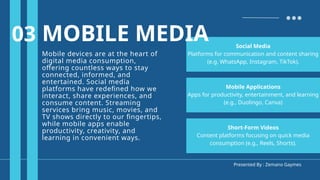
MOBILE MEDIA
Mobile devices are at the heart of
digital media consumption,
offering countless ways to stay
connected, informed, and
entertained. Social media
platforms have redefined how we
interact, share experiences, and
consume content. Streaming
services bring music, movies, and
TV shows directly to our fingertips,
while mobile apps enable
productivity, creativity, and
learning in convenient ways.
Short-Form Videos
Content platforms focusing on quick media
consumption (e.g., Reels, Shorts).
03
Mobile Applications
Apps for productivity, entertainment, and learning
(e.g., Duolingo, Canva)
Social Media
Platforms for communication and content sharing
(e.g. WhatsApp, Instagram, TikTok).
MOBILE MEDIA
14.
Presented By :Alysson Ambrose
0
1
Social Media
Platforms
02
gital
rtising
04
nment
encis
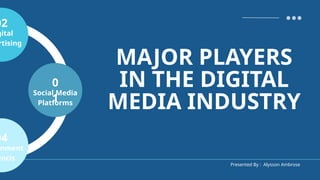
MAJOR PLAYERS
IN THE DIGITAL
MEDIA INDUSTRY
15.
Presented By :Alysson Ambrose
0
1
Social Media
Platforms
02
gital
rtising
04
nment
encis
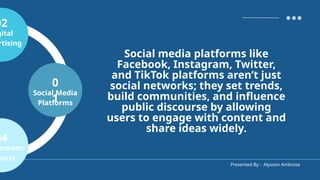
Social media platforms like
Facebook, Instagram, Twitter,
and TikTok platforms aren’t just
social networks; they set trends,
build communities, and influence
public discourse by allowing
users to engage with content and
share ideas widely.
16.
Presented By :Alysson Ambrose
0
1
Media
orms
02
Digital
Advertising
3
nds &
profits
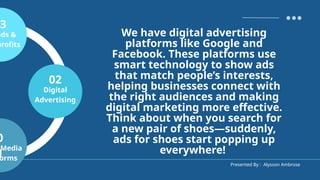
We have digital advertising
platforms like Google and
Facebook. These platforms use
smart technology to show ads
that match people’s interests,
helping businesses connect with
the right audiences and making
digital marketing more effective.
Think about when you search for
a new pair of shoes—suddenly,
ads for shoes start popping up
everywhere!
17.
Presented By :Alysson Ambrose
2
ital
tising
03
Brands &
Non-profits
4
nment
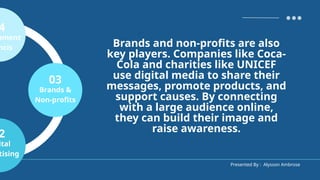
ncis Brands and non-profits are also
key players. Companies like Coca-
Cola and charities like UNICEF
use digital media to share their
messages, promote products, and
support causes. By connecting
with a large audience online,
they can build their image and
raise awareness.
18.
Presented By :Alysson Ambrose
0
1
Media
orms
3
nds &
profits
04
Government
Agencis
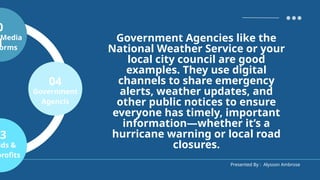
Government Agencies like the
National Weather Service or your
local city council are good
examples. They use digital
channels to share emergency
alerts, weather updates, and
other public notices to ensure
everyone has timely, important
information—whether it’s a
hurricane warning or local road
closures.
19.
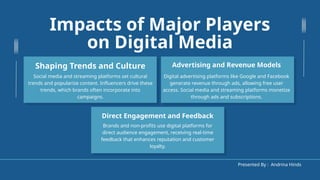
Impacts of MajorPlayers
on Digital Media
Digital advertising platforms like Google and Facebook
generate revenue through ads, allowing free user
access. Social media and streaming platforms monetize
through ads and subscriptions.
Advertising and Revenue Models
Social media and streaming platforms set cultural
trends and popularize content. Influencers drive these
trends, which brands often incorporate into
campaigns.
Shaping Trends and Culture
Brands and non-profits use digital platforms for
direct audience engagement, receiving real-time
feedback that enhances reputation and customer
loyalty.
Direct Engagement and Feedback
Presented By : Andrina Hinds
20.
Emerging Trends andDigital
Media Industries
Presented By : Andrina Hinds
The Digital Media Ecosystem is evolving as
businesses and industries adapt to new
technologies and business models. Companies,
whether new or existing, will modify their
operations to offer updated services to consumers
and creators. Collaboration and trade-offs will
become essential, as businesses recognize their
interdependence to achieve mutual profitability and
sustainability.
21.
Presented By :Andrina Hinds
Some Emerging Trends and
Digital Media Industries
Influencer’s culture thrives on
social media, where influencers
connect with followers through
authentic content. Community
engagement and video apps
drive this shift, blurring lines
between celebrities and
everyday people.
Influencer Culture
VoD apps and streaming
platforms have fueled the
demand for short videos in
education and entertainment.
As attention spans shrink,
tailored, quick content has
become popular for ‘anytime,
anywhere’ viewing.
Micro-
Content
Live streaming on OTT
platforms, social media, and
YouTube has surged with the
rise of mobile devices and the
internet, offering viewers real-
time access to niche content on
any device, increasing demand
for flexible, instant
engagement.
Live
Streaming
 Most read
 Most read
 Most read