International Journal of Trend in Scientific Research and Development (IJTSRD)
Volume 6 Issue 6, September-October 2022 Available Online: www.ijtsrd.com e-ISSN: 2456 – 6470
@ IJTSRD | Unique Paper ID – IJTSRD51904 | Volume – 6 | Issue – 6 | September-October 2022 Page 476
Digital Media: A Mini-Review
Matthew N. O. Sadiku1
, Uwakwe C. Chukwu2
, Abayomi Ajayi-Majebi3
, Sarhan M. Musa1
1
Roy G. Perry College of Engineering, Prairie View A&M University, Prairie View, TX, USA
2
Department of Engineering Technology, South Carolina State University, Orangeburg, SC, USA
3
Department of Manufacturing Engineering, Central State University, Wilberforce, OH, USA
ABSTRACT
Digital media refers to content formats that are accessible on digital
devices. It is an electronic medium that uses digital codes rather than
analog signals. It is the digitized content that can be transmitted over
the computer networks such as the Internet. Digital media is simple
to access and to disperse through digital storage mediums and the
web. It is often put away on digital devices such as hard drives.
Easier means for storage and distribution has led to the success of
digital media. This paper provides an introduction on digital media,
including its various types, applications, benefits, and challenges.
KEYWORDS: technology, digitalization, digital technology, digital
media, social media
How to cite this paper: Matthew N. O.
Sadiku | Uwakwe C. Chukwu | Abayomi
Ajayi-Majebi | Sarhan M. Musa "Digital
Media: A Mini-Review" Published in
International
Journal of Trend in
Scientific Research
and Development
(ijtsrd), ISSN:
2456-6470,
Volume-6 | Issue-6,
October 2022,
pp.476-483, URL:
www.ijtsrd.com/papers/ijtsrd51904.pdf
Copyright © 2022 by author(s) and
International Journal of Trend in
Scientific Research and Development
Journal. This is an
Open Access article
distributed under the
terms of the Creative Commons
Attribution License (CC BY 4.0)
(http://creativecommons.org/licenses/by/4.0)
INTRODUCTION
Before the digital age, the most popular forms of
media were analog or traditional media: radio,
newspapers, magazines, billboards, journals, books,
and other printed materials. Since then, the
technological revolution has brought with it many
new types of media. The first media we could truly
call digital appeared with digital computers. They
employ binary code and Boolean logic to process and
store information. Unlike traditional media, digital
media is transmitted as digital data (sending binary
signals –– 0s and 1s) to devices that translate them
into audio, video, graphics, text, etc. While traditional
media has long been central to informing the public
and focusing public attention on particular subjects,
digital media is helping to amplify the response to
humanitarian crises and to support those afflicted by
these crises. Today, the average American now
spends more time with digital media than traditional
media.
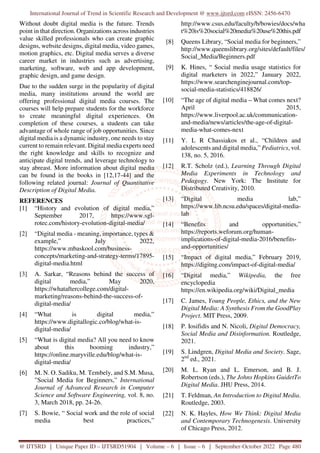
Our world is increasingly digitalized. As illustrated in
Figure 1, digitalization has been rapid [1]. The
defining difference between the modern and the early
age was the fact that early media was analog. It has
been observed that the rise of digital media (the
Internet, computers, video games, compact discs, etc.)
marks one of the great events of our time. Digital
media is a relatively recent means of directly
communicating with our audiences. Information
aimed at an audience can be delivered in many
different forms such as print (books, newspapers,
magazines, etc.), billboards, banners, posters, direct
mail, electronic (radio, television, computer), social
media, etc.
WHAT IS DIGITAL MEDIA?
Digital media basically involves using technology
like the Internet and electronic devices to create
content, such as audio and video, websites, social
media, and video games. It is any kind of media
which covers content delivered through digital
platforms including electronic media, mobile phones,
computers, podcasts, applications, etc. Digital media
is somewhat similar to traditional media (e.g. books,
newspapers, magazines, radio, and TV) in terms of its
ability to deliver content to potential customers; it
IJTSRD51904
International Journal of Trend in Scientific Research and Development @ www.ijtsrd.com eISSN: 2456-6470
@ IJTSRD | Unique Paper ID – IJTSRD51904 | Volume – 6 | Issue – 6 | September-October 2022 Page 477
differs only in the sense that it is totally digital in
nature. Typical examples of digital media include
software, digital videos, images, web pages,
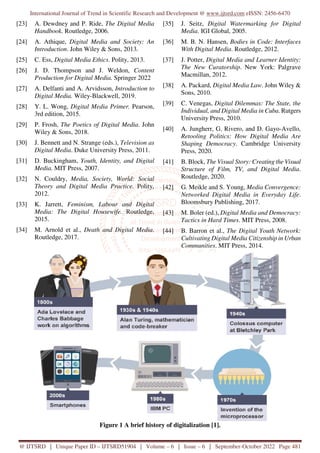
databases, digital audio, and ebooks. Some examples
of digital media are shown in Figure 2 [2].
Digital media has allowed individuals to be much
more active in content creation.
Digital media companies are include Google, Netflix,
Apple, Facebook, Twitter, and Amazon. The impact
of digital media has brought about a technological
revolution. The digital media created a whole new
world in the fields of business, journalism,
entertainment, education, publishing, commerce, and
politics.
A major reason for the success of digital media is that
it can be manipulated. For example, photographs can
be resized, edited, and modified in ways to make it
look better.
Today, digital media has become a part of our lives. It
has made our lives easier, help in doing business
effectively, get more customers, and reach out to
people worldwide [3].
TYPES OF DIGITAL MEDIA
Digital media is one which can be created, viewed,
modified, communicated, preserved on electronics
devices. It consists of a wide array of websites, tech
devices, and platforms. It is either assets or content.
There are 3 types of digital media [4]: (1) Owned
media, which is unique to your brand or any online
asset that you control; (2) Paid media, which
promotes your online content to improve traffic to
your owned media assets; and (3) Earned media,
which is advertising generated by your customers.
There are different types of digital media including
the following [5]:
Audio: Audio forms of digital media include
digital radio stations, podcasts, and audiobooks.
Millions of Americans subscribe to digital radio
services such as Apple Music, Spotify, Tidal,
Pandora, and Sirius, which provide a wide range
of musical stations.
Video: Many digital media outlets are visual,
from streaming movie and television services
such as Netflix and YouTube.
Advertising: Advertisers have made their way into
the digital media landscape, taking advantage of
marketing partnerships and advertising space
wherever possible.
Social media: Worldwide, popular social media
include Twitter, Facebook, Instagram, LinkedIn,
WhatsApp, Instagram, and Snapchat, which
enable their users to interact with one another
through text posts, photographs, and videos. Since
these media are common, they will be treated
fully in the next section.
SOCIAL MEDIA
All media are social in the sense that they establish
and maintain relations among humans as individuals
and collectives. A social media is any medium of
communication that allows two-way interaction.
Social media are computer-mediated communication
tools that enable users to share and consume content
through varied modalities such as text, image, and
video. Social media (or social networking) is a
universal phenomenon. It is the most popular online
activity worldwide. It empowers people to share their
opinions with others online. It has opened new ways
of communication in the hyper-connected world. It
has become an integral part of modern society as they
provide means of interacting and socializing [6].
Anyone with access to computers and the Internet can
participate in social media.
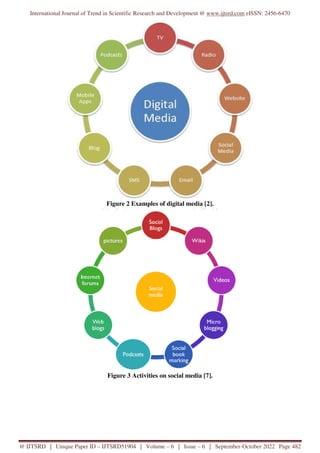
Social media takes on many forms. The six basic
forms are: (1) social networks such as Facebook and
Twitter, (2) blogs, (3) wikis (4) podcasts, (5) content
communities, and (6) micro blogging. These and
other activities on the social media are illustrated in
Figure 3 [7].
The six most popular social media platforms are
described here [8].
Facebook: This is the most popular social media
in the US and the rest of the world. It was
launched on February 2004 by Mark Zuckerberg
(ex-Harvard student). Facebook can sensitize
individuals (consumers) about manyproducts and
services. A company can use Facebook to
communicate their core values to a wide range of
customers.
Twitter: Twitter was launched on July 2006 to
provide a microblogging service. It allows
individuals and companies to post short messages,
share content, and have conversations with other
Twitter users. Many Twitter posts (or "tweets")
focus on the minutiae of everyday life. Twitter is
well known as the most popular microblogging
site.
LinkedIn: This is a networking website designed
for the business community. It was created in
2002 by Reid Hoffman It allows people to create
professional profiles, post resumes, and
communicate with other professionals. LinkedIn
is now the world's largest social network for
professionals. It can be used as a tool for career
management and job hunting.
International Journal of Trend in Scientific Research and Development @ www.ijtsrd.com eISSN: 2456-6470
@ IJTSRD | Unique Paper ID – IJTSRD51904 | Volume – 6 | Issue – 6 | September-October 2022 Page 478
YouTube: YouTube has established itself as social
media. It was launched in May 2005. It allows
individuals to watch and share videos. YouTube
may serve as home to aspiring filmmakers who
might not have industry connections. It is most
popular online video community in the world.
Searching on YouTube is second only to Google.
MySpace: MySpace was established in 2003 by
Specific Media and Justin Timberlake. Its main
appeal is the ability to connect with brands and
individuals. Its usage has declined over the years.
Instagram: This is a social network that is
currently only available through a free iPhone
app. It is an image-based social media platform. It
allows users to send and share videos and photos.
Users can find and follow individuals and brands.
It has become popular among young social media
users, aged between 12 and 24 years.
Other social media include Tumblr, Reddit, Pinterest,
Flickr, Forum, Yelp, Snapchat, Bebo, WeChat,
Foursquare, Goodreads, Tik Tok, Google+, and Vine
Camera. The following are the statistics for monthly
users of the top 10 social media apps globally in 2021
[9]:
1. Facebook – 2.89 billion
2. YouTube – 2.29 billion
3. WhatsApp – 2.00 billion
4. Instagram – 1.39 billion
5. Facebook Messenger – 1.30 billion
6. WeChat (Weixin) – 1.25 billion
7. TikTok (Douyin) – 1 billion
8. LinkedIn – 800 million
9. QQ – 591 million
10. Sina Weibo – 566million
APPLICATIONS OF DIGITAL MEDIA
Companies and individuals use digital media for
various reasons. Digital media are used in various
industries such as entertainment, ecommerce,
healthcare, education, business (marketing and
advertising), finance, retail, government, military,
sports, television. gaming, and publishing. Some of
these applications are discussed next.
Marketing: Digital media provides a very
substantial customer base for the marketers. It is
proving to be the pioneer in marketing platforms
because it is highly cost effective. For example,
websites, email marketing, interactive blogs,
mobile apps, and SMS services provide medium
for promoting marketing content to the customers.
The interactivity and social media aspect of
digital media makes it really important for
marketers to use them effectively in addition to
traditional channels [2].
News Broadcasting: Digital media is playing a
central role in the news broadcasting industry.
The broadcasting companies have been
optimizing their digital news to increase
efficiency and reach out to a wider audience. For
example, BBC and SKY news have invested
millions in their digital offer, making sure that
their viewers and listeners have total faith in what
they see on their websites [10].
Children’s Use of Digital Media: Today’s
children are digital natives and they are immersed
in digital media. Digital technologies promote
interactive and social engagement; it allow
children instant access to entertainment,
information, and social contact. Digital media
allows information sharing including text,
photographs, video, and audio. Most children
primarily use mobile technology and watch
YouTube or Netflix. A large minority of them
play video games or cartoons and may be
involved in video-chatting. Lines are getting
blurred between media use for communication
versus for entertainment. Commercial video
games have incorporated cutting-edge graphics
and exciting stories. The benefits of social largely
depend on a child’s age and developmental stage.
High use of social media has been linked to
obesity, cardiovascular risk, cyberbullying,
Internet-initiated sex crimes, and online sexual
images (pornography). Parents should regularly
discuss online behavior of their children, find out
about their child’s online friendships and
relationships, and maintain open communication
about issues. Pediatricians can help families
identify negative online behavior and minimize
unhealthy behaviors [11].
Learning Through Digital Media: Where, when,
how, and what we learn is changing rapidly.
Teachers need to consider how to engage learners
with content by connecting to their current
interests. The altered roles of the teacher and the
student substantially change teaching itself.
Digital media can be used for learning on campus
and off. Learning with digital media is exploring
radically new approaches to instruction. Digital
media can play a positive role in this process of
transformation. Today, learning is at least as
much about access to other people as it is about
access to information. Such participatory learning
also assists learners to reflect on social justice,
love, history, and ethics in addition to preparing
them for career or vocational training. Digital
learning takes place online, in the university
classroom, in high schools, museums, after school
International Journal of Trend in Scientific Research and Development @ www.ijtsrd.com eISSN: 2456-6470
@ IJTSRD | Unique Paper ID – IJTSRD51904 | Volume – 6 | Issue – 6 | September-October 2022 Page 479
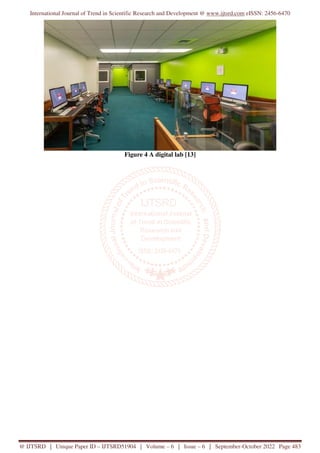
programs, and public libraries [12]. A digital lab
is shown in Figure 4 [13].
Other applications of digital media include brand
recognition and digital media parenting.
BENEFITS
Digital media has greatly influenced our daily lives in
the way they connect, communicate, work, and
collaborate. It has been proven to provide an effective
means of communication for the businesses and the
customers. Its benefits to the community at large are
many. It has enabled several opportunities for
communication, community building, and social
interaction, breaking the barriers of location. It has
provided underserved communities with better
opportunities. It has improved the quality of life for
professionals worldwide. Today, the modern world is
populated by digital media devices (such as video-on-
demand, video games, digital audio, AR, VR,
animation, and weather app on a smartphone
console); they are flourishing because they are
engaging and easy to use.
Digital media facilitates social interaction and
empowers people. It connects people as never before
and enables users to maintain friendships across time
and distance. It can help to deepen relationships and
facilitate the formation of support networks. People
can use social media platforms to support family and
friends in times of crisis. By facilitating social
interaction, digital media can reduce emotional stress
[14]. Digital media can be used to facilitate life-long
learning. It can help to close skill gaps by supporting
teaching and self-education. Digital media has led to
entirely new careers. Other benefits of digital media
include [2,15]:
Digital media helps companies connect with its
target audience.
It empowers people and facilitates social
interaction.
It plays a central role and offers many benefits to
the ordinary citizen.
It increases civic participation, gives people a
voice and facilitates the creation of communities.
It is revolutionizing how work is done.
It has facilitated education and life-long learning.
It helps increase sales and business.
It allows people to have access to information and
make well-informed decisions.
It helps people to respond in real time and expose
certain ills such as political corruption and unfair
business practices.
It has enhanced information sharing around the
world.
It allows people around the globe to build
communities, organize action, and make their
voices heard on various issues.
Online financial support is growing in response to
humanitarian crises.
Digital media is used for attracting talents,
especially young, digitally savvy workers.
It has opened up and eliminated many barriers of
information exchange and gone beyond national
boundaries.
Using digital media helps establish the brand
using all the channels that customers use.
CHALLENGES
Digital media has both positive and negative impacts
on society. Copyright challenges are spreading to
every aspect of digital media. Digital media copyright
protection is under the umbrella of intellectual
property protection technology. Content creators such
as YouTube must follow guidelines set by copyright,
IP laws, and the platform's copyright guidelines [16].
Due to its excessive use by humans, social media can
negatively influence their behavior and mental health.
Other challenges include:
It has increased the ease of spreading propaganda
and harassment.
Over the years, digital media has broken the
social bond that existed between humanity.
Social media (such as computer games,
messaging, and dating websites) can be addictive.
Research has identified negative health outcomes
for children immerse in digital media.
Risks of social media include negative health
effects on sleep, attention, and learning.
It is important to understand the benefits of digital
media and how to reap from them while minimizing
the negative effects.
CONCLUSION
Digital media is any form of media that uses
electronic devices for distribution. It may be regarded
as a form of communication that can be stored and
communicated via computers. Digital media has
become part and parcel of the global community.
Consumers are now spending 6 ¾ hours per day on
line.
The role of digital media is increasing in everyone’s
life. Its growing popularity is revolutionizing the
creative landscape and creating new business models.
International Journal of Trend in Scientific Research and Development @ www.ijtsrd.com eISSN: 2456-6470
@ IJTSRD | Unique Paper ID – IJTSRD51904 | Volume – 6 | Issue – 6 | September-October 2022 Page 480
Without doubt digital media is the future. Trends
point in that direction. Organizations across industries
value skilled professionals who can create graphic
designs, website designs, digital media, video games,
motion graphics, etc. Digital media serves a diverse
career market in industries such as advertising,
marketing, software, web and app development,
graphic design, and game design.
Due to the sudden surge in the popularity of digital
media, many institutions around the world are
offering professional digital media courses. The
courses will help prepare students for the workforce
to create meaningful digital experiences. On
completion of these courses, a students can take
advantage of whole range of job opportunities. Since
digital media is a dynamic industry, one needs to stay
current to remain relevant. Digital media experts need
the right knowledge and skills to recognize and
anticipate digital trends, and leverage technology to
stay abreast. More information about digital media
can be found in the books in [12,17-44] and the
following related journal: Journal of Quantitative
Description of Digital Media.
REFERENCES
[1] “History and evolution of digital media,”
September 2017, https://www.sgl-
rotec.com/history-evolution-digital-media/
[2] “Digital media - meaning, importance, types &
example,” July 2022,
https://www.mbaskool.com/business-
concepts/marketing-and-strategy-terms/17895-
digital-media.html
[3] A. Sarkar, “Reasons behind the success of
digital media,” May 2020,
https://whataftercollege.com/digital-
marketing/reasons-behind-the-success-of-
digital-media/
[4] “What is digital media,”
https://www.digitallogic.co/blog/what-is-
digital-media/
[5] “What is digital media? All you need to know
about this booming industry,”
https://online.maryville.edu/blog/what-is-
digital-media/
[6] M. N. O. Sadiku, M. Tembely, and S.M. Musa,
”Social Media for Beginners,” International
Journal of Advanced Research in Computer
Science and Software Engineering, vol. 8, no.
3, March 2018, pp. 24-26.
[7] S. Bowie, “ Social work and the role of social
media best practices,”
http://www.csus.edu/faculty/b/bowies/docs/wha
t%20is%20social%20media%20use%20this.pdf
[8] Queens Library, “Social media for beginners,”
http://www.queenslibrary.org/sites/default/files/
Social_Media/Beginners.pdf
[9] K. Hines, “ Social media usage statistics for
digital marketers in 2022,” January 2022,
https://www.searchenginejournal.com/top-
social-media-statistics/418826/
[10] “The age of digital media – What comes next?
April 2015,
https://www.liverpool.ac.uk/communication-
and-media/news/articles/the-age-of-digital-
media-what-comes-next
[11] Y. L R Chassiakos et al., “Children and
adolescents and digital media,” Pediatrics, vol.
138, no. 5, 2016.
[12] R.T. Scholz (ed.), Learning Through Digital
Media Experiments in Technology and
Pedagogy. New York: The Institute for
Distributed Creativity, 2010.
[13] “Digital media lab,”
https://www.lib.ncsu.edu/spaces/digital-media-
lab
[14] “Benefits and opportunities,”
https://reports.weforum.org/human-
implications-of-digital-media-2016/benefits-
and-opportunities/
[15] “Impact of digital media,” February 2019,
https://digitng.com/impact-of-digital-media/
[16] “Digital media,” Wikipedia, the free
encyclopedia
https://en.wikipedia.org/wiki/Digital_media
[17] C. James, Young People, Ethics, and the New
Digital Media: A Synthesis From the GoodPlay
Project. MIT Press, 2009.
[18] P. Iosifidis and N. Nicoli, Digital Democracy,
Social Media and Disinformation. Routledge,
2021.
[19] S. Lindgren, Digital Media and Society. Sage,
2nd
ed., 2021.
[20] M. L. Ryan and L. Emerson, and B. J.
Robertson (eds.), The Johns Hopkins GuidetTo
Digital Media. JHU Press, 2014.
[21] T. Feldman, An Introduction to Digital Media.
Routledge, 2003.
[22] N. K. Hayles, How We Think: Digital Media
and Contemporary Technogenesis. University
of Chicago Press, 2012.
International Journal of Trend in Scientific Research and Development @ www.ijtsrd.com eISSN: 2456-6470
@ IJTSRD | Unique Paper ID – IJTSRD51904 | Volume – 6 | Issue – 6 | September-October 2022 Page 481
[23] A. Dewdney and P. Ride, The Digital Media
Handbook. Routledge, 2006.
[24] A. Athique, Digital Media and Society: An
Introduction. John Wiley & Sons, 2013.
[25] C. Ess, Digital Media Ethics. Polity, 2013.
[26] J. D. Thompson and J. Weldon, Content
Production for Digital Media. Springer 2022
[27] A. Delfanti and A. Arvidsson, Introduction to
Digital Media. Wiley-Blackwell, 2019.
[28] Y. L. Wong, Digital Media Primer. Pearson,
3rd edition, 2015.
[29] P. Frosh, The Poetics of Digital Media. John
Wiley & Sons, 2018.
[30] J. Bennett and N. Strange (eds.), Television as
Digital Media. Duke University Press, 2011.
[31] D. Buckingham, Youth, Identity, and Digital
Media. MIT Press, 2007.
[32] N. Couldry, Media, Society, World: Social
Theory and Digital Media Practice. Polity,
2012.
[33] K. Jarrett, Feminism, Labour and Digital
Media: The Digital Housewife. Routledge,
2015.
[34] M. Arnold et al., Death and Digital Media.
Routledge, 2017.
[35] J. Seitz, Digital Watermarking for Digital
Media. IGI Global, 2005.
[36] M. B. N. Hansen, Bodies in Code: Interfaces
With Digital Media. Routledge, 2012.
[37] J. Potter, Digital Media and Learner Identity:
The New Curatorship. New York: Palgrave
Macmillan, 2012.
[38] A. Packard, Digital Media Law. John Wiley &
Sons, 2010.
[39] C. Venegas, Digital Dilemmas: The State, the
Individual, and Digital Media in Cuba. Rutgers
University Press, 2010.
[40] A. Jungherr, G. Rivero, and D. Gayo-Avello,
Retooling Politics: How Digital Media Are
Shaping Democracy. Cambridge University
Press, 2020.
[41] B. Block, The Visual Story: Creating the Visual
Structure of Film, TV, and Digital Media.
Routledge, 2020.
[42] G. Meikle and S. Young, Media Convergence:
Networked Digital Media in Everyday Life.
Bloomsbury Publishing, 2017.
[43] M. Boler (ed.), Digital Media and Democracy:
Tactics in Hard Times. MIT Press, 2008.
[44] B. Barron et al., The Digital Youth Network:
Cultivating Digital Media Citizenship in Urban
Communities. MIT Press, 2014.
Figure 1 A brief history of digitalization [1].
International Journal of Trend in Scientific Research and Development @ www.ijtsrd.com eISSN: 2456-6470
@ IJTSRD | Unique Paper ID – IJTSRD51904 | Volume – 6 | Issue – 6 | September-October 2022 Page 482
Figure 2 Examples of digital media [2].
Figure 3 Activities on social media [7].
International Journal of Trend in Scientific Research and Development @ www.ijtsrd.com eISSN: 2456-6470
@ IJTSRD | Unique Paper ID – IJTSRD51904 | Volume – 6 | Issue – 6 | September-October 2022 Page 483
Figure 4 A digital lab [13]