THINKING WAY
Each timeI do A under same
conditions, B occurs.
Next time I do A under these
conditions
B will occur.
Inductive reasoning is a type of logical
thinking that starts from specific observations
to formulate a general conclusion. Inductive
reasoning leads to a probable but not
guaranteed conclusion.
2.
THINKING WAY
A isB
All Bs are Cs
A is, deductively, C
Deductive reasoning is a type of logical
reasoning that starts from a general rule
to reach a specific conclusion. If the
premises are true and the logic is
correctly followed, the conclusion will be
true.
3.
THINKING WAY
I’ve donesomething like A before, but the
circumstances weren’t the same.
I’ve seen something like B before, but the circumstances
weren’t the same.
I’m able to abduct that C is the reason B is occuring
Abductive reasoning is a type of logical thinking that seeks the most
plausible explanation for a set of observations, even without absolute
certainty. It is widely used when there is incomplete information, and
we need to make inferences based on the best available hypothesis.
WHAT IS DESIGN
“Designis the thought and action applied
to indeterminate problems, the so-called
wicked problems, which do not have a
single correct solution and require
creative and iterative approaches”
(Buchanan, 1992)
6.
WHAT IS DESIGN
Itis the discipline focused on the
interaction between individuals,
referred to as users, and the man-made
environment. This encompasses
considerations that are aesthetic,
functional, contextual, cultural, and
societal.
7.
WHAT IS DESIGN
Designmanifests in our daily
interactions with physical
objects, built spaces, and
digital environments.
Everything from clothing and
devices to transportation
systems and urban
landscapes has been shaped
by designers.
Beyond their functional and
formal attributes, these
designed artifacts influence
cultural meaning, expressing,
reflecting, and even shaping
societal norms.
Design Thinking
"Design Thinkingis a human-centered
approach to innovation that draws from
the designer's toolkit to integrate the
needs of people, the possibilities of
technology, and the requirements for
business success.“
Brown, T. (2009)
10.
Design Thinking
"Design Thinkingis a problem-solving
approach that combines creativity,
empathy, and rationality to meet user
needs and drive business success.“
Brown, T., & Katz, B. (2011).
12.
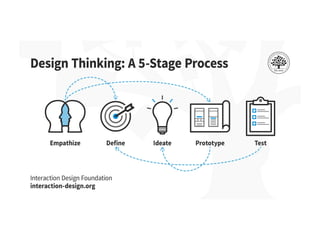
Empathize
The first stageof design thinking is
about understanding users through
empathic research.
This involves consulting experts,
observing behavior, and immersing
yourself in users’ environments to
grasp their experiences and needs.
Empathy helps designers move
beyond their own assumptions and
uncover real user insights. The goal
is to gather meaningful
information that will guide the next
stage of the process.
13.
Define
In the Definestage, you make sense of the
information gathered during the
Empathize phase.
This involves analyzing your observations
to identify key user needs and challenges,
then clearly framing them in a human-
centered problem statement.
Instead of focusing on business goals, like
increasing market share, you reframe the
issue around the user's perspective, such
as helping teenage girls access nutritious
food.
A well-defined problem guides the team
toward meaningful solutions and leads
naturally into the Ideation phase, where
you’ll start asking “How might we…”
questions to spark creative ideas.
14.
Ideate
In the thirdstage of design thinking,
Ideate, you begin generating creative
solutions. After empathizing with
users and defining a clear, user-
centered problem, your team can
explore the challenge from different
angles.
The goal is to think broadly and push
past obvious answers.
Techniques like Brainstorming,
Brainwriting, Worst Possible Idea,
and SCAMPER help spark fresh ideas.
Early in the process, methods that
encourage free thinking are key to
expanding possibilities. Later, you can
narrow down and refine ideas,
selecting the most promising ones to
develop further in the next stage.
15.
Prototype
In the Prototypestage, the team builds
simple, low-cost versions of the product
or its features to explore the ideas from
the Ideate phase.
These prototypes are tested within
the team or with a small group of
users to evaluate how well they
address the identified problems.
This is a hands-on, experimental
phase aimed at learning what works.
Solutions are tested, refined, or
discarded based on user feedback. By
the end, the team gains valuable
insights into the product’s strengths,
limitations, and how users actually
interact with it.
16.
Testing
In the finalstage, designers test the
complete product using the best
solutions from the Prototype phase.
This step evaluates how users interact
with the product, revealing insights
into their behaviors, thoughts, and
feelings.
Testing often leads to new
discoveries, prompting a return to
earlier stages for further refinement.
Design thinking is iterative, so
feedback from this phase helps
improve the solution until it truly
meets user needs. The goal is a deep
understanding of both the product
and its users.
17.
Prática
Separados em grupos,deverão buscar
soluções para a seguinte questão:
“Como aproximar academia e
comunidade?”