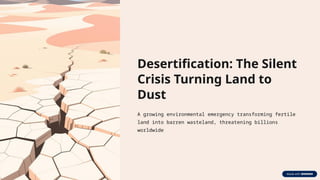
Desertification: The Silent
CrisisTurning Land to
Dust
A growing environmental emergency transforming fertile
land into barren wasteland, threatening billions
worldwide
2.
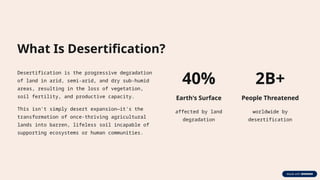
What Is Desertification?
Desertificationis the progressive degradation
of land in arid, semi-arid, and dry sub-humid
areas, resulting in the loss of vegetation,
soil fertility, and productive capacity.
This isn't simply desert expansion—it's the
transformation of once-thriving agricultural
lands into barren, lifeless soil incapable of
supporting ecosystems or human communities.
40%
Earth's Surface
affected by land
degradation
2B+
People Threatened
worldwide by
desertification
3.
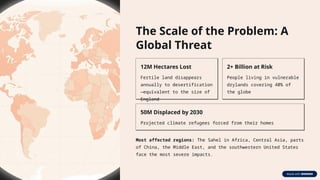
The Scale ofthe Problem: A
Global Threat
12M Hectares Lost
Fertile land disappears
annually to desertification
—equivalent to the size of
England
2+ Billion at Risk
People living in vulnerable
drylands covering 40% of
the globe
50M Displaced by 2030
Projected climate refugees forced from their homes
Most affected regions: The Sahel in Africa, Central Asia, parts
of China, the Middle East, and the southwestern United States
face the most severe impacts.
4.
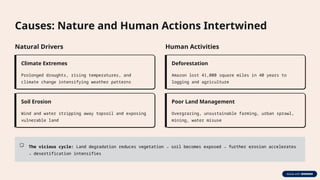
Causes: Nature andHuman Actions Intertwined
Natural Drivers
Climate Extremes
Prolonged droughts, rising temperatures, and
climate change intensifying weather patterns
Soil Erosion
Wind and water stripping away topsoil and exposing
vulnerable land
Human Activities
Deforestation
Amazon lost 41,000 square miles in 40 years to
logging and agriculture
Poor Land Management
Overgrazing, unsustainable farming, urban sprawl,
mining, water misuse
The vicious cycle: Land degradation reduces vegetation → soil becomes exposed → further erosion accelerates
→ desertification intensifies
5.
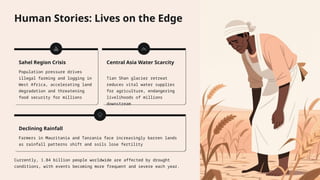
Human Stories: Liveson the Edge
Sahel Region Crisis
Population pressure drives
illegal farming and logging in
West Africa, accelerating land
degradation and threatening
food security for millions
Central Asia Water Scarcity
Tian Shan glacier retreat
reduces vital water supplies
for agriculture, endangering
livelihoods of millions
downstream
Declining Rainfall
Farmers in Mauritania and Tanzania face increasingly barren lands
as rainfall patterns shift and soils lose fertility
Currently, 1.84 billion people worldwide are affected by drought
conditions, with events becoming more frequent and severe each year.
6.
Environmental and SocietalImpacts
Biodiversity Collapse
Loss of critical ecosystem services for food production, water regulation, and climate stabili
Food Insecurity
Declining soil fertility triggers poverty, hunger, and competition for scarce resources
Carbon Release
Degraded lands release stored carbon, creating dangerous climate feedback loops
Water Crisis
Shortages threaten agriculture, livelihoods, health, and force mass migration
7.
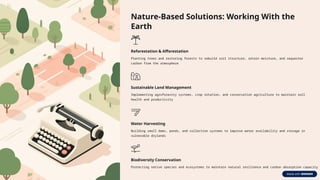
Nature-Based Solutions: WorkingWith the
Earth
Reforestation & Afforestation
Planting trees and restoring forests to rebuild soil structure, retain moisture, and sequester
carbon from the atmosphere
Sustainable Land Management
Implementing agroforestry systems, crop rotation, and conservation agriculture to maintain soil
health and productivity
Water Harvesting
Building small dams, ponds, and collection systems to improve water availability and storage in
vulnerable drylands
Biodiversity Conservation
Protecting native species and ecosystems to maintain natural resilience and carbon absorption capacity
8.
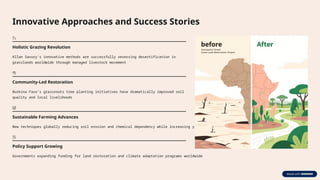
Innovative Approaches andSuccess Stories
Holistic Grazing Revolution
Allan Savory's innovative methods are successfully reversing desertification in
grasslands worldwide through managed livestock movement
Community-Led Restoration
Burkina Faso's grassroots tree planting initiatives have dramatically improved soil
quality and local livelihoods
Sustainable Farming Advances
New techniques globally reducing soil erosion and chemical dependency while increasing yields
Policy Support Growing
Governments expanding funding for land restoration and climate adaptation programs worldwide
9.
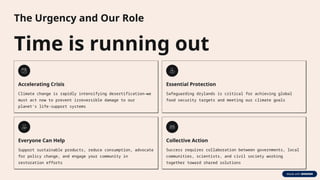
The Urgency andOur Role
Time is running out
Accelerating Crisis
Climate change is rapidly intensifying desertification—we
must act now to prevent irreversible damage to our
planet's life-support systems
Essential Protection
Safeguarding drylands is critical for achieving global
food security targets and meeting our climate goals
Everyone Can Help
Support sustainable products, reduce consumption, advocate
for policy change, and engage your community in
restoration efforts
Collective Action
Success requires collaboration between governments, local
communities, scientists, and civil society working
together toward shared solutions
10.
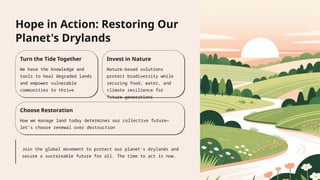
Hope in Action:Restoring Our
Planet's Drylands
Turn the Tide Together
We have the knowledge and
tools to heal degraded lands
and empower vulnerable
communities to thrive
Invest in Nature
Nature-based solutions
protect biodiversity while
securing food, water, and
climate resilience for
future generations
Choose Restoration
How we manage land today determines our collective future—
let's choose renewal over destruction
Join the global movement to protect our planet's drylands and
secure a sustainable future for all. The time to act is now.