Deforestation policy diagnostics a tool to step up results
Presented by Stibniati Atmadja (Landscape Alliance) at "Forests, finance, synergies: Advancing integrated climate action towards 2030" UNFCCC SB64 side event on 15 June 2026.
Deforestation policy diagnostics a tool to step up results
1.
Deforestation policy diagnostics
atool to step up results
Why?
• deforestation contexts and policy mechanisms are varied
• effective deforestation policies are needed to achieve results fast
Designed to facilitate learning from experience
• a systematic approach to understand which policies work in which
contexts
• facilitates policy design based on evidence and linked to context
(deforestation archetypes)
By
Stibniati Atmadja, Beria Leimona, Christopher Martius – Landscape Alliance
Arild Angelsen – Norwegian University of Life Sciences
SB64 Side Event, 15 June 2026
• case studies for Brazil,
DRC, Indonesia and Peru
2.
Example: The caseof RDC
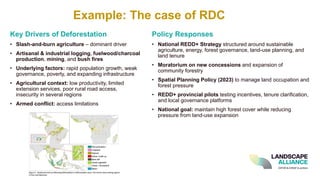
Key Drivers of Deforestation
• Slash-and-burn agriculture – dominant driver
• Artisanal & industrial logging, fuelwood/charcoal
production, mining, and bush fires
• Underlying factors: rapid population growth, weak
governance, poverty, and expanding infrastructure
• Agricultural context: low productivity, limited
extension services, poor rural road access,
insecurity in several regions
• Armed conflict: access limitations
Policy Responses
• National REDD+ Strategy structured around sustainable
agriculture, energy, forest governance, land-use planning, and
land tenure
• Moratorium on new concessions and expansion of
community forestry
• Spatial Planning Policy (2023) to manage land occupation and
forest pressure
• REDD+ provincial pilots testing incentives, tenure clarification,
and local governance platforms
• National goal: maintain high forest cover while reducing
pressure from land-use expansion
3.
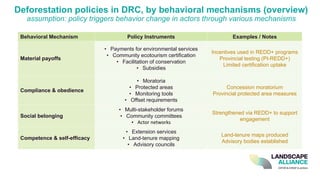
Deforestation policies inDRC, by behavioral mechanisms (overview)
assumption: policy triggers behavior change in actors through various mechanisms
Behavioral Mechanism Policy Instruments Examples / Notes
Material payoffs
• Payments for environmental services
• Community ecotourism certification
• Facilitation of conservation
• Subsidies
Incentives used in REDD+ programs
Provincial testing (PI-REDD+)
Limited certification uptake
Compliance & obedience
• Moratoria
• Protected areas
• Monitoring tools
• Offset requirements
Concession moratorium
Provincial protected area measures
Social belonging
• Multi-stakeholder forums
• Community committees
• Actor networks
Strengthened via REDD+ to support
engagement
Competence & self-efficacy
• Extension services
• Land-tenure mapping
• Advisory councils
Land-tenure maps produced
Advisory bodies established
4.
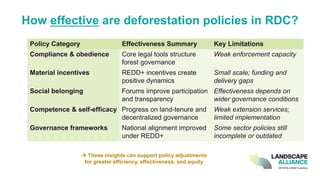
How effective aredeforestation policies in RDC?
Policy Category Effectiveness Summary Key Limitations
Compliance & obedience Core legal tools structure
forest governance
Weak enforcement capacity
Material incentives REDD+ incentives create
positive dynamics
Small scale; funding and
delivery gaps
Social belonging Forums improve participation
and transparency
Effectiveness depends on
wider governance conditions
Competence & self-efficacy Progress on land-tenure and
decentralized governance
Weak extension services;
limited implementation
Governance frameworks National alignment improved
under REDD+
Some sector policies still
incomplete or outdated
→ These insights can support policy adjustments
for greater efficiency, effectiveness, and equity
5.
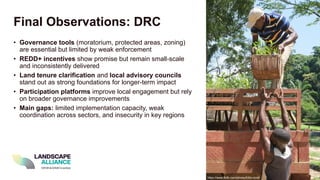
Final Observations: DRC
•Governance tools (moratorium, protected areas, zoning)
are essential but limited by weak enforcement
• REDD+ incentives show promise but remain small-scale
and inconsistently delivered
• Land tenure clarification and local advisory councils
stand out as strong foundations for longer-term impact
• Participation platforms improve local engagement but rely
on broader governance improvements
• Main gaps: limited implementation capacity, weak
coordination across sectors, and insecurity in key regions
https://www.flickr.com/photos/cifor-icraf/
6.
Headquarters
Center for InternationalForestry Research
(CIFOR)
Jalan CIFOR
Situ Gede, Bogor Barat
Bogor 16115, Indonesia
Tel: +62 251 8622 622
Fax: +62 251 8622 100
Email: cifor@landscapealliance.org
International Centre for Research on
Agroforestry (ICRAF)
United Nations Avenue, Gigiri
PO Box 30677, 00100
Nairobi, Kenya
Tel: +254 20 7224 000
Fax: +254 20 7224 001
Email: icraf@landscapealliance.org
About us
Landscape Alliance transforms science into action, unlocking the power of trees, forests and
agroforestry landscapes to advance planetary health and human well-being.
Landscape Alliance is the operating name of the Center for International Forestry Research
(CIFOR) and the International Centre for Research on Agroforestry (ICRAF). CIFOR and ICRAF
are independent International Organizations and CGIAR Research Centers.
landscapealliance.org