DeFi Marketing Strategies for Sustainable Growth in 2026
Explore effective DeFi marketing tactics including liquidity attraction, community engagement, security communication, and governance to scale decentralized finance protocols successfully in 2026.
DeFi Marketing Strategies for Sustainable Growth in 2026
1.
DeFi Marketing StrategiesThat Drive Real
Growth
The decentralized finance landscape in 2026 looks nothing like it did five years ago. What
began as a fragmented, speculative environment has consolidated into a multi-billion-dollar
ecosystem where institutional capital coexists with retail participation. For growth professionals,
however, the challenge has become more demanding—not less. Increased regulatory oversight
2.
and a userbase with higher expectations mean that outdated promotional tactics no longer
generate sustainable results.
This guide breaks down the mechanics behind high-performing DeFi marketing, written for
marketers and growth strategists who want to scale decentralized protocols with precision.
What Is DeFi Marketing?
DeFi marketing is the disciplined process of building awareness, attracting liquidity, and driving
governance engagement for decentralized financial protocols. It differs from conventional fintech
growth work in one critical way: instead of optimizing for customer acquisition cost (CAC) and
lifetime value (LTV), DeFi marketing operates on three interdependent pillars—Liquidity,
Community, and Security.
This specialization demands fluency in smart contract architecture, yield mechanics, and
on-chain behavioral data. The fundamental ask is not "use our product." It is "lock your capital
into our code." Closing that gap between technical complexity and financial trust is the core
challenge—and the core opportunity.
Why Marketing Is Non-Negotiable in DeFi
In a permissionless environment, product quality alone rarely generates sustainable traction.
With thousands of protocols competing for the same liquidity pool, marketing is the mechanism
that separates protocols with momentum from those that stagnate.
Liquidity is path-dependent. Users follow existing liquidity. Marketing creates the initial
"flywheel effect" that draws the first wave of Liquidity Providers (LPs) and makes the protocol
attractive for subsequent participants.
Security communication builds moat. In an ecosystem frequently marked by exploits and
bridge hacks, marketing is how a protocol communicates its audit history, bug bounty structure,
and battle-tested codebase—effectively converting security credibility into competitive
advantage.
Governance distribution prevents centralization. A protocol cannot claim true
decentralization if its voting power sits in a handful of whale wallets. Broad token distribution,
enabled by effective marketing, protects governance integrity and reduces single points of
failure.
3.
Network effects compoundover time. Most DeFi products function as infrastructure
primitives. Each additional integration and active user increases protocol value for the next
entrant—a self-reinforcing dynamic that marketing directly accelerates.
Proven DeFi Marketing Strategies for 2026
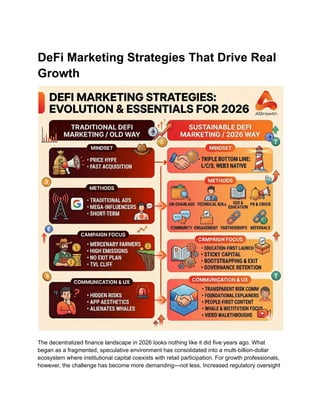
Winning in today's market requires a coordinated, multi-channel strategy that balances
immediate traffic with durable brand equity. The following approaches represent best-in-class
execution across active protocols.
Use Blockchain-Native Advertising Networks
Standard ad platforms like Google and Meta have relaxed some restrictions on crypto content,
but they still lack the targeting precision required for DeFi-specific campaigns. Blockchain-native
ad networks fill this gap by enabling wallet-level behavioral targeting.
Specifically, these networks allow advertisers to reach users who have already interacted with
lending protocols, DEXs, or yield aggregators—dramatically improving spend efficiency.
Targeting users by on-chain balance thresholds (e.g., ETH or stablecoin holdings above a
defined floor) ensures that impressions reach high-intent, high-value participants rather than
casual browsers.
Build a Long-Term DeFi SEO Strategy
Organic search remains the highest ROI acquisition channel over a 12–24 month horizon. Users
querying terms like "best stablecoin yield" or "how to hedge impermanent loss" are
demonstrating explicit purchase intent.
Effective DeFi SEO involves building a topical authority cluster around the protocol's core
mechanics—educational content hubs, glossary pages that own technical definitions, and
comparison content targeting users actively evaluating alternatives. Protocols that invest in this
early compound their advantage as the content matures in search rankings.
Partner With KOLs and Technical Researchers
The most effective Key Opinion Leader (KOL) partnerships in 2026 are not transactional content
arrangements. They are long-term relationships with researchers and analysts who can
genuinely evaluate protocol documentation and explain yield sources to their audience.
Single sponsored posts produce minimal durable impact. What drives meaningful community
growth is a partner who holds a protocol position, participates in governance votes, and
4.
provides ongoing technicalcommentary. This alignment of financial incentive and public
credibility is far more persuasive than any ad placement.
Run Targeted Crypto Display Advertising
High-traffic crypto media properties and coin aggregators—platforms like CoinGecko and
CoinMarketCap—remain primary destination hubs for active DeFi users. Native banner
placements on these platforms, particularly when contextually positioned on competitor or
complementary asset pages, generate qualified traffic efficiently.
Publish on Medium and LinkedIn
While Discord serves the existing community, Medium and LinkedIn reach a distinct and
valuable audience: liquidity providers, institutional partners, and venture-stage investors.
Medium is well-suited for technical deep-dives, protocol upgrade analyses, and development
transparency updates. LinkedIn is the appropriate channel for founder-led thought leadership
and B2B partnership development. A protocol with active founder presence on LinkedIn signals
organizational credibility to the institutional audience most capable of providing sustained,
large-scale liquidity.
Execute a Structured Crypto PR Strategy
In DeFi, public relations is primarily a narrative control function. A well-placed feature in a tier-1
crypto outlet validates protocol legitimacy and generates high-authority backlinks. More
importantly, every protocol should maintain a pre-written crisis communication playbook—ready
to deploy within hours of any smart contract incident or market volatility event.
Engage DeFi Communities With Purpose
Twitter (X) remains the primary real-time communication layer for the DeFi audience, but the
most effective approach has shifted from announcement-driven posting to analytical content and
governance dialogue. Sharing market trend analysis and framing protocol features as direct
responses to current conditions performs significantly better than feature announcements alone.
Discord and Telegram channel architecture matters as well. Dedicated channels for developers,
governance, and risk discussion attract more sophisticated participants than open chat
environments dominated by low-signal noise.
Build Protocol Integration Partnerships
DeFi's "money lego" composability creates natural partnership opportunities. Joint liquidity pools
with established tokens provide immediate access to an existing, activated user base.
Integration with yield aggregators or portfolio dashboards generates passive protocol exposure
without requiring new users to discover the platform from scratch.
5.
Launch an On-ChainReferral Program
Smart contract-based referral mechanics are among the highest-converting tools in a DeFi
growth stack. Automatically distributing a defined percentage of protocol fees to qualifying
referrers creates a self-sustaining acquisition loop. Tiered reward structures—offering "power
referrers" exclusive NFT access or boosted yield allocations—extend the program's reach while
concentrating incentives on the most productive participants.
Prioritize People-First Content
Faceless protocols do not build trust at scale. In 2026, audiences consistently favor teams with
identifiable, regularly engaged leadership—whether fully public or verifiably pseudonymous.
Video walkthroughs of the UI/UX, showing the exact mechanics of depositing, staking, and
withdrawing, reduce friction for new users and demonstrate protocol confidence that text alone
cannot convey.
DeFi Marketing Case Studies: Three High-Performance
Models
Consistent success across high-performing protocols maps to three distinct strategic patterns.
Education-First Launch Campaigns
Protocols with strong retention rates typically delay the hype phase until their documentation is
comprehensive. The funnel prioritizes Research → Confidence → Capital Deployment.
This approach involves releasing interactive whitepapers, sandbox simulation environments
(allowing users to test strategies without committing real assets), and thorough GitBook
documentation. By the time the deposit function goes live, users already understand the
risk-reward profile in detail—producing "sticky" capital with lower early churn rates compared to
hype-first launches.
Liquidity Bootstrapping With Exit Narrative
This model addresses the cold start problem directly using time-bounded incentive
campaigns—typically 30–90 days of elevated emission rates. The critical differentiator is that
effective campaigns pair high incentives with a clear, publicly communicated exit narrative: an
explicit explanation of how the protocol remains economically viable after the incentive period
ends.
Protocols that skip this step face a predictable "TVL cliff"—an abrupt liquidity withdrawal once
rewards normalize. Protocols that communicate the post-incentive value proposition
6.
successfully convert mercenaryyield farmers into long-term participants during the window they
are most attentive.
Governance-Led Retention
Here, the marketing focus is not the product—it is protocol ownership. Campaigns that highlight
the direct impact of user governance participation (fee structure votes, asset listing approvals,
parameter adjustments) reframe users as stakeholders rather than customers.
The behavioral outcome is measurable: users who are financially and structurally invested in a
protocol's direction are substantially less likely to migrate for marginal APY differentials
elsewhere.
Common DeFi Marketing Mistakes to Avoid
Many protocols fail not because of technical shortcomings, but because their marketing attracts
users who actively damage protocol health metrics.
Over-indexing on mercenary liquidity. Campaigns that incentivize TVL without any retention
loop create a predictable pattern: capital enters for peak rewards and exits immediately when
incentives normalize, triggering price pressure on the governance token and a perception of
abandonment.
Token price as the primary value narrative. Linking protocol utility too closely to speculative
token appreciation creates a fragile foundation. When market conditions turn, users conflate
price decline with technology failure. This framing also attracts heightened regulatory scrutiny in
the US and UK markets.
Inadequate risk disclosure. The misconception that DeFi users are indifferent to risk is
demonstrably incorrect—institutional capital, in particular, avoids ambiguity. Burying
impermanent loss mechanics, oracle dependency risks, or smart contract vulnerability
information in fine print produces high churn and reputational exposure. In DeFi, clarity is a trust
signal.
Optimizing for consumer app aesthetics over financial transparency. Sophisticated LPs are
evaluating the underlying math, not the interface design. Over-investing in visual polish while
under-investing in technical documentation repels the high-value participants most capable of
providing stable, large-scale liquidity.
Frequently Asked Questions
7.
Is DeFi marketinglegally compliant in the US and UK? The regulatory environment has
tightened through 2025–2026. Marketing must avoid language that implies guaranteed returns
or positions the protocol as an unregistered broker-dealer. Best practice is to anchor all
messaging in technical utility rather than speculative value, supported by appropriate legal
disclaimers.
Can DeFi protocols run paid ads effectively on mainstream platforms? Yes, with important
qualifications. Google and Meta campaigns typically require certifications such as FinCEN
registration in the US context. Blockchain-native ad networks remain the most efficient and least
restricted path for paid DeFi acquisition.
Which KPIs matter most for DeFi growth measurement? The highest-signal metrics are:
Sticky TVL (liquidity remaining after incentive programs expire), Unique Active Wallets (UAW),
Protocol Revenue (the most reliable proxy for product-market fit), and Governance Participation
Rate (percentage of token holders actively voting).
How does DeFi marketing differ from broader Web3 marketing? Web3 marketing
encompasses NFTs, gaming, and SocialFi. DeFi marketing is finance-specific, centered on
liquidity mechanics, slippage, yield optimization, and quantitative risk communication. It requires
substantially more technical depth and data-driven framing.
When should marketing begin for a new DeFi protocol? Testnet phase. Building an early
community of beta testers and security-focused researchers before mainnet launch ensures that
initial liquidity providers arrive already educated, reducing the educational burden post-launch
and accelerating the feedback loop on protocol stability.
What is the correct response to a smart contract exploit? Immediate, full transparency
across all communication channels—Twitter, Discord, and Telegram simultaneously. Where
technically feasible, pause the protocol. Issue a preliminary acknowledgment within the first
hour and a structured post-mortem within 24 hours. Silence in this context is consistently
interpreted as abandonment, regardless of the team's actual activity level.
Recommended Resources for DeFi Marketing Strategies
DeFi Marketing Strategies A comprehensive guide covering channel-by-channel execution for
decentralized finance protocols, from liquidity bootstrapping to governance-led retention
frameworks.
https://agrowth.io/blogs/knowledge/defi-marketing-strategies A comprehensive guide
covering channel-by-channel execution for decentralized finance protocols, from liquidity
bootstrapping to governance-led retention frameworks.
8.
VERSION 1 —3000 Characters
DeFi Marketing Strategies That Drive Real Protocol Growth
The DeFi landscape in 2026 has outgrown hype-driven tactics. Institutional liquidity and a more
sophisticated user base mean that sustainable growth now requires a structured, multi-channel
marketing approach — not token price promotion.
Why marketing is mission-critical in DeFi
In a permissionless environment, "build it and they will come" is a dangerous assumption.
Liquidity is path-dependent: users follow existing capital, not potential. Marketing creates the
initial momentum that draws the first wave of Liquidity Providers, which in turn attracts the next.
Without that flywheel, even technically sound protocols stagnate.
Beyond acquisition, marketing serves three additional functions: communicating security
credibility (audits, bug bounties, battle-tested code), distributing governance tokens broadly
enough to prevent whale-controlled voting, and accelerating the network effects that make each
new user more valuable than the last.
The strategies that consistently outperform
Blockchain-native ad networks allow wallet-level behavioral targeting — reaching users who
have already interacted with lending protocols or DEXs, and filtering by on-chain balance
thresholds. This eliminates the low-intent traffic problem endemic to standard display
campaigns.
SEO remains the highest long-term ROI channel. Users searching for "best stablecoin yield" or
"how to hedge impermanent loss" are high-intent leads. Building a topical content cluster around
core protocol mechanics — educational hubs, glossary pages, comparison content —
compounds over 12–24 months in a way no paid campaign can replicate.
KOL partnerships in 2026 have shifted decisively away from transactional sponsored posts
toward long-term technical ambassadorships. The most credible influencers are researchers
who hold protocol positions, participate in governance, and can genuinely explain yield sources
to their audience. One credible technical review outperforms a hundred generic promotional
tweets.
On-chain referral programs with smart contract-enforced rewards create self-sustaining
acquisition loops. Tiered incentives — exclusive NFT access or boosted yields for top referrers
— concentrate rewards on the participants generating the most value.
Three patterns behind high-performing protocol launches
Education-first campaigns delay the hype phase until documentation is comprehensive.
Interactive whitepapers, sandbox simulations, and thorough GitBook docs ensure that when the
9.
deposit function goeslive, users already understand the risk-reward profile — producing sticky
capital rather than speculative churn.
Liquidity bootstrapping campaigns use time-bounded emission increases (typically 30–90 days)
paired with a clear exit narrative — an explicit explanation of how the protocol remains profitable
after incentives normalize. Protocols that skip the exit narrative face a predictable TVL cliff:
capital exits the moment rewards drop, and the protocol is perceived as a ghost town.
Governance-led retention reframes users as stakeholders. Marketing that highlights the direct
impact of governance participation — fee structure votes, asset listing decisions — creates
ownership psychology. Users invested in a protocol's direction are measurably less likely to
migrate for a marginal APY differential elsewhere.
The mistakes that quietly kill protocols
Over-incentivizing TVL without a retention loop attracts mercenary capital that exits the moment
rewards normalize. Linking the protocol's value narrative too closely to governance token price
creates fragility: when markets turn bearish, users conflate price decline with technology failure.
The most underestimated mistake is poor risk communication. Institutional-grade liquidity avoids
ambiguity. Burying impermanent loss mechanics or oracle dependency risks in fine print
produces high churn and reputational damage. In DeFi, clarity is a direct trust signal.
Full breakdown of execution strategy, KPIs, and channel-by-channel frameworks: 👉
https://agrowth.io/blogs/knowledge/defi-marketing-strategies
#DeFi #DeFiMarketing #Web3Growth #LiquidityStrategy #CryptoMarketing #DeFi2026 #Web3
#ProtocolGrowth #DecentralizedFinance #GrowthMarketing
VERSION 2 — 1000 Characters
DeFi Marketing in 2026: What Actually Works
Sustainable DeFi growth runs on three pillars: Liquidity, Community, and Security
communication — not token price narratives.
The strategies generating consistent results right now:
→ Blockchain-native ad networks — wallet-level targeting reaches users who have already
interacted with DeFi protocols, eliminating low-intent traffic → SEO content clusters —
educational hubs and glossary pages compound in organic rankings over 12–24 months,
generating the highest long-term acquisition ROI → Technical KOL partnerships — long-term
ambassadors who hold protocol positions outperform transactional sponsored posts by a wide
10.
margin → On-chainreferral programs — smart contract-enforced rewards create
self-sustaining acquisition loops without ongoing manual management → Governance-led
retention — users who vote on protocol decisions are significantly less likely to migrate for
marginal yield gains elsewhere
The biggest risk: over-incentivizing TVL without a retention loop. Capital attracted purely by high
emissions exits the moment rewards normalize — leaving a ghost protocol behind.
Full execution playbook: 👉https://agrowth.io/blogs/knowledge/defi-marketing-strategies
#DeFi #DeFiMarketing #Web3Growth #LiquidityStrategy #CryptoMarketing #ProtocolGrowth
VERSION 3 — 300 Characters
Sustainable DeFi growth = Liquidity + Community + Security communication.
Not token hype. Not mercenary TVL.
Protocols that win in 2026 lead with education, build governance-led retention, and
communicate risk clearly.
Full strategy breakdown: 👉https://agrowth.io/blogs/knowledge/defi-marketing-strategies
#DeFiMarketing #Web3Growth #DeFi
VERSION 4 — Social Post (Short)
Most DeFi protocols don't fail because of bad code.
They fail because their marketing attracts the wrong users.
High emissions → mercenary capital → TVL cliff → ghost protocol.
The fix isn't spending more. It's targeting differently:
● Wallet-behavioral ad targeting
● Education-first content funnels
● Governance as a retention mechanic
Users who understand what they're holding don't leave for 1% extra APY.
Full framework: https://agrowth.io/blogs/knowledge/defi-marketing-strategies
11.
#DeFi #DeFiMarketing #Web3#CryptoMarketing #LiquidityStrategy #ProtocolGrowth
#Web3Growth #DecentralizedFinance
VERSION 5 — Social Post (Long — Storytelling + Helpful
Content)
A DeFi protocol launched with $40M TVL in week one. By week six, it had $800K.
The code was solid. The audits were clean. The team was credible.
What went wrong?
Their entire marketing strategy was built around one thing: high emission rates. They attracted
capital — but not users. The moment the reward curve flattened, every LP exited
simultaneously. The token price followed. The community interpreted it as a rug. It wasn't. It was
a retention architecture failure.
This pattern has a name: the TVL cliff. And it's one of the most common — and avoidable —
failure modes in DeFi growth.
Here's what high-performing protocols do differently:
1. They market before they launch. Building a community of beta testers during testnet means
that when mainnet goes live, initial liquidity comes from educated participants — not speculators
chasing APY.
2. They pair incentive campaigns with an exit narrative. "Here's our emission schedule" is
not enough. "Here's why the protocol remains profitable after incentives normalize" is what
converts mercenary farmers into long-term holders.
3. They treat governance as a product feature. Users who vote on fee structures, asset
listings, and risk parameters develop ownership psychology. They stop comparing your APY to
a competitor's. They start defending your protocol on Twitter.
4. They communicate risk clearly — on purpose. Institutional LPs don't avoid risky protocols.
They avoid ambiguous ones. Explaining impermanent loss mechanics, oracle dependencies,
and smart contract risks upfront is not a liability. It's a trust signal.
5. They build SEO before they need it. Organic content compounds. A protocol that invests in
educational content, glossary pages, and comparison articles 12 months before a major product
launch arrives at launch with distribution already built.
12.
The protocols thatsurvive market cycles aren't the ones with the best tokenomics.
They're the ones whose users understand what they're holding — and chose to be there
anyway.
That's what DeFi marketing actually builds.
Full execution framework, KPIs, and channel strategy: 👉
https://agrowth.io/blogs/knowledge/defi-marketing-strategies
#DeFi #DeFiMarketing #Web3 #CryptoMarketing #LiquidityStrategy #ProtocolGrowth
#Web3Growth #DecentralizedFinance #TokenMarketing #GrowthMarketing #TVL
#GovernanceToken #DeFi2026 #Web3Strategy #CryptoGrowth