Sanjivani Rural Education Society’s
Sanjivani College of Engineering, Kopargaon-423603
(An Autonomous Institute Affiliated to Savitribai Phule Pune University, Pune)
NAAC ‘A’ Grade Accredited, ISO 9001:2015 Certified
Department of Mechanical Engineering
Subject : Foundations of AI and ML
Class : T.Y. Mechanical
Subject Code : PEME 312D
Unit 4 : Optimization and Neural Foundations
By
V. P. Bhaurkar
Department of Mechanical Engineering
2025 – 26 (sem – 6)
V. P. Bhaurkar AI ML (T. Y. Mechanical)
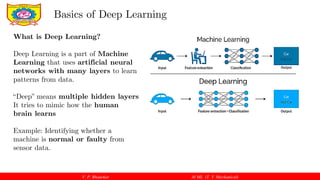
What is Deep Learning?
Deep Learning is a part of Machine
Learning that uses artificial neural
networks with many layers to learn
patterns from data.
“Deep” means multiple hidden layers
It tries to mimic how the human
brain learns
Example: Identifying whether a
machine is normal or faulty from
sensor data.
Basics of Deep Learning
V. P. Bhaurkar AI ML (T. Y. Mechanical)
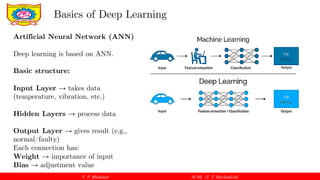
Artificial Neural Network (ANN)
Deep learning is based on ANN.
Basic structure:
Input Layer → takes data
(temperature, vibration, etc.)
Hidden Layers → process data
Output Layer → gives result (e.g.,
normal/faulty)
Each connection has:
Weight → importance of input
Bias → adjustment value
Basics of Deep Learning
V. P. Bhaurkar AI ML (T. Y. Mechanical)
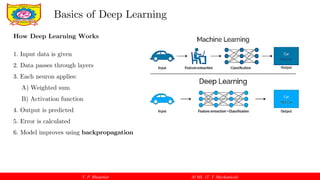
How Deep Learning Works
1. Input data is given
2. Data passes through layers
3. Each neuron applies:
A) Weighted sum
B) Activation function
4. Output is predicted
5. Error is calculated
6. Model improves using backpropagation
Basics of Deep Learning
V. P. Bhaurkar AI ML (T. Y. Mechanical)
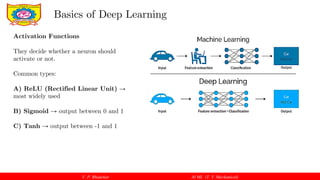
Activation Functions
They decide whether a neuron should
activate or not.
Common types:
A) ReLU (Rectified Linear Unit) →
most widely used
B) Sigmoid → output between 0 and 1
C) Tanh → output between -1 and 1
Basics of Deep Learning
V. P. Bhaurkar AI ML (T. Y. Mechanical)
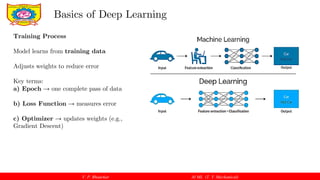
Training Process
Model learns from training data
Adjusts weights to reduce error
Key terms:
a) Epoch → one complete pass of data
b) Loss Function → measures error
c) Optimizer → updates weights (e.g.,
Gradient Descent)
Basics of Deep Learning
V. P. Bhaurkar AI ML (T. Y. Mechanical)
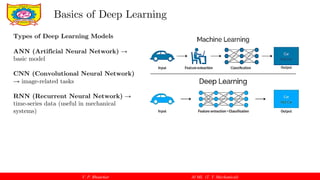
Types of Deep Learning Models
ANN (Artificial Neural Network) →
basic model
CNN (Convolutional Neural Network)
→ image-related tasks
RNN (Recurrent Neural Network) →
time-series data (useful in mechanical
systems)
Basics of Deep Learning
V. P. Bhaurkar AI ML (T. Y. Mechanical)
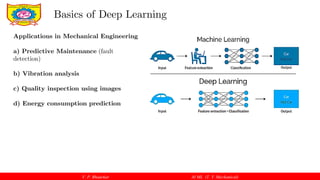
Applications in Mechanical Engineering
a) Predictive Maintenance (fault
detection)
b) Vibration analysis
c) Quality inspection using images
d) Energy consumption prediction
Basics of Deep Learning
V. P. Bhaurkar AI and ML (T. Y. Mechanical)
Thank You !