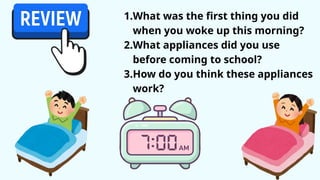
1.What was thefirst thing you did
when you woke up this morning?
2.What appliances did you use
before coming to school?
3.How do you think these appliances
work?
4.
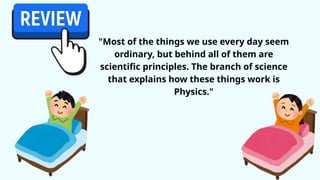
"Most of thethings we use every day seem
ordinary, but behind all of them are
scientific principles. The branch of science
that explains how these things work is
Physics."
5.
A day withoutPhysics
Divide the class into groups of 4–5 students.
Assign one scenario to each group.
Group 1 – No electric fan
Group 2 – No refrigerator
Group 3 – No washing machine
Group 4 – No cellphone charger
Group 5 – No rice cooker
6.
A day without
Physics
•What would happen if this appliance did
not exist?
• How would your daily routine change?
• What tasks would become difficult?
7.
A day withoutPhysics
• What did you notice about these
appliances?
• Why did life become more difficult
without them?
• What makes these appliances work?
• Can we imagine modern life without the
principles of Physics?
8.
A day withoutPhysics
"Many of the things that make our lives
easier exist because of Physics. Physics is
not just about formulas and
computations. It is a science that helps
improve our everyday lives."
9.
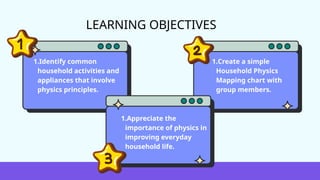
LEARNING OBJECTIVES
1.Identify common
householdactivities and
appliances that involve
physics principles.
1.Create a simple
Household Physics
Mapping chart with
group members.
1.Appreciate the
importance of physics in
improving everyday
household life.
PHYSICS
1.Why do objectsfall to the ground?
2.Why does an electric fan spin?
3.Why does a flat iron become hot?
4.How does a cellphone charge?
12.
PHYSICS
is the sciencethat studies how things
move and interact in the world
around us. It tries to understand the
basic rules that govern the universe
— from tiny atoms to huge planets
and galaxies.
13.
PHYSICS
In simple terms:
Physicsasks questions like:
■ Why do things fall down?
■ How does light travel?
■ What makes things move?
■ What is energy, and how is it used?
14.
PHYSICS
Some everyday examplesof physics:
■ A ball falling (gravity)
■ A car speeding up or slowing down (motion
and force)
■ Electricity turning on a light (energy and
circuits)
■ Sound coming from a speaker (vibrations and
waves)
PHYSICS
We need tostudy physics because it helps us understand how
the world works — and that understanding helps us solve
problems, build things, and improve our lives.
Here's why physics is important (in simple terms):
■ Explains everyday things
■ Helps create technology
■ Solves real-world problems
■ Trains your brain
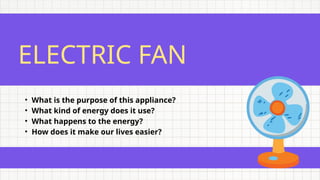
ELECTRIC FAN
• Whatis the purpose of this appliance?
• What kind of energy does it use?
• What happens to the energy?
• How does it make our lives easier?
19.
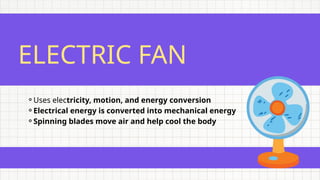
ELECTRIC FAN
⚬Uses electricity,motion, and energy conversion
⚬Electrical energy is converted into mechanical energy
⚬Spinning blades move air and help cool the body
20.
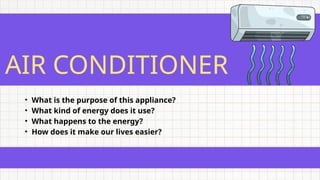
AIR CONDITIONER
• Whatis the purpose of this appliance?
• What kind of energy does it use?
• What happens to the energy?
• How does it make our lives easier?
21.
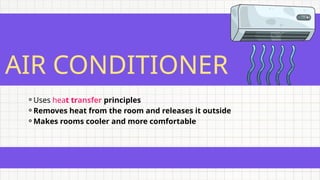
AIR CONDITIONER
⚬Uses heattransfer principles
⚬Removes heat from the room and releases it outside
⚬Makes rooms cooler and more comfortable
22.
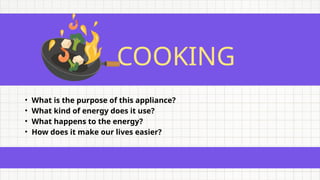
COOKING
• What isthe purpose of this appliance?
• What kind of energy does it use?
• What happens to the energy?
• How does it make our lives easier?
23.
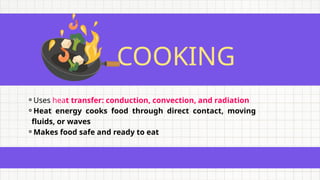
COOKING
⚬Uses heat transfer:conduction, convection, and radiation
⚬Heat energy cooks food through direct contact, moving
fluids, or waves
⚬Makes food safe and ready to eat
24.
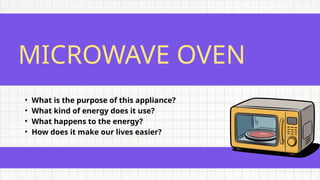
MICROWAVE OVEN
• Whatis the purpose of this appliance?
• What kind of energy does it use?
• What happens to the energy?
• How does it make our lives easier?
25.
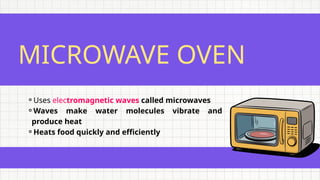
MICROWAVE OVEN
⚬Uses electromagneticwaves called microwaves
⚬Waves make water molecules vibrate and
produce heat
⚬Heats food quickly and efficiently
26.
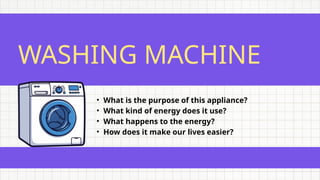
WASHING MACHINE
• Whatis the purpose of this appliance?
• What kind of energy does it use?
• What happens to the energy?
• How does it make our lives easier?
27.
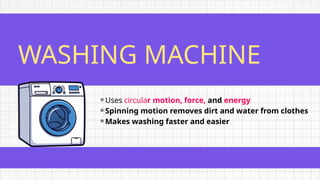
WASHING MACHINE
⚬Uses circularmotion, force, and energy
⚬Spinning motion removes dirt and water from clothes
⚬Makes washing faster and easier
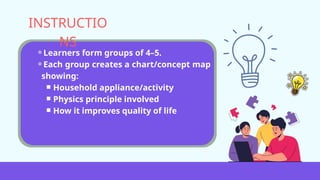
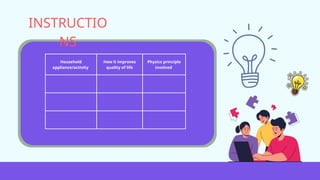
⚬Learners form groupsof 4–5.
⚬Each group creates a chart/concept map
showing:
■ Household appliance/activity
■ Physics principle involved
■ How it improves quality of life
INSTRUCTIO
NS