Explore the nature of dark matter, current theories like WIMPs and axions, its role in cosmic structure, and ongoing detection methods including direct and indirect experiments.
Unveiling the Mysteriesof Dark Matter:
the nature of dark matter, Current
theories, its impact on the Universe’s
structure, and ongoing detection efforts
Presented by: Ali Mustafa Khan
University of Sargodha
2.
Objectives oftopic
Dark Matter
Nature of Dark Matter
Current Theories
Impact on Universe Structure
Current detection Efforts
Compendium
3.
•To know aboutfundamental nature of Universe
•To study its nature
•Current Developments
•Interesting theories
•Detection Manner
Objectives
4.
Dark Matter
Mysterious Substance
thatmade 27% of the
universe.
It doesn’t emit, absorb
or reflect light
We know it exists
because of its
gravitational effects on
stars, galaxies, and
galaxy clusters.
Even though we can't see
it directly, we can detect
its presence through its
gravitational pull
(Gravitational lensing)
Ordinary matter also known
as Baryonic matter, is the
stuff that makes up
everything we see and touch
It's composed of atoms, which
are made up of protons,
neutrons, and electrons
Basically, if you can see or feel
something, it's probably made
of ordinary matter.
5.
o Invisible andNon Luminous
Dark matter does not emit, absorb, or reflect
light,making it invisible to telescopes that rely on
detecting electromagnetic radiation.
o Massive and Slow Moving
Dark matter particles are hypothesized to be
massive compared to known particles like
electrons or neutrinos. They also move relatively
slowly due to their gravitational interactions.
Nature of Dark Matter
6.
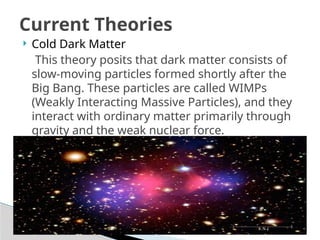
Cold DarkMatter
This theory posits that dark matter consists of
slow-moving particles formed shortly after the
Big Bang. These particles are called WIMPs
(Weakly Interacting Massive Particles), and they
interact with ordinary matter primarily through
gravity and the weak nuclear force.
Current Theories
7.
Warm Dark Matter
Thisalternative theory
suggests that dark
matter particles have
lighter masses and
higher velocities than
those proposed by
CDM. This would
suppress the
formation of small-
scale structures in the
universe
Axion Theory
1) A hypothetical particle having no
charge, zero spin and small mass.
2) As cold dark matter candidates,
axions would have been produced
abundantly in the early universe and
would behave as cold, collisionless
particles.
8.
Galaxy formation
Darkmatter plays a crucial role in the formation and
evolution of galaxies. Its gravitational influence helps
galaxies form and holds them together.
Cosmic Microwave Background
The cosmic microwave background radiation provides
evidence for the presence of dark matter through its
effect on the early universe's density fluctuations.
Large Scale Structure
Dark matter forms the scaffolding upon which
galaxies and galaxy clusters are built. It influences the
distribution of matter on the largest scales in the
universe.
Impact on Universe Structure
9.
Direct DetectionExperiments: These
experiments aim to detect dark matter
particles directly through their interactions
with ordinary matter. They typically involve
sensitive detectors placed deep underground
to shield from cosmic rays.
Indirect Detection: Indirect methods look for
the products of dark matter annihilation or
decay, such as gamma rays, neutrinos, or
cosmic rays. These experiments involve
searching for anomalous signals from regions
rich in dark matter.
Current Detection Efforts
10.
Astrophysical Observations:
Astronomers useobservations of
galaxies, galaxy clusters, and
gravitational lensing to infer the presence
and distribution of dark matter in the
universe.