Dark matter (1) asaaaaaaaaaaaaaaaaaaaaaaaaaaaaaaaaaaaaaaaaaaaaaaaaaaaaaaaaaaaaaaaaaaaaaaaaaaaaaaaaaaaaaaaa.pptx
1.
The Silent Pillar:
DarkMatter & The
Universe’s Foundation
Prepared By:
Sibansha Rath
+3 IIIrd Year Science
BS(P)22-015
Under The Guidance Of:
Mr. Subodha Kumar Jagdev
Lecturer in Physics
2.
Topics To BeCovered
• Introduction
• Properties Of Dark Matter
• Observational Evidence
• What Is Dark Matter Made Up Of ?
3.
Introduction
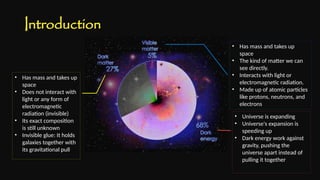
• Has massand takes up
space
• The kind of matter we can
see directly.
• Interacts with light or
electromagnetic radiation.
• Made up of atomic particles
like protons, neutrons, and
electrons
• Has mass and takes up
space
• Does not interact with
light or any form of
electromagnetic
radiation (invisible)
• Its exact composition
is still unknown
• Invisible glue: It holds
galaxies together with
its gravitational pull
• Universe is expanding
• Universe's expansion is
speeding up
• Dark energy work against
gravity, pushing the
universe apart instead of
pulling it together
4.
Properties of DarkMatter
• It must be Dark (Invisible)
• It interacts via gravitational interaction
• It either doesn’t interact with itself & other matters or interacts very
weakly
• It must be cold i.e. dark matter particles must move slowly
• It must be stable
Fritz Zwicky’s observationon Coma Galaxy
Cluster
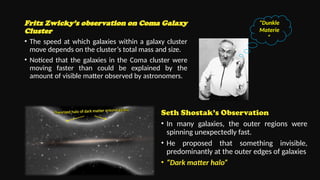
• The speed at which galaxies within a galaxy cluster
move depends on the cluster’s total mass and size.
• Noticed that the galaxies in the Coma cluster were
moving faster than could be explained by the
amount of visible matter observed by astronomers.
“Dunkle
Materie
”
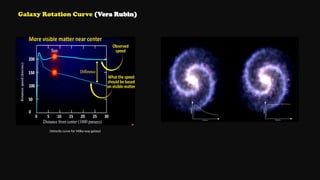
Seth Shostak’s Observation
• In many galaxies, the outer regions were
spinning unexpectedly fast.
• He proposed that something invisible,
predominantly at the outer edges of galaxies
• “Dark matter halo”
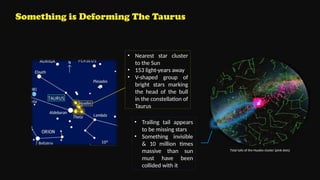
Something is DeformingThe Taurus
• Nearest star cluster
to the Sun
• 153 light-years away
• V-shaped group of
bright stars marking
the head of the bull
in the constellation of
Taurus
Tidal tails of the Hyades cluster (pink dots)
• Trailing tail appears
to be missing stars
• Something invisible
& 10 million times
massive than sun
must have been
collided with it
9.
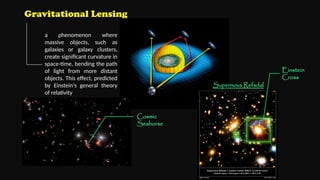
Gravitational Lensing
a phenomenonwhere
massive objects, such as
galaxies or galaxy clusters,
create significant curvature in
space-time, bending the path
of light from more distant
objects. This effect, predicted
by Einstein's general theory
of relativity
Cosmic
Seahorse
Einstein
Cross
Supernova Refsdal
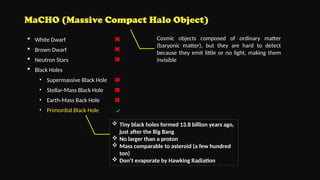
MaCHO (Massive CompactHalo Object)
White Dwarf
Brown Dwarf
Neutron Stars
Black Holes
• Supermassive Black Hole
• Stellar-Mass Black Hole
• Earth-Mass Back Hole
• Primordial Black Hole ✔
Tiny black holes formed 13.8 billion years ago,
just after the Big Bang
No larger than a proton
Mass comparable to asteroid (a few hundred
ton)
Don’t evaporate by Hawking Radiation
Cosmic objects composed of ordinary matter
(baryonic matter), but they are hard to detect
because they emit little or no light, making them
invisible
14.
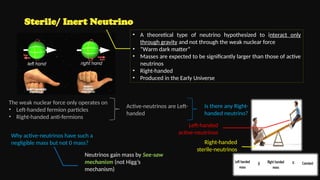
Sterile/ Inert Neutrino
•A theoretical type of neutrino hypothesized to interact only
through gravity and not through the weak nuclear force
• “Warm dark matter”
• Masses are expected to be significantly larger than those of active
neutrinos
• Right-handed
• Produced in the Early Universe
The weak nuclear force only operates on
• Left-handed fermion particles
• Right-handed anti-fermions
Active-neutrinos are Left-
handed
Is there any Right-
handed neutrino?
Why active-neutrinos have such a
negligible mass but not 0 mass?
Neutrinos gain mass by See-saw
mechanism (not Higg’s
mechanism)
Left-handed
active-neutrinos
Right-handed
sterile-neutrinos
15.
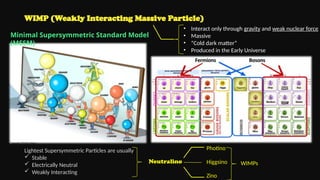
WIMP (Weakly InteractingMassive Particle)
Minimal Supersymmetric Standard Model
(MSSM)
Lightest Supersymmetric Particles are usually
Stable
Electrically Neutral
Weakly Interacting
Neutralino Higgsino
Zino
Photino
WIMPs
• Interact only through gravity and weak nuclear force
• Massive
• “Cold dark matter”
• Produced in the Early Universe
16.
SIMP (Strongly InteractingMassive Particle)
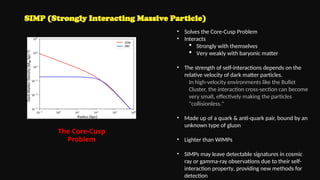
• Solves the Core-Cusp Problem
• Interacts
Strongly with themselves
Very weakly with baryonic matter
• The strength of self-interactions depends on the
relative velocity of dark matter particles.
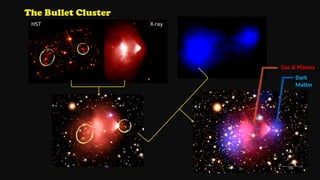
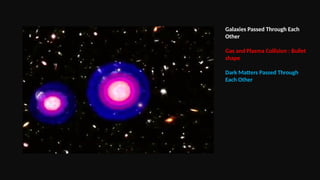
In high-velocity environments like the Bullet
Cluster, the interaction cross-section can become
very small, effectively making the particles
"collisionless."
• Made up of a quark & anti-quark pair, bound by an
unknown type of gluon
• Lighter than WIMPs
• SIMPs may leave detectable signatures in cosmic
ray or gamma-ray observations due to their self-
interaction property, providing new methods for
detection
The Core-Cusp
Problem
17.
Axion
Strong CP-Problem
According toQCD,
ℒQCD = ℒINVARIANT + θ ℒVIOLATING
Where, θ is a constant.
Strong interaction violates CP-symmetry
Neutron has Electeic dipole moment
Reality,
Neutron has no Electric
dipole moment
Strong interaction is CP-
symmetric
Peccei-Quinn (PQ)
symmetry
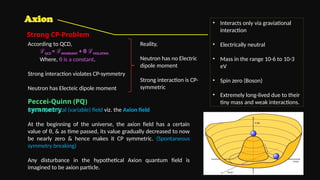
θ is a dynamical (variable) field viz. the Axion field
At the beginning of the universe, the axion field has a certain
value of θ, & as time passed, its value gradually decreased to now
be nearly zero & hence makes it CP symmetric. (Spontaneous
symmetry breaking)
Any disturbance in the hypothetical Axion quantum field is
imagined to be axion particle.
• Interacts only via graviational
interaction
• Electrically neutral
• Mass in the range 10-6 to 10-3
eV
• Spin zero (Boson)
• Extremely long-lived due to their
tiny mass and weak interactions.
18.
MOND (Modified NewtonianDynamics)
Modifies the Newton’s Laws of Motion, to explain
the velocity anomaly
Neutron Stars: Axion Factory
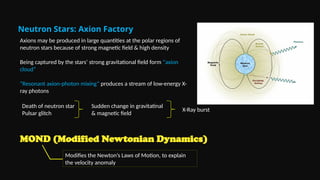
Axions may be produced in large quantities at the polar regions of
neutron stars because of strong magnetic field & high density
Being captured by the stars’ strong gravitational field form “axion
cloud”
“Resonant axion-photon mixing” produces a stream of low-energy X-
ray photons
Death of neutron star
Pulsar glitch
Sudden change in gravitatinal
& magnetic field
X-Ray burst