


Cytology Excellence Manual Dr J L Meena
Cytology Excellence Manual – Dr J L Meena | Page 1
CYTOLOGY
EXCELLENCE MANUAL
Global Standards for Cytology Excellence, Screening Safety, and Quality Healthcare
A Comprehensive Reference for
THE MULTIDISCIPLINARY CYTOLOGY TEAM
Cytopathologists • Cytotechnologists • Screening Specialists • Rapid On-Site Evaluation & Allied Cytology
Professionals
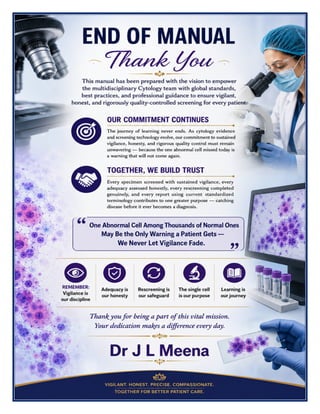
“One Abnormal Cell Among Thousands of Normal Ones May Be the Only Warning a Patient
Gets — We Never Let Vigilance Fade.”
Dr J L Meena
Cytology Excellence Manual Dr J L Meena
Cytology Excellence Manual – Dr J L Meena | Page 2
DEDICATION
This book is dedicated to all those who are committed to advancing healthcare through a discipline unlike almost
any other in diagnostics: most of the people whose cells pass beneath a cytology screener's eyes are not sick at all,
and the entire purpose of that examination is to find the rare, single abnormal cell among thousands of normal ones
before that person ever becomes a patient with a diagnosis — a search that must never let its own success, day after
day of genuinely normal results, become the reason vigilance quietly fades.
To Every Person Whose Screening Test Found Nothing Wrong, Because There Was Genuinely Nothing to Find
For whom a Pap smear screened with the same rigour on the ten-thousandth normal slide as on the first represents
a promise kept: that a truly clean result was never the product of fatigue or complacency, but of genuine, sustained
vigilance.
To Every Patient Whose Single Abnormal Cell Was Found in Time
For whom a cervical cancer caught at its earliest, most treatable stage, or a malignancy identified through a fine
needle aspiration before more invasive surgery was needed, began with a cytotechnologist who saw one abnormal
cell among thousands of normal ones and did not let it pass.
To My Family
For their unwavering love, patience, and encouragement, which have been the foundation of this journey.
To My Mentors & Teachers
For inspiring my passion, guiding my path, and instilling in me the understanding that cytology is built on a paradox
unlike most of diagnostic medicine: it screens overwhelmingly healthy populations for a disease that, in the vast
majority of slides examined, genuinely is not there, and that this very rarity is what makes sustained, fatigue-resistant
vigilance the discipline's central and most difficult obligation.
To My Colleagues & Friends
For their support, collaboration, and shared dedication to a discipline where a screener's ninety-ninth slide of the
day deserves the same unwavering attention as their first, because the patient whose single abnormal cell appears
on that ninety-ninth slide has no way of knowing it was their screener's last slide before a break.
To Every Member of the Cytology Team
Cytopathologists, cytotechnologists, screening specialists, and every professional who has looked at cell after normal
cell without ever letting that repetition dull the eye that might catch the one that is not — the guardians of a warning
that, for an asymptomatic patient, may be the only one they will ever be given.
Your vigilance, your screening discipline, and your unwavering commitment to finding one abnormal cell among
thousands of normal ones are the silent pillars of a healthcare system that catches disease before it ever
becomes a diagnosis. This book is for you, and because of you. Thank you to everyone who has been a part of
this journey.
Dr J L Meena
Cytology Excellence Manual Dr J L Meena
Cytology Excellence Manual – Dr J L Meena | Page 3
FOREWORD
There is a discipline in laboratory medicine built on a paradox unlike most of diagnostic medicine: it screens
overwhelmingly healthy populations for a disease that, in the vast majority of specimens examined, genuinely
is not there. A cytology screener examining a Pap smear is not looking at a symptomatic patient with a known
lesion, the way a histopathologist examines a biopsy already suspected of malignancy — they are searching,
among thousands of entirely normal cells, for the rare single abnormal cell that may be the only warning a
genuinely asymptomatic person will ever receive that something is beginning to go wrong. This very rarity is
what makes cytology's central obligation so demanding: sustained, fatigue-resistant vigilance across specimen
after specimen where the honest, correct answer is almost always “normal,” without ever letting that
repetition become the reason the one abnormal slide is missed.
The “Cytology Excellence Manual: Global Standards for Cytology Excellence, Screening Safety, and Quality
Healthcare” has been developed to provide a comprehensive professional framework for the multidisciplinary
Cytology team — cytopathologists, cytotechnologists, screening specialists, and allied rapid on-site evaluation
professionals — working together to find the single abnormal cell among thousands of normal ones, every
time, without exception.
This manual brings together internationally recognized principles of rigorous screening quality control and
rescreening protocols, adequacy assessment for both gynaecological and non-gynaecological specimens,
standardized Bethesda System reporting, rapid on-site evaluation (ROSE) supporting fine needle aspiration
procedures, cytology-histology correlation as a quality safeguard, and screener workload and fatigue
management. It is built around globally accepted accreditation frameworks — WHO cervical cancer screening
guidelines, NABH, JCI, and international standards from the College of American Pathologists (CAP) and the
American Society of Cytopathology (ASC) — to provide a rigorous, regulation-compliant framework for
Cytology excellence.
The chapters of this manual guide the Cytology team through every dimension of the role — from disciplined,
fatigue-resistant screening and rigorous specimen adequacy assessment, through standardized Bethesda
reporting and rapid on-site evaluation, to cytology-histology correlation and honest management of workload
that could otherwise erode vigilance, and the professional conduct that defines excellence across every
category of cytological diagnosis: the ten-thousandth Pap smear of the year screened with the same rigour as
the first, the fine needle aspiration whose immediate on-site adequacy assessment determines whether a
patient undergoes one needle pass or several, and the single abnormal cell that, found in time, becomes an
early diagnosis rather than a missed warning.
Cytology is not simply a laboratory service that examines cells — it is a distinct discipline built on the
understanding that screening an overwhelmingly healthy population demands a vigilance that must resist its
own success, that a false negative in an asymptomatic screening population can mean a patient's only warning
sign was missed and never repeated, and that this team's discipline against fatigue and complacency is what
makes population-based cancer screening genuinely protective rather than a false reassurance. Their work is
Cytology Excellence Manual Dr J L Meena
Cytology Excellence Manual – Dr J L Meena | Page 4
defined by an attentiveness that must never relax, because the abnormal cell missed on an ordinary day is a
warning that will not come again.
It is hoped that this manual will serve as an indispensable resource for Cytopathologists, Cytotechnologists,
Screening Specialists, hospital administrators, quality heads, and all those committed to building a healthcare
system where the one abnormal cell among thousands of normal ones is never the one that gets away.
“One Abnormal Cell Among Thousands of Normal Ones May Be the Only Warning a Patient Gets — We
Never Let Vigilance Fade.”
With Best Wishes, Dr J L Meena
Cytology Excellence Manual Dr J L Meena
Cytology Excellence Manual – Dr J L Meena | Page 5
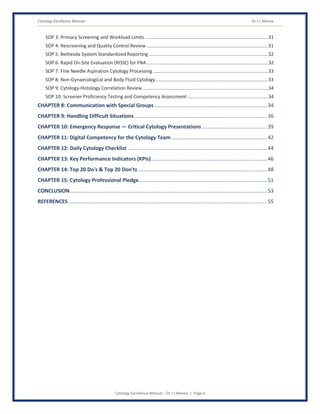
TABLE OF CONTENTS
FOREWORD............................................................................................................................................3
LIST OF ABBREVIATIONS........................................................................................................................8
MANUAL MOTTO.................................................................................................................................10
CHAPTER 1: Introduction.....................................................................................................................11
Purpose...........................................................................................................................................................11
Objectives .......................................................................................................................................................12
Vision & Mission .............................................................................................................................................13
CHAPTER 2: Role of the Cytology Team in Quality Healthcare ..........................................................14
Screening Quality Control & Fatigue Management........................................................................................14
Specimen Adequacy Assessment....................................................................................................................14
Standardized Bethesda System Reporting......................................................................................................15
Rapid On-Site Evaluation (ROSE) ....................................................................................................................15
Fine Needle Aspiration Cytology (FNAC).........................................................................................................16
Non-Gynaecological Cytology.........................................................................................................................16
Cytology-Histology Correlation.......................................................................................................................17
Rescreening & Proficiency Testing..................................................................................................................17
CHAPTER 3: Professional Standards for the Cytology Team ..............................................................17
Professional Appearance & Behaviour ...........................................................................................................17
Communication Standards .............................................................................................................................18
Confidentiality & Information Security...........................................................................................................19
Ethical Standards ............................................................................................................................................19
Time Management, Teamwork & Continuous Learning.................................................................................20
CHAPTER 4: Clinician- and Patient-Centered Communication in Cytology........................................21
The A-T-C-R-C Communication Model............................................................................................................21
Communicating Screening Results & Adequacy Limitations...........................................................................22
CHAPTER 5: Patient Safety and Screening Standards.........................................................................24
The R-T-A-C-A Framework ..............................................................................................................................24
Daily Quality Standards Checklist ...................................................................................................................26
CHAPTER 6: Confidentiality, Privacy, and Information Security ........................................................28
Privacy in Cytology Practice............................................................................................................................28
Cybersecurity of Cytology Information Systems.............................................................................................29
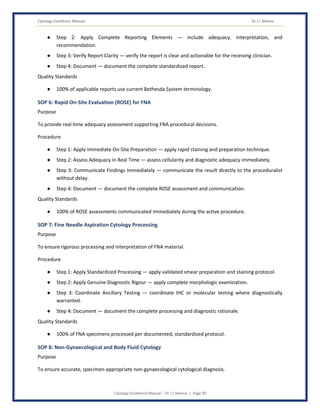
CHAPTER 7: Standard Operating Procedures (SOPs)..........................................................................30
SOP 1: Specimen Collection, Labelling, and Preparation................................................................................30
SOP 2: Specimen Adequacy Assessment ........................................................................................................30
Cytology Excellence Manual Dr J L Meena
Cytology Excellence Manual – Dr J L Meena | Page 6
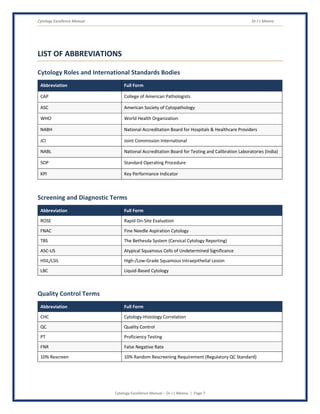
SOP 3: Primary Screening and Workload Limits .............................................................................................31
SOP 4: Rescreening and Quality Control Review ............................................................................................31
SOP 5: Bethesda System Standardized Reporting ..........................................................................................32
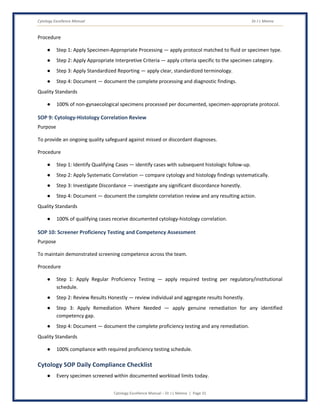
SOP 6: Rapid On-Site Evaluation (ROSE) for FNA............................................................................................32
SOP 7: Fine Needle Aspiration Cytology Processing .......................................................................................33
SOP 8: Non-Gynaecological and Body Fluid Cytology.....................................................................................33
SOP 9: Cytology-Histology Correlation Review...............................................................................................34
SOP 10: Screener Proficiency Testing and Competency Assessment .............................................................34
CHAPTER 8: Communication with Special Groups..............................................................................34
CHAPTER 9: Handling Difficult Situations ...........................................................................................36
CHAPTER 10: Emergency Response — Critical Cytology Presentations.............................................39
CHAPTER 11: Digital Competency for the Cytology Team..................................................................42
CHAPTER 12: Daily Cytology Checklist ................................................................................................44
CHAPTER 13: Key Performance Indicators (KPIs)................................................................................46
CHAPTER 14: Top 20 Do's & Top 20 Don'ts.........................................................................................48
CHAPTER 15: Cytology Professional Pledge........................................................................................51
CONCLUSION........................................................................................................................................53
REFERENCES.........................................................................................................................................55
Cytology Excellence Manual Dr J L Meena
Cytology Excellence Manual – Dr J L Meena | Page 7
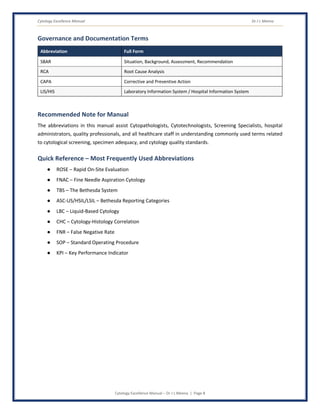
LIST OF ABBREVIATIONS
Cytology Roles and International Standards Bodies
Abbreviation Full Form
CAP College of American Pathologists
ASC American Society of Cytopathology
WHO World Health Organization
NABH National Accreditation Board for Hospitals & Healthcare Providers
JCI Joint Commission International
NABL National Accreditation Board for Testing and Calibration Laboratories (India)
SOP Standard Operating Procedure
KPI Key Performance Indicator
Screening and Diagnostic Terms
Abbreviation Full Form
ROSE Rapid On-Site Evaluation
FNAC Fine Needle Aspiration Cytology
TBS The Bethesda System (Cervical Cytology Reporting)
ASC-US Atypical Squamous Cells of Undetermined Significance
HSIL/LSIL High-/Low-Grade Squamous Intraepithelial Lesion
LBC Liquid-Based Cytology
Quality Control Terms
Abbreviation Full Form
CHC Cytology-Histology Correlation
QC Quality Control
PT Proficiency Testing
FNR False Negative Rate
10% Rescreen 10% Random Rescreening Requirement (Regulatory QC Standard)
Cytology Excellence Manual Dr J L Meena
Cytology Excellence Manual – Dr J L Meena | Page 8
Governance and Documentation Terms
Abbreviation Full Form
SBAR Situation, Background, Assessment, Recommendation
RCA Root Cause Analysis
CAPA Corrective and Preventive Action
LIS/HIS Laboratory Information System / Hospital Information System
Recommended Note for Manual
The abbreviations in this manual assist Cytopathologists, Cytotechnologists, Screening Specialists, hospital
administrators, quality professionals, and all healthcare staff in understanding commonly used terms related
to cytological screening, specimen adequacy, and cytology quality standards.
Quick Reference – Most Frequently Used Abbreviations
● ROSE – Rapid On-Site Evaluation
● FNAC – Fine Needle Aspiration Cytology
● TBS – The Bethesda System
● ASC-US/HSIL/LSIL – Bethesda Reporting Categories
● LBC – Liquid-Based Cytology
● CHC – Cytology-Histology Correlation
● FNR – False Negative Rate
● SOP – Standard Operating Procedure
● KPI – Key Performance Indicator
Cytology Excellence Manual Dr J L Meena
Cytology Excellence Manual – Dr J L Meena | Page 9
MANUAL MOTTO
“One Abnormal Cell Among Thousands of Normal Ones”
“May Be the Only Warning a Patient Gets —”
“We Never Let Vigilance Fade.”
Cytology Excellence Manual Dr J L Meena
Cytology Excellence Manual – Dr J L Meena | Page 10
CHAPTER 1: INTRODUCTION
1. Purpose
There is a discipline in laboratory medicine built on a paradox unlike most of diagnostic medicine: it screens
overwhelmingly healthy populations for a disease that, in the vast majority of specimens examined, genuinely
is not there. A cytology screener is not looking at a symptomatic patient with a known lesion — they are
searching, among thousands of entirely normal cells, for the rare single abnormal cell that may be the only
warning a genuinely asymptomatic person will ever receive. This manual exists because this very rarity makes
sustained, fatigue-resistant vigilance across specimen after specimen the discipline's central and most
demanding obligation.
The World Health Organization and international cytology bodies — CAP, ASC — recognize that disciplined
screening quality control, rigorous rescreening protocols, and careful workload management are directly and
measurably linked to reduced false-negative rates in cervical cancer screening and other cytological diagnosis.
Research consistently demonstrates that cytology laboratories applying standardized adequacy assessment,
mandatory rescreening quality control, and evidence-based screener workload limits achieve dramatically and
measurably lower false-negative rates than laboratories where any of these safeguards is treated as optional,
particularly at high screening volume. In institutions where the Cytology team applies systematic screening
discipline, honest adequacy assessment, and rigorous quality control, patient outcomes are demonstrably and
measurably better. The investment in Cytology excellence is, without qualification, one of the highest-yield
investments any healthcare system can make — catching disease before it ever becomes a diagnosis.
Why the Cytology Team Is Critical to Healthcare Quality
● Provides population-based screening that catches cancer and precancerous change before symptoms
ever appear.
● Applies rigorous, fatigue-resistant screening discipline preventing the false-negative result an
asymptomatic patient may never have a second warning for.
● Delivers honest specimen adequacy assessment, ensuring an inadequate specimen is never forced into
a false sense of reassurance.
● Applies standardized Bethesda System reporting supporting consistent, actionable clinical
communication.
● Provides real-time rapid on-site evaluation guiding fine needle aspiration procedures toward
diagnostic adequacy.
● Applies rigorous cytology-histology correlation as an ongoing quality safeguard against missed or
discordant diagnoses.
● Maintains mandatory rescreening and proficiency testing protecting against individual screener error.
● Contributes to accreditation compliance (NABH, JCI, NABL, CAP) for cytology laboratory standards.
Cytology Excellence Manual Dr J L Meena
Cytology Excellence Manual – Dr J L Meena | Page 11
Key Responsibilities of the Cytology Team
● Applying disciplined, fatigue-resistant primary screening to every specimen, regardless of volume or
time of day.
● Applying honest, standardized specimen adequacy assessment.
● Applying standardized Bethesda System terminology for every applicable report.
● Providing real-time rapid on-site evaluation supporting fine needle aspiration adequacy.
● Applying rigorous quality control through mandatory rescreening and proficiency testing.
● Applying systematic cytology-histology correlation review.
● Managing screener workload to prevent fatigue-related diagnostic error.
● Engaging in continuous professional development to maintain competence in evolving cytology
evidence.
2. Objectives
1. Sustain Vigilance Against Its Own Success
Every specimen must be screened with the same rigour whether it is the first of the day or the last — this is
the Cytology team's foundational, non-negotiable obligation, because the patient whose single abnormal cell
appears on a fatigued screener's last slide has no way of knowing it.
How to Achieve:
● Apply evidence-based screener workload limits preventing fatigue-related error.
● Apply mandatory rescreening and proficiency testing as ongoing quality safeguards.
● Never allow screening volume pressure to compress the time genuine vigilance requires.
2. Assess Specimen Adequacy Honestly
● Apply standardized, honest adequacy criteria for every specimen type.
● Never force a diagnosis from an inadequate specimen; report it as inadequate and recommend repeat
collection.
3. Apply Standardized, Actionable Reporting
● Apply current Bethesda System terminology consistently for cervical cytology.
● Apply standardized, clear reporting for non-gynaecological cytology.
4. Support Real-Time Procedural Decision-Making
● Provide accurate, immediate rapid on-site evaluation during fine needle aspiration procedures.
● Communicate ROSE findings clearly, guiding the proceduralist toward diagnostic adequacy.
5. Apply Rigorous Quality Control
● Apply mandatory rescreening per regulatory and institutional protocol.
● Apply systematic cytology-histology correlation, reviewing discordance honestly.
Cytology Excellence Manual Dr J L Meena
Cytology Excellence Manual – Dr J L Meena | Page 12
6. Maintain Regulatory and Accreditation Compliance
● Comply with national cytology laboratory standards and international accreditation guidelines.
● Maintain NABH/JCI/NABL/CAP cytology documentation standards.
● Participate in accreditation surveys with complete, auditable screening, adequacy, and quality control
records.
3. Vision
Vision Statement
“To build and maintain a Cytology service where every specimen is screened with vigilance that never fades,
every adequacy assessment is honest, every report uses standardized terminology, and no patient's single
warning sign is ever missed to fatigue or complacency.”
4. Mission
Mission Statement
“To deliver disciplined, fatigue-resistant, and rigorously quality-controlled cytological screening and diagnosis
that finds the rare abnormal cell among thousands of normal ones, through honest adequacy assessment,
standardized reporting, and systematic rescreening and correlation safeguards, enabling population-based
cancer screening the healthcare organization and its patients can trust completely.”
Expected Outcomes of an Excellent Cytology Practice
● 100% of specimens screened within documented, evidence-based screener workload limits.
● 100% of specimens receive documented, honest adequacy assessment.
● 100% of applicable cervical cytology reports use current Bethesda System terminology.
● 100% of qualifying cases receive documented rescreening and cytology-histology correlation.
● Full compliance with national cytology laboratory standards and international accreditation guidelines.
The Cytology team searches, among thousands of entirely normal cells, for the rare single abnormal cell
that may be a genuinely asymptomatic patient's only warning — their fatigue-resistant screening
discipline, honest adequacy assessment, and rigorous quality control ensure that this warning, when it
exists, is never the one that gets away.
Cytology Excellence Manual Dr J L Meena
Cytology Excellence Manual – Dr J L Meena | Page 13
CHAPTER 2: ROLE OF THE CYTOLOGY TEAM IN QUALITY HEALTHCARE
1. Screening Quality Control and Fatigue Management
Overview
Screening an overwhelmingly normal population demands vigilance that must resist its own success —
evidence-based workload limits and fatigue management protect against the false-negative risk that repetitive,
largely normal findings can create.
Responsibilities
● Apply evidence-based screener workload limits preventing fatigue-related error.
● Apply structured breaks and workload distribution protecting sustained attentiveness.
2. Specimen Adequacy Assessment
Overview
An inadequate specimen reported as though it were adequate can provide false reassurance to a patient who
genuinely needs repeat screening — honest adequacy assessment is a foundational safeguard against this risk.
Responsibilities
● Apply standardized, honest adequacy criteria for every specimen type.
● Never force a diagnosis from inadequate material; report and recommend repeat collection instead.
3. Standardized Bethesda System Reporting
Overview
Standardized terminology ensures every clinician receiving a cervical cytology report understands precisely
what was found and what action it requires, regardless of which laboratory issued the report.
Responsibilities
● Apply current Bethesda System terminology consistently for every applicable report.
● Apply clear, actionable management recommendations consistent with current guidelines.
4. Rapid On-Site Evaluation (ROSE)
Overview
Real-time evaluation during fine needle aspiration procedures determines whether the sample obtained is
diagnostically adequate, directly reducing the number of needle passes and repeat procedures a patient must
undergo.
Cytology Excellence Manual Dr J L Meena
Cytology Excellence Manual – Dr J L Meena | Page 14
Responsibilities
● Provide accurate, immediate adequacy assessment during the procedure.
● Communicate findings clearly and immediately to the proceduralist, guiding further sampling as
needed.
5. Fine Needle Aspiration Cytology (FNAC)
Overview
FNAC provides a minimally invasive diagnostic alternative to surgical biopsy, requiring rigorous processing and
interpretation to deliver reliable results from limited cellular material.
Responsibilities
● Apply rigorous specimen processing and staining technique for FNA material.
● Apply genuine diagnostic rigour, seeking additional sampling or ancillary testing when warranted.
6. Non-Gynaecological Cytology
Overview
Body fluid, urine, and respiratory cytology extend cytological diagnosis beyond cervical screening, each with its
own adequacy and interpretive standards.
Responsibilities
● Apply specimen-appropriate processing and interpretive criteria for each non-gynaecological
specimen type.
● Apply standardized, clear reporting supporting appropriate clinical action.
7. Cytology-Histology Correlation
Overview
Systematically comparing cytology diagnoses against subsequent histologic findings is a core quality safeguard,
revealing discordance that might otherwise go undetected.
Responsibilities
● Apply systematic correlation review for all qualifying cases.
● Investigate and learn from any significant discordance honestly.
8. Rescreening and Proficiency Testing
Overview
Mandatory rescreening and regular proficiency testing protect against the individual screener error that even
the most diligent professional can experience, providing a systematic second layer of vigilance.
Cytology Excellence Manual Dr J L Meena
Cytology Excellence Manual – Dr J L Meena | Page 15
Responsibilities
● Apply mandatory rescreening per regulatory and institutional protocol.
● Participate regularly in proficiency testing, maintaining demonstrated screening competence.
How the Cytology Team Contributes to Quality Healthcare
● By managing screener fatigue proactively, the team protects against the false-negative risk that
repetitive, largely normal screening creates.
● By assessing adequacy honestly, the team ensures no patient receives false reassurance from an
inadequate specimen.
● By applying standardized reporting, the team ensures every clinician receiving a result understands
exactly what action it requires.
● By providing real-time ROSE, the team reduces the number of needle passes and repeat procedures
patients must undergo.
● By applying rigorous rescreening and correlation, the team catches the rare error any single screener,
however diligent, can make.
The Cytology team searches, among thousands of entirely normal cells, for the rare single abnormal cell
that may be a genuinely asymptomatic patient's only warning — their fatigue-resistant screening
discipline, honest adequacy assessment, and rigorous quality control ensure that this warning, when it
exists, is never the one that gets away.
Cytology Excellence Manual Dr J L Meena
Cytology Excellence Manual – Dr J L Meena | Page 16
CHAPTER 3: PROFESSIONAL STANDARDS FOR THE CYTOLOGY TEAM
Cytology practice requires an uncommon combination of sustained visual vigilance across specimens that are
overwhelmingly, genuinely normal, the discipline to resist the complacency that repetitive normal findings can
create, and honest adequacy assessment that never allows an inadequate specimen to masquerade as a
reassuring result. The standards that govern Cytology practice derive from patient safety science specific to a
discipline whose central risk is the erosion of vigilance through its own routine success.
1. Professional Appearance
Standards
Attire and Identification
● Wear appropriate laboratory attire, PPE, and ID badge as per hospital biosafety policy.
Professional Presence
● Maintain sustained, disciplined visual attention throughout every screening session.
● Model unwavering screening discipline that never relaxes, regardless of how many consecutive normal
specimens precede a given slide.
2. Professional Behaviour
Expected Behaviours
Screening Discipline
● Never exceed evidence-based workload limits, regardless of specimen backlog.
● Never allow a run of normal findings to reduce the attention given to the next specimen.
Adequacy Discipline
● Never report an inadequate specimen as adequate to avoid recommending repeat collection.
● Escalate immediately upon any identified quality control concern or discordant finding.
Accountability
● Own every screening decision, every adequacy assessment, and every diagnostic interpretation made
under this team's responsibility.
● Report and disclose critical incidents and adverse events honestly and promptly.
Collaborative Respect
● Treat every member of the multidisciplinary Cytology team — cytopathologist, cytotechnologist,
screening specialist — as an essential, equal safety partner.
Cytology Excellence Manual Dr J L Meena
Cytology Excellence Manual – Dr J L Meena | Page 17
Patient-Centered Focus
● Every screening decision and every adequacy assessment is ultimately about the single abnormal cell
that may be a genuinely asymptomatic patient's only warning — never about convenience or speed.
3. Communication Standards
Communication with Clinicians
● Communicate screening results and adequacy limitations honestly and completely.
● Communicate ROSE findings clearly and immediately during active procedures.
Communication Within the Team
● Communicate quality control concerns or discordant findings rapidly and clearly.
● Use structured handover tools (SBAR or equivalent) for every transfer of screening or diagnostic
responsibility.
● Escalate any workload concern or fatigue risk immediately and directly.
Written Communication Standards
● Cytology documentation must be accurate, contemporaneous, and complete, reflecting adequacy
assessment and diagnostic rationale.
● Reports must use standardized terminology and be free of language that could be misinterpreted by
the treating clinician.
4. Confidentiality and Information Security
Overview
Cytology involves sensitive diagnostic information, including cancer screening results, requiring heightened
confidentiality discipline.
Responsibilities
● Discuss specimen and screening information only in appropriate settings and only with those who have
a legitimate need to know.
● Protect access credentials for LIS/HIS and cytology information systems.
● Apply particular discretion for cancer screening findings.
5. Ethical Standards
Core Ethical Principles for Cytology Practice
Non-Maleficence
● Never allow a known workload excess or fatigue risk to persist unaddressed.
● Never report an inadequate specimen as adequate.
Cytology Excellence Manual Dr J L Meena
Cytology Excellence Manual – Dr J L Meena | Page 18
Beneficence
● Apply rigorous, evidence-based screening practice consistently, ensuring the most accurate result
achievable.
Honesty and Transparency
● Communicate adequacy limitations, genuine uncertainty, and any error honestly.
Justice and Equity
● Apply the same rigorous screening and adequacy standard to every specimen, regardless of setting or
volume.
6. Time Management and Prioritization
Clinical Priority Framework
● Immediate/Emergency: ROSE awaited during active FNA procedure — immediate response, no delay.
● Urgent: Significant abnormal finding requiring prompt communication — prompt escalation and
notification.
● Routine: Standard screening and reporting — managed within evidence-based workload limits, with
unwavering vigilance discipline.
7. Teamwork and Collaboration
Work Effectively With
● Interventional radiology and clinical proceduralists — for real-time ROSE coordination during FNA.
● Histopathology — for cytology-histology correlation review.
● Gynaecology and primary care — for cervical screening follow-up coordination.
● Quality department — for incident reporting, RCA, and accreditation support.
8. Professional Competence and Continuous Learning
Areas of Competence
● Screening methodology and fatigue management principles.
● Specimen adequacy assessment criteria across specimen types.
● Current Bethesda System terminology and reporting.
● Rapid on-site evaluation technique and communication.
● FMEA, RCA, and CAPA methodologies for cytology-specific quality improvement.
Continuous Learning
● Maintain current certification in relevant cytology competencies.
● Maintain current knowledge of evolving cytology evidence and guidelines (CAP, ASC, WHO).
Cytology Excellence Manual Dr J L Meena
Cytology Excellence Manual – Dr J L Meena | Page 19
● Engage with national and international cytology professional bodies.
● Participate regularly in proficiency testing and screening quality simulation training.
● Participate in NABH, JCI, NABL, and CAP accreditation training for cytology standards.
Professional Standards Checklist
● Have I remained within evidence-based workload limits today?
● Have I applied honest, standardized adequacy assessment to every specimen?
● Have I applied current Bethesda System terminology to every applicable report?
● Have I provided accurate, immediate ROSE for every active procedure?
● Have I completed mandatory rescreening and correlation review as required?
● Have I reported any incident or safety concern through the appropriate system?
Cytology professionalism is vigilance sustained against its own success — the team that screens the last
slide of a long day with the same rigour as the first, and that never lets an inadequate specimen
masquerade as reassurance, is the team that ensures a patient's one warning sign is never the one that
gets away.
Cytology Excellence Manual Dr J L Meena
Cytology Excellence Manual – Dr J L Meena | Page 20
CHAPTER 4: CLINICIAN- AND PATIENT-CENTERED COMMUNICATION IN
CYTOLOGY
Communication in Cytology must accomplish something genuinely distinctive: most patients receiving a
cytology screening result are not sick and were not expecting to become a patient at all, meaning the
communication of an abnormal finding must be honest and clear without unnecessarily alarming someone who
was, moments before, simply attending a routine screening appointment.
Why Communication Quality Matters in Cytology
● Clear communication of an adequacy limitation ensures a patient understands why repeat screening
is needed, rather than assuming a normal result when none was genuinely given.
● Honest communication of Bethesda System findings supports appropriate, timely follow-up rather
than either unnecessary alarm or false reassurance.
● Immediate, clear ROSE communication during an active procedure directly affects how many needle
passes a patient must undergo.
● Compassionate communication of a screening abnormality respects that this news often arrives
unexpectedly, to someone who did not anticipate becoming a patient that day.
The A-T-C-R-C Communication Model for Cytology
A — Acknowledge
Definition
Acknowledge the genuine, sometimes unexpected weight of a screening finding, recognizing the patient did
not anticipate this news.
Examples
● “I understand this may not be the news you were expecting from a routine screening — let's walk
through exactly what this finding means and what happens next.”
T — Listen (Elicit Genuine Understanding and Concerns)
Definition
Listen genuinely to the patient's or clinician's specific concerns about the finding and its implications.
C — Clarify (Communicate the Finding and Its Genuine Significance)
Definition
Communicate the Bethesda category or diagnostic finding, and its genuine clinical significance, in clear, honest
language.
Cytology Excellence Manual Dr J L Meena
Cytology Excellence Manual – Dr J L Meena | Page 21
Examples
● “This result shows some abnormal cells that need a closer look, but this is a common finding and does
not mean you have cancer — here is exactly what the next step involves.”
R — Respond (Answer Questions Honestly)
Definition
Respond to questions honestly, including honest disclosure of adequacy limitations or genuine diagnostic
uncertainty.
C — Confirm (Verify Understanding)
Definition
Confirm genuine understanding of the finding and the recommended follow-up, particularly for any required
repeat testing.
Communicating Screening Results and Adequacy Limitations
Principles for Communicating Screening Findings
● Communicate findings honestly, avoiding both unnecessary alarm and false reassurance for a
genuinely unexpected result.
● Explain Bethesda System terminology in clear, non-technical language supporting genuine patient
understanding.
Communicating Adequacy Limitations
● Communicate an inadequate specimen result clearly, ensuring the patient understands repeat
screening is genuinely necessary, not merely a formality.
● Avoid language that could be misread as a normal result when adequacy was not achieved.
Communicating ROSE Findings
● Communicate real-time adequacy findings directly and immediately to the proceduralist during active
FNA.
● Communicate any genuine limitation honestly, supporting the decision on further sampling.
Common Cytology Communication Mistakes to Avoid
● Communicating an inadequate specimen result in language that could be misread as reassuring.
● Using Bethesda terminology without ensuring genuine patient understanding of its clinical
significance.
● Delaying ROSE communication during an active procedure.
● Failing to acknowledge that an abnormal screening finding often arrives unexpectedly to someone
who did not anticipate becoming a patient.
Cytology Excellence Manual Dr J L Meena
Cytology Excellence Manual – Dr J L Meena | Page 22
Communication in Cytology must be honest with people who did not expect to become patients — the
team that communicates adequacy limitations clearly, screening findings without false reassurance or
unnecessary alarm, and ROSE results immediately protects every patient whose only warning may have
come from a routine screening appointment.
Cytology Excellence Manual Dr J L Meena
Cytology Excellence Manual – Dr J L Meena | Page 23
CHAPTER 5: PATIENT SAFETY AND SCREENING STANDARDS
Patient safety in Cytology is uniquely defined by vigilance sustained against its own success — a laboratory that
manages screener workload proactively, assesses adequacy honestly, and applies rigorous rescreening quality
control produces measurably better outcomes than one where any of these safeguards is compressed by
volume pressure. The R-T-A-C-A framework applies with particular intensity to a discipline whose greatest risk
is the gradual erosion of attention through the routine repetition of genuinely normal findings.
1. RESPECT
Definition
Treating every specimen's screening and every adequacy assessment as equally deserving of the Cytology
team's full vigilance, regardless of how many consecutive normal specimens preceded it.
How the Cytology Team Demonstrates Respect
● Respect for Every Slide's Individual Chance: Apply the same screening rigour to the hundredth slide as
to the first.
● Respect for Honest Adequacy: Never let convenience override an honest “inadequate” determination.
● Respect for Every Team Member's Vigilance: Value the screening specialist's careful review as highly
as the cytopathologist's final sign-out.
● Equal Service Standards: Apply the same rigorous protocol to every specimen, regardless of setting or
volume.
2. TIMELINESS
Definition
Recognizing and responding to real-time ROSE needs and urgent abnormal findings within timeframes that
protect patient safety, while never rushing the screening process that requires its full, uncompressed time to
sustain genuine vigilance.
Why Timeliness Is a Patient Safety Issue — and Why It Cuts Both Ways
A delayed ROSE communication during an active FNA can mean unnecessary additional needle passes for a
patient. Yet the opposite lesson applies equally: rushing screening to increase throughput is precisely the
shortcut that erodes the vigilance this discipline's central risk depends upon — a far more consequential error
than a longer, properly paced screening session. Timeliness in Cytology means responding immediately to real-
time procedural needs while refusing to compress the screening time genuine vigilance requires.
Cytology Timeliness Standards
● ROSE communication: immediate, during the active procedure, without delay.
Cytology Excellence Manual Dr J L Meena
Cytology Excellence Manual – Dr J L Meena | Page 24
● Primary screening: full, uncompressed time per specimen, within evidence-based workload limits,
regardless of volume pressure.
● Significant abnormal finding communication: prompt, without unnecessary delay.
3. ACCURACY
Definition
Applying every screening pass exactly, assessing every specimen's adequacy honestly, and applying
standardized terminology precisely, sustained without deviation across every specimen, regardless of how
repetitive the findings have been.
Why Accuracy Is Non-Negotiable in Cytology
A missed abnormal cell in a screening population may be the only warning that patient ever receives before
disease progresses. An inaccurately reported adequacy assessment can provide false reassurance to a patient
who genuinely needs repeat screening. Accuracy in Cytology, sustained across thousands of genuinely normal
specimens, is what separates a discipline that reliably protects an asymptomatic population from one whose
vigilance quietly erodes under its own routine.
Areas Requiring Cytology Accuracy
● Primary Screening: Every specimen must be examined completely, with genuine, sustained attention.
● Adequacy Assessment: Every specimen must be assessed honestly against standardized criteria.
● Bethesda Reporting: Every applicable report must use current, precise standardized terminology.
● Documentation: Every cytology record must accurately and completely reflect screening and adequacy
findings.
4. COMPASSION
Definition
Recognizing that most cytology patients did not anticipate becoming patients at all, and that genuine
compassion in communicating an unexpected finding is as important as screening accuracy itself.
How the Cytology Team Demonstrates Compassion
● Remember the Unexpecting Patient: A screening result arrives without the emotional preparation a
symptomatic diagnosis often carries.
● Communicate Honestly with Genuine Warmth: Avoiding both false alarm and false reassurance.
● Support Colleagues Through Fatigue Honestly: A culture that allows screeners to flag genuine fatigue
protects every patient.
● Respect the Weight of a Screening Diagnosis: Even a common, treatable finding can feel frightening to
someone receiving it unexpectedly.
Cytology Excellence Manual Dr J L Meena
Cytology Excellence Manual – Dr J L Meena | Page 25
5. ACCOUNTABILITY
Definition
Taking full professional responsibility for every screening decision, every adequacy assessment, and every
diagnostic interpretation reported under Cytology team responsibility.
Cytology Accountability Standards
● Every screening, adequacy, and diagnostic decision is documented with the responsible team
member's identification.
● Never allow a known workload excess or fatigue risk to go unaddressed.
● Report every critical incident and adverse cytology event honestly through the quality reporting
system.
● Participate in RCA for significant incidents, including any missed diagnosis or discordant correlation,
with complete clinical honesty.
● Participate in quality audits and accreditation surveys with accurate, complete cytology records.
The R-T-A-C-A Framework in Cytology
Standard Core Focus in Cytology
Respect Every slide's individual chance honoured equally, regardless of routine
Timeliness Immediate ROSE communication; uncompressed screening time
Accuracy Sustained screening attention; honest adequacy; precise terminology
Compassion Genuine care for the unexpecting patient; honest fatigue culture
Accountability Every decision owned and documented; every incident honestly reviewed
Daily Quality Standards Checklist for Cytology
● Remain within evidence-based workload limits today.
● Apply honest, standardized adequacy assessment to every specimen.
● Apply current Bethesda System terminology to every applicable report.
● Provide accurate, immediate ROSE for every active procedure.
● Complete mandatory rescreening and correlation review as required.
● Document every screening, adequacy, and diagnostic step completely.
● Report any incident or safety concern through the quality reporting system.
In Cytology, patient safety is measured against a discipline's own routine success — a patient experiences
it as a screening result that genuinely reflects what was there, found by a screener whose vigilance never
faded, whether that patient was the first of the day or the last.
Cytology Excellence Manual Dr J L Meena
Cytology Excellence Manual – Dr J L Meena | Page 26
CHAPTER 6: CONFIDENTIALITY, PRIVACY, AND INFORMATION
SECURITY
Cytology involves particularly sensitive diagnostic information, including cancer screening findings, requiring
heightened confidentiality discipline throughout screening, diagnosis, and reporting.
1. Privacy in Cytology Practice
Responsibilities
● Conduct any direct patient disclosure discussions in as private a setting as available.
● Never discuss one patient's screening findings within earshot of another patient or unauthorized staff.
● Apply particular discretion when discussing screening abnormalities.
2. Confidentiality of Sensitive Findings
Overview
Cervical cancer screening results and other cytological cancer findings carry particular emotional and legal
weight requiring heightened discretion.
Responsibilities
● Handle screening abnormality information with heightened confidentiality until appropriate clinical
communication occurs.
● Communicate only the clinically necessary information to the wider care team.
3. Clinical Data and LIS/HIS Confidentiality
Responsibilities
● Access only the specimen and patient records necessary for current cytology responsibilities.
● Never discuss a patient's screening information with anyone outside the legitimate care team.
● Follow hospital IT and cybersecurity policy for all LIS/HIS and cytology information system access.
● Never leave cytology workstations unlocked or logged in when unattended.
4. Cybersecurity of Cytology Information Systems
Why Cybersecurity Is a Patient Safety Issue
Cytology information systems store screening, adequacy, and rescreening quality control data upon which
population-based screening safety depends. A compromised system risks both sensitive data breach and, if
screening or quality control data is corrupted, direct patient safety harm.
Cytology Excellence Manual Dr J L Meena
Cytology Excellence Manual – Dr J L Meena | Page 27
Responsibilities
● Use only authorized, unique login credentials for all LIS/HIS and cytology information system access.
● Never share login credentials with colleagues, regardless of workload pressure.
● Never connect personal devices to hospital clinical networks without IT authorization.
● Report any suspected unauthorized access or cybersecurity anomaly to IT security immediately.
5. Confidentiality for High-Profile and Vulnerable Patients
Responsibilities
● Maintain the same confidentiality standard for high-profile or notorious patients as for every other
patient.
● Never disclose patient identity, diagnosis, or condition to media or unauthorized persons.
Confidentiality Checklist for the Cytology Team
● Conduct any direct disclosure discussions with maximum available privacy.
● Handle screening abnormality information with heightened discretion.
● Use only authorized credentials for LIS/HIS and cytology information systems.
● Never connect personal devices to hospital clinical networks without IT authorization.
In Cytology, confidentiality must be actively maintained for screening information carrying particular
emotional weight, given how often it arrives unexpectedly to a patient who did not anticipate becoming
one.
Cytology Excellence Manual Dr J L Meena
Cytology Excellence Manual – Dr J L Meena | Page 28
CHAPTER 7: STANDARD OPERATING PROCEDURES (SOPs) FOR
CYTOLOGY
Objectives of Cytology SOPs
● Ensure consistent, vigilant screening and honest adequacy assessment for every specimen.
● Minimize harm through systematic, documented screening and quality control protocols.
● Support NABH/JCI/NABL/CAP accreditation compliance for cytology standards.
● Provide a defensible clinical framework for incident investigation and quality improvement.
SOP 1: Specimen Collection, Labelling, and Preparation
Purpose
To ensure specimens are collected, labelled, and prepared correctly for reliable screening.
Procedure
● Step 1: Verify Specimen Identity — verify patient identity and specimen labelling match exactly.
● Step 2: Apply Correct Collection and Fixation — apply specimen-appropriate collection and fixation
technique.
● Step 3: Apply Standardized Preparation — apply validated slide preparation or liquid-based processing
protocol.
● Step 4: Document — document collection, fixation, and preparation completely.
Quality Standards
● 100% of specimens verified for correct identity and preparation before screening.
SOP 2: Specimen Adequacy Assessment
Purpose
To ensure honest, standardized adequacy determination for every specimen.
Procedure
● Step 1: Apply Standardized Adequacy Criteria — apply criteria specific to specimen type.
● Step 2: Assess Honestly — determine adequacy based on genuine criteria, without exception for
convenience.
● Step 3: Recommend Repeat Collection When Indicated — recommend repeat collection for
inadequate specimens.
● Step 4: Document — document the complete adequacy assessment and rationale.
Cytology Excellence Manual Dr J L Meena
Cytology Excellence Manual – Dr J L Meena | Page 29
Quality Standards
● 100% of specimens receive documented, honest adequacy assessment.
SOP 3: Primary Screening and Workload Limits
Purpose
To sustain genuine screening vigilance and prevent fatigue-related error.
Procedure
● Step 1: Apply Evidence-Based Workload Limits — apply documented maximum daily screening
volume.
● Step 2: Apply Structured Breaks — apply scheduled breaks supporting sustained attention.
● Step 3: Apply Complete Screening Technique — apply systematic, complete field-by-field screening.
● Step 4: Document — document screening completion and workload tracking.
Quality Standards
● 100% of screening performed within documented, evidence-based workload limits.
SOP 4: Rescreening and Quality Control Review
Purpose
To provide a systematic second layer of vigilance against individual screener error.
Procedure
● Step 1: Apply Mandatory Rescreening — apply required rescreening percentage per
regulatory/institutional protocol.
● Step 2: Apply Independent Review — apply genuinely independent rescreening, blind to the original
result where required.
● Step 3: Resolve Discordance — apply structured resolution for any rescreening discordance.
● Step 4: Document — document the complete rescreening process and outcome.
Quality Standards
● 100% compliance with required rescreening percentage.
SOP 5: Bethesda System Standardized Reporting
Purpose
To ensure consistent, actionable cervical cytology reporting.
Procedure
● Step 1: Apply Current Bethesda Terminology — apply the current edition's standardized categories.
Cytology Excellence Manual Dr J L Meena
Cytology Excellence Manual – Dr J L Meena | Page 30
● Step 2: Apply Complete Reporting Elements — include adequacy, interpretation, and
recommendation.
● Step 3: Verify Report Clarity — verify the report is clear and actionable for the receiving clinician.
● Step 4: Document — document the complete standardized report.
Quality Standards
● 100% of applicable reports use current Bethesda System terminology.
SOP 6: Rapid On-Site Evaluation (ROSE) for FNA
Purpose
To provide real-time adequacy assessment supporting FNA procedural decisions.
Procedure
● Step 1: Apply Immediate On-Site Preparation — apply rapid staining and preparation technique.
● Step 2: Assess Adequacy in Real Time — assess cellularity and diagnostic adequacy immediately.
● Step 3: Communicate Findings Immediately — communicate the result directly to the proceduralist
without delay.
● Step 4: Document — document the complete ROSE assessment and communication.
Quality Standards
● 100% of ROSE assessments communicated immediately during the active procedure.
SOP 7: Fine Needle Aspiration Cytology Processing
Purpose
To ensure rigorous processing and interpretation of FNA material.
Procedure
● Step 1: Apply Standardized Processing — apply validated smear preparation and staining protocol.
● Step 2: Apply Genuine Diagnostic Rigour — apply complete morphologic examination.
● Step 3: Coordinate Ancillary Testing — coordinate IHC or molecular testing where diagnostically
warranted.
● Step 4: Document — document the complete processing and diagnostic rationale.
Quality Standards
● 100% of FNA specimens processed per documented, standardized protocol.
SOP 8: Non-Gynaecological and Body Fluid Cytology
Purpose
To ensure accurate, specimen-appropriate non-gynaecological cytological diagnosis.
Cytology Excellence Manual Dr J L Meena
Cytology Excellence Manual – Dr J L Meena | Page 31
Procedure
● Step 1: Apply Specimen-Appropriate Processing — apply protocol matched to fluid or specimen type.
● Step 2: Apply Appropriate Interpretive Criteria — apply criteria specific to the specimen category.
● Step 3: Apply Standardized Reporting — apply clear, standardized terminology.
● Step 4: Document — document the complete processing and diagnostic findings.
Quality Standards
● 100% of non-gynaecological specimens processed per documented, specimen-appropriate protocol.
SOP 9: Cytology-Histology Correlation Review
Purpose
To provide an ongoing quality safeguard against missed or discordant diagnoses.
Procedure
● Step 1: Identify Qualifying Cases — identify cases with subsequent histologic follow-up.
● Step 2: Apply Systematic Correlation — compare cytology and histology findings systematically.
● Step 3: Investigate Discordance — investigate any significant discordance honestly.
● Step 4: Document — document the complete correlation review and any resulting action.
Quality Standards
● 100% of qualifying cases receive documented cytology-histology correlation.
SOP 10: Screener Proficiency Testing and Competency Assessment
Purpose
To maintain demonstrated screening competence across the team.
Procedure
● Step 1: Apply Regular Proficiency Testing — apply required testing per regulatory/institutional
schedule.
● Step 2: Review Results Honestly — review individual and aggregate results honestly.
● Step 3: Apply Remediation Where Needed — apply genuine remediation for any identified
competency gap.
● Step 4: Document — document the complete proficiency testing and any remediation.
Quality Standards
● 100% compliance with required proficiency testing schedule.
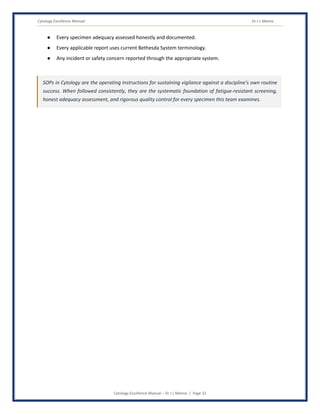
Cytology SOP Daily Compliance Checklist
● Every specimen screened within documented workload limits today.
Cytology Excellence Manual Dr J L Meena
Cytology Excellence Manual – Dr J L Meena | Page 32
● Every specimen adequacy assessed honestly and documented.
● Every applicable report uses current Bethesda System terminology.
● Any incident or safety concern reported through the appropriate system.
SOPs in Cytology are the operating instructions for sustaining vigilance against a discipline's own routine
success. When followed consistently, they are the systematic foundation of fatigue-resistant screening,
honest adequacy assessment, and rigorous quality control for every specimen this team examines.
Cytology Excellence Manual Dr J L Meena
Cytology Excellence Manual – Dr J L Meena | Page 33
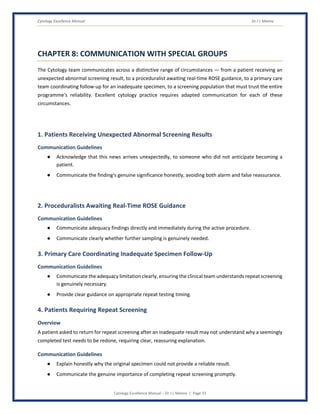
CHAPTER 8: COMMUNICATION WITH SPECIAL GROUPS
The Cytology team communicates across a distinctive range of circumstances — from a patient receiving an
unexpected abnormal screening result, to a proceduralist awaiting real-time ROSE guidance, to a primary care
team coordinating follow-up for an inadequate specimen, to a screening population that must trust the entire
programme's reliability. Excellent cytology practice requires adapted communication for each of these
circumstances.
1. Patients Receiving Unexpected Abnormal Screening Results
Communication Guidelines
● Acknowledge that this news arrives unexpectedly, to someone who did not anticipate becoming a
patient.
● Communicate the finding's genuine significance honestly, avoiding both alarm and false reassurance.
2. Proceduralists Awaiting Real-Time ROSE Guidance
Communication Guidelines
● Communicate adequacy findings directly and immediately during the active procedure.
● Communicate clearly whether further sampling is genuinely needed.
3. Primary Care Coordinating Inadequate Specimen Follow-Up
Communication Guidelines
● Communicate the adequacy limitation clearly, ensuring the clinical team understands repeat screening
is genuinely necessary.
● Provide clear guidance on appropriate repeat testing timing.
4. Patients Requiring Repeat Screening
Overview
A patient asked to return for repeat screening after an inadequate result may not understand why a seemingly
completed test needs to be redone, requiring clear, reassuring explanation.
Communication Guidelines
● Explain honestly why the original specimen could not provide a reliable result.
● Communicate the genuine importance of completing repeat screening promptly.
Cytology Excellence Manual Dr J L Meena
Cytology Excellence Manual – Dr J L Meena | Page 34
5. Oncology Teams for FNAC and Non-Gynaecological Findings
Communication Guidelines
● Communicate diagnostic findings completely, including any genuine diagnostic limitation.
● Coordinate on any additional sampling or ancillary testing needed.
6. Referring Pathologists for Second Opinion Cases
Communication Guidelines
● Communicate the rationale for any diagnostic discordance or revision clearly and professionally.
7. Screening Programme Coordinators and Public Health Authorities
Communication Guidelines
● Communicate screening quality metrics and programme performance data accurately.
● Support population-level screening programme evaluation and improvement.
8. Hospital Administration and Quality/Accreditation Bodies
Communication Guidelines
● Present workload compliance, adequacy rates, and rescreening data in management-accessible
formats.
● Advocate for necessary resources (staffing, screening capacity) with clear patient safety justification.
Universal Cytology Communication Principles
● Communicate honestly, avoiding both false alarm and false reassurance for genuinely unexpected
findings.
● Respond to every real-time procedural need and every clinician's genuine urgency with appropriate
speed.
● Always confirm genuine understanding, particularly for adequacy limitations and follow-up
recommendations.
● Document every significant clinical communication completely.
The Cytology team that communicates with equal skill toward an unexpecting patient's fear and a
proceduralist's real-time procedural need serves every stakeholder at maximum impact — honest,
unhurried communication delivered alongside the genuine compassion that a screening result arriving
without warning deserves.
Cytology Excellence Manual Dr J L Meena
Cytology Excellence Manual – Dr J L Meena | Page 35
CHAPTER 9: HANDLING DIFFICULT SITUATIONS
Common Difficult Situations for the Cytology Team
● A screener identifies genuine fatigue affecting their ability to maintain vigilance.
● A specimen adequacy determination is genuinely borderline.
● A rescreening review identifies a discordant finding.
● A cytology-histology correlation reveals a significant discordance.
● A referring clinician requests a diagnosis be “softer” than the findings support.
● A colleague's screening or diagnostic call raises genuine concern.
● A patient is reluctant to return for necessary repeat screening.
● An error is discovered in a previously issued report.
● ROSE reveals inadequate material despite multiple passes.
● Screening backlog creates pressure to exceed workload limits.
Core Principles for Handling Difficult Situations
1. Screening Vigilance and Honest Adequacy Are Never Compromised
In every difficult situation, genuine screening vigilance and honest adequacy assessment drive every decision
— no volume pressure, however genuine, justifies a shortcut in either.
2. Apply Standardized Protocols Under Pressure
Workload pressure and diagnostic uncertainty are precisely when standardized protocols matter most — resist
the temptation to improvise when a proven protocol exists.
3. Escalate Immediately and Persistently
A genuine safety concern is not resolved until it reaches someone who can act on it — escalate through
alternative channels if the first attempt does not produce a response.
4. Document Everything
Every difficult situation must be contemporaneously documented — what was found, what was
communicated, what decisions were made, and by whom.
Handling Genuine Screener Fatigue
Steps
● Support the screener in reporting fatigue honestly, without penalty.
● Apply immediate workload redistribution or break as needed.
Cytology Excellence Manual Dr J L Meena
Cytology Excellence Manual – Dr J L Meena | Page 36
Handling a Borderline Adequacy Determination
Steps
● Apply complete, honest criteria review before finalizing the determination.
● Seek peer consultation genuinely when the determination remains genuinely uncertain.
Handling a Discordant Rescreening Finding
Steps
● Apply structured resolution process comparing the original and rescreening findings.
● Document the resolution and any resulting corrective action.
Handling a Significant Cytology-Histology Discordance
Steps
● Investigate the discordance honestly, without defensiveness.
● Apply any indicated corrective action, including practice review if a pattern is identified.
Handling a Request to Soften a Diagnosis
Steps
● Decline any request that would compromise diagnostic accuracy, professionally and clearly.
● Explain the diagnostic rationale and offer to discuss any genuine clinical question.
Handling Concern About a Colleague's Screening or Diagnostic Call
Steps
● Address the concern directly and professionally with the colleague.
● Escalate to department leadership if the concern involves a pattern or remains unresolved.
Handling Patient Reluctance to Return for Repeat Screening
Steps
● Communicate the genuine importance of repeat screening compassionately and clearly.
● Coordinate with the referring clinician on outreach and follow-up support.
Handling a Discovered Error in a Previous Report
Steps
● Communicate the correction immediately and honestly to the treating clinician.
● Document the error, correction, and communication completely.
Cytology Excellence Manual Dr J L Meena
Cytology Excellence Manual – Dr J L Meena | Page 37
Handling Persistent ROSE Inadequacy
Steps
● Communicate the inadequacy honestly with the proceduralist, supporting the decision on further
approach.
Handling Screening Backlog Pressure
Steps
● Maintain workload limits and screening rigour, escalating the backlog concern to leadership rather
than compressing safety steps.
● Advocate for additional resources or turnaround time adjustment as genuinely needed.
The CALM Model for Cytology
● C – Control the immediate screening or diagnostic risk.
● A – Acknowledge the clinical reality accurately, including genuine uncertainty or fatigue.
● L – Lead with evidence — adequacy criteria, workload guidelines, and diagnostic protocols.
● M – Manage through documented escalation channels when needed.
Difficult situations in Cytology are always, ultimately, tests of whether screening vigilance and honest
adequacy hold firm under volume or time pressure. The team that never compromises either, escalates
persistently, and communicates honestly even when uncertain is fulfilling the highest professional
obligation of cytology practice.
Cytology Excellence Manual Dr J L Meena
Cytology Excellence Manual – Dr J L Meena | Page 38
CHAPTER 10: EMERGENCY RESPONSE — CRITICAL CYTOLOGY
PRESENTATIONS
Overview
Certain presentations demand the Cytology team's most immediate, standardized, and rehearsed response —
scenarios where the difference between a coordinated, protocol-driven response and an improvised one is
measured directly in whether a critical finding reaches the clinical team in time, or whether an active procedure
proceeds safely and efficiently.
Critical Presentations Requiring Immediate Response
● High-grade abnormality identified on cervical cytology screening.
● Malignant finding on FNAC requiring urgent clinical notification.
● Persistent ROSE inadequacy during an active, invasive procedure.
● Suspected specimen mix-up or mislabelling discovered post-screening.
● Critical incidental finding (e.g., unexpected infectious organism) requiring immediate notification.
● Equipment failure affecting active specimen processing.
● A significant rescreening discordance suggesting a systemic quality concern.
● A screener reports acute inability to continue screening safely.
● Urgent reference laboratory consultation required for a time-critical case.
● A suspected outbreak of screening quality failures affecting multiple specimens.
1. High-Grade Abnormality on Cervical Cytology
Immediate Response
● Apply immediate pathologist review and sign-out.
● Communicate the finding promptly to the ordering clinician per critical result protocol.
2. Malignant Finding on FNAC
Steps
● Communicate the finding directly and promptly to the ordering clinician.
● Coordinate any additional workup or urgent consultation needed.
3. Persistent ROSE Inadequacy During Active Procedure
Steps
● Communicate the inadequacy honestly and immediately to the proceduralist.
Cytology Excellence Manual Dr J L Meena
Cytology Excellence Manual – Dr J L Meena | Page 39
● Support the decision on further sampling approach or procedure modification.
4. Suspected Specimen Mix-Up
Steps
● Halt any dependent process immediately pending investigation.
● Apply complete, urgent investigation and resolution before any diagnosis is finalized.
5. Critical Incidental Finding
Steps
● Apply immediate notification to the ordering clinician and, where indicated, infection control.
6. Equipment Failure During Active Processing
Steps
● Apply immediate contingency processing pathway to prevent specimen damage or diagnostic delay.
● Communicate any resulting delay transparently to affected clinical teams.
7. Significant Rescreening Discordance
Steps
● Apply immediate investigation for any systemic quality pattern.
● Escalate to laboratory leadership if a broader quality concern is identified.
8. Screener Acute Inability to Continue
Steps
● Apply immediate workload reassignment and support for the affected screener.
● Verify no compromised screening occurred before the issue was identified.
9. Urgent Reference Laboratory Consultation
Steps
● Apply expedited, secure specimen and data transfer for time-critical cases.
● Communicate the referral status and expected timeline to the clinical team.
10. Suspected Outbreak of Screening Quality Failures
Steps
● Apply immediate, comprehensive quality investigation across affected specimens.
● Escalate to laboratory leadership and quality department without delay.
Cytology Excellence Manual Dr J L Meena
Cytology Excellence Manual – Dr J L Meena | Page 40
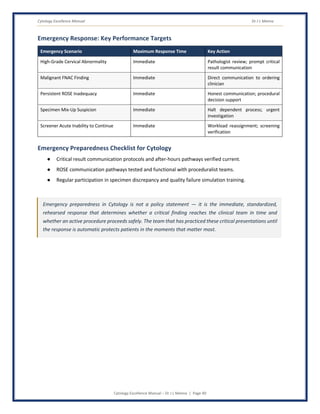
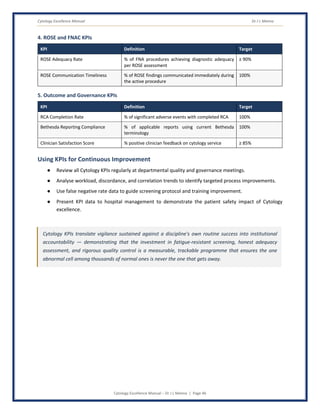
Emergency Response: Key Performance Targets
Emergency Scenario Maximum Response Time Key Action
High-Grade Cervical Abnormality Immediate Pathologist review; prompt critical
result communication
Malignant FNAC Finding Immediate Direct communication to ordering
clinician
Persistent ROSE Inadequacy Immediate Honest communication; procedural
decision support
Specimen Mix-Up Suspicion Immediate Halt dependent process; urgent
investigation
Screener Acute Inability to Continue Immediate Workload reassignment; screening
verification
Emergency Preparedness Checklist for Cytology
● Critical result communication protocols and after-hours pathways verified current.
● ROSE communication pathways tested and functional with proceduralist teams.
● Regular participation in specimen discrepancy and quality failure simulation training.
Emergency preparedness in Cytology is not a policy statement — it is the immediate, standardized,
rehearsed response that determines whether a critical finding reaches the clinical team in time and
whether an active procedure proceeds safely. The team that has practiced these critical presentations until
the response is automatic protects patients in the moments that matter most.
Cytology Excellence Manual Dr J L Meena
Cytology Excellence Manual – Dr J L Meena | Page 41
CHAPTER 11: DIGITAL COMPETENCY FOR THE CYTOLOGY TEAM
Objectives
● Enable the Cytology team to use screening, adequacy, and quality control tracking systems accurately,
securely, and efficiently.
● Leverage technology to improve screening quality assurance and workload tracking.
● Manage the cybersecurity of cytology information systems as a core patient safety function.
Core Digital Competencies for the Cytology Team
1. Laboratory Information System (LIS)
Essential Skills
● Use LIS accurately for specimen tracking, screening documentation, and diagnostic reporting.
2. Liquid-Based Cytology and Automated Screening Systems
Essential Skills
● Use liquid-based processing and automated screening-assist systems accurately, verifying output
appropriately.
3. Workload and Quality Control Tracking Systems
Essential Skills
● Use workload tracking systems accurately to maintain evidence-based screening limits.
4. Electronic Medical Record (EMR) / Hospital Information System (HIS)
Essential Skills
● Document screening, adequacy, and diagnostic findings accurately and in real time.
5. AI-Assisted Screening Support Tools
Awareness
● AI-assisted tools are increasingly applied to support cervical cytology pre-screening and abnormality
flagging.
● Understand and appropriately leverage these tools while maintaining independent clinical judgment
— AI tools are decision-support, not a substitute for genuine cytotechnologist and cytopathologist
screening.
Cytology Excellence Manual Dr J L Meena
Cytology Excellence Manual – Dr J L Meena | Page 42
6. Digital Cytology and Remote Consultation
Essential Skills
● Use digital cytology and telecytology platforms for remote consultation where clinically appropriate.
7. Cybersecurity and Information Security
Personal Digital Security Responsibilities
● Use unique, strong credentials for all LIS/HIS and cytology information system logins.
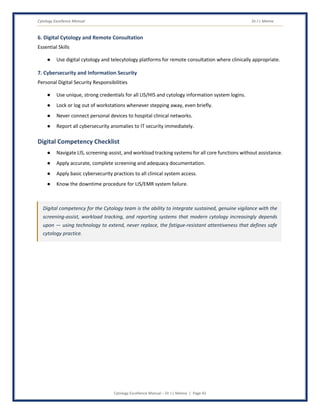
● Lock or log out of workstations whenever stepping away, even briefly.
● Never connect personal devices to hospital clinical networks.
● Report all cybersecurity anomalies to IT security immediately.
Digital Competency Checklist
● Navigate LIS, screening-assist, and workload tracking systems for all core functions without assistance.
● Apply accurate, complete screening and adequacy documentation.
● Apply basic cybersecurity practices to all clinical system access.
● Know the downtime procedure for LIS/EMR system failure.
Digital competency for the Cytology team is the ability to integrate sustained, genuine vigilance with the
screening-assist, workload tracking, and reporting systems that modern cytology increasingly depends
upon — using technology to extend, never replace, the fatigue-resistant attentiveness that defines safe
cytology practice.
Cytology Excellence Manual Dr J L Meena
Cytology Excellence Manual – Dr J L Meena | Page 43
CHAPTER 12: DAILY CYTOLOGY CHECKLIST
Objectives
● Provide a structured daily framework for sustained screening vigilance and honest adequacy
assessment.
● Ensure every screening, adequacy, and quality control obligation is addressed every shift.
● Support accurate clinical documentation and departmental performance data quality.
PART A: START-OF-SHIFT CHECKLIST
Personal and Professional Readiness
● Appropriate laboratory attire, PPE, and ID badge displayed.
● LIS/HIS systems functional and accessible.
Equipment and Readiness Review
● Verified microscopes, processing, and screening-assist equipment functional.
● Verified ROSE equipment and supplies stocked for scheduled procedures.
PART B: SPECIMEN HANDLING CHECKLIST
● Every specimen verified for correct identity and preparation before screening.
● Adequacy assessed honestly and documented for every specimen.
PART C: SCREENING CHECKLIST
● Screening remained within documented, evidence-based workload limits today.
● Structured breaks taken to support sustained attention.
PART D: QUALITY CONTROL CHECKLIST
● Mandatory rescreening completed per required percentage.
● Cytology-histology correlation reviewed for qualifying cases.
PART E: REPORTING CHECKLIST
● Current Bethesda System terminology applied to every applicable report.
● Any critical or high-grade finding communicated promptly.
PART F: SAFETY AND INCIDENT CHECKLIST
● Any incident, near-miss, or fatigue concern reported through the appropriate system.
Cytology Excellence Manual Dr J L Meena
Cytology Excellence Manual – Dr J L Meena | Page 44
● CAPA actions from previous incidents reviewed for completion.
PART G: END-OF-SHIFT CHECKLIST
● All clinical records updated and complete for the shift.
● Structured handover prepared for the incoming shift.
● Clinical systems securely logged out.
Daily Self-Assessment for the Cytology Team
● Did we remain within evidence-based workload limits today?
● Did we apply honest, standardized adequacy assessment to every specimen?
● Did we apply current Bethesda System terminology to every applicable report?
● Did we provide accurate, immediate ROSE for every active procedure?
● Did we complete mandatory rescreening and correlation review as required?
A consistent, structured daily routine — from start-of-shift equipment verification to end-of-shift handover
— transforms individual screening vigilance into a systemic cytology safety programme that operates
reliably against its own greatest risk: the quiet erosion of attention through routine, genuinely normal
findings.
Cytology Excellence Manual Dr J L Meena
Cytology Excellence Manual – Dr J L Meena | Page 45
CHAPTER 13: KEY PERFORMANCE INDICATORS (KPIs) FOR CYTOLOGY
Objectives
● Measure screening quality, adequacy assessment, and correlation performance objectively.
● Enable data-driven continuous improvement in Cytology practice.
● Support NABH/JCI/NABL/CAP accreditation standards for cytology.
● Demonstrate the value and patient safety impact of Cytology to institutional leadership.
Categories of Cytology KPIs
1. Screening Quality KPIs
KPI Definition Target
Workload Compliance Rate % of screening performed within documented workload
limits
100%
Adequacy Assessment Compliance % of specimens with documented, honest adequacy
assessment
100%
Specimen Rejection Rate % of specimens rejected for quality or labelling issues Track and trend;
minimize toward
zero
2. Quality Control KPIs
KPI Definition Target
Rescreening Compliance % compliance with required rescreening percentage 100%
Rescreening Discordance Rate % of rescreened cases with significant discordance At or below
institutional/national
benchmark
Proficiency Testing Compliance % compliance with required proficiency testing
schedule
100%
3. Correlation and Accuracy KPIs
KPI Definition Target
Cytology-Histology Correlation
Compliance
% of qualifying cases with documented correlation
review
100%
False Negative Rate Rate of confirmed false-negative results on correlation
review
At or below
institutional/national
benchmark
Cytology Excellence Manual Dr J L Meena
Cytology Excellence Manual – Dr J L Meena | Page 46
4. ROSE and FNAC KPIs
KPI Definition Target
ROSE Adequacy Rate % of FNA procedures achieving diagnostic adequacy
per ROSE assessment
≥ 90%
ROSE Communication Timeliness % of ROSE findings communicated immediately during
the active procedure
100%
5. Outcome and Governance KPIs
KPI Definition Target
RCA Completion Rate % of significant adverse events with completed RCA 100%
Bethesda Reporting Compliance % of applicable reports using current Bethesda
terminology
100%
Clinician Satisfaction Score % positive clinician feedback on cytology service ≥ 85%
Using KPIs for Continuous Improvement
● Review all Cytology KPIs regularly at departmental quality and governance meetings.
● Analyse workload, discordance, and correlation trends to identify targeted process improvements.
● Use false negative rate data to guide screening protocol and training improvement.
● Present KPI data to hospital management to demonstrate the patient safety impact of Cytology
excellence.
Cytology KPIs translate vigilance sustained against a discipline's own routine success into institutional
accountability — demonstrating that the investment in fatigue-resistant screening, honest adequacy
assessment, and rigorous quality control is a measurable, trackable programme that ensures the one
abnormal cell among thousands of normal ones is never the one that gets away.
Cytology Excellence Manual Dr J L Meena
Cytology Excellence Manual – Dr J L Meena | Page 47
CHAPTER 14: TOP 20 DO'S & TOP 20 DON'TS FOR CYTOLOGY
Introduction
The Cytology team searches, among thousands of entirely normal cells, for the rare single abnormal cell that
may be a genuinely asymptomatic patient's only warning. Their daily professional decisions — about workload
discipline, honest adequacy assessment, and sustained screening vigilance — determine whether that warning,
when it exists, is ever found. These Do's and Don'ts provide the practical daily architecture of Cytology
excellence.
TOP 20 DO'S FOR CYTOLOGY
● 1. Remain Within Evidence-Based Workload Limits — Every day, without exception.
● 2. Apply the Same Rigour to the Last Slide as the First — Fatigue is never an excuse.
● 3. Assess Adequacy Honestly — Every specimen, without exception for convenience.
● 4. Apply Current Bethesda System Terminology — Every applicable report, every time.
● 5. Complete Mandatory Rescreening — Per required percentage, without exception.
● 6. Communicate ROSE Findings Immediately — During the active procedure, every time.
● 7. Apply Systematic Cytology-Histology Correlation — Every qualifying case.
● 8. Participate Genuinely in Proficiency Testing — It protects every patient's result.
● 9. Report Genuine Fatigue Honestly — Without fear of penalty.
● 10. Take Structured Breaks — Supporting sustained attention across a full shift.
● 11. Debrief After Every Significant Event — Consolidate learning while it is fresh.
● 12. Provide Structured Handover for Every Transfer — SBAR or equivalent, every time.
● 13. Communicate with Exact, Unambiguous Language — Especially for adequacy and follow-up.
● 14. Report Every Near-Miss Honestly — Including your own, especially in screening.
● 15. Acknowledge the Unexpecting Patient's Fear — Genuinely, every time.
● 16. Seek Peer Review for Genuinely Uncertain Findings — Humility protects the patient.
● 17. Coordinate Proactively with Proceduralists — For ROSE and FNAC needs.
● 18. Apply the Same Rigour to Every Specimen — Regardless of volume or routine appearance.
● 19. Advocate for Resources When Backlog Threatens Vigilance — Escalate, don't compress.
● 20. Continue Learning — Cytology evidence evolves. The team that does not learn continuously treats
today's patients with yesterday's protocols.
Cytology Excellence Manual Dr J L Meena
Cytology Excellence Manual – Dr J L Meena | Page 48
TOP 20 DON'TS FOR CYTOLOGY
● 1. Don't Exceed Evidence-Based Workload Limits — Regardless of backlog pressure.
● 2. Don't Let a Run of Normal Findings Erode Attention — Every slide deserves full vigilance.
● 3. Don't Report an Inadequate Specimen as Adequate — Ever, for any reason.
● 4. Don't Use Outdated Bethesda Terminology — Current guidelines only, every time.
● 5. Don't Skip Mandatory Rescreening — It is a genuine safeguard, not a formality.
● 6. Don't Delay ROSE Communication — A proceduralist and patient are waiting.
● 7. Don't Skip Cytology-Histology Correlation — Discordance reveals genuine learning.
● 8. Don't Skip Proficiency Testing — It protects every patient's result, including your own.
● 9. Don't Hide Genuine Fatigue — Honesty protects the next patient's slide.
● 10. Don't Skip Structured Breaks — Sustained vigilance requires them.
● 11. Don't Skip Team Debriefing After a Critical Event — Unprocessed events repeat their gaps.
● 12. Don't Hand Over Complex Cases Informally — Structure protects against critical omissions.
● 13. Don't Use Ambiguous Language in Any Report — A treatment decision depends on every word.
● 14. Don't Hide or Minimize a Near-Miss — Suppressed incidents cannot drive the improvement that
prevents recurrence.
● 15. Don't Dismiss an Unexpecting Patient's Fear as Routine Anxiety — It is genuinely real.
● 16. Don't Let Ego Prevent Genuine Peer Consultation — Humility protects the patient.
● 17. Don't Delay Communication with a Waiting Proceduralist — Real-time decisions depend on you.
● 18. Don't Let Volume Erode Screening Rigour — Every specimen deserves the same standard.
● 19. Don't Compress Screening Time to Meet a Backlog — Escalate the resource concern instead.
● 20. Don't Practice Outside Current Cytology Evidence — Personal habit or outdated method must
never override current best practice.
Cytology Golden Rules
● Remain within workload limits — vigilance requires it, every day.
● Screen the last slide like the first — fatigue is never an excuse.
● Assess adequacy honestly — never force reassurance from inadequate material.
● Apply current Bethesda terminology — every applicable report.
● Complete mandatory rescreening — it is a genuine safeguard.
● Communicate ROSE immediately — a patient's needle passes depend on it.
● Correlate cytology and histology systematically — discordance teaches.
● Report genuine fatigue honestly — without fear.
● Report every near-miss — honestly, including your own.
Cytology Excellence Manual Dr J L Meena
Cytology Excellence Manual – Dr J L Meena | Page 49
● Never stop learning — today's cytology evidence is not yesterday's.
Daily Commitment Statement
“Today, I will remain within workload limits, screen every slide with sustained vigilance, assess adequacy
honestly, and apply current standardized reporting — because one abnormal cell among thousands of normal
ones may be a patient's only warning, and I will never let vigilance fade.”
The Top 20 Do's and Top 20 Don'ts are the daily professional architecture of Cytology excellence — each
shaped by the understanding that this discipline's greatest risk is the quiet erosion of attention through its
own routine success, and that there are no minor lapses when the one abnormal cell missed today is a
warning that will not come again.
Cytology Excellence Manual Dr J L Meena
Cytology Excellence Manual – Dr J L Meena | Page 50
CHAPTER 15: CYTOLOGY PROFESSIONAL PLEDGE
Introduction
A Cytology Professional Pledge is a formal, collective commitment to uphold the highest standards of sustained
screening vigilance, honest adequacy assessment, and rigorous quality control. It serves as a daily affirmation
that the one abnormal cell among thousands of normal ones is never the one that gets away.
Official Cytology Professional Pledge
“We solemnly pledge that as the Cytology team, we will fulfil our collective and individual responsibilities with
the highest standards of sustained vigilance, honesty, and unwavering commitment to every patient whose
only warning sign may be a single abnormal cell among thousands of normal ones.
We will remain within evidence-based workload limits, apply the same screening rigour to the last specimen
of a long day as to the first, and never allow the routine repetition of genuinely normal findings to erode the
attention every slide deserves.
We will assess every specimen's adequacy honestly, never allowing an inadequate specimen to masquerade as
reassurance, and we will apply current Bethesda System terminology consistently, ensuring every clinician
receiving our report understands exactly what it means and what action it requires.
We will provide accurate, immediate rapid on-site evaluation supporting every fine needle aspiration
procedure, apply systematic cytology-histology correlation as an ongoing safeguard, and complete every
mandatory rescreening and proficiency testing requirement, knowing these are genuine protections, not
formalities.
We will report genuine fatigue honestly, without fear, report every incident and near-miss honestly, resist any
pressure to compromise screening or adequacy integrity, and continuously expand our knowledge and skill,
knowing that cytology evidence evolves and that the team that does not learn continuously treats today's
patients with yesterday's protocols.
With unwavering vigilance, genuine honesty, and profound respect for the patient whose only warning may
depend on us, we pledge to be the Cytology team that finds the one abnormal cell among thousands of normal
ones, every single time.”
Daily Commitment Statement
“Today, we commit to remaining within workload limits, screening with sustained vigilance, assessing adequacy
honestly, and applying current standardized reporting — because one abnormal cell among thousands of
normal ones may be a patient's only warning, and we will never let vigilance fade.”
Cytology Excellence Manual Dr J L Meena
Cytology Excellence Manual – Dr J L Meena | Page 51
Core Values Reflected in the Pledge
1. Sustained Vigilance
Screening discipline that never relaxes, regardless of how many normal specimens preceded a given slide.
2. Honest Adequacy Assessment
Every specimen's adequacy determined honestly, never compromised for convenience.
3. Standardized, Actionable Reporting
Current Bethesda System terminology applied consistently, supporting clear clinical action.
4. Real-Time Procedural Support
Accurate, immediate ROSE guiding every fine needle aspiration toward diagnostic adequacy.
5. Systematic Quality Control
Rescreening, correlation, and proficiency testing applied genuinely as safeguards, not formalities.
6. Accountability
Every decision owned and documented; every incident honestly reviewed.
7. Continuous Learning
Cytology evidence evolves. Professional competence requires perpetual learning.
When the Pledge Should Be Recited
● At the beginning of every new Cytology team member's appointment.
● At quality governance and screening quality review meetings.
● At NABH/JCI/NABL/CAP accreditation preparation events.
● As a periodic collective affirmation, particularly following a significant adverse event.
Cytology Oath of the Single Cell
“We pledge to search, among thousands of normal cells, for the one that is not — never letting routine success
dull the vigilance a genuinely asymptomatic patient's only warning depends upon.”
Cytology Signature Commitment
This pledge is recited collectively by the multidisciplinary Cytology team and may be individually signed by:
Name: ___________________________
Role: Cytopathologist / Cytotechnologist / Screening Specialist
Department: Cytology
Registration/Employee ID: _______________
Cytology Excellence Manual Dr J L Meena
Cytology Excellence Manual – Dr J L Meena | Page 52
Signature: ________________________
Date: ____________________________
Cytology Excellence Manual Dr J L Meena
Cytology Excellence Manual – Dr J L Meena | Page 53
CONCLUSION
There is a discipline in laboratory medicine built on a paradox unlike most of diagnostic medicine: it screens
overwhelmingly healthy populations for a disease that, in the vast majority of specimens examined, genuinely
is not there. This manual has returned, again and again, to why this rarity demands a vigilance that must resist
its own success — evidence-based workload limits protecting against fatigue, honest adequacy assessment
never allowing an inadequate specimen to masquerade as reassurance, and rigorous rescreening and
correlation catching the rare error even the most diligent screener can make.
Throughout this manual, we have explored the full scope of Cytology professional practice — from disciplined,
fatigue-resistant screening and honest adequacy assessment, through standardized Bethesda reporting and
rapid on-site evaluation, to systematic cytology-histology correlation, rigorous quality control, and the
professional conduct that defines excellence across every category of cytological diagnosis. These
responsibilities collectively define a discipline that demands both sustained visual vigilance and the humility to
seek consultation whenever genuine uncertainty remains.
The Importance of the Cytology Team in Healthcare Quality
● The vigilant screener — finding the rare abnormal cell among thousands of normal ones, resisting the
erosion of attention through routine success.
● The honest assessor — never letting an inadequate specimen masquerade as reassurance.
● The real-time guide — providing ROSE that reduces the needle passes and repeat procedures patients
must undergo.
● The systematic quality controller — applying rescreening and correlation that catches the rare error
any single screener can make.
● The standardized reporter — ensuring every clinician receiving a result understands exactly what
action it requires.
● The honest reviewer — examining every incident and near-miss to protect the next patient whose only
warning may depend on a single abnormal cell being found.
Final Commitment
“As the Cytology team, we commit to remaining within workload limits, screening with sustained vigilance,
assessing adequacy honestly, and applying current standardized reporting — because one abnormal cell among
thousands of normal ones may be a patient's only warning, and we will never let vigilance fade.”
Cytology Excellence Manual Dr J L Meena
Cytology Excellence Manual – Dr J L Meena | Page 54
Final Motto
“One Abnormal Cell Among Thousands of Normal Ones May Be the Only Warning a Patient Gets — We Never
Let Vigilance Fade.”
Together, We Prove That Vigilance Sustained Across Thousands of Normal Slides Is Still Vigilance —
Every Single Time.
Cytology Excellence Manual Dr J L Meena
Cytology Excellence Manual – Dr J L Meena | Page 55
REFERENCES
Global Accreditation and Regulatory Standards
● World Health Organization (WHO) – WHO Guidelines for Cervical Cancer Screening and Prevention.
● Joint Commission International (JCI) – JCI Accreditation Standards for Hospitals: Assessment of
Patients (AOP) Chapter, including Cytology Requirements.
● National Accreditation Board for Hospitals & Healthcare Providers (NABH, India) – Standards for
Cytology Laboratory Services (5th Edition).
Cytology Practice Standards
● College of American Pathologists (CAP) – Cytopathology Checklist and Accreditation Requirements.
● American Society of Cytopathology (ASC) – Practice Guidelines for Cytology.
Screening Quality Control Standards
● College of American Pathologists (CAP) / Clinical Laboratory Improvement Amendments (CLIA) –
Screener Workload Limits and Rescreening Requirements.
● American Society of Cytopathology (ASC) – Guidelines for Proficiency Testing and Quality Assurance.
Bethesda System and Reporting Standards
● The Bethesda System (TBS) for Reporting Cervical Cytology – Current Edition Terminology and
Reporting Guidelines.
● Papanicolaou Society of Cytopathology – Standardized Terminology for Non-Gynaecological Cytology.
ROSE and FNAC Standards
● Papanicolaou Society of Cytopathology – Guidelines for Rapid On-Site Evaluation and Fine Needle
Aspiration Practice.
Indian Regulatory and National Framework
● National Accreditation Board for Testing and Calibration Laboratories (NABL), India – Medical
Laboratory Accreditation Standards.
● Indian Academy of Cytologists (IAC) – Clinical Practice Guidelines for Cytology.
● National Medical Commission (NMC) – Code of Medical Ethics Regulations Applicable to Cytology
Practice.
Cytology Excellence Manual Dr J L Meena
Cytology Excellence Manual – Dr J L Meena | Page 56
Quality Improvement and Patient Safety Frameworks
● Institute for Healthcare Improvement (IHI) – Framework for Patient Safety and Quality Improvement
in Diagnostic Services.
● World Health Organization – Global Patient Safety Action Plan 2021–2030.
Cybersecurity and Digital Health Records
● NIST Cybersecurity Framework – Applied to Healthcare Laboratory Information Systems.
● HL7 International – Health Level Seven Data Interchange Standards.
This manual has been developed using internationally recognized principles and best practices from WHO
Cervical Cancer Screening Guidelines, JCI Assessment of Patients Standards, NABH Cytology Laboratory
Standards, CAP Cytopathology Checklist, ASC Practice Guidelines, CAP/CLIA Screener Workload and
Rescreening Requirements, The Bethesda System Reporting Guidelines, Papanicolaou Society ROSE and FNAC
Guidelines, India's NABL Medical Laboratory Accreditation Standards, Indian Academy of Cytologists
Guidelines, and applicable Indian statutory and regulatory requirements. Institutions should verify current
versions of all cited guidelines and regulatory requirements, as clinical protocols and accreditation standards
are subject to periodic revision.
ॐ जय माता द( ॐ
Cytology Excellence Manual Dr J L Meena
Cytology Excellence Manual – Dr J L Meena | Page 57
END OF MANUAL
Thank You
This manual has been prepared with the vision to empower the multidisciplinary Cytology team with global
standards, best practices, and professional guidance to ensure vigilant, honest, and rigorously quality-
controlled screening for every patient.
Our Commitment Continues
The journey of learning never ends. As cytology evidence and screening technology evolve, our commitment
to sustained vigilance, honesty, and rigorous quality control must remain unwavering — because the one
abnormal cell missed today is a warning that will not come again.
Together, We Build Trust
Every specimen screened with sustained vigilance, every adequacy assessed honestly, every rescreening
completed genuinely, and every report using current standardized terminology contributes to one greater
purpose — catching disease before it ever becomes a diagnosis.
“One Abnormal Cell Among Thousands of Normal Ones May Be the Only Warning a Patient
Gets — We Never Let Vigilance Fade.”
REMEMBER: Vigilance is our discipline • Adequacy is our honesty • Rescreening is our safeguard • The single
cell is our purpose • Learning is our journey
Thank you for being a part of this vital mission. Your dedication makes a difference every day.
Dr J L Meena