CT Scan Technician Excellence Manual Dr J L Meena
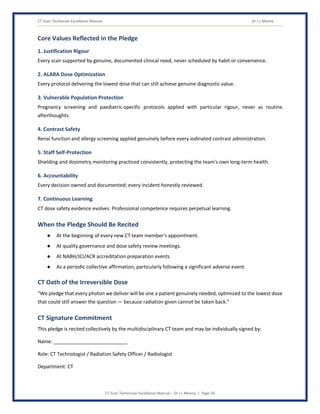
CT Scan Technician Excellence Manual – Dr J L Meena | Page 1
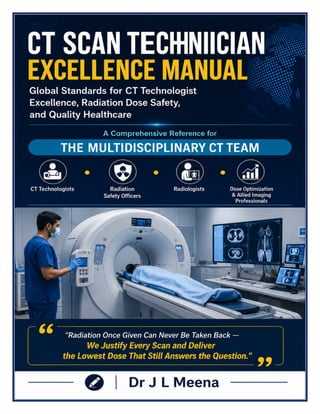
CT SCAN TECHNICIAN
EXCELLENCE MANUAL
Global Standards for CT Technologist Excellence, Radiation Dose Safety, and Quality
Healthcare
A Comprehensive Reference for
THE MULTIDISCIPLINARY CT TEAM
CT Technologists • Radiation Safety Officers • Radiologists • Dose Optimization & Allied Imaging Professionals
“Radiation Once Given Can Never Be Taken Back — We Justify Every Scan and Deliver the
Lowest Dose That Still Answers the Question.”
Dr J L Meena
CT Scan Technician Excellence Manual Dr J L Meena
CT Scan Technician Excellence Manual – Dr J L Meena | Page 2
DEDICATION
This book is dedicated to all those who are committed to advancing healthcare through a discipline built on a decision
that, unlike almost any other in medicine, cannot be undone once made: every dose of ionizing radiation delivered
during a CT scan adds permanently to a patient's lifetime radiation burden, and no amount of care afterward can
retrieve a single photon once it has passed through the body.
To Every Patient Whose Scan Was Genuinely Necessary
For whom a CT scan justified by real clinical need, protocolled to deliver the lowest dose that could still answer the
question, and never repeated without genuine cause represents a promise kept: that the radiation their body
absorbed that day was radiation they truly needed.
To Every Child Whose Growing Body Received a Dose Calculated Just for Them
For whom paediatric-specific dose reduction was never an afterthought but a first principle, recognizing that a child's
radiosensitivity and remaining lifetime both demand a caution adult protocols cannot simply be scaled down to
provide.
To My Family
For their unwavering love, patience, and encouragement, which have been the foundation of this journey.
To My Mentors & Teachers
For inspiring my passion, guiding my path, and instilling in me the understanding that CT imaging carries a form of
risk unlike most decisions in medicine: radiation delivered cannot be recalled, cannot be reduced after the fact, and
accumulates silently and invisibly across a patient's entire lifetime of imaging, making the ALARA principle — as low
as reasonably achievable — not a slogan but the daily, technical discipline this entire profession depends upon.
To My Colleagues & Friends
For their support, collaboration, and shared dedication to a discipline where a scan ordered out of habit rather than
genuine clinical justification is never a minor convenience, but an irreversible dose a patient did not need to receive.
To Every Member of the CT Team
CT Technologists, Radiation Safety Officers, Radiologists, and every professional who has optimized a protocol to
shave away every unnecessary photon while still answering the clinical question — the guardians standing between
urgent, life-saving diagnostic speed and a radiation dose that, once given, can never be returned.
Your vigilance, your dose optimization discipline, and your unwavering commitment to justifying every scan
are the silent pillars of a healthcare system that can offer this fast, life-saving imaging technology responsibly,
protecting every patient's lifetime radiation burden as carefully as their immediate diagnosis. This book is for
you, and because of you. Thank you to everyone who has been a part of this journey.
Dr J L Meena
CT Scan Technician Excellence Manual Dr J L Meena
CT Scan Technician Excellence Manual – Dr J L Meena | Page 3
FOREWORD
There is a discipline in medical imaging built on a decision that, unlike almost any other in medicine, cannot be
undone once made: every dose of ionizing radiation delivered during a CT scan adds permanently to a patient's
lifetime radiation burden. A medication can be stopped. A procedure can, in many cases, be reversed or
revised. A CT scan's radiation, once it has passed through a patient's body, cannot be recalled, reduced, or
given back — it simply becomes part of that patient's cumulative lifetime exposure, silently and invisibly,
whether or not the scan that delivered it was genuinely necessary. This irreversibility is what makes CT
imaging's central discipline unlike its neighbouring radiology technologies: the question is never only “what
does this image show,” but always also “was this dose genuinely justified, and was it the lowest dose that could
still answer the clinical question.”
The “CT Scan Technician Excellence Manual: Global Standards for CT Technologist Excellence, Radiation Dose
Safety, and Quality Healthcare” has been developed to provide a comprehensive professional framework for
the multidisciplinary CT team — CT Technologists, Radiation Safety Officers, Radiologists, and allied dose
optimization professionals — working together to deliver fast, life-saving diagnostic imaging while protecting
every patient's lifetime radiation burden with the same seriousness as their immediate clinical need.
This manual brings together internationally recognized principles of the ALARA (As Low As Reasonably
Achievable) dose optimization principle, rigorous scan justification and clinical decision support, safe iodinated
contrast administration, paediatric and pregnancy-specific dose protocols, staff radiation protection, and
cumulative dose tracking across a patient's imaging history. It is built around globally accepted accreditation
frameworks — WHO radiological protection guidelines, NABH, JCI, and international standards from the
American College of Radiology (ACR) and the International Commission on Radiological Protection (ICRP) — to
provide a rigorous, regulation-compliant framework for CT Technologist excellence.
The chapters of this manual guide the CT team through every dimension of the role — from rigorous scan
justification and ALARA-based protocol optimization, through safe contrast administration and pregnancy
screening, to paediatric dose reduction, staff radiation protection, and the professional conduct that defines
excellence across every category of CT practice: the trauma scan acquired within minutes because a patient's
life depends on speed, the paediatric protocol adjusted specifically for a smaller, more radiosensitive body,
and the routine follow-up scan questioned honestly to ask whether it is genuinely still necessary.
CT Technology is not simply an imaging service that produces detailed cross-sectional images at extraordinary
speed — it is a distinct discipline built on the understanding that its core clinical value, speed and precision in
emergencies, comes paired with a radiation dose that is genuinely irreversible, that unjustified or unnecessarily
repeated scanning is not a convenience but an avoidable, permanent addition to a patient's cancer risk, and
that this team's dose optimization discipline is what makes offering this extraordinary technology responsibly
possible at all. Their work is defined by a vigilance that must never relax, because the dose delivered today
cannot be reduced tomorrow.
CT Scan Technician Excellence Manual Dr J L Meena
CT Scan Technician Excellence Manual – Dr J L Meena | Page 4
It is hoped that this manual will serve as an indispensable resource for CT Technologists, Radiation Safety
Officers, Radiologists, hospital administrators, quality heads, and all those committed to building a healthcare
system where every CT scan is genuinely justified, and every dose delivered is the lowest one that could still
answer the question a patient's life may depend upon.
“Radiation Once Given Can Never Be Taken Back — We Justify Every Scan and Deliver the Lowest Dose
That Still Answers the Question.”
With Best Wishes, Dr J L Meena
CT Scan Technician Excellence Manual Dr J L Meena
CT Scan Technician Excellence Manual – Dr J L Meena | Page 5
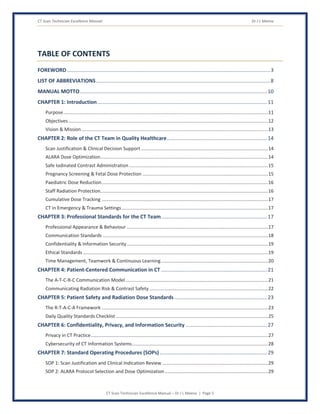
TABLE OF CONTENTS
FOREWORD............................................................................................................................................3
LIST OF ABBREVIATIONS........................................................................................................................8
MANUAL MOTTO.................................................................................................................................10
CHAPTER 1: Introduction.....................................................................................................................11
Purpose...........................................................................................................................................................11
Objectives .......................................................................................................................................................12
Vision & Mission .............................................................................................................................................13
CHAPTER 2: Role of the CT Team in Quality Healthcare.....................................................................14
Scan Justification & Clinical Decision Support ................................................................................................14
ALARA Dose Optimization...............................................................................................................................14
Safe Iodinated Contrast Administration .........................................................................................................15
Pregnancy Screening & Fetal Dose Protection ...............................................................................................15
Paediatric Dose Reduction..............................................................................................................................16
Staff Radiation Protection...............................................................................................................................16
Cumulative Dose Tracking ..............................................................................................................................17
CT in Emergency & Trauma Settings...............................................................................................................17
CHAPTER 3: Professional Standards for the CT Team.........................................................................17
Professional Appearance & Behaviour ...........................................................................................................17
Communication Standards .............................................................................................................................18
Confidentiality & Information Security...........................................................................................................19
Ethical Standards ............................................................................................................................................19
Time Management, Teamwork & Continuous Learning.................................................................................20
CHAPTER 4: Patient-Centered Communication in CT .........................................................................21
The A-T-C-R-C Communication Model............................................................................................................21
Communicating Radiation Risk & Contrast Safety..........................................................................................22
CHAPTER 5: Patient Safety and Radiation Dose Standards................................................................23
The R-T-A-C-A Framework ..............................................................................................................................23
Daily Quality Standards Checklist ...................................................................................................................25
CHAPTER 6: Confidentiality, Privacy, and Information Security ........................................................27
Privacy in CT Practice......................................................................................................................................27
Cybersecurity of CT Information Systems.......................................................................................................28
CHAPTER 7: Standard Operating Procedures (SOPs)..........................................................................29
SOP 1: Scan Justification and Clinical Indication Review ................................................................................29
SOP 2: ALARA Protocol Selection and Dose Optimization ..............................................................................29
CT Scan Technician Excellence Manual Dr J L Meena
CT Scan Technician Excellence Manual – Dr J L Meena | Page 6
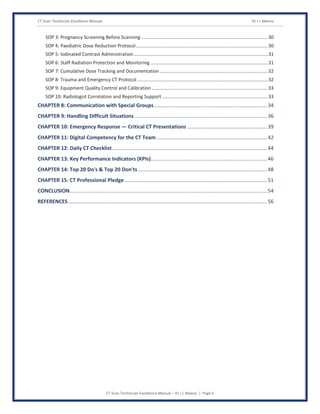
SOP 3: Pregnancy Screening Before Scanning ................................................................................................30
SOP 4: Paediatric Dose Reduction Protocol....................................................................................................30
SOP 5: Iodinated Contrast Administration......................................................................................................31
SOP 6: Staff Radiation Protection and Monitoring .........................................................................................31
SOP 7: Cumulative Dose Tracking and Documentation..................................................................................32
SOP 8: Trauma and Emergency CT Protocol ...................................................................................................32
SOP 9: Equipment Quality Control and Calibration ........................................................................................33
SOP 10: Radiologist Correlation and Reporting Support ................................................................................33
CHAPTER 8: Communication with Special Groups..............................................................................34
CHAPTER 9: Handling Difficult Situations ...........................................................................................36
CHAPTER 10: Emergency Response — Critical CT Presentations .......................................................39
CHAPTER 11: Digital Competency for the CT Team ............................................................................42
CHAPTER 12: Daily CT Checklist...........................................................................................................44
CHAPTER 13: Key Performance Indicators (KPIs)................................................................................46
CHAPTER 14: Top 20 Do's & Top 20 Don'ts.........................................................................................48
CHAPTER 15: CT Professional Pledge ..................................................................................................51
CONCLUSION........................................................................................................................................54
REFERENCES.........................................................................................................................................56
CT Scan Technician Excellence Manual Dr J L Meena
CT Scan Technician Excellence Manual – Dr J L Meena | Page 7
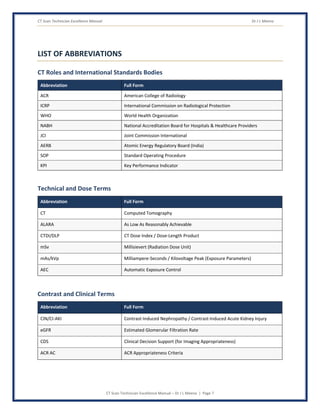
LIST OF ABBREVIATIONS
CT Roles and International Standards Bodies
Abbreviation Full Form
ACR American College of Radiology
ICRP International Commission on Radiological Protection
WHO World Health Organization
NABH National Accreditation Board for Hospitals & Healthcare Providers
JCI Joint Commission International
AERB Atomic Energy Regulatory Board (India)
SOP Standard Operating Procedure
KPI Key Performance Indicator
Technical and Dose Terms
Abbreviation Full Form
CT Computed Tomography
ALARA As Low As Reasonably Achievable
CTDI/DLP CT Dose Index / Dose-Length Product
mSv Millisievert (Radiation Dose Unit)
mAs/kVp Milliampere-Seconds / Kilovoltage Peak (Exposure Parameters)
AEC Automatic Exposure Control
Contrast and Clinical Terms
Abbreviation Full Form
CIN/CI-AKI Contrast-Induced Nephropathy / Contrast-Induced Acute Kidney Injury
eGFR Estimated Glomerular Filtration Rate
CDS Clinical Decision Support (for Imaging Appropriateness)
ACR AC ACR Appropriateness Criteria
CT Scan Technician Excellence Manual Dr J L Meena
CT Scan Technician Excellence Manual – Dr J L Meena | Page 8
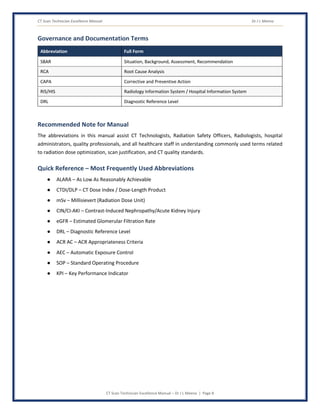
Governance and Documentation Terms
Abbreviation Full Form
SBAR Situation, Background, Assessment, Recommendation
RCA Root Cause Analysis
CAPA Corrective and Preventive Action
RIS/HIS Radiology Information System / Hospital Information System
DRL Diagnostic Reference Level
Recommended Note for Manual
The abbreviations in this manual assist CT Technologists, Radiation Safety Officers, Radiologists, hospital
administrators, quality professionals, and all healthcare staff in understanding commonly used terms related
to radiation dose optimization, scan justification, and CT quality standards.
Quick Reference – Most Frequently Used Abbreviations
● ALARA – As Low As Reasonably Achievable
● CTDI/DLP – CT Dose Index / Dose-Length Product
● mSv – Millisievert (Radiation Dose Unit)
● CIN/CI-AKI – Contrast-Induced Nephropathy/Acute Kidney Injury
● eGFR – Estimated Glomerular Filtration Rate
● DRL – Diagnostic Reference Level
● ACR AC – ACR Appropriateness Criteria
● AEC – Automatic Exposure Control
● SOP – Standard Operating Procedure
● KPI – Key Performance Indicator
CT Scan Technician Excellence Manual Dr J L Meena
CT Scan Technician Excellence Manual – Dr J L Meena | Page 9
MANUAL MOTTO
“Radiation Once Given Can Never Be Taken Back —”
“We Justify Every Scan”
“And Deliver the Lowest Dose That Still Answers the Question.”
CT Scan Technician Excellence Manual Dr J L Meena
CT Scan Technician Excellence Manual – Dr J L Meena | Page 10
CHAPTER 1: INTRODUCTION
1. Purpose
There is a discipline in medical imaging built on a decision that, unlike almost any other in medicine, cannot be
undone once made: every dose of ionizing radiation delivered during a CT scan adds permanently to a patient's
lifetime radiation burden. A medication can be stopped; a CT scan's radiation, once delivered, simply becomes
part of a patient's cumulative lifetime exposure, whether or not the scan was genuinely necessary. This manual
exists because this irreversibility demands a discipline of scan justification and dose optimization that must
never relax, because the dose delivered today cannot be reduced tomorrow.
The World Health Organization and international radiological protection bodies — ACR, ICRP — recognize that
rigorous scan justification, disciplined ALARA-based dose optimization, and careful paediatric and pregnancy-
specific protocols are directly and measurably linked to reduced lifetime radiation-attributable cancer risk.
Research consistently demonstrates that CT facilities applying standardized justification review, protocol
optimization, and cumulative dose tracking achieve dramatically and measurably lower unnecessary radiation
exposure than facilities where scanning is ordered by habit rather than genuine clinical need. In institutions
where the CT team applies systematic dose optimization, honest scan justification, and rigorous safety
screening, patient outcomes and long-term safety are demonstrably and measurably better. The investment
in CT Technologist excellence is, without qualification, one of the highest-yield investments any healthcare
system can make — offering fast, life-saving imaging while protecting every patient's irreversible, cumulative
radiation burden.
Why the CT Team Is Critical to Healthcare Quality
● Provides fast, high-resolution diagnostic imaging essential to trauma, stroke, and time-critical
emergency care.
● Applies rigorous scan justification, ensuring every dose delivered is genuinely clinically necessary.
● Applies ALARA-based dose optimization, delivering the lowest dose that can still answer the clinical
question.
● Delivers safe iodinated contrast administration, protecting patients with renal impairment or
contrast allergy history.
● Applies pregnancy screening and paediatric dose reduction, protecting the most radiosensitive
patients.
● Maintains staff radiation protection, protecting the team delivering this technology every day.
● Applies cumulative dose tracking, supporting genuinely informed decisions about a patient's total
imaging history.
● Contributes to accreditation compliance (NABH, JCI, ACR) for CT facility standards.
CT Scan Technician Excellence Manual Dr J L Meena
CT Scan Technician Excellence Manual – Dr J L Meena | Page 11
Key Responsibilities of the CT Team
● Applying rigorous scan justification review before every examination.
● Applying ALARA-based protocol selection and dose optimization for every patient.
● Applying safe, evidence-based iodinated contrast administration protocols.
● Applying pregnancy screening before every scan of reproductive-age patients.
● Applying paediatric-specific dose reduction protocols for every child.
● Maintaining rigorous staff radiation protection practice.
● Applying systematic cumulative dose tracking and documentation.
● Engaging in continuous professional development to maintain competence in evolving CT dose safety
evidence.
2. Objectives
1. Justify Every Scan Before It Is Performed
Every CT examination must be genuinely clinically justified before the radiation is delivered — this is the CT
team's foundational, non-negotiable obligation, because an unjustified scan is an irreversible dose a patient
did not need to receive.
How to Achieve:
● Apply structured clinical decision support and appropriateness criteria review before scheduling.
● Question genuinely unclear or habitual scan requests professionally rather than proceeding
automatically.
● Never allow scheduling convenience to substitute for genuine clinical justification.
2. Optimize Every Dose to the Lowest Achievable Level
● Apply ALARA-based protocol selection matched precisely to clinical indication and patient size.
● Apply automatic exposure control and current dose-reduction technology consistently.
3. Administer Contrast Safely
● Apply evidence-based renal function and allergy screening before every iodinated contrast
administration.
● Apply the lowest effective, clinically appropriate contrast dose and rate.
4. Protect the Most Radiosensitive Patients
● Apply pregnancy screening before every scan of reproductive-age patients.
● Apply paediatric-specific, size-based dose reduction protocols for every child.
5. Protect Staff and Track Cumulative Dose
● Apply rigorous staff radiation protection practice, including shielding and dosimetry monitoring.
● Apply systematic cumulative dose tracking supporting informed future imaging decisions.
CT Scan Technician Excellence Manual Dr J L Meena
CT Scan Technician Excellence Manual – Dr J L Meena | Page 12
6. Support Time-Critical Emergency Care
● Apply rapid, accurate trauma and emergency CT protocols without compromising dose optimization
discipline.
7. Maintain Regulatory and Accreditation Compliance
● Comply with national radiation safety standards and international accreditation guidelines.
● Maintain NABH/JCI/ACR CT documentation standards.
● Participate in accreditation surveys with complete, auditable justification and dose records.
3. Vision
Vision Statement
“To build and maintain a CT service where every scan is genuinely justified, every dose is optimized to the
lowest level that can still answer the clinical question, and no patient's lifetime radiation burden is ever
increased by a scan they did not truly need.”
4. Mission
Mission Statement
“To deliver fast, technically excellent, and rigorously dose-optimized CT imaging that supports time-critical
diagnosis while protecting every patient's irreversible, cumulative radiation burden, through disciplined scan
justification, ALARA-based protocol optimization, and honest, compassionate communication, enabling the
healthcare organization to offer this extraordinary technology responsibly.”
Expected Outcomes of an Excellent CT Technologist Practice
● 100% of scans supported by documented clinical justification before scheduling.
● 100% of protocols optimized per ALARA principles and matched to patient size and clinical indication.
● 100% of iodinated contrast administrations preceded by documented renal function and allergy
screening.
● 100% of reproductive-age patients screened for pregnancy before scanning.
● Full compliance with national radiation safety standards and international accreditation guidelines.
The CT team delivers a technology whose core clinical value — speed and precision in emergencies —
comes paired with a dose that is genuinely irreversible. Their rigorous scan justification and ALARA-based
dose optimization ensure every photon delivered was one a patient genuinely needed, because the dose
given today can never be reduced tomorrow.
CT Scan Technician Excellence Manual Dr J L Meena
CT Scan Technician Excellence Manual – Dr J L Meena | Page 13
CHAPTER 2: ROLE OF THE CT TEAM IN QUALITY HEALTHCARE
1. Scan Justification and Clinical Decision Support
Overview
Because CT radiation is genuinely irreversible, every scan must be justified by real clinical need before it is
performed — clinical decision support and appropriateness criteria review are the first, essential safeguard
against unnecessary dose.
Responsibilities
● Apply structured clinical decision support and appropriateness criteria review before scheduling.
● Question genuinely unclear or habitual scan requests professionally rather than proceeding
automatically.
2. ALARA Dose Optimization
Overview
The ALARA principle — As Low As Reasonably Achievable — governs every technical decision in CT protocol
selection, ensuring diagnostic image quality is achieved with the minimum radiation dose genuinely required.
Responsibilities
● Apply protocol selection matched precisely to clinical indication and patient size.
● Apply automatic exposure control and current dose-reduction technology consistently.
3. Safe Iodinated Contrast Administration
Overview
Iodinated contrast carries risks distinct from CT's radiation dose — contrast-induced nephropathy and allergic
reaction — requiring rigorous screening before every administration.
Responsibilities
● Apply evidence-based renal function and allergy screening before every administration.
● Apply the lowest effective, clinically appropriate contrast dose and injection rate.
4. Pregnancy Screening and Fetal Dose Protection
Overview
A developing fetus is among the most radiosensitive populations, making pregnancy screening before every
scan of a reproductive-age patient an essential, non-negotiable safeguard.
Responsibilities
CT Scan Technician Excellence Manual Dr J L Meena
CT Scan Technician Excellence Manual – Dr J L Meena | Page 14
● Apply pregnancy screening before every scan of reproductive-age patients.
● Apply fetal dose minimization techniques and alternative imaging consideration when pregnancy is
confirmed and scanning remains necessary.
5. Paediatric Dose Reduction
Overview
Children are more radiosensitive than adults and have more remaining lifetime for radiation-attributable risk
to manifest, making paediatric-specific, size-based dose protocols essential rather than optional adult-protocol
scaling.
Responsibilities
● Apply paediatric-specific, size-based dose reduction protocols for every child.
● Apply genuine clinical justification review with particular rigour for paediatric scans.
6. Staff Radiation Protection
Overview
The CT team itself works daily in proximity to ionizing radiation, requiring rigorous personal protection and
monitoring to protect their own long-term health.
Responsibilities
● Apply appropriate shielding and distance practices consistently.
● Wear and monitor personal dosimetry devices without exception.
7. Cumulative Dose Tracking
Overview
A patient's total lifetime radiation exposure across multiple studies and institutions informs genuinely
responsible future imaging decisions, making systematic dose tracking a core safety function.
Responsibilities
● Apply systematic dose recording for every examination.
● Review a patient's imaging history when clinically relevant to inform justification decisions.
8. CT in Emergency and Trauma Settings
Overview
CT's speed makes it the definitive imaging modality in trauma, stroke, and acute chest pain, requiring the team
to deliver rapid, accurate imaging without abandoning dose optimization discipline under time pressure.
Responsibilities
● Apply rapid, accurate trauma and emergency protocols matched to the clinical urgency.
CT Scan Technician Excellence Manual Dr J L Meena
CT Scan Technician Excellence Manual – Dr J L Meena | Page 15
● Maintain dose optimization discipline even under genuine time pressure.
How the CT Team Contributes to Quality Healthcare
● By justifying every scan, the team ensures no patient receives an irreversible dose they did not
genuinely need.
● By optimizing dose through ALARA, the team delivers diagnostic image quality with the minimum
radiation genuinely required.
● By screening for pregnancy and applying paediatric protocols, the team protects the most
radiosensitive patients with particular rigour.
● By tracking cumulative dose, the team supports genuinely informed decisions about a patient's total
lifetime imaging history.
● By maintaining speed without abandoning dose discipline in emergencies, the team proves that
urgency and responsibility are not in conflict.
The CT team delivers a technology whose core clinical value — speed and precision in emergencies —
comes paired with a dose that is genuinely irreversible. Their rigorous scan justification and ALARA-based
dose optimization ensure every photon delivered was one a patient genuinely needed, because the dose
given today can never be reduced tomorrow.
CT Scan Technician Excellence Manual Dr J L Meena
CT Scan Technician Excellence Manual – Dr J L Meena | Page 16
CHAPTER 3: PROFESSIONAL STANDARDS FOR THE CT TEAM
CT practice requires an uncommon combination of technical dose optimization discipline applied to a risk that
is genuinely irreversible, the professional courage to question a scan request that lacks genuine clinical
justification, and the speed and precision demanded by time-critical emergency imaging. The standards that
govern CT practice derive from radiological protection science unique to a discipline whose core value and core
risk are delivered by the same technology in the same instant.
1. Professional Appearance
Standards
Attire and Identification
● Wear appropriate attire, dosimetry badge, and ID badge as per facility policy.
Professional Presence
● Maintain rigorous attention to dose optimization throughout every shift.
● Model unwavering justification discipline that never relaxes, regardless of scheduling pressure.
2. Professional Behaviour
Expected Behaviours
Justification Discipline
● Never proceed with a scan lacking genuine clinical justification without appropriate professional
clarification.
● Never allow scheduling convenience to substitute for genuine clinical need.
Dose Optimization Discipline
● Never apply a higher-dose protocol than genuinely required for the clinical question.
● Escalate immediately upon any identified dose optimization gap or equipment malfunction.
Accountability
● Own every justification decision, every protocol selection, and every dose delivered under this
team's responsibility.
● Report and disclose critical incidents and adverse events honestly and promptly.
Collaborative Respect
● Treat every member of the multidisciplinary CT team — technologist, radiation safety officer,
radiologist — as an essential, equal safety partner.
CT Scan Technician Excellence Manual Dr J L Meena
CT Scan Technician Excellence Manual – Dr J L Meena | Page 17
Patient-Centered Focus
● Every justification review and every protocol decision is ultimately about protecting a patient's
irreversible lifetime radiation burden — never about convenience or speed alone.
3. Communication Standards
Communication with Patients
● Communicate radiation dose and contrast safety information honestly and in clear, non-technical
language.
● Communicate pregnancy screening requirements clearly and compassionately.
Communication Within the Team
● Communicate any justification uncertainty or dose optimization concern rapidly and clearly.
● Use structured handover tools (SBAR or equivalent) for every transfer of patient or safety
responsibility.
● Escalate any equipment malfunction or protocol concern immediately and directly.
Written Communication Standards
● CT documentation must be accurate, contemporaneous, and complete, reflecting justification,
protocol, and dose rationale.
● Reports must be exact and free of language that could be misinterpreted regarding dose or safety
status.
4. Confidentiality and Information Security
Overview
CT involves sensitive diagnostic and dose history information, including cumulative radiation exposure records,
requiring heightened confidentiality discipline.
Responsibilities
● Discuss patient screening and diagnostic information only in appropriate settings and only with those
who have a legitimate need to know.
● Protect access credentials for RIS/HIS and CT information systems.
● Apply particular discretion for sensitive medical history and cumulative dose information.
5. Ethical Standards
Core Ethical Principles for CT Practice
Non-Maleficence
● Never allow a known justification gap or dose optimization uncertainty to persist unaddressed.
● Never proceed with an unjustified scan under external pressure.
CT Scan Technician Excellence Manual Dr J L Meena
CT Scan Technician Excellence Manual – Dr J L Meena | Page 18
Beneficence
● Apply rigorous, evidence-based practice consistently, ensuring the most diagnostically valuable
examination achievable at the lowest genuine dose.
Honesty and Transparency
● Communicate genuine justification uncertainty, dose information, and any error honestly.
Justice and Equity
● Apply the same rigorous justification and dose optimization standard to every patient, regardless of
setting, familiarity, or volume.
6. Time Management and Prioritization
Clinical Priority Framework
● Immediate/Emergency: Trauma, stroke, or acute chest pain protocol — immediate response, no
delay.
● Urgent: Time-sensitive diagnostic scan requiring prompt scheduling — prompt resolution.
● Routine: Standard scanning and reporting — managed per defined schedule, with unwavering
justification and dose discipline.
7. Teamwork and Collaboration
Work Effectively With
● Radiologists — for protocol selection, correlation, and reporting support.
● Emergency and trauma teams — for time-critical imaging coordination.
● Nephrology — for contrast safety consultation in patients with renal impairment.
● Quality department — for incident reporting, RCA, and accreditation support.
8. Professional Competence and Continuous Learning
Areas of Competence
● Clinical decision support and scan justification methodology.
● ALARA-based protocol selection and dose optimization technique.
● Iodinated contrast safety and administration.
● Paediatric and pregnancy-specific dose reduction protocols.
● FMEA, RCA, and CAPA methodologies for CT-specific quality improvement.
Continuous Learning
● Maintain current certification in relevant CT dose safety competencies.
● Maintain current knowledge of evolving CT dose safety evidence and guidelines (ACR, ICRP, WHO).
CT Scan Technician Excellence Manual Dr J L Meena
CT Scan Technician Excellence Manual – Dr J L Meena | Page 19
● Engage with national and international radiological protection professional bodies.
● Participate regularly in dose optimization and trauma protocol simulation training.
● Participate in NABH, JCI, and ACR accreditation training for CT standards.
Professional Standards Checklist
● Have I verified genuine clinical justification for every scan today?
● Have I applied ALARA-based, size-appropriate protocol selection for every patient?
● Have I applied appropriate renal function and allergy screening before any contrast administration?
● Have I applied pregnancy screening for every applicable patient?
● Have I applied paediatric-specific dose reduction for every child scanned?
● Have I reported any incident or safety concern through the appropriate system?
CT professionalism is dose optimization discipline applied without exception to a risk that is genuinely
irreversible — the team that questions an unjustified scan and never applies more dose than a clinical
question genuinely requires is the team that keeps an extraordinary, life-saving technology responsible.
CT Scan Technician Excellence Manual Dr J L Meena
CT Scan Technician Excellence Manual – Dr J L Meena | Page 20
CHAPTER 4: PATIENT-CENTERED COMMUNICATION IN CT
Communication in CT must accomplish something genuinely distinctive: patients frequently have real concerns
about radiation exposure, and clear, honest communication about genuine risk — neither dismissive nor
alarmist — is essential to informed consent and trust in a technology many people misunderstand.
Why Communication Quality Matters in CT
● Clear, honest radiation risk communication supports genuinely informed patient decisions rather
than either uninformed compliance or unnecessary anxiety.
● Compassionate pregnancy screening communication protects both the patient and the developing
fetus without unnecessary alarm.
● Clear contrast safety communication helps patients report genuine allergy or renal history
accurately.
● Honest communication about scan justification builds patient trust in why a particular examination is
genuinely necessary.
The A-T-C-R-C Communication Model for CT
A — Acknowledge
Definition
Acknowledge the patient's genuine concern about radiation exposure or contrast safety before proceeding.
Examples
● “I understand you have questions about radiation — that's a completely reasonable thing to ask
about. Let me explain exactly why this scan is needed and what we do to keep the dose as low as
possible.”
T — Listen (Elicit Genuine Concerns)
Definition
Listen genuinely to the patient's specific concerns — radiation anxiety, prior contrast reaction history, or
pregnancy possibility.
C — Clarify (Communicate Risk and Rationale Honestly)
Definition
Communicate genuine radiation dose context, contrast safety information, and the clinical rationale for the
scan in clear, honest, non-technical language.
Examples
CT Scan Technician Excellence Manual Dr J L Meena
CT Scan Technician Excellence Manual – Dr J L Meena | Page 21
● “This scan uses a small, carefully optimized amount of radiation — we've selected the protocol
specifically to give you the lowest dose that can still answer your doctor's question clearly.”
R — Respond (Answer Questions Honestly)
Definition
Respond to questions honestly, including honest disclosure of genuine risk and any contrast safety
consideration.
C — Confirm (Verify Understanding)
Definition
Confirm genuine understanding of screening answers, particularly pregnancy status and contrast allergy or
renal history.
Communicating Radiation Risk and Contrast Safety
Principles for Communicating Radiation Risk Honestly
● Communicate genuine risk context without minimizing it or exaggerating it into unnecessary alarm.
● Explain the genuine clinical justification and ALARA dose optimization applied to their specific scan.
Communicating Pregnancy Screening Requirements
● Communicate the screening question compassionately, explaining its genuine protective purpose.
● Communicate alternative imaging or protocol adjustment options honestly when pregnancy is
confirmed.
Communicating Contrast Safety Requirements
● Communicate the genuine purpose of allergy and renal function screening questions clearly.
● Communicate any identified contrast risk and the resulting management plan honestly.
Common CT Communication Mistakes to Avoid
● Dismissing a patient's genuine radiation concern as unfounded without honest explanation.
● Presenting radiation dose information in technical units without meaningful context.
● Failing to explain why pregnancy or contrast screening questions are being asked.
● Proceeding with a scan without ensuring the patient genuinely understands the justification.
Communication in CT must be honest about a genuine, irreversible risk without becoming either
dismissive or alarmist — the team that explains dose optimization honestly and screens for pregnancy
and contrast risk compassionately protects every patient's trust in a technology many people
misunderstand.
CT Scan Technician Excellence Manual Dr J L Meena
CT Scan Technician Excellence Manual – Dr J L Meena | Page 22
CHAPTER 5: PATIENT SAFETY AND RADIATION DOSE STANDARDS
Patient safety in CT is uniquely defined by a risk that is genuinely irreversible — a facility that justifies every
scan, optimizes every dose through ALARA, and applies rigorous paediatric and pregnancy-specific protocols
produces measurably better long-term outcomes than one where any of these safeguards is compressed by
scheduling pressure or habit. The R-T-A-C-A framework applies with particular intensity to a discipline whose
core clinical value and core risk are delivered simultaneously, in the same instant, by the same technology.
1. RESPECT
Definition
Treating every scan justification review and every dose optimization decision as equally deserving of the CT
team's full rigour, regardless of scheduling pressure or how routine a request appears.
How the CT Team Demonstrates Respect
● Respect for the Irreversibility of Dose: Apply the same justification rigour to the routine follow-up
scan as to the complex new case.
● Respect for the Most Radiosensitive Patients: Apply particular care to paediatric and pregnancy
screening, never treating it as routine.
● Respect for Every Team Member's Judgment: Value the technologist's justification question as highly
as the radiologist's protocol decision.
● Equal Service Standards: Apply the same rigorous protocol to every patient, regardless of setting or
volume.
2. TIMELINESS
Definition
Recognizing and responding to trauma, stroke, and other time-critical emergencies within timeframes that
protect patient safety, while never rushing the justification and dose optimization process that requires its
own, uncompressed rigour.
Why Timeliness Is a Patient Safety Issue — and Why It Cuts Both Ways
A delayed trauma or stroke scan can cost a patient time-critical treatment. Yet the opposite lesson applies
equally: rushing justification review or dose optimization to save time is precisely the shortcut that can deliver
an irreversible, unnecessary dose — a consequence with lifetime implications, unlike a delayed report.
Timeliness in CT means responding to genuine emergencies with maximum speed while refusing to compress
the justification and dose discipline that requires its full, uncompressed rigour, even in the emergency setting.
CT Timeliness Standards
● Trauma and stroke protocol acquisition: immediate, without avoidable delay.
CT Scan Technician Excellence Manual Dr J L Meena
CT Scan Technician Excellence Manual – Dr J L Meena | Page 23
● Scan justification review: complete, even when performed rapidly under emergency time pressure.
● Routine scan scheduling: managed per defined schedule, with unwavering dose optimization
discipline.
3. ACCURACY
Definition
Applying every justification review exactly, selecting every protocol precisely matched to clinical indication and
patient size, and delivering every dose at the genuinely lowest achievable level, sustained without deviation
across every patient.
Why Accuracy Is Non-Negotiable in CT
An inaccurately justified scan delivers an irreversible dose a patient did not need. An inaccurately selected
protocol can deliver more radiation than the clinical question genuinely required, or produce an image
inadequate to answer it at all. Accuracy in CT, sustained across justification and dose optimization alike, is what
separates a discipline that offers extraordinary diagnostic speed responsibly from one whose convenience
quietly becomes a patient's unnecessary, permanent radiation burden.
Areas Requiring CT Accuracy
● Scan Justification: Every examination must be supported by genuine, documented clinical need.
● Protocol Selection: Every protocol must be matched exactly to clinical indication and patient size.
● Contrast Administration: Every administration must follow verified renal function and allergy
screening.
● Documentation: Every CT record must accurately and completely reflect justification, protocol, and
dose.
4. COMPASSION
Definition
Recognizing that many patients carry genuine anxiety about radiation exposure, and that honest,
compassionate communication about this real risk is as important as the technical dose optimization itself.
How the CT Team Demonstrates Compassion
● Communicate Radiation Risk Honestly and Kindly: Neither dismissive nor alarmist, always genuine.
● Protect the Most Vulnerable with Extra Care: Paediatric and pregnant patients deserve particular
gentleness alongside particular rigour.
● Support Colleagues Through Justification Uncertainty: A collegial, non-punitive culture of
professional questioning protects every patient.
● Respect the Weight of an Emergency Scan: Even a rapid trauma protocol is happening to a
frightened, real person.
CT Scan Technician Excellence Manual Dr J L Meena
CT Scan Technician Excellence Manual – Dr J L Meena | Page 24
5. ACCOUNTABILITY
Definition
Taking full professional responsibility for every justification decision, every protocol selection, and every dose
delivered under CT team responsibility.
CT Accountability Standards
● Every justification, protocol, and dose decision is documented with the responsible team member's
identification.
● Never allow a known justification gap or dose optimization uncertainty to go unaddressed.
● Report every critical incident and adverse CT event honestly through the quality reporting system.
● Participate in RCA for significant incidents, including any unjustified scan or dose excursion, with
complete clinical honesty.
● Participate in quality audits and accreditation surveys with accurate, complete CT records.
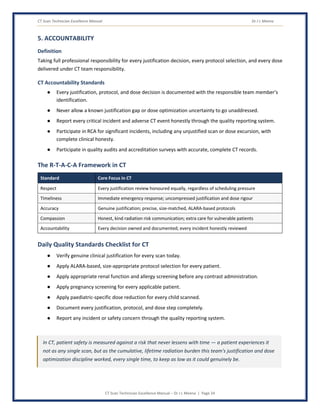
The R-T-A-C-A Framework in CT
Standard Core Focus in CT
Respect Every justification review honoured equally, regardless of scheduling pressure
Timeliness Immediate emergency response; uncompressed justification and dose rigour
Accuracy Genuine justification; precise, size-matched, ALARA-based protocols
Compassion Honest, kind radiation risk communication; extra care for vulnerable patients
Accountability Every decision owned and documented; every incident honestly reviewed
Daily Quality Standards Checklist for CT
● Verify genuine clinical justification for every scan today.
● Apply ALARA-based, size-appropriate protocol selection for every patient.
● Apply appropriate renal function and allergy screening before any contrast administration.
● Apply pregnancy screening for every applicable patient.
● Apply paediatric-specific dose reduction for every child scanned.
● Document every justification, protocol, and dose step completely.
● Report any incident or safety concern through the quality reporting system.
In CT, patient safety is measured against a risk that never lessens with time — a patient experiences it
not as any single scan, but as the cumulative, lifetime radiation burden this team's justification and dose
optimization discipline worked, every single time, to keep as low as it could genuinely be.
CT Scan Technician Excellence Manual Dr J L Meena
CT Scan Technician Excellence Manual – Dr J L Meena | Page 25
CHAPTER 6: CONFIDENTIALITY, PRIVACY, AND INFORMATION
SECURITY
CT involves sensitive diagnostic and radiation dose history information, including cumulative lifetime exposure
records, requiring heightened confidentiality discipline throughout screening, scanning, and reporting.
1. Privacy in CT Practice
Responsibilities
● Conduct screening interviews in as private a setting as available.
● Never discuss one patient's screening or diagnostic findings within earshot of another patient or
unauthorized staff.
● Apply particular discretion when discussing sensitive medical or pregnancy-related history.
2. Confidentiality of Sensitive Findings
Overview
CT findings can reveal significant, unexpected diagnoses requiring particular discretion until appropriate clinical
communication occurs.
Responsibilities
● Handle significant or unexpected imaging findings with heightened confidentiality until clinical
communication occurs.
● Communicate only the clinically necessary information to the wider care team.
3. Clinical Data and RIS/HIS Confidentiality
Responsibilities
● Access only the patient and dose history records necessary for current responsibilities.
● Never discuss a patient's screening or dose information with anyone outside the legitimate care
team.
● Follow hospital IT and cybersecurity policy for all RIS/HIS and CT information system access.
● Never leave CT workstations unlocked or logged in when unattended.
4. Cybersecurity of CT Information Systems
Why Cybersecurity Is a Patient Safety Issue
CT information systems store justification, protocol, and cumulative dose data upon which patient safety
directly depends. A compromised system risks both sensitive data breach and, if dose history data is corrupted,
decisions about future imaging made without an accurate picture of a patient's lifetime exposure.
CT Scan Technician Excellence Manual Dr J L Meena
CT Scan Technician Excellence Manual – Dr J L Meena | Page 26
Responsibilities
● Use only authorized, unique login credentials for all RIS/HIS and CT information system access.
● Never share login credentials with colleagues, regardless of workload pressure.
● Never connect personal devices to hospital clinical networks without IT authorization.
● Report any suspected unauthorized access or cybersecurity anomaly to IT security immediately.
5. Confidentiality for High-Profile and Vulnerable Patients
Responsibilities
● Maintain the same confidentiality standard for high-profile or notorious patients as for every other
patient.
● Never disclose patient identity, diagnosis, or condition to media or unauthorized persons.
Confidentiality Checklist for the CT Team
● Conduct screening interviews with maximum available privacy.
● Handle significant imaging findings with heightened discretion.
● Use only authorized credentials for RIS/HIS and CT information systems.
● Never connect personal devices to hospital clinical networks without IT authorization.
In CT, confidentiality must be actively maintained for screening and cumulative dose information carrying
particular sensitivity, demanding a discretion this team applies without exception.
CT Scan Technician Excellence Manual Dr J L Meena
CT Scan Technician Excellence Manual – Dr J L Meena | Page 27
CHAPTER 7: STANDARD OPERATING PROCEDURES (SOPs) FOR CT
Objectives of CT SOPs
● Ensure consistent, rigorous justification and dose optimization for every examination.
● Minimize harm through systematic, documented safety and quality protocols.
● Support NABH/JCI/ACR accreditation compliance for CT facility standards.
● Provide a defensible clinical and legal framework for incident investigation and quality improvement.
SOP 1: Scan Justification and Clinical Indication Review
Purpose
To ensure every dose delivered is genuinely, clinically necessary.
Procedure
● Step 1: Apply Clinical Decision Support Review — apply appropriateness criteria review before
scheduling.
● Step 2: Verify Genuine Clinical Indication — verify the documented clinical question the scan is
intended to answer.
● Step 3: Clarify Ambiguous Requests — clarify with the ordering clinician when justification is
genuinely unclear.
● Step 4: Document — document the complete justification rationale.
Quality Standards
● 100% of scans supported by documented clinical justification before scheduling.
SOP 2: ALARA Protocol Selection and Dose Optimization
Purpose
To deliver the lowest radiation dose that can still answer the clinical question.
Procedure
● Step 1: Select Indication-Matched Protocol — apply the protocol matched precisely to clinical
indication.
● Step 2: Apply Size-Based Dose Adjustment — apply automatic exposure control and size-based
parameters.
● Step 3: Verify Dose Reasonableness — verify the delivered dose against diagnostic reference levels.
● Step 4: Document — document the complete protocol and dose delivered.
CT Scan Technician Excellence Manual Dr J L Meena
CT Scan Technician Excellence Manual – Dr J L Meena | Page 28
Quality Standards
● 100% of protocols optimized per ALARA principles and matched to patient size and indication.
SOP 3: Pregnancy Screening Before Scanning
Purpose
To protect the developing fetus, among the most radiosensitive populations.
Procedure
● Step 1: Apply Standardized Pregnancy Screening — apply screening for every reproductive-age
patient.
● Step 2: Consult on Confirmed Pregnancy — consult with the ordering clinician and radiologist when
pregnancy is confirmed.
● Step 3: Apply Fetal Dose Minimization — apply minimization techniques or alternative imaging when
scanning remains necessary.
● Step 4: Document — document the complete screening and any resulting decision.
Quality Standards
● 100% of reproductive-age patients screened for pregnancy before scanning.
SOP 4: Paediatric Dose Reduction Protocol
Purpose
To protect children, who are more radiosensitive with more remaining lifetime for risk to manifest.
Procedure
● Step 1: Apply Paediatric-Specific Protocol — apply size-based, paediatric-specific dose parameters.
● Step 2: Apply Particular Justification Rigour — apply heightened justification review for paediatric
scans.
● Step 3: Apply Motion Minimization — apply appropriate technique to minimize repeat acquisition
need.
● Step 4: Document — document the complete paediatric protocol and dose.
Quality Standards
● 100% of paediatric scans apply documented, size-based dose reduction protocols.
SOP 5: Iodinated Contrast Administration
Purpose
To administer contrast safely, protecting patients with renal impairment or allergy history.
CT Scan Technician Excellence Manual Dr J L Meena
CT Scan Technician Excellence Manual – Dr J L Meena | Page 29
Procedure
● Step 1: Apply Renal Function and Allergy Screening — apply evidence-based screening before every
administration.
● Step 2: Apply Lowest Effective Dose — apply the lowest clinically appropriate contrast dose and rate.
● Step 3: Monitor for Reaction — monitor the patient during and after administration.
● Step 4: Document — document the complete screening, dose, and monitoring record.
Quality Standards
● 100% of contrast administrations preceded by documented renal function and allergy screening.
SOP 6: Staff Radiation Protection and Monitoring
Purpose
To protect the CT team's own long-term health from occupational radiation exposure.
Procedure
● Step 1: Apply Appropriate Shielding — apply shielding and distance practices consistently.
● Step 2: Wear Dosimetry Devices — wear and monitor personal dosimetry without exception.
● Step 3: Review Dosimetry Data — review individual and departmental dosimetry data regularly.
● Step 4: Document — document compliance and any dosimetry concern.
Quality Standards
● 100% staff compliance with dosimetry monitoring.
SOP 7: Cumulative Dose Tracking and Documentation
Purpose
To support genuinely informed decisions about a patient's total lifetime imaging history.
Procedure
● Step 1: Record Dose for Every Examination — apply systematic dose recording (CTDI/DLP) for every
scan.
● Step 2: Review Imaging History When Relevant — review prior imaging history to inform justification
decisions.
● Step 3: Flag Significant Cumulative Exposure — flag cases of significant cumulative exposure for
clinical awareness.
● Step 4: Document — document the complete dose record.
Quality Standards
● 100% of examinations include documented dose recording.
CT Scan Technician Excellence Manual Dr J L Meena
CT Scan Technician Excellence Manual – Dr J L Meena | Page 30
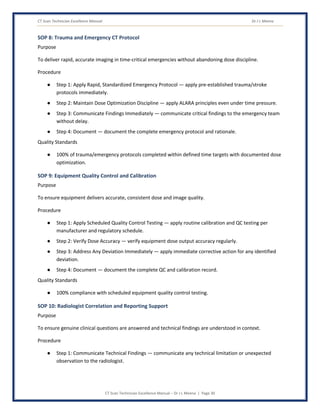
SOP 8: Trauma and Emergency CT Protocol
Purpose
To deliver rapid, accurate imaging in time-critical emergencies without abandoning dose discipline.
Procedure
● Step 1: Apply Rapid, Standardized Emergency Protocol — apply pre-established trauma/stroke
protocols immediately.
● Step 2: Maintain Dose Optimization Discipline — apply ALARA principles even under time pressure.
● Step 3: Communicate Findings Immediately — communicate critical findings to the emergency team
without delay.
● Step 4: Document — document the complete emergency protocol and rationale.
Quality Standards
● 100% of trauma/emergency protocols completed within defined time targets with documented dose
optimization.
SOP 9: Equipment Quality Control and Calibration
Purpose
To ensure equipment delivers accurate, consistent dose and image quality.
Procedure
● Step 1: Apply Scheduled Quality Control Testing — apply routine calibration and QC testing per
manufacturer and regulatory schedule.
● Step 2: Verify Dose Accuracy — verify equipment dose output accuracy regularly.
● Step 3: Address Any Deviation Immediately — apply immediate corrective action for any identified
deviation.
● Step 4: Document — document the complete QC and calibration record.
Quality Standards
● 100% compliance with scheduled equipment quality control testing.
SOP 10: Radiologist Correlation and Reporting Support
Purpose
To ensure genuine clinical questions are answered and technical findings are understood in context.
Procedure
● Step 1: Communicate Technical Findings — communicate any technical limitation or unexpected
observation to the radiologist.
CT Scan Technician Excellence Manual Dr J L Meena
CT Scan Technician Excellence Manual – Dr J L Meena | Page 31
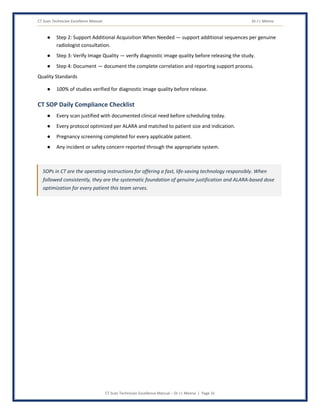
● Step 2: Support Additional Acquisition When Needed — support additional sequences per genuine
radiologist consultation.
● Step 3: Verify Image Quality — verify diagnostic image quality before releasing the study.
● Step 4: Document — document the complete correlation and reporting support process.
Quality Standards
● 100% of studies verified for diagnostic image quality before release.
CT SOP Daily Compliance Checklist
● Every scan justified with documented clinical need before scheduling today.
● Every protocol optimized per ALARA and matched to patient size and indication.
● Pregnancy screening completed for every applicable patient.
● Any incident or safety concern reported through the appropriate system.
SOPs in CT are the operating instructions for offering a fast, life-saving technology responsibly. When
followed consistently, they are the systematic foundation of genuine justification and ALARA-based dose
optimization for every patient this team serves.
CT Scan Technician Excellence Manual Dr J L Meena
CT Scan Technician Excellence Manual – Dr J L Meena | Page 32
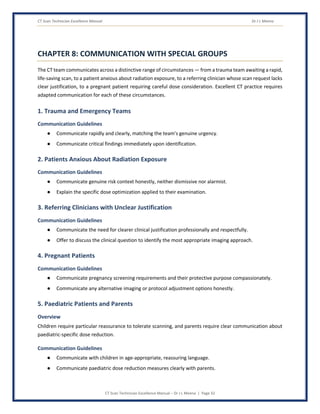
CHAPTER 8: COMMUNICATION WITH SPECIAL GROUPS
The CT team communicates across a distinctive range of circumstances — from a trauma team awaiting a rapid,
life-saving scan, to a patient anxious about radiation exposure, to a referring clinician whose scan request lacks
clear justification, to a pregnant patient requiring careful dose consideration. Excellent CT practice requires
adapted communication for each of these circumstances.
1. Trauma and Emergency Teams
Communication Guidelines
● Communicate rapidly and clearly, matching the team's genuine urgency.
● Communicate critical findings immediately upon identification.
2. Patients Anxious About Radiation Exposure
Communication Guidelines
● Communicate genuine risk context honestly, neither dismissive nor alarmist.
● Explain the specific dose optimization applied to their examination.
3. Referring Clinicians with Unclear Justification
Communication Guidelines
● Communicate the need for clearer clinical justification professionally and respectfully.
● Offer to discuss the clinical question to identify the most appropriate imaging approach.
4. Pregnant Patients
Communication Guidelines
● Communicate pregnancy screening requirements and their protective purpose compassionately.
● Communicate any alternative imaging or protocol adjustment options honestly.
5. Paediatric Patients and Parents
Overview
Children require particular reassurance to tolerate scanning, and parents require clear communication about
paediatric-specific dose reduction.
Communication Guidelines
● Communicate with children in age-appropriate, reassuring language.
● Communicate paediatric dose reduction measures clearly with parents.
CT Scan Technician Excellence Manual Dr J L Meena
CT Scan Technician Excellence Manual – Dr J L Meena | Page 33
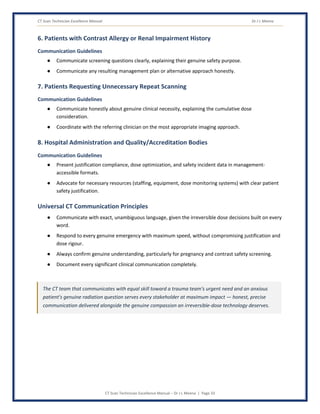
6. Patients with Contrast Allergy or Renal Impairment History
Communication Guidelines
● Communicate screening questions clearly, explaining their genuine safety purpose.
● Communicate any resulting management plan or alternative approach honestly.
7. Patients Requesting Unnecessary Repeat Scanning
Communication Guidelines
● Communicate honestly about genuine clinical necessity, explaining the cumulative dose
consideration.
● Coordinate with the referring clinician on the most appropriate imaging approach.
8. Hospital Administration and Quality/Accreditation Bodies
Communication Guidelines
● Present justification compliance, dose optimization, and safety incident data in management-
accessible formats.
● Advocate for necessary resources (staffing, equipment, dose monitoring systems) with clear patient
safety justification.
Universal CT Communication Principles
● Communicate with exact, unambiguous language, given the irreversible dose decisions built on every
word.
● Respond to every genuine emergency with maximum speed, without compromising justification and
dose rigour.
● Always confirm genuine understanding, particularly for pregnancy and contrast safety screening.
● Document every significant clinical communication completely.
The CT team that communicates with equal skill toward a trauma team's urgent need and an anxious
patient's genuine radiation question serves every stakeholder at maximum impact — honest, precise
communication delivered alongside the genuine compassion an irreversible-dose technology deserves.
CT Scan Technician Excellence Manual Dr J L Meena
CT Scan Technician Excellence Manual – Dr J L Meena | Page 34
CHAPTER 9: HANDLING DIFFICULT SITUATIONS
Common Difficult Situations for the CT Team
● A scan request lacks clear clinical justification.
● A referring clinician insists on an unjustified or duplicate scan.
● A patient's pregnancy status is uncertain or the patient is reluctant to disclose it.
● A patient with significant renal impairment requires contrast for a genuinely necessary diagnosis.
● A colleague appears to be applying a higher-dose protocol than genuinely necessary.
● A trauma scan must be acquired under extreme time pressure.
● Equipment malfunction is identified during an active examination.
● A patient experiences a contrast reaction.
● A patient refuses genuinely necessary pregnancy screening.
● Image quality is inadequate, raising the question of repeat scanning and additional dose.
Core Principles for Handling Difficult Situations
1. Justification and Dose Integrity Are Never Compromised
In every difficult situation, genuine clinical justification and dose optimization drive every decision — no
scheduling or clinical pressure, however genuine, justifies an unjustified or excessive dose.
2. Apply Standardized Protocols Under Pressure
Unclear justification and time pressure are precisely when standardized protocols matter most — resist the
temptation to improvise when a proven protocol exists.
3. Escalate Immediately and Persistently
A genuine safety concern is not resolved until it reaches someone who can act on it — escalate through
alternative channels if the first attempt does not produce a response.
4. Document Everything
Every difficult situation must be contemporaneously documented — what was found, what was
communicated, what decisions were made, and by whom.
Handling an Unclear Justification Request
Steps
● Communicate the need for clearer justification professionally to the ordering clinician.
● Decline to proceed until genuine clinical justification is established.
CT Scan Technician Excellence Manual Dr J L Meena
CT Scan Technician Excellence Manual – Dr J L Meena | Page 35
Handling Insistence on an Unjustified or Duplicate Scan
Steps
● Communicate the genuine dose concern and cumulative exposure consideration clearly.
● Escalate to radiologist or medical leadership if insistence continues without genuine clinical
rationale.
Handling Uncertain or Undisclosed Pregnancy Status
Steps
● Communicate the screening question's genuine protective purpose clearly and compassionately.
● Apply appropriate precaution when status remains genuinely uncertain.
Handling Contrast Need in Significant Renal Impairment
Steps
● Apply careful risk-benefit consultation with the referring clinician and, where appropriate,
nephrology.
● Apply the lowest effective dose or alternative imaging approach as clinically indicated.
Handling Concern About a Colleague's Protocol Selection
Steps
● Address the concern directly and professionally with the colleague.
● Escalate to department leadership if the concern involves a pattern or remains unresolved.
Handling Extreme Time Pressure in Trauma Scanning
Steps
● Apply the pre-established, standardized trauma protocol rather than improvising.
● Maintain dose optimization discipline even within a rapid acquisition.
Handling Equipment Malfunction Mid-Examination
Steps
● Apply immediate contingency protocol to prevent unnecessary repeat exposure.
● Communicate any resulting delay transparently to the clinical team.
Handling a Contrast Reaction
Steps
● Apply immediate emergency response per contrast reaction protocol.
● Coordinate immediately with the emergency response team.
CT Scan Technician Excellence Manual Dr J L Meena
CT Scan Technician Excellence Manual – Dr J L Meena | Page 36
Handling Refusal of Necessary Pregnancy Screening
Steps
● Explain the genuine, non-negotiable safety rationale calmly and clearly.
● Apply appropriate precautionary measures or decline to proceed until resolved.
Handling Inadequate Image Quality
Steps
● Apply careful risk-benefit consideration before any repeat acquisition, given the additional dose
involved.
● Communicate any persistent limitation honestly to the interpreting radiologist.
The CALM Model for CT
● C – Control the immediate justification or dose risk.
● A – Acknowledge the clinical reality accurately, including genuine uncertainty.
● L – Lead with evidence — appropriateness criteria, ALARA guidelines, and dose reference levels.
● M – Manage through documented escalation channels when needed.
Difficult situations in CT are always, ultimately, tests of whether justification and dose integrity hold firm
under clinical or scheduling pressure. The team that never compromises either, escalates persistently,
and communicates honestly even when it means delay is fulfilling the highest professional obligation of
CT practice.
CT Scan Technician Excellence Manual Dr J L Meena
CT Scan Technician Excellence Manual – Dr J L Meena | Page 37
CHAPTER 10: EMERGENCY RESPONSE — CRITICAL CT PRESENTATIONS
Overview
Certain presentations demand the CT team's most immediate, standardized, and rehearsed response —
scenarios where the difference between a coordinated, protocol-driven response and an improvised one is
measured directly in whether time-critical treatment is enabled or a preventable radiation or contrast harm
occurs.
Critical Presentations Requiring Immediate Response
● Suspected acute stroke requiring immediate CT/CT angiography.
● Major trauma requiring rapid whole-body CT protocol.
● Suspected acute aortic dissection or pulmonary embolism.
● Severe contrast reaction (anaphylaxis) during or after administration.
● Contrast extravasation causing significant tissue injury.
● Equipment malfunction affecting active scanning.
● Unexpected critical incidental finding requiring immediate notification.
● Confirmed pregnancy discovered after a scan involving significant fetal dose.
● Suspected significant dose excursion or equipment error.
● Patient deterioration during scanning requiring emergency response.
1. Suspected Acute Stroke
Immediate Response
● Apply immediate, standardized stroke CT/CTA protocol without delay.
● Communicate results immediately to the stroke team per time-critical protocol.
2. Major Trauma
Steps
● Apply immediate, standardized whole-body trauma protocol.
● Communicate critical findings immediately to the trauma team.
3. Suspected Aortic Dissection or Pulmonary Embolism
Steps
● Apply immediate, appropriately timed contrast-enhanced protocol.
● Communicate findings immediately given the time-critical nature of these diagnoses.
CT Scan Technician Excellence Manual Dr J L Meena
CT Scan Technician Excellence Manual – Dr J L Meena | Page 38
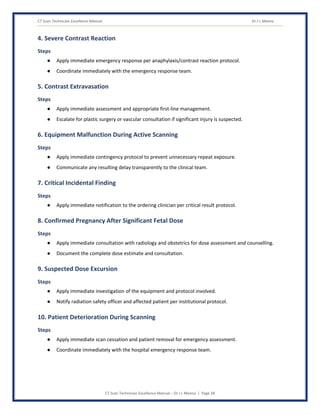
4. Severe Contrast Reaction
Steps
● Apply immediate emergency response per anaphylaxis/contrast reaction protocol.
● Coordinate immediately with the emergency response team.
5. Contrast Extravasation
Steps
● Apply immediate assessment and appropriate first-line management.
● Escalate for plastic surgery or vascular consultation if significant injury is suspected.
6. Equipment Malfunction During Active Scanning
Steps
● Apply immediate contingency protocol to prevent unnecessary repeat exposure.
● Communicate any resulting delay transparently to the clinical team.
7. Critical Incidental Finding
Steps
● Apply immediate notification to the ordering clinician per critical result protocol.
8. Confirmed Pregnancy After Significant Fetal Dose
Steps
● Apply immediate consultation with radiology and obstetrics for dose assessment and counselling.
● Document the complete dose estimate and consultation.
9. Suspected Dose Excursion
Steps
● Apply immediate investigation of the equipment and protocol involved.
● Notify radiation safety officer and affected patient per institutional protocol.
10. Patient Deterioration During Scanning
Steps
● Apply immediate scan cessation and patient removal for emergency assessment.
● Coordinate immediately with the hospital emergency response team.
CT Scan Technician Excellence Manual Dr J L Meena
CT Scan Technician Excellence Manual – Dr J L Meena | Page 39
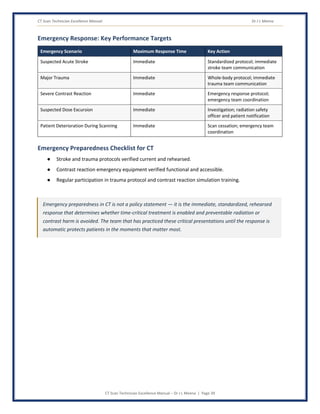
Emergency Response: Key Performance Targets
Emergency Scenario Maximum Response Time Key Action
Suspected Acute Stroke Immediate Standardized protocol; immediate
stroke team communication
Major Trauma Immediate Whole-body protocol; immediate
trauma team communication
Severe Contrast Reaction Immediate Emergency response protocol;
emergency team coordination
Suspected Dose Excursion Immediate Investigation; radiation safety
officer and patient notification
Patient Deterioration During Scanning Immediate Scan cessation; emergency team
coordination
Emergency Preparedness Checklist for CT
● Stroke and trauma protocols verified current and rehearsed.
● Contrast reaction emergency equipment verified functional and accessible.
● Regular participation in trauma protocol and contrast reaction simulation training.
Emergency preparedness in CT is not a policy statement — it is the immediate, standardized, rehearsed
response that determines whether time-critical treatment is enabled and preventable radiation or
contrast harm is avoided. The team that has practiced these critical presentations until the response is
automatic protects patients in the moments that matter most.
CT Scan Technician Excellence Manual Dr J L Meena
CT Scan Technician Excellence Manual – Dr J L Meena | Page 40
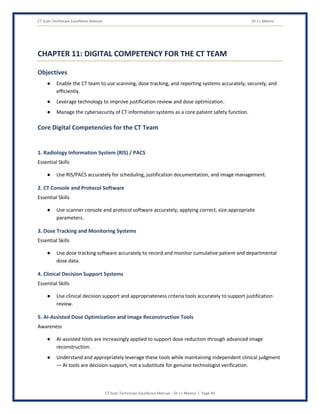
CHAPTER 11: DIGITAL COMPETENCY FOR THE CT TEAM
Objectives
● Enable the CT team to use scanning, dose tracking, and reporting systems accurately, securely, and
efficiently.
● Leverage technology to improve justification review and dose optimization.
● Manage the cybersecurity of CT information systems as a core patient safety function.
Core Digital Competencies for the CT Team
1. Radiology Information System (RIS) / PACS
Essential Skills
● Use RIS/PACS accurately for scheduling, justification documentation, and image management.
2. CT Console and Protocol Software
Essential Skills
● Use scanner console and protocol software accurately, applying correct, size-appropriate
parameters.
3. Dose Tracking and Monitoring Systems
Essential Skills
● Use dose tracking software accurately to record and monitor cumulative patient and departmental
dose data.
4. Clinical Decision Support Systems
Essential Skills
● Use clinical decision support and appropriateness criteria tools accurately to support justification
review.
5. AI-Assisted Dose Optimization and Image Reconstruction Tools
Awareness
● AI-assisted tools are increasingly applied to support dose reduction through advanced image
reconstruction.
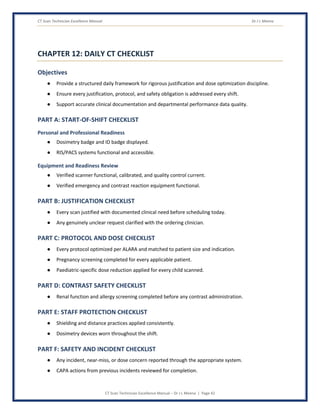
● Understand and appropriately leverage these tools while maintaining independent clinical judgment
— AI tools are decision-support, not a substitute for genuine technologist verification.
CT Scan Technician Excellence Manual Dr J L Meena
CT Scan Technician Excellence Manual – Dr J L Meena | Page 41
6. Electronic Medical Record (EMR) / Hospital Information System (HIS)
Essential Skills
● Document justification, protocol, and dose findings accurately and in real time.
7. Cybersecurity and Information Security
Personal Digital Security Responsibilities
● Use unique, strong credentials for all RIS/HIS and CT information system logins.
● Lock or log out of workstations whenever stepping away, even briefly.
● Never connect personal devices to hospital clinical networks.
● Report all cybersecurity anomalies to IT security immediately.
Digital Competency Checklist
● Navigate RIS/PACS, scanner console, and dose tracking systems for all core functions without
assistance.
● Apply accurate, complete justification and dose documentation.
● Apply basic cybersecurity practices to all clinical system access.
● Know the downtime procedure for RIS/PACS system failure.
Digital competency for the CT team is the ability to integrate rigorous justification and dose judgment
with the scanning, tracking, and clinical decision support systems that modern CT increasingly depends
upon — using technology to extend, never replace, the dose optimization discipline that defines
responsible CT practice.
CT Scan Technician Excellence Manual Dr J L Meena
CT Scan Technician Excellence Manual – Dr J L Meena | Page 42
CHAPTER 12: DAILY CT CHECKLIST
Objectives
● Provide a structured daily framework for rigorous justification and dose optimization discipline.
● Ensure every justification, protocol, and safety obligation is addressed every shift.
● Support accurate clinical documentation and departmental performance data quality.
PART A: START-OF-SHIFT CHECKLIST
Personal and Professional Readiness
● Dosimetry badge and ID badge displayed.
● RIS/PACS systems functional and accessible.
Equipment and Readiness Review
● Verified scanner functional, calibrated, and quality control current.
● Verified emergency and contrast reaction equipment functional.
PART B: JUSTIFICATION CHECKLIST
● Every scan justified with documented clinical need before scheduling today.
● Any genuinely unclear request clarified with the ordering clinician.
PART C: PROTOCOL AND DOSE CHECKLIST
● Every protocol optimized per ALARA and matched to patient size and indication.
● Pregnancy screening completed for every applicable patient.
● Paediatric-specific dose reduction applied for every child scanned.
PART D: CONTRAST SAFETY CHECKLIST
● Renal function and allergy screening completed before any contrast administration.
PART E: STAFF PROTECTION CHECKLIST
● Shielding and distance practices applied consistently.
● Dosimetry devices worn throughout the shift.
PART F: SAFETY AND INCIDENT CHECKLIST
● Any incident, near-miss, or dose concern reported through the appropriate system.
● CAPA actions from previous incidents reviewed for completion.
CT Scan Technician Excellence Manual Dr J L Meena
CT Scan Technician Excellence Manual – Dr J L Meena | Page 43
PART G: END-OF-SHIFT CHECKLIST
● All clinical records updated and complete for the shift.
● Structured handover prepared for the incoming shift.
● Clinical systems securely logged out.
Daily Self-Assessment for the CT Team
● Did we verify genuine clinical justification for every scan today?
● Did we apply ALARA-based, size-appropriate protocol selection for every patient?
● Did we apply appropriate contrast safety screening for every administration?
● Did we apply pregnancy screening and paediatric dose reduction where applicable?
● Did we communicate honestly with every patient and clinical team today?
A consistent, structured daily routine — from start-of-shift equipment verification to end-of-shift
handover — transforms individual dose optimization discipline into a systemic CT safety programme that
operates reliably against a risk that never lessens over time.
CT Scan Technician Excellence Manual Dr J L Meena
CT Scan Technician Excellence Manual – Dr J L Meena | Page 44
CHAPTER 13: KEY PERFORMANCE INDICATORS (KPIs) FOR CT
Objectives
● Measure justification, dose optimization, and safety performance objectively.
● Enable data-driven continuous improvement in CT practice.
● Support NABH/JCI/ACR accreditation standards for CT facilities.
● Demonstrate the value and patient safety impact of the CT team to institutional leadership.
Categories of CT KPIs
1. Justification KPIs
KPI Definition Target
Justification Compliance Rate % of scans supported by documented clinical justification 100%
Unnecessary Repeat Scan Rate % of scans identified as avoidable duplicates Track and trend;
minimize toward
zero
2. Dose Optimization KPIs
KPI Definition Target
ALARA Protocol Compliance % of protocols matched to indication and patient size
per ALARA
100%
Dose Reference Level Compliance % of scans within institutional/national diagnostic
reference levels
≥ 95%
3. Vulnerable Population Protection KPIs
KPI Definition Target
Pregnancy Screening Compliance % of reproductive-age patients screened before
scanning
100%
Paediatric Protocol Compliance % of paediatric scans using documented size-based
dose reduction
100%
4. Contrast Safety KPIs
KPI Definition Target
Contrast Screening Compliance % of contrast administrations preceded by
documented renal/allergy screening
100%
Contrast Reaction Rate Rate of significant contrast reactions At or below
institutional/national
benchmark
CT Scan Technician Excellence Manual Dr J L Meena
CT Scan Technician Excellence Manual – Dr J L Meena | Page 45
5. Outcome and Governance KPIs
KPI Definition Target
RCA Completion Rate % of significant adverse events with completed RCA 100%
Staff Dosimetry Compliance % staff compliance with dosimetry monitoring 100%
Trauma Protocol Time Compliance % of trauma scans meeting defined time targets ≥ 95%
Using KPIs for Continuous Improvement
● Review all CT KPIs regularly at departmental quality and governance meetings.
● Analyse justification, dose, and reaction rate trends to identify targeted process improvements.
● Use dose reference level data to identify protocol optimization opportunities.
● Present KPI data to hospital management to demonstrate the patient safety impact of CT excellence.
CT KPIs translate the discipline of managing an irreversible risk into institutional accountability —
demonstrating that the investment in genuine justification, ALARA-based dose optimization, and
vulnerable population protection is a measurable, trackable programme that keeps an extraordinary, life-
saving technology genuinely responsible.
CT Scan Technician Excellence Manual Dr J L Meena
CT Scan Technician Excellence Manual – Dr J L Meena | Page 46
CHAPTER 14: TOP 20 DO'S & TOP 20 DON'TS FOR CT
Introduction
The CT team delivers a technology whose core clinical value — speed and precision in emergencies — comes
paired with a dose that is genuinely irreversible. Their daily professional decisions — about justification, ALARA-
based dose optimization, and vulnerable population protection — determine whether every photon delivered
was one a patient genuinely needed. These Do's and Don'ts provide the practical daily architecture of CT
excellence.
TOP 20 DO'S FOR CT
● 1. Verify Genuine Clinical Justification for Every Scan — Before scheduling, every time.
● 2. Apply ALARA to Every Protocol — The lowest dose that can still answer the question.
● 3. Match Protocol to Patient Size — Every scan, every time.
● 4. Screen for Pregnancy Before Every Applicable Scan — Without exception.
● 5. Apply Paediatric-Specific Dose Reduction — Every child, every time.
● 6. Screen Renal Function and Allergy History Before Contrast — Every administration.
● 7. Wear Dosimetry Devices Consistently — Protecting your own long-term health.
● 8. Apply Standardized Trauma Protocols — Speed without abandoning dose discipline.
● 9. Track Cumulative Dose Systematically — Supporting informed future decisions.
● 10. Communicate Radiation Risk Honestly — Neither dismissive nor alarmist.
● 11. Debrief After Every Significant Event — Consolidate learning while it is fresh.
● 12. Provide Structured Handover for Every Transfer — SBAR or equivalent, every time.
● 13. Communicate with Exact, Unambiguous Language — Irreversible decisions depend on every
word.
● 14. Report Every Near-Miss Honestly — Including your own, especially in dose optimization.
● 15. Question an Unjustified Scan Request — Professionally, every time.
● 16. Verify Equipment Calibration Regularly — Accurate dose depends on it.
● 17. Apply the Same Rigour to Every Patient — Regardless of setting or volume.
● 18. Coordinate Closely with Radiologists — For protocol and correlation support.
● 19. Advocate for Resources When Safety Requires It — Escalate, don't compress.
● 20. Continue Learning — CT dose safety evidence evolves. The team that does not learn continuously
treats today's patients with yesterday's protocols.
CT Scan Technician Excellence Manual Dr J L Meena
CT Scan Technician Excellence Manual – Dr J L Meena | Page 47
TOP 20 DON'TS FOR CT
● 1. Don't Proceed Without Genuine Clinical Justification — Ever, for any reason.
● 2. Don't Apply a Higher-Dose Protocol Than Genuinely Necessary — ALARA, every time.
● 3. Don't Scale an Adult Protocol Down for a Child — Use dedicated paediatric protocols.
● 4. Don't Skip Pregnancy Screening — The fetus is among the most radiosensitive populations.
● 5. Don't Administer Contrast Without Renal/Allergy Screening — No exceptions.
● 6. Don't Skip Dosimetry Monitoring — Your own health depends on it.
● 7. Don't Improvise Under Trauma Time Pressure — Use the standardized protocol.
● 8. Don't Repeat a Scan Without Genuine Clinical Need — Cumulative dose matters.
● 9. Don't Present Radiation Risk Dismissively or Alarmingly — Honest context, always.
● 10. Don't Skip Team Debriefing After a Critical Event — Unprocessed events repeat their gaps.
● 11. Don't Hand Over Complex Cases Informally — Structure protects against critical omissions.
● 12. Don't Use Ambiguous Language in Any Report — Every word carries irreversible weight.
● 13. Don't Hide or Minimize a Near-Miss — Suppressed incidents cannot drive the improvement that
prevents recurrence.
● 14. Don't Proceed with an Unclear Justification to Avoid an Awkward Conversation — Clarify first.
● 15. Don't Skip Equipment Quality Control — Accurate dose depends on calibration.
● 16. Don't Let Volume Erode Justification Rigour — Every patient deserves the same standard.
● 17. Don't Bypass Radiologist Consultation on Genuine Protocol Uncertainty — Ask, don't guess.
● 18. Don't Compress Dose Optimization to Save Scheduling Time — Escalate the resource concern
instead.
● 19. Don't Ignore a Flagged Significant Cumulative Exposure — It should inform the justification
decision.
● 20. Don't Practice Outside Current CT Dose Safety Evidence — Personal habit or outdated method
must never override current best practice.
CT Golden Rules
● Justify every scan — genuine clinical need, every time.
● Optimize every dose through ALARA — the lowest that can still answer the question.
● Match protocol to patient size — never a one-size-fits-all approach.
● Screen for pregnancy and apply paediatric protocols — the most radiosensitive deserve the most
care.
● Screen before contrast — renal function and allergy history, every time.
● Protect your own health — dosimetry monitoring, consistently.
● Maintain dose discipline even in emergencies — speed and responsibility are not opposites.
CT Scan Technician Excellence Manual Dr J L Meena
CT Scan Technician Excellence Manual – Dr J L Meena | Page 48
● Communicate radiation risk honestly — neither dismissive nor alarmist.
● Report every near-miss — honestly, including your own.
● Never stop learning — today's CT dose evidence is not yesterday's.
Daily Commitment Statement
“Today, I will verify genuine justification for every scan, apply ALARA-based, size-matched protocols, screen for
pregnancy and contrast risk appropriately, and communicate radiation risk honestly — because radiation once
given can never be taken back, and I will justify every scan and deliver the lowest dose that still answers the
question.”
The Top 20 Do's and Top 20 Don'ts are the daily professional architecture of CT excellence — each shaped
by the understanding that this discipline's core clinical value and core risk are delivered by the same
technology in the same instant, and that there are no minor lapses when a dose delivered today can
never be reduced tomorrow.
CT Scan Technician Excellence Manual Dr J L Meena
CT Scan Technician Excellence Manual – Dr J L Meena | Page 49
CHAPTER 15: CT PROFESSIONAL PLEDGE
Introduction
A CT Professional Pledge is a formal, collective commitment to uphold the highest standards of scan
justification, ALARA-based dose optimization, and vulnerable population protection. It serves as a daily
affirmation that every photon delivered was one a patient genuinely needed, because radiation once given can
never be taken back.
Official CT Professional Pledge
“We solemnly pledge that as the CT team, we will fulfil our collective and individual responsibilities with the
highest standards of justification rigour, dose optimization discipline, and unwavering commitment to a
technology whose core clinical value and core risk are delivered simultaneously, by the same photons, in the
same instant.
We will verify genuine clinical justification for every scan before it is performed, questioning any request that
lacks clear necessity professionally rather than proceeding automatically, and we will apply ALARA-based
protocol selection matched precisely to clinical indication and patient size, delivering the lowest dose that can
still answer the clinical question.
We will screen every reproductive-age patient for pregnancy before scanning, apply paediatric-specific, size-
based dose reduction to every child, and apply evidence-based renal function and allergy screening before
every iodinated contrast administration.
We will protect our own long-term health through consistent shielding practice and dosimetry monitoring,
track cumulative patient dose systematically to inform genuinely responsible future imaging decisions, and
maintain speed and accuracy in trauma and emergency imaging without ever abandoning our dose
optimization discipline.
We will report every incident and near-miss honestly, resist any pressure to compromise justification or dose
integrity, and continuously expand our knowledge and skill, knowing that CT dose safety evidence evolves and
that the team that does not learn continuously treats today's patients with yesterday's protocols.
With unwavering justification rigour, genuine dose optimization discipline, and profound respect for a risk that
is genuinely irreversible, we pledge to be the CT team that justifies every scan and delivers the lowest dose
that still answers the question, every single time.”
Daily Commitment Statement
“Today, we commit to verifying genuine justification for every scan, applying ALARA-based, size-matched
protocols, and protecting our most radiosensitive patients with particular care — because radiation once given
can never be taken back, and we will justify every scan and deliver the lowest dose that still answers the
question.”
CT Scan Technician Excellence Manual Dr J L Meena
CT Scan Technician Excellence Manual – Dr J L Meena | Page 50
Core Values Reflected in the Pledge
1. Justification Rigour
Every scan supported by genuine, documented clinical need, never scheduled by habit or convenience.
2. ALARA Dose Optimization
Every protocol delivering the lowest dose that can still achieve genuine diagnostic value.
3. Vulnerable Population Protection
Pregnancy screening and paediatric-specific protocols applied with particular rigour, never as routine
afterthoughts.
4. Contrast Safety
Renal function and allergy screening applied genuinely before every iodinated contrast administration.
5. Staff Self-Protection
Shielding and dosimetry monitoring practiced consistently, protecting the team's own long-term health.
6. Accountability
Every decision owned and documented; every incident honestly reviewed.
7. Continuous Learning
CT dose safety evidence evolves. Professional competence requires perpetual learning.
When the Pledge Should Be Recited
● At the beginning of every new CT team member's appointment.
● At quality governance and dose safety review meetings.
● At NABH/JCI/ACR accreditation preparation events.
● As a periodic collective affirmation, particularly following a significant adverse event.
CT Oath of the Irreversible Dose
“We pledge that every photon we deliver will be one a patient genuinely needed, optimized to the lowest dose
that could still answer the question — because radiation given cannot be taken back.”
CT Signature Commitment
This pledge is recited collectively by the multidisciplinary CT team and may be individually signed by:
Name: ___________________________
Role: CT Technologist / Radiation Safety Officer / Radiologist
Department: CT
CT Scan Technician Excellence Manual Dr J L Meena
CT Scan Technician Excellence Manual – Dr J L Meena | Page 51
Registration/Employee ID: _______________
Signature: ________________________
Date: ____________________________
CT Scan Technician Excellence Manual Dr J L Meena
CT Scan Technician Excellence Manual – Dr J L Meena | Page 52
CONCLUSION
There is a discipline in medical imaging built on a decision that, unlike almost any other in medicine, cannot be
undone once made: every dose of ionizing radiation delivered during a CT scan adds permanently to a patient's
lifetime radiation burden. This manual has returned, again and again, to why this irreversibility demands a
discipline that never relaxes — genuine scan justification that ensures every dose delivered was truly needed,
ALARA-based protocol optimization that delivers the lowest dose that could still answer the clinical question,
and particular rigour protecting the most radiosensitive patients.
Throughout this manual, we have explored the full scope of CT Technologist professional practice — from
rigorous scan justification and ALARA-based dose optimization, through safe contrast administration,
pregnancy screening, and paediatric dose reduction, to staff radiation protection, cumulative dose tracking,
and the professional conduct that defines excellence across every category of CT practice. These
responsibilities collectively define a discipline that demands both extraordinary technical speed and precision
in emergencies, and unwavering discipline in protecting every patient's genuinely irreversible radiation burden.
The Importance of the CT Team in Healthcare Quality
● The disciplined justifier — ensuring every dose delivered was genuinely, clinically necessary.
● The ALARA optimizer — delivering diagnostic image quality with the minimum radiation genuinely
required.
● The vulnerable population protector — applying particular rigour to pregnancy and paediatric
scanning.
● The rapid, responsible emergency responder — proving that speed and dose discipline are not in
conflict.
● The cumulative dose tracker — supporting genuinely informed decisions about a patient's total
lifetime exposure.
● The honest reviewer — examining every incident and near-miss to protect the next patient whose
lifetime radiation burden depends on this team's discipline.
Final Commitment
“As the CT team, we commit to verifying genuine justification for every scan, applying ALARA-based, size-
matched protocols, and protecting our most radiosensitive patients with particular care — because radiation
once given can never be taken back, and we will justify every scan and deliver the lowest dose that still answers
the question.”
CT Scan Technician Excellence Manual Dr J L Meena
CT Scan Technician Excellence Manual – Dr J L Meena | Page 53
Final Motto
“Radiation Once Given Can Never Be Taken Back — We Justify Every Scan and Deliver the Lowest Dose That
Still Answers the Question.”
Together, We Deliver Speed and Precision Where Seconds Matter — And Restraint and Care Where a
Lifetime Is at Stake.
CT Scan Technician Excellence Manual Dr J L Meena
CT Scan Technician Excellence Manual – Dr J L Meena | Page 54
REFERENCES
Global Accreditation and Regulatory Standards
● World Health Organization (WHO) – Global Initiative on Radiation Safety in Health Care Settings.
● Joint Commission International (JCI) – JCI Accreditation Standards for Hospitals: Assessment of
Patients (AOP) Chapter, including Diagnostic Imaging Requirements.
● National Accreditation Board for Hospitals & Healthcare Providers (NABH, India) – Standards for
Diagnostic Imaging and CT Facility Services (5th Edition).
Radiological Protection Standards
● International Commission on Radiological Protection (ICRP) – Recommendations on Radiological
Protection, including the ALARA Principle.
● American College of Radiology (ACR) – ACR–AAPM Practice Parameters for CT and Dose Optimization
Guidance.
Scan Justification and Appropriateness Standards
● American College of Radiology (ACR) – ACR Appropriateness Criteria for Diagnostic Imaging.
● Royal College of Radiologists (RCR) – iRefer Guidelines for Imaging Referral.
Contrast Safety Standards
● American College of Radiology (ACR) – ACR Manual on Contrast Media, including Iodinated Contrast
Safety.
● European Society of Urogenital Radiology (ESUR) – Guidelines on Contrast Media Safety.
Paediatric and Diagnostic Reference Level Standards
● Image Gently Alliance – Paediatric CT Dose Reduction Guidelines.
● International Atomic Energy Agency (IAEA) – Diagnostic Reference Levels in Medical Imaging.
Indian Regulatory and National Framework
● Atomic Energy Regulatory Board (AERB), India – Radiological Safety Requirements for Medical
Diagnostic Imaging.
● Indian Radiological and Imaging Association (IRIA) – Clinical Practice Guidelines for CT.
● National Medical Commission (NMC) – Code of Medical Ethics Regulations Applicable to Radiology
Practice.
CT Scan Technician Excellence Manual Dr J L Meena
CT Scan Technician Excellence Manual – Dr J L Meena | Page 55
Quality Improvement and Patient Safety Frameworks
● Institute for Healthcare Improvement (IHI) – Framework for Patient Safety and Quality Improvement
in Diagnostic Imaging.
● World Health Organization – Global Patient Safety Action Plan 2021–2030.
Cybersecurity and Digital Health Records
● NIST Cybersecurity Framework – Applied to Healthcare Radiology Information Systems.
● HL7 International / DICOM Standards Committee – Medical Imaging Data Interchange Standards.
This manual has been developed using internationally recognized principles and best practices from WHO
Global Initiative on Radiation Safety, JCI Assessment of Patients Standards, NABH Diagnostic Imaging
Standards, ICRP Recommendations on Radiological Protection, ACR–AAPM Practice Parameters, ACR
Appropriateness Criteria, RCR iRefer Guidelines, ACR Manual on Contrast Media, ESUR Contrast Safety
Guidelines, Image Gently Paediatric Dose Guidelines, IAEA Diagnostic Reference Levels, India's AERB
Radiological Safety Requirements, IRIA Clinical Practice Guidelines, and applicable Indian statutory and
regulatory requirements. Institutions should verify current versions of all cited guidelines and regulatory
requirements, as clinical protocols and accreditation standards are subject to periodic revision.
ॐ जय माता द( ॐ
CT Scan Technician Excellence Manual Dr J L Meena
CT Scan Technician Excellence Manual – Dr J L Meena | Page 56
END OF MANUAL
Thank You
This manual has been prepared with the vision to empower the multidisciplinary CT team with global
standards, best practices, and professional guidance to offer this fast, life-saving imaging technology
responsibly, protecting every patient's irreversible lifetime radiation burden.
Our Commitment Continues
The journey of learning never ends. As CT technology and dose safety evidence evolve, our commitment to
justification rigour, ALARA-based optimization, and vulnerable population protection must remain unwavering
— because the dose delivered today cannot be reduced tomorrow.
Together, We Build Trust
Every scan genuinely justified, every protocol optimized to the lowest achievable dose, every pregnant and
paediatric patient protected with particular care, and every contrast administration screened appropriately
contributes to one greater purpose — speed and precision where seconds matter, and restraint and care where
a lifetime is at stake.
“Radiation Once Given Can Never Be Taken Back — We Justify Every Scan and Deliver the
Lowest Dose That Still Answers the Question.”
REMEMBER: Justification is our first question • ALARA is our discipline • The vulnerable get extra care •
Speed and safety together • Learning is our journey
Thank you for being a part of this vital mission. Your dedication makes a difference every day.
Dr J L Meena