COVER TEST:
Objective testto confirm or exclude
possibility of manifest squint (tropia).
Differentiates between pseudosquint & true
concomitant squint.
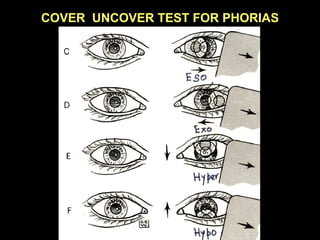
COVER UNCOVER TEST:
Objective test to confirm or exclude
possibility of latent squint (phoria).
ALTERNATE COVER TEST:
Objective test to find out total angle of
squint.
PRISM COVER TEST:
To measure the angle of squint.
4.
FOR TROPIAS :
COVERTEST : Normally at 2 distances:
far (6m) & near (1/3m)
Done with glasses & without
glasses.
Far distance cover test :
in divergent squint.
FIXATION OBJECT : 6m—6/60 letter
1/3m – small object & for
babies : light.
5.
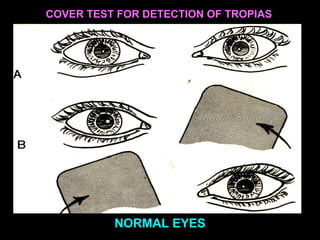
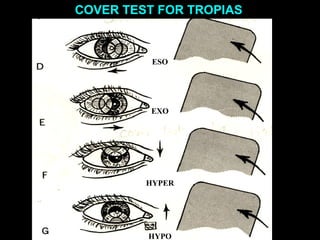
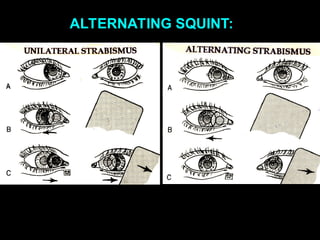
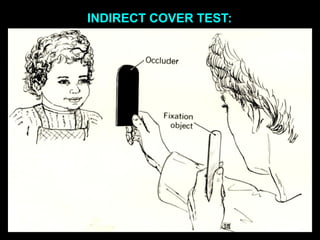
Procedure: Ask thepatient to look at the
object .Then cover 1 eye & see
other eye movement.
No movement : No squint.
If no tropiathen only we test for phorias.
For phorias : Cover Uncover test.
Maddox rod test
Maddox wing test.
11.
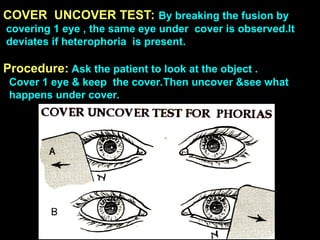
COVER UNCOVER TEST:By breaking the fusion by
covering 1 eye , the same eye under cover is observed.It
deviates if heterophoria is present.
Procedure: Ask the patient to look at the object .
Cover 1 eye & keep the cover.Then uncover &see what
happens under cover.
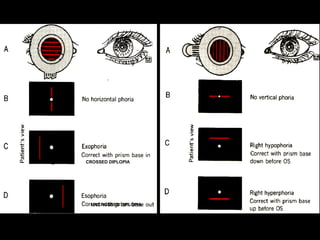
MADDOX ROD TEST: To detect phorias for distance.
Procedure: One eye sees a spot light at 6m distance.
Maddox rod is kept in front of other eye
horizontally ( for horizontal phoria ) or
vertically ( for vertical phoria ).
When horizontally placed image is a vertical line.
Loose prisms are superimposed on the rod until
line is centered on the light.
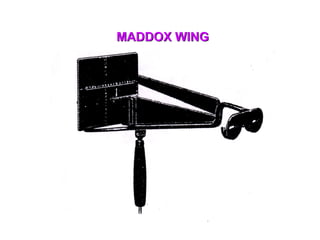
MADDOX WING TEST:Todetect phoria for near & for
subjective measurement of angle of latent squint.
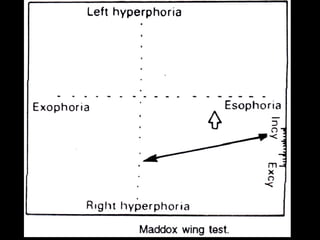
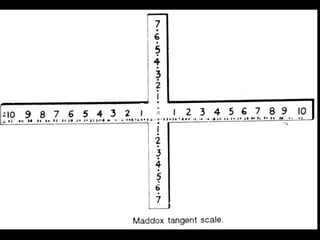
Patient’s right eye sees a vertical white arrow &
horizontal red arrow while left eye sees vertical &
horizontal line of numbers.Then the patient is asked
to see with both eyes & asked: To which no. on
horizontal line white arrow is pointing –
HORIZONTAL PHORIA.
To which no.on vertical line red arrow is pointing-
VERTICAL PHORIA.
To align red arrow with no.on the side line –
CYCLOPHORIA.
ALTERNATE COVER UNCOVERTEST:
Cover is placed alternately over each eye several times to
dissociate the eyes &to bring out maximal deviation.
The just uncovered eye is observed. It makes a
movement of redress opposite the direction of deviation.
It is mainly used with the prism cover test to find the total
angle of squint.
It also gives us clue if microtropia is present when cover
test & cover uncover test do not reveal any deviation as
microtropia is combination of small degree of phoria &
tropia.Then to confirm it 4 prism drop out test can be
done..Then to confirm it 4
20.
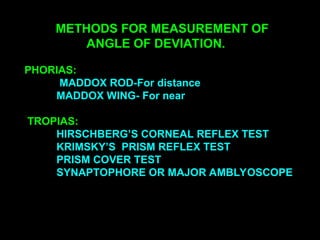
METHODS FOR MEASUREMENTOF
ANGLE OF DEVIATION.
PHORIAS:
MADDOX ROD-For distance
MADDOX WING- For near
TROPIAS:
HIRSCHBERG’S CORNEAL REFLEX TEST
KRIMSKY’S PRISM REFLEX TEST
PRISM COVER TEST
SYNAPTOPHORE OR MAJOR AMBLYOSCOPE
21.
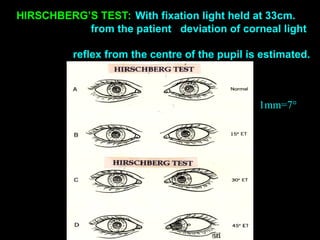
HIRSCHBERG’S TEST::With fixationlight held at 33cm.
from the patient deviation of corneal light
reflex from the centre of the pupil is estimated.
1mm=7°
22.
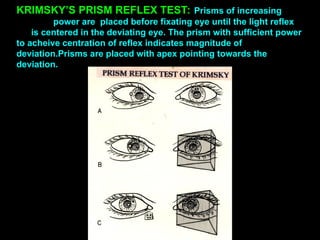
KRIMSKY’S PRISM REFLEXTEST: Prisms of increasing
power are placed before fixating eye until the light reflex
is centered in the deviating eye. The prism with sufficient power
to acheive centration of reflex indicates magnitude of
deviation.Prisms are placed with apex pointing towards the
deviation.
23.
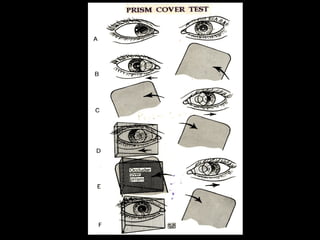
PRISM COVER TEST:
Alternatecover test is done then the movement of
redress is compensated for by using prisms of
increasing power until it stops.Prism power is equal to
the amount of deviation.Prism is kept with apex
towards the deviation.
It is done by fixating each eye at 33cm.&6m. with
&without glasses.
25.
SYNAPTOPHORE METHOD:
1.Measurement ofOBJECTIVE ANGLE of deviation:Simultaneous
perception slides are used.Patient is asked to look at pictures & arm
controlling the picture in front of deviating eye is moved by examiner
until there is no movement of either eye on a cover test performed by
alternately turning off the light.Reading on the scale in front of the
deviating eye represents objective angle of deviation.
2.Measurement of SUBJECTIVE ANGLE of deviation:After measuring
obj.. angle if patient claims superimposition it is also his subjective
angle.If not ,arms are moved back to zero &patient asked to move the
handle controlling the picture in front of the nonfixating eye till the
pictures superimpose.This is subjective angle.
3.Measurement of cyclodeviations can also be done.
26.
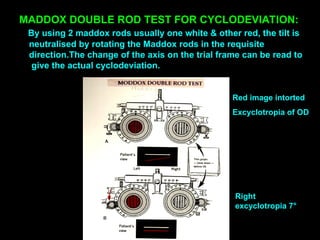
MADDOX DOUBLE RODTEST FOR CYCLODEVIATION:
By using 2 maddox rods usually one white & other red, the tilt is
neutralised by rotating the Maddox rods in the requisite
direction.The change of the axis on the trial frame can be read to
give the actual cyclodeviation.
Red image intorted
Excyclotropia of OD
Right
excyclotropia 7°

 Most read
 Most read
 Most read