Could robots have a conscience?
The science of morality.
Paul H. Carr and Albert J. Levis
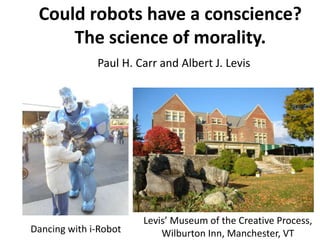
Dancing with i-Robot
Levis’ Museum of the Creative Process,
Wilburton Inn, Manchester, VT
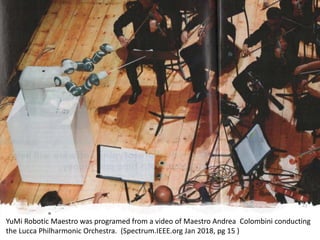
YuMi Robotic Maestro was programed from a video of Maestro Andrea Colombini conducting
the Lucca Philharmonic Orchestra. (Spectrum.IEEE.org Jan 2018, pg 15 )
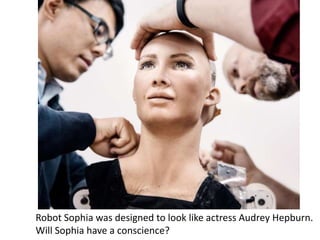
Robot Sophia was designed to look like actress Audrey Hepburn.
Will Sophia have a conscience?
<iframe width="560" height="315"
src="https://www.youtube.com/embed/KYshJ
RYCArE" fraeborder="0" allow="autoplay;
encrypted-media" allowfullscreen></iframe>
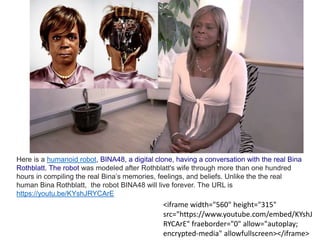
Here is a humanoid robot, BINA48, a digital clone, having a conversation with the real Bina
Rothblatt. The robot was modeled after Rothblatt's wife through more than one hundred
hours in compiling the real Bina’s memories, feelings, and beliefs. Unlike the the real
human Bina Rothblatt, the robot BINA48 will live forever. The URL is
https://youtu.be/KYshJRYCArE
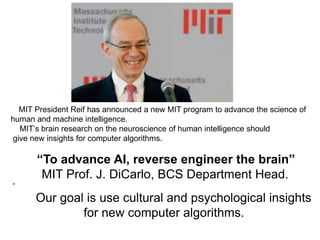
MIT President Reif has announced a new MIT program to advance the science of
human and machine intelligence.
MIT’s brain research on the neuroscience of human intelligence should
give new insights for computer algorithms.
“To advance AI, reverse engineer the brain”
MIT Prof. J. DiCarlo, BCS Department Head.
“
Our goal is use cultural and psychological insights
for new computer algorithms.
Our emerging science of the moral mind might someday be programed into robots
to resolve conflicts and give them a conscience.
The adaptive evolutionally process has programmed our unconscious minds to
creatively resolve conflict, from stressful chaos to order.
Albert Levis, MD, a Jew, born in Greece in 1937, miraculously survived the conflicts
of WWII and the holocaust. This led him to realize that a purpose of Greek myths
and biblical stories was to reduce conflict and murder within the family. This was
expanded to society’s moral laws, like the Moses Commandment “Do not
murder.”
We will trace our understanding of this creative, conflict-resolving process from
medieval theologian Meister Eckhart to psychiatrist Albert Levis.
Levis uses art to model the process as a pendulum that oscillates between
extremes, transforming emotional energy into personal and societal change. We
will show how this creative process is a measurable, repeatable phenomenon and
hence a science, which is emerging from religious stories.
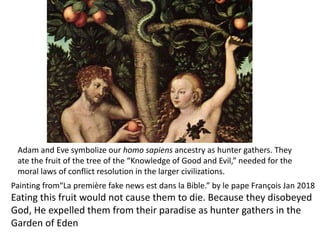
Adam and Eve symbolize our homo sapiens ancestry as hunter gathers. They
ate the fruit of the tree of the “Knowledge of Good and Evil,” needed for the
moral laws of conflict resolution in the larger civilizations.
Painting from“La première fake news est dans la Bible.” by le pape François Jan 2018
Eating this fruit would not cause them to die. Because they disobeyed
God, He expelled them from their paradise as hunter gathers in the
Garden of Eden
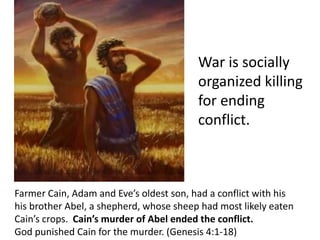
Farmer Cain, Adam and Eve’s oldest son, had a conflict with his
his brother Abel, a shepherd, whose sheep had most likely eaten
Cain’s crops. Cain’s murder of Abel ended the conflict.
God punished Cain for the murder. (Genesis 4:1-18)
War is socially
organized killing
for ending
conflict.
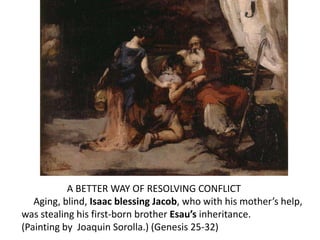
A BETTER WAY OF RESOLVING CONFLICT
Aging, blind, Isaac blessing Jacob, who with his mother’s help,
was stealing his first-born brother Esau’s inheritance.
(Painting by Joaquin Sorolla.) (Genesis 25-32)
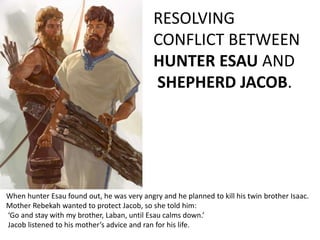
When hunter Esau found out, he was very angry and he planned to kill his twin brother Isaac.
Mother Rebekah wanted to protect Jacob, so she told him:
‘Go and stay with my brother, Laban, until Esau calms down.’
Jacob listened to his mother’s advice and ran for his life.
RESOLVING
CONFLICT BETWEEN
HUNTER ESAU AND
SHEPHERD JACOB.
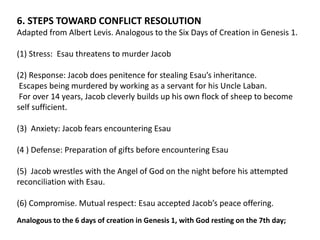
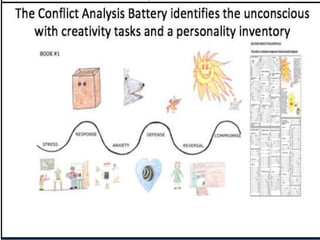
6. STEPS TOWARD CONFLICT RESOLUTION
Adapted from Albert Levis. Analogous to the Six Days of Creation in Genesis 1.
(1) Stress: Esau threatens to murder Jacob
(2) Response: Jacob does penitence for stealing Esau’s inheritance.
Escapes being murdered by working as a servant for his Uncle Laban.
For over 14 years, Jacob cleverly builds up his own flock of sheep to become
self sufficient.
(3) Anxiety: Jacob fears encountering Esau
(4 ) Defense: Preparation of gifts before encountering Esau
(5) Jacob wrestles with the Angel of God on the night before his attempted
reconciliation with Esau.
(6) Compromise. Mutual respect: Esau accepted Jacob’s peace offering.
Analogous to the 6 days of creation in Genesis 1, with God resting on the 7th day;
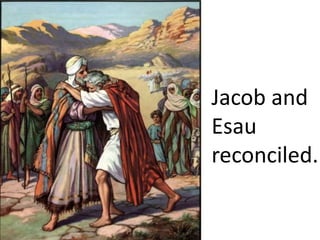
Jacob and
Esau
reconciled.
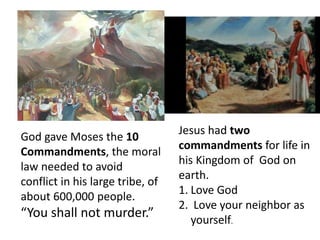
God gave Moses the 10
Commandments, the moral
law needed to avoid
conflict in his large tribe, of
about 600,000 people.
“You shall not murder.”
Jesus had two
commandments for life in
his Kingdom of God on
earth.
1. Love God
2. Love your neighbor as
yourself.
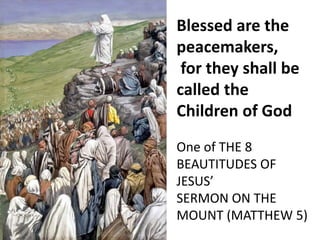
Blessed are the
peacemakers,
for they shall be
called the
Children of God
One of THE 8
BEAUTITUDES OF
JESUS’
SERMON ON THE
MOUNT (MATTHEW 5)
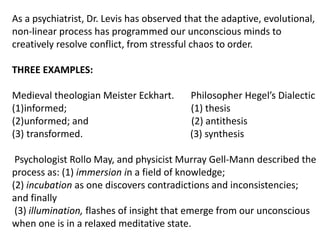
As a psychiatrist, Dr. Levis has observed that the adaptive, evolutional,
non-linear process has programmed our unconscious minds to
creatively resolve conflict, from stressful chaos to order.
THREE EXAMPLES:
Medieval theologian Meister Eckhart. Philosopher Hegel’s Dialectic
(1)informed; (1) thesis
(2)unformed; and (2) antithesis
(3) transformed. (3) synthesis
Psychologist Rollo May, and physicist Murray Gell-Mann described the
process as: (1) immersion in a field of knowledge;
(2) incubation as one discovers contradictions and inconsistencies;
and finally
(3) illumination, flashes of insight that emerge from our unconscious
when one is in a relaxed meditative state.
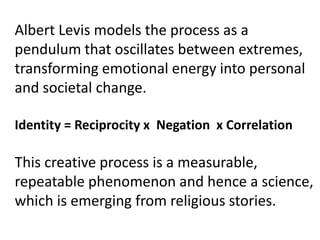
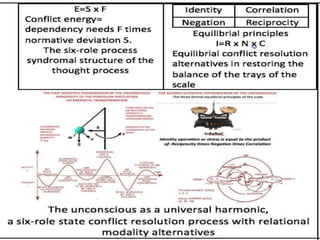
Albert Levis models the process as a
pendulum that oscillates between extremes,
transforming emotional energy into personal
and societal change.
Identity = Reciprocity x Negation x Correlation
This creative process is a measurable,
repeatable phenomenon and hence a science,
which is emerging from religious stories.
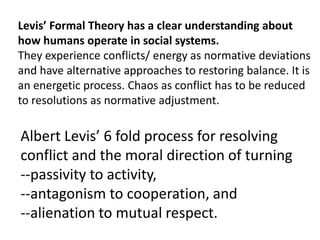
Albert Levis’ 6 fold process for resolving
conflict and the moral direction of turning
--passivity to activity,
--antagonism to cooperation, and
--alienation to mutual respect.
Levis’ Formal Theory has a clear understanding about
how humans operate in social systems.
They experience conflicts/ energy as normative deviations
and have alternative approaches to restoring balance. It is
an energetic process. Chaos as conflict has to be reduced
to resolutions as normative adjustment.
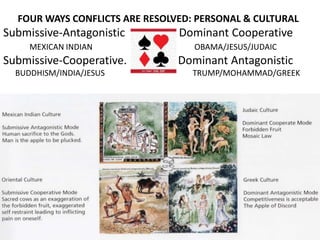
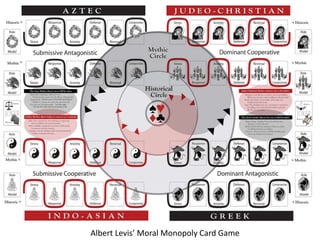
FOUR WAYS CONFLICTS ARE RESOLVED: PERSONAL & CULTURAL
Submissive-Antagonistic Dominant Cooperative
MEXICAN INDIAN OBAMA/JESUS/JUDAIC
Submissive-Cooperative. Dominant Antagonistic
BUDDHISM/INDIA/JESUS TRUMP/MOHAMMAD/GREEK
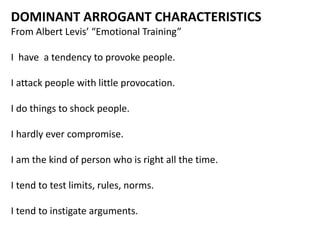
DOMINANT ARROGANT CHARACTERISTICS
From Albert Levis’ “Emotional Training”
I have a tendency to provoke people.
I attack people with little provocation.
I do things to shock people.
I hardly ever compromise.
I am the kind of person who is right all the time.
I tend to test limits, rules, norms.
I tend to instigate arguments.
Albert Levis’ Moral Monopoly Card Game
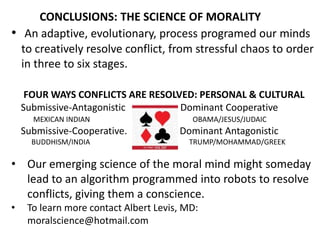
CONCLUSIONS: THE SCIENCE OF MORALITY
• An adaptive, evolutionary, process programed our minds
to creatively resolve conflict, from stressful chaos to order
in three to six stages.
FOUR WAYS CONFLICTS ARE RESOLVED: PERSONAL & CULTURAL
Submissive-Antagonistic Dominant Cooperative
MEXICAN INDIAN OBAMA/JESUS/JUDAIC
Submissive-Cooperative. Dominant Antagonistic
BUDDHISM/INDIA TRUMP/MOHAMMAD/GREEK
• Our emerging science of the moral mind might someday
lead to an algorithm programmed into robots to resolve
conflicts, giving them a conscience.
• To learn more contact Albert Levis, MD:
moralscience@hotmail.com