Health Products
Regulatory Systems
Innovation in ASEAN
A Perspective from the
Centre of Regulatory Excellence
A/Prof John CW Lim
Executive Director, Centre of Regulatory Excellence
Duke-NUS Graduate Medical School
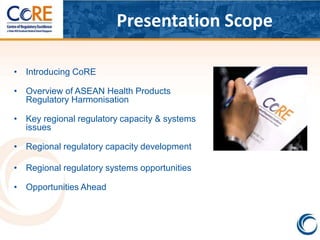
• Introducing CoRE
• Overview of ASEAN Health Products
Regulatory Harmonisation
• Key regional regulatory capacity & systems
issues
• Regional regulatory capacity development
• Regional regulatory systems opportunities
• Opportunities Ahead
Presentation Scope
Introducing CoRE
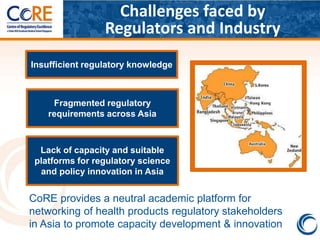
Insufficient regulatory knowledge
Lack of capacity and suitable
platforms for regulatory science
and policy innovation in Asia
Fragmented regulatory
requirements across Asia
Challenges faced by
Regulators and Industry
CoRE provides a neutral academic platform for
networking of health products regulatory stakeholders
in Asia to promote capacity development & innovation
Centre of Regulatory Excellence
Singapore Deputy Prime Minister
Tharman Shanmugaratnam
11 March 2015
“We are now looking beyond the immediate value-chain
activities, to develop leadership in developing regulatory
standards and to prototype new business models:
In November 2014, a new Centre of Regulatory
Excellence (CoRE) was set up at the Duke-NUS Graduate
Medical School Singapore … It will promote regulatory
leadership and policy innovation in regulatory science.
The centre will bring together industry players and
regulators, as well as build a pipeline of regulatory
talent to support Asia's rapidly-growing healthcare
sector.”
Centre of Regulatory Excellence
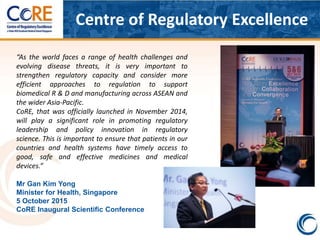
“As the world faces a range of health challenges and
evolving disease threats, it is very important to
strengthen regulatory capacity and consider more
efficient approaches to regulation to support
biomedical R & D and manufacturing across ASEAN and
the wider Asia-Pacific.
CoRE, that was officially launched in November 2014,
will play a significant role in promoting regulatory
leadership and policy innovation in regulatory
science. This is important to ensure that patients in our
countries and health systems have timely access to
good, safe and effective medicines and medical
devices.”
Mr Gan Kim Yong
Minister for Health, Singapore
5 October 2015
CoRE Inaugural Scientific Conference
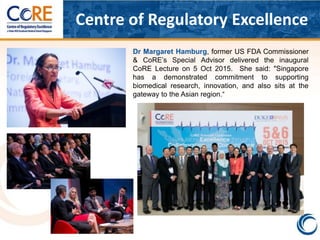
Dr Margaret Hamburg, former US FDA Commissioner
& CoRE’s Special Advisor delivered the inaugural
CoRE Lecture on 5 Oct 2015. She said: "Singapore
has a demonstrated commitment to supporting
biomedical research, innovation, and also sits at the
gateway to the Asian region.“
Centre of Regulatory Excellence
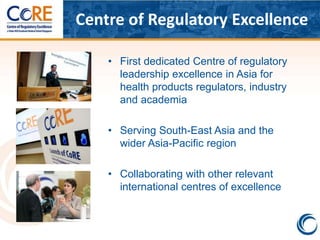
• First dedicated Centre of regulatory
leadership excellence in Asia for
health products regulators, industry
and academia
• Serving South-East Asia and the
wider Asia-Pacific region
• Collaborating with other relevant
international centres of excellence
Centre of Regulatory Excellence
• Supported by the Singapore Ministry of Health and
Economic Development Board
• MOU with Health Sciences Authority
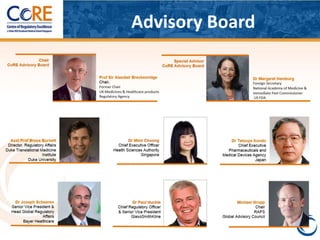
Advisory Board
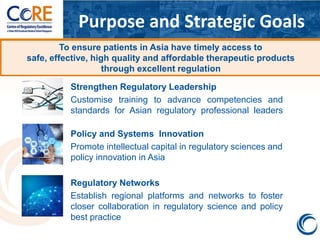
Purpose and Strategic Goals
Strengthen Regulatory Leadership
Customise training to advance competencies and
standards for Asian regulatory professional leaders
Policy and Systems Innovation
Promote intellectual capital in regulatory sciences and
policy innovation in Asia
Regulatory Networks
Establish regional platforms and networks to foster
closer collaboration in regulatory science and policy
best practice
To ensure patients in Asia have timely access to
safe, effective, high quality and affordable therapeutic products
through excellent regulation
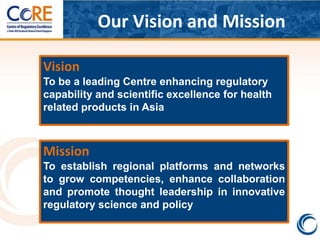
Vision
To be a leading Centre enhancing regulatory
capability and scientific excellence for health
related products in Asia
Mission
To establish regional platforms and networks
to grow competencies, enhance collaboration
and promote thought leadership in innovative
regulatory science and policy
Our Vision and Mission
Overview of ASEAN
Health Products
Regulatory Harmonisation
Declaration signed on 22 Nov
2015 to formally establish
ASEAN Community (comprising
Economic, Political-Security &
Socio-Cultural Communities) on
31 Dec 2015
Aims of ASEAN Economic
Community:
• Single market and
production base
• Free movement of goods,
services, investment and
skilled labour, and freer flow of
capital
• Increase competiveness,
narrow development gaps and
improve resilience
ASEAN Economic Community
ASEAN Harmonisation
ASEAN Consultative Committee for Standards and
Quality (ACCSQ) formed in 1992 to:
• Harmonise national standards with international
standards and lower trade barriers
• Minimise duplicative testing procedures due to
different national conformity assessment requirements
• Implement Mutual Recognition Agreements for
conformity assessment to achieve
“One Standard, One Test, Accepted Everywhere”
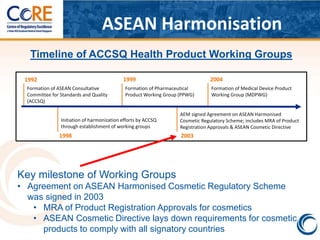
1992
Formation of ASEAN Consultative
Committee for Standards and Quality
(ACCSQ)
1998
Initiation of harmonization efforts by ACCSQ
through establishment of working groups
1999
Formation of Pharmaceutical
Product Working Group (PPWG)
2004
Formation of Medical Device Product
Working Group (MDPWG)
2003
AEM signed Agreement on ASEAN Harmonised
Cosmetic Regulatory Scheme; includes MRA of Product
Registration Approvals & ASEAN Cosmetic Directive
Timeline of ACCSQ Health Product Working Groups
Key milestone of Working Groups
• Agreement on ASEAN Harmonised Cosmetic Regulatory Scheme
was signed in 2003
• MRA of Product Registration Approvals for cosmetics
• ASEAN Cosmetic Directive lays down requirements for cosmetic
products to comply with all signatory countries
ASEAN Harmonisation
Current status of PPWG and MDPWG harmonisation
• Guidances developed through consensus approach
 Respects Asian/ASEAN context
 Addresses socio-cultural and environmental issues
• Implementation of guidances varies
 Jurisdictional and country-specific requirements
 Varying regulatory capabilities
 Different implementation timelines
• Effective implementation can be enhanced by
 Streamlining and coordination of regulatory processes
 Enhancing of regulatory competencies
 Enhancing communication
With advent of ASEAN Economic Community,
important to find practical approaches for
greater convergence and implementation
ASEAN Harmonisation
Key Regional Regulatory
Capacity & Systems Issues
Stakeholders Feedback
• Meetings with Heads of regulatory agencies
and their teams in various ASEAN countries
• Focus groups with representatives from MNC
and SME Pharmaceutical and Medical Device
companies
• Survey to assess needs of Regulatory
Professionals
Capacity and Innovation
• Technical Knowledge
• Soft Skills
Knowledge Gaps
Communication
Crisis Management
Decision Making
Strategy Planning
Leadership skills
• Career progression
• Structured, continuous education
• Affordability of training
• Existing training too US/EU centric
Development Needs
Innovation Opportunities
• Mutual recognition processes
• Experience sharing
• Policy changes
• Platforms for cross dialogue between
regulators and industry
Regulatory Landscape
Key issues identified by March 2015
Roundtable on “Developing a roadmap
for referencing in Asia”:
• Disparities in regional regulatory
requirements and capacities
• Opportunities for more communication
of regulatory decisions among
stakeholders
• Need for more structured framework
and tools
• Resource issues
Opportunities for innovation in
regulatory strategies and
solutioning
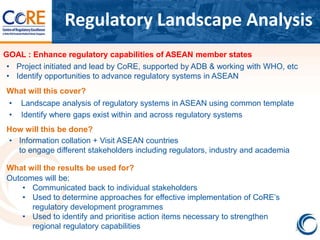
Regulatory Landscape Analysis
22
• Landscape analysis of regulatory systems in ASEAN using common template
• Identify where gaps exist within and across regulatory systems
GOAL : Enhance regulatory capabilities of ASEAN member states
• Project initiated and lead by CoRE, supported by ADB & working with WHO, etc
• Identify opportunities to advance regulatory systems in ASEAN
What will this cover?
How will this be done?
• Information collation + Visit ASEAN countries
to engage different stakeholders including regulators, industry and academia
Outcomes will be:
• Communicated back to individual stakeholders
• Used to determine approaches for effective implementation of CoRE’s
regulatory development programmes
• Used to identify and prioritise action items necessary to strengthen
regional regulatory capabilities
What will the results be used for?
Regional Regulatory
Capacity Development
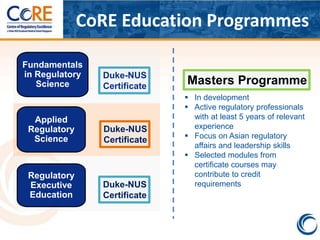
Fundamentals
in Regulatory
Science
Applied
Regulatory
Science
Regulatory
Executive
Education
Duke-NUS
Certificate
Duke-NUS
Certificate
Duke-NUS
Certificate
Masters Programme
 In development
 Active regulatory professionals
with at least 5 years of relevant
experience
 Focus on Asian regulatory
affairs and leadership skills
 Selected modules from
certificate courses may
contribute to credit
requirements
CoRE Education Programmes
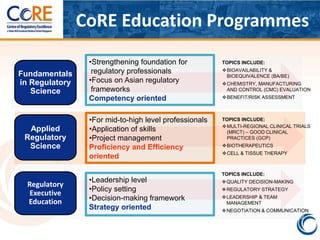
Fundamentals
in Regulatory
Science
Applied
Regulatory
Science
Regulatory
Executive
Education
TOPICS INCLUDE:
BIOAVAILABILITY &
BIOEQUIVALENCE (BA/BE)
CHEMISTRY, MANUFACTURING
AND CONTROL (CMC) EVALUATION
BENEFIT/RISK ASSESSMENT
•Strengthening foundation for
regulatory professionals
•Focus on Asian regulatory
frameworks
Competency oriented
TOPICS INCLUDE:
MULTI-REGIONAL CLINICAL TRIALS
(MRCT) – GOOD CLINICAL
PRACTICES (GCP)
BIOTHERAPEUTICS
CELL & TISSUE THERAPY
•For mid-to-high level professionals
•Application of skills
•Project management
Proficiency and Efficiency
oriented
•Leadership level
•Policy setting
•Decision-making framework
Strategy oriented
TOPICS INCLUDE:
QUALITY DECISION-MAKING
REGULATORY STRATEGY
LEADERSHIP & TEAM
MANAGEMENT
NEGOTIATION & COMMUNICATION
CoRE Education Programmes
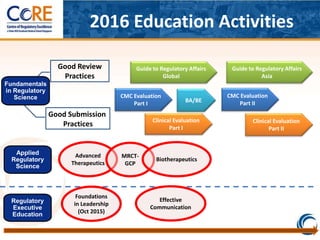
2016 Education Activities
Advanced
Therapeutics
MRCT-
GCP
Biotherapeutics
CMC Evaluation
Part I
CMC Evaluation
Part II
Clinical Evaluation
Part I
Clinical Evaluation
Part II
Guide to Regulatory Affairs
Global
Guide to Regulatory Affairs
Asia
BA/BE
Good Review
Practices
Good Submission
Practices
Foundations
in Leadership
(Oct 2015)
Effective
Communication
Fundamentals
in Regulatory
Science
Applied
Regulatory
Science
Regulatory
Executive
Education
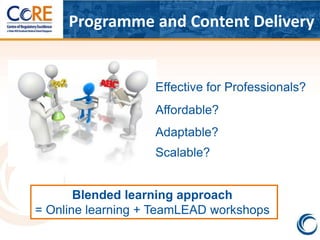
Programme and Content Delivery
Effective for Professionals?
Affordable?
Adaptable?
Scalable?
Blended learning approach
= Online learning + TeamLEAD workshops
Blended Learning Approach
 Duke-NUS medical students out performed US students
especially in applied skills and knowledge retention
Does the new approach work? Are students learning?
Example of Practical Implementation in Adult Education
 Multi-Regional Clinical Trial (MRCT) Workshop, 2014
Three day workshop successfully conducted to train APEC
regulatory professionals to assess data from MRCTs
 Designated 1st APEC Centre of Excellence for MRCT in
September 2015
 Next MRCT Workshop in March 2016
Regulatory Education Outcomes
• Address capacity gaps
• National agencies enabled to fill key gaps in capacity and capability
• National agencies strengthened to ensure their systems are better
able to manage innovation around new technology and approaches
• Better manage cutting edge therapeutic products
A. For regulatory systems in ASEAN
• Curriculum focuses on common understanding and application of
international guidelines and best practices
Support may be provided to eligible economies
• Training opportunities with value-add (Certificate, Masters)
• Asia-centric and affordable
• Enabling professionals at different career stages
• Networking platform with other regulatory professionals
B. For Industry
C. For Regulatory Professionals
• Increased regulatory workforce with
– enhanced technical competencies
– improved project management and leadership skills
• Networking platform
Regulatory Education Outcomes
Regional Regulatory
Systems Opportunities
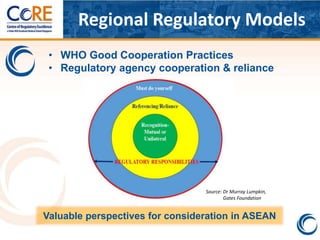
Regional Regulatory Models
• WHO Good Cooperation Practices
• Regulatory agency cooperation & reliance
Valuable perspectives for consideration in ASEAN
Source: Dr Murray Lumpkin,
Gates Foundation
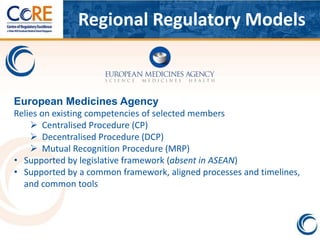
European Medicines Agency
Relies on existing competencies of selected members
 Centralised Procedure (CP)
 Decentralised Procedure (DCP)
 Mutual Recognition Procedure (MRP)
• Supported by legislative framework (absent in ASEAN)
• Supported by a common framework, aligned processes and timelines,
and common tools
Regional Regulatory Models
International Consortium “ACSS”
(TGA, Health Canada, Swissmedic, HSA)
• Formed in 2007
• An example of collaboration among like-minded, similar sized
agencies faced with resource constraints
• Past collaborations on Benefit-Risk framework template (with
Centre for Innovation in Regulatory Science) and generics
work-sharing
• Currently exploring greater coordination for New Chemical
Entities
Early experiences demonstrate benefits of
inter-agency and cross-regional cooperation
Regional Regulatory Models
Regulatory Reliance
Benefits of agency work-sharing and risk-based reliance
• Reduces review work by leveraging on reports available from
reference agencies, addressing resource and expertise issues
• Aim of reducing approval timelines and providing timely
access to health products
• Enables decision-making based on local context and
maintaining sovereignty in decision-making
A need to identify suitable
practices for the region
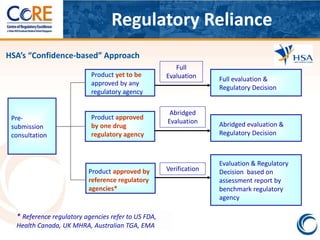
* Reference regulatory agencies refer to US FDA,
Health Canada, UK MHRA, Australian TGA, EMA
Pre-
submission
consultation
Full evaluation &
Regulatory Decision
Product approved
by one drug
regulatory agency
Evaluation & Regulatory
Decision based on
assessment report by
benchmark regulatory
agency
Full
Evaluation
Abridged
Evaluation
Verification
Abridged evaluation &
Regulatory Decision
Product approved by
reference regulatory
agencies*
Product yet to be
approved by any
regulatory agency
HSA’s “Confidence-based” Approach
Regulatory Reliance
Opportunities Ahead
Opportunities Ahead
(1) Enhance regulatory capabilities and framework
• Develop competencies beyond market authorisation
product reviews to cover product life cycle management
and soft-skills, e.g. communication
• Develop coordinated mentoring programmes among ASEAN
agencies
 Intra- and sub-regional efforts
• Develop mentoring arrangements with external reference
organisations like WHO
 Prequalification of Medicines Programme
Opportunities Ahead
(2) Improve regulatory processes and frameworks
• Develop frameworks and tools to implement cooperation
practices, including common template for reporting and
sharing regulatory decisions
• Use a phased approach, starting with generics
(3) Strengthen infrastructure and support
• Strengthen support from regional platforms like ASEAN
Secretariat
• Collaborative efforts with global partners like WHO
• System enhancements to include IT infrastructure for better
data sharing
Opportunities Ahead
(4) Promote convergence of requirements
• Prioritise key areas for minimising different requirements,
where socio-political and legal issues are less of an issue
 more realistic than trying to achieve 100%
harmonisation
• Round-tables and workshops to share best practice,
develop pilots, test-bed and monitor for positive outcomes
(5) Facilitate Regulatory Agency Cooperation & Reliance
Regulatory Reliance
1. Addresses current regulatory challenges
• Inadequate manpower and competencies
• Does not require agencies to adopt unsuitable reference
agency structures and systems
2. Respects sovereignty of decision-making
• Supports ASEAN harmonisation guidelines
• Allows relevant decisions based on local context
• Focuses on technical and scientific perspectives rather
than legal system constraints
3. Facilitates access to patients
• Improves quality of healthcare systems
Collaboration and Commitment
are Keys to Success
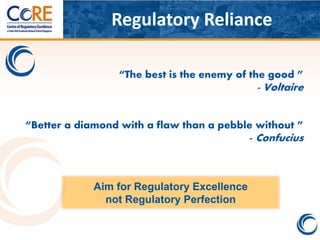
“Better a diamond with a flaw than a pebble without ”
- Confucius
“The best is the enemy of the good ”
- Voltaire
Aim for Regulatory Excellence
not Regulatory Perfection
Regulatory Reliance
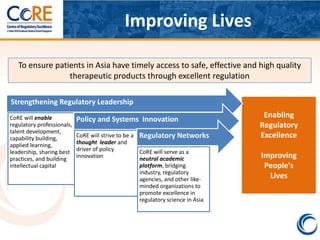
Enabling
Regulatory
Excellence
Improving
People's
Lives
Strengthening Regulatory Leadership
CoRE will enable
regulatory professionals,
talent development,
capability building,
applied learning,
leadership, sharing best
practices, and building
intellectual capital
Policy and Systems Innovation
CoRE will strive to be a
thought leader and
driver of policy
innovation
Regulatory Networks
CoRE will serve as a
neutral academic
platform, bridging
industry, regulatory
agencies, and other like-
minded organizations to
promote excellence in
regulatory science in Asia
To ensure patients in Asia have timely access to safe, effective and high quality
therapeutic products through excellent regulation
Improving Lives
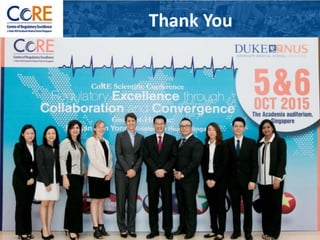
Thank You
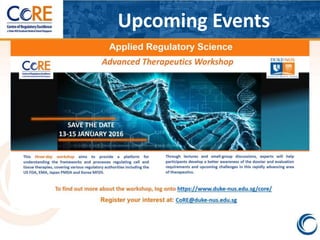
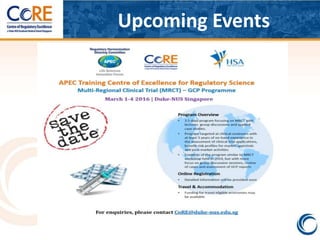
Upcoming Events
Upcoming Events