Controlle drug delivery System PPT Prepared by Dr Deshmukh K.P.
1.
Control Release DrugDelivery System
Prepared By
Dr.Deshmukh K.P
Balwantrao Chavan College of Pharmacy Naigaon
2.
History Of CRDDS
The science of controlled release was first originated from the development of
oral sustained release products in the 1940s and early 1950s.
The first patent for oral sustained release preparation went in the favour of
Lipowski;
His preparation contained small coated beads that were releasing the drug
slowly & constantly.
This idea later developed by Blythe and launched the first marketed
sustained release product in 1952.
Over the past 30 years as the complication involves in the marketing of new
drug increased and various advantages recognized of Controlled release drug
delivery system (CRDDS), the greater attention is being paid in this field. 1
3.
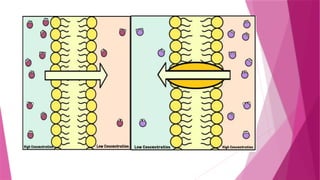
INTRODUCTION
Controlled drugdelivery system refers to system that provides
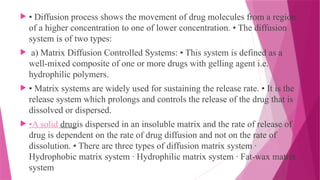
some control to either temporal or spatial or both nature of the
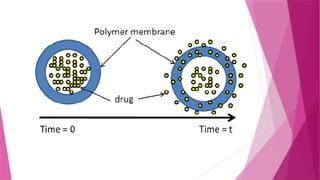
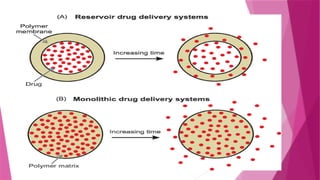
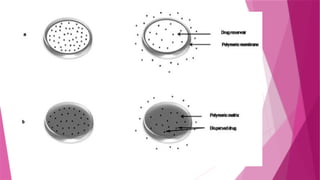
drug release. Temporal :- refers to controlling the rate of
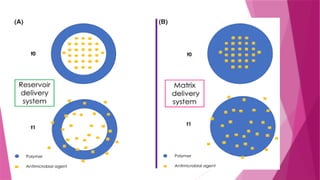
specific time of drug delivery to targeted tissue . Spatial :-
refers to targeting a drug to a specific organ or tissue.
Ideal condition for DDS :- i. It should deliver drug at a rate
that is required by the body over a period of treatment.
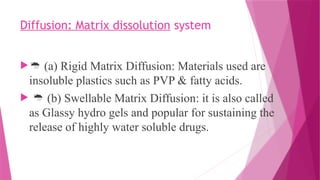
ii. It should deliver drug solely to the site of action.
4.
i. sustain drugaction at a predetermined rate by maintaining
effective drug level in body and thereby minimizing
undesirable side effects of drug. ii. Localize drug action by
spatial placement of controlled release system in diseased
tissue or organ.
Generally , very few systems fulfil the above principles .
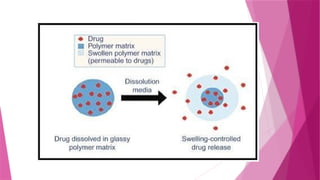
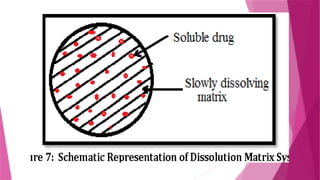
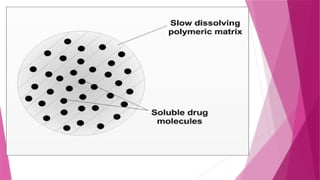
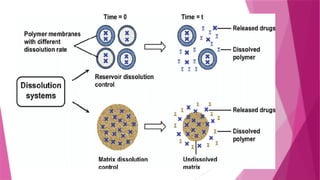
In most cases , the release system creates constant conc. of
drug within body over extended period of time.
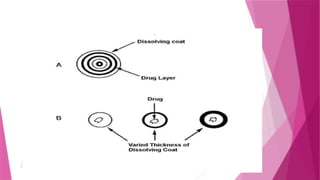
Ideally , it is desirable to place drug at site of target , be it a
tissue ,organ or receptor, leaving rest of the body drug free ,
but it would be quiet difficult if the target is covered by some
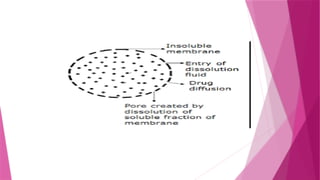
barriers.
5.
Controlled ReleaseDrug Delivery System is one which delivers the drug at a
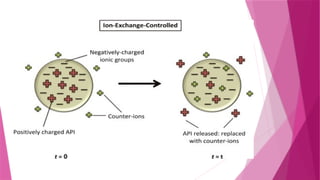
predetermined and predictable rate, locally or systematically, for specified
period of time.
SUSTAINED DRUG DELIVERY SYSTEM (ER, Slow Release, Delayed
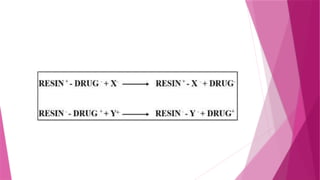
Release, Prolong Release, Long Acting) Sustained release are drug delivery
system that achieve slow release of drug over an extended period of time after
administration of single dose.
6.
Why CRDDS?Due to
limitations associated with a conventional dosage form:
Poor patient compliance; increased chances of missing the dose of a
drug with short half-life for which frequent administration is necessary.
A typical peak-valley plasma concentration-time profile is obtained
which makes attainment of steady-state condition difficult.
The unavoidable fluctuations in the drug concentration may lead to
under medication or overmedication as the Css values fall or rise beyond
the therapeutic range.
The fluctuating drug levels may lead to precipitation of adverse
effects especially of a drug with small therapeutic index whenever
overmedication occurs.
7.
. The ideal
Drug delivery system should be
Inert
Biocompatible
Mechanically strong
Comfortable for the patient
Capable of achieving high drug loading
Safe from accidental release
Simple to administer and remove
Easy to fabricate and sterilize 1
8.
Advantages
Improveabsorption
by enhancing the bioavailability of
drugs
Decreased local and systemic side effects gastrointestinal
irritation.
Reduction in dosing frequency.
improved patient compliance.
Reduced fluctuations in circulating drug levels increased
safety margin of potent drug
Reduction in the health care cost.
Stabilization of Medical condition
9.
Disadvantages
Dosedumping is
possible in case of poor formulation
Possibility of less accurate Dose adjustment in some cases
Patient education is required for successful therapy
Poor In Vivo & In Vitro correlation
Higher cost of single unit as compared to cost of single
conventional unit. Stability problems
Not all the drugs are suitable for formulating in CRDDS
10.
Immediate release dosageforms:
The conventional dosage forms belong to this class.
The dosage form releases the drug present in it after
administration to achieve rapid and complete systemic
absorption. After absorption of the drug from the dosage
form, plasma concentration of the drug starts decreasing
according to its pharmacokinetic profile.
Finally, the concentration falls below the minimum
therapeutic concentration (MEC) and therapeutic
activity ceases.
11.
The periodatwhich the drug concentration remains
within the therapeutic window is called the duration of
action and the time at which the maximum concentration
is attained is called the onset of action.
Modified release dosage form: The dosage forms, in
which the rate of release of the drug and the time at
which the release of the drug would take place are
different from conventional type, are called modified
release dosage form.
12.
Site-specific targeting:These systems refer to targeting the release
of a drug straight to a particular biological location. In this case, the
target is adjacent to or in the diseased organ or tissue.
Receptor targeting: Thesesystems refer to targeting a specific
biological receptor. In this case, the target is the specific receptor for
a drug within an organ or tissue. Site-specific targeting and receptor
targeting systems satisfy the spatial aspect of drug delivery and are
also considered to be sustained drug delivery systems. Delayed
release dosage form:
When a dosage form does not release the drug immediately after
administration like immediate release or conventional dosage form
but releases the drug in portions at a predetermined time or at times,
it is called delayed release dosage form.
13.
Extended-release dosageform: If a dosage form reduces the frequency of
dose at least by two-fold as compared to the frequency of
administration of immediate release or conventional dosage form, the
dosage form is said to be the extended release dosage form. Sustained
release dosage form:
The drug release from sustained release dosage form exhibit a
predetermined rate in order to maintain an approximately constant
drug concentration in the body over a prolonged period.
Prolonged action dosageform:
In this type of dosage form the drug is released at a rate
relatively slower rate, but for a long period; so that, the
therapeutic action of the drug remains for an extended
period.
14.
Difference Between CRDDS& SRDDS
Controlled drug delivery- which delivers the drug at a pre determined rate for a
specified period of time. Controlled release is perfectly zero order release that is
the drug release over time irrespective of concentration.
Sustain release dosage form- is defined as the type of dosage form in which
a portion i.e. (initial dose) of the drug is released immediately, in order to
achieve desired therapeutic response more promptly, and the
remaining(maintenance dose) is then released slowly there by achieving a
therapeutic level which is prolonged, but not maintained constant.
Sustained release implies slow release of the drug over a time period. It may
or may not be controlled release.
15.
RATIONALE OFCONTROLLEDDRUG DELIVERY SYSTEM:
1. The basic rationale of a controlled release drug delivery system is to optimize
the biopharmaceutics, pharmacokinetics, and pharmacodynamics properties of a
drug in such a way that its utility is maximized through reduction in side effects
and cure or control of disease condition in the shortest possible time by using
smallest quantity of drug, administered by most suitable route.
2. To provide a location specific action within the GIT.
3. To avoid an undesirable local action within the GIT.
4. To provide programmed delivery pattern.
5. To increase the extend of absorption/bioavailability.
6. To extend the time of action of drug after administration.
16.
Rational ofCRDDS
To optimize the
Biopharmaceutical,
Pharmacokinetic and
Pharmacodynamics properties of a drug
its utility is maximized by reduction in side effects and
better control of disease condition in the shortest possible
time by using smallest quantity of drug and administered by
the most suitable route.
17.
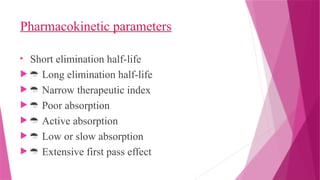
Pharmacokinetic parameters
Short eliminationhalf-life
Long elimination half-life
Narrow therapeutic index
Poor absorption
Active absorption
Low or slow absorption
Extensive first pass effect
18.
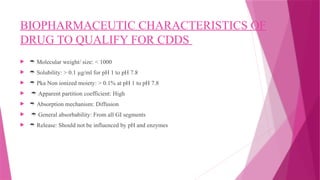
BIOPHARMACEUTIC CHARACTERISTICS OF
DRUGTO QUALIFY FOR CDDS
Molecular weight/ size: < 1000
Solubility: > 0.1 µg/ml for pH 1 to pH 7.8
Pka Non ionized moiety: > 0.1% at pH 1 to pH 7.8
Apparent partition coefficient: High
Absorption mechanism: Diffusion
General absorbability: From all GI segments
Release: Should not be influenced by pH and enzymes
19.
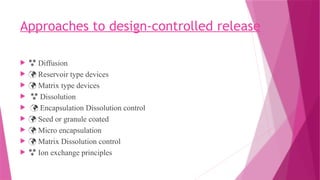
Approaches to design-controlledrelease
Diffusion
Reservoir type devices
Matrix type devices
Dissolution
Encapsulation Dissolution control
Seed or granule coated
Micro encapsulation
Matrix Dissolution control
Ion exchange principles
20.
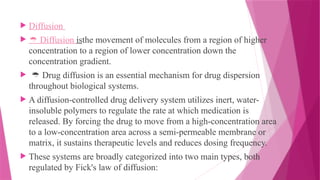
Diffusion
Diffusion
isthe movement of molecules from a region of higher
concentration to a region of lower concentration down the
concentration gradient.
Drug diffusion is an essential mechanism for drug dispersion
throughout biological systems.
A diffusion-controlled drug delivery system utilizes inert, water-
insoluble polymers to regulate the rate at which medication is
released. By forcing the drug to move from a high-concentration area
to a low-concentration area across a semi-permeable membrane or
matrix, it sustains therapeutic levels and reduces dosing frequency.
These systems are broadly categorized into two main types, both
regulated by Fick's law of diffusion:
22.
. • Diffusionprocess shows the movement of drug
molecules from a region of a higher concentration to one
of lower concentration.
• The diffusion system is of two types: a) Matrix
Diffusion Controlled Systems:
• This system is defined as a well-mixed composite of
one or more drugs with gelling agent i.e. hydrophilic
polymers. • Matrix systems are widely used for sustaining
the release rate.
• It is the release system which prolongs and controls the
release of the drug that is dissolved or dispersed
23.
Diffusion: Reservoir diffusionsystem
It is also called as laminated matrix device.
It is a hollow system containing an inner core surrounded by
water insoluble membrane and polymer can be applied by coating or
micro encapsulation.
The Rate controlling mechanism is that drug will partition into
membrane and exchange with the fluid surrounding the drug by
diffusion.
Commonly used polymers are HPC, ethyl cellulose & polyvinyl
acetate. Examples: Nico-400, Nitro-Bid.
24.
Reservoir DiffusionControlledSystems:
• In this system, a water insoluble polymeric material like Ethyl
cellulose or Polymethacrylate covers a core of drug.
• Drug will partition into the membrane and exchange with the
fluid surrounding the particle or tablet.
• Additional drug will enter the polymer, diffuse to the periphery
and exchange with the surrounding media.
• The drug release takes place by diffusion mechanism.
• The polymer can be applied by coating and microencapsulation
technique.
• The disadvantage of reservoir devices over matrix diffusion
controlled system is a chance of sudden drug dumping.
28.
Diffusion: Matrix dissolutionsystem
(a) Rigid Matrix Diffusion: Materials used are
insoluble plastics such as PVP & fatty acids.
(b) Swellable Matrix Diffusion: it is also called
as Glassy hydro gels and popular for sustaining the
release of highly water soluble drugs.
29.
• Diffusionprocess shows the movement of drug molecules from a region
of a higher concentration to one of lower concentration. • The diffusion
system is of two types:
a) Matrix Diffusion Controlled Systems: • This system is defined as a
well-mixed composite of one or more drugs with gelling agent i.e.
hydrophilic polymers.
• Matrix systems are widely used for sustaining the release rate. • It is the
release system which prolongs and controls the release of the drug that is
dissolved or dispersed.
•A solid drugis dispersed in an insoluble matrix and the rate of release of
drug is dependent on the rate of drug diffusion and not on the rate of
dissolution. • There are three types of diffusion matrix system ·
Hydrophobic matrix system · Hydrophilic matrix system · Fat-wax matrix
system
34.
Dissolution
Dissolution
isthe process in which a
substance forms a solution.
When administered orally, a drug has to first
dissolve in gastrointestinal fluids before it can be
absorbed in to the blood and reach its site of
action
35.
• Adrug with a slow dissolution rate is inherently sustained and for those
drugs with high water solubility, one can decrease dissolution through
appropriate salt or derivative formation.
• These systems are most commonly employed in the production of enteric
coated dosage forms.
• To protect the stomach from the effects of drugs such as Aspirin, a
coating that dissolves in natural or alkaline media is used.
• This inhibits release of drug from the dosage form until it reaches the
higher pH of the intestine.
• Dissolution controlled release can be obtained by slowing the dissolution
rate of a drug in the GI medium, incorporating the drug in an insoluble
polymer and coating drug particles or granules with polymeric materials of
varying thickness
• The rate of dissolution can be expressed as following dm/dt= ADS/h
36.
The dissolutionsystemis of two types:
a) Matrix Dissolution Controlled Systems: - As the drug is
homogeneously dispersed throughout the rate controlling medium,
this system also called as monolith system.
It isvery common and employs waxes such as beeswax, carnauba
wax which control the drug release rate by controlling the rate of
dissolution fluid penetration into the matrix by altering the porosity
of tablet, decreasing its wettability or by itself getting dissolved at a
slower rate.
b) Reservoir Dissolution Controlled Systems: - In this type, the
drug particles are coated or encapsulated by one of
microencapsulation techniques the several with slowly dissolving
materials like cellulose and polyethylene glycol.
38.
Dissolution: Encapsulated dissolutionsystem
This is also known as Coating dissolution controlled system.
Dissolution rate of coat depends upon stability & thickness of
coating.
It masks color, odor, taste and minimize GI irritation. Controlled
release products by decreasing the dissolution rate of drugs which
are highly water soluble can be formulated by preparing appropriate
salt or derivatives, by coating the drug with a slowly dissolving
material, or by incorporating the drug into a slowly dissolving
carrier. Examples: Ornade spansules, Chlortrimeto Repetabs.
41.
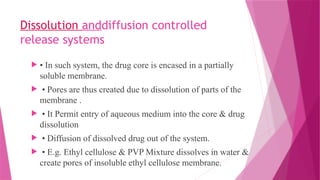
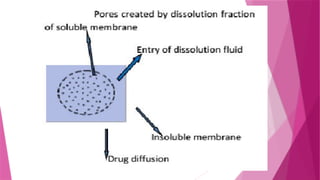
Dissolution anddiffusion controlled
releasesystems
• In such system, the drug core is encased in a partially
soluble membrane.
• Pores are thus created due to dissolution of parts of the
membrane .
• It Permit entry of aqueous medium into the core & drug
dissolution
• Diffusion of dissolved drug out of the system.
• E.g. Ethyl cellulose & PVP Mixture dissolves in water &
create pores of insoluble ethyl cellulose membrane.
43.
Ion exchangeresindrug complex.
• Ion exchange resins are cross-linked water-insoluble polymers
carrying ionisable functional groups .
• The resins have been used in various pharmaceutical applications,
primarily for taste masking and controlled release systems.
• In tablet formulations, ion exchange resins have been used as
disintegrants, because of their swelling ability.
• It forms irreversible complex with ionisable drugs upon prolonged
exposure of the drug to the resin.
A resin bound drug is removed when appropriate ions are in contact
with ion-exchanged groups.
• The area and length of diffusion pathway and the amount of cross-
linked polymer in the resin moiety governs the rate of drug release.
44.
An ionexchange resin (IER) controlled drug delivery
system uses water-insoluble, cross-linked polymers
containing ionizable groups to reversibly bind drugs
and release them in a sustained or targeted manner. The
drug-resin complex (called a resinate) exchanges ions
with the body's gastrointestinal fluids, allowing for
slow, predictable drug release and effective taste
masking
46.
Ionexchange isa reversible interchange of one kind of ion present on an
insoluble solid with another of like charge present in a solution surrounding the
solid with the reaction being used especially for softening or making water
demineralised, the purification of chemicals and separation of substances.
on exchange Resins Ion exchange resins are cross-linked water insoluble
polymers carrying ionizable functional groups. These resins are used for
taste masking and controlled release system. The formulations are
developed by embedding the drug molecules in the ion-exchange resin matrix
and this core is then coated with a semi permeable coating material such as
Ethyl Cellulose. This system reduced the degradation of drug in GIT. The
most widely used and safe ion-exchange resin is divinylbenzene sulphonate. In
tablet formulations ion-exchange resins have been used as disintegrant.
47.
.Ion-exchange systems
Ion-exchange
systems generally use resins composed of water-
insoluble, cross-linked polymers. These polymers contain salt-
forming functional groups in repeating positions on the polymer
chain. The drug is bound to the resin and released by
exchanging with appropriately charged ions in contact with the ion-
exchange groups Where, X and Y are ions in the GI tract.
The free drug then diffuses out of the resin. The drug-resin
complex is prepared by mixing the resin with drug solution either
by repeated exposure of the resin to the drug in a chromatography
column or by prolonged contact in solution
49.
Ion exchangeResins
Also used as excipients in pharmaceutical
formulations such as tablets, capsules, gums, and suspensions.
In these uses the ion-exchange resin can have several different functions,
including taste-masking, extended release, tablet disintegration, increased
bioavailability, and improving the chemical stability of the active ingredients.
Selective polymeric chelators have been proposed for maintenance therapy of
some pathologies, where chronic ion accumulation occurs, such as Wilson disease
(where copper accumulation occurs) or hereditary hemochromatosis (iron overload,
where iron accumulation occurs)
These polymers or particles have a negligible or null systemic biological
availability and they are designed to form stable complexes with Fe2+ and Fe3+ in
the GIT and thus limiting the uptake of these ions and their long-term accumulation.
Although this method has only a limited efficacy, unlike small-molecular
chelators (deferasirox, deferiprone, or deferoxamine), such an approach may have
only minor side effects in sub-chronic
51.
1. DoseSize Impact on Formulation: The dose size of a drug can significantly
influence the design of a controlled release system. High dose sizes (greater
than 0.5 g) can create challenges in formulating a dosage form that is easy to
swallow and acceptable to patients. Considerations: For high-dose drugs,
formulators might need to explore high-density formulations, use of
compressible excipients, or multiparticulate systems to ensure patient
compliance and ease of administration.
2. Aqueous Solubility Impact on Release Rate: Drugs with low aqueous
solubility often exhibit slow dissolution rates, which can limit the rate of drug
release from the delivery system. This can be advantageous for controlled
release but may also require solubility enhancement techniques. Enhancement
Techniques: Methods such as solid dispersions, use of solubilizing agents, and
inclusion complexes (e.g., cyclodextrins) can improve solubility and ensure a
consistent release profile.
52.
Partition Coefficient(log P)
•Optimal Range: The partition coefficient, typically measured as log P,
indicates the drug's lipophilicity. Drugs with a log P value between 1 and 3 are
generally considered optimal for oral controlled release systems because they
balance aqueous solubility and membrane permeability.
•Formulation Strategies: For drugs outside this range, strategies such as
modifying the chemical structure, using permeability enhancers, or developing
prodrugs can be employed to improve suitability for controlled release. 4.
Drug Stability
•Stability Concerns: The drug must remain stable throughout its passage in the
gastrointestinal tract, where it encounters varying pH conditions (acidic in the
stomach, alkaline in the intestines). •Protection Strategies: Enteric coatings,
pH-sensitive polymers, and protective matrices can be used to shield the drug
from degradation and ensure its stability and release at the desired site.
53.
pKa and IonizationEffect on Absorption:
The extent of ionization of the drug at different pH levels affects its
solubility and permeability. Drugs are usually absorbed better in their
unionized form. Formulation Adjustments: Adjusting the pH of the
formulation, using buffering agents, or selecting appropriate salt forms
can help optimize the drug's ionization and improve absorption. 6.
Molecular Size and Diffusivity Diffusion Considerations: Smaller
molecules generally have higher diffusivity and are absorbed more
readily through biological membranes compared to larger molecules.
Formulation Plan: For larger molecules, techniques such as reducing
particle size, using absorption enhancers, or designing targeted delivery
systems (e.g., liposomes, nanoparticles) can be employed to enhance
absorption.
54.
Polymorphism •Impact onProperties:
Different polymorphic forms of a drug can have varying
solubility, stability, and dissolution rates, which can affect the
drug's release profile and bioavailability. •Control Measures:
Identifying and controlling the polymorphic form used in the
formulation is essential. Solid-state characterization techniques
(e.g., X-ray diffraction, DSC) are used to ensure consistency.
55.
Biological Properties 1.Absorption Window
•Relevance to CRDDS: The absorption window refers to specific regions in the
gastrointestinal tract where the drug is efficiently absorbed. Drugs with a narrow
absorption window may benefit from targeted release formulations.
•Targeted Delivery: Gastro retentive systems, mucoadhesive formulations, and
pulsatile release systems can be used to release the drug at specific sites within
the GI tract to maximize absorption. 2. Permeability
•Importance: High permeability across the gut wall is necessary for efficient drug
absorption and bioavailability. The Biopharmaceutics Classification System
(BCS) categorizes drugs based on their solubility and permeability.
•Enhancement Techniques: Permeability enhancers, formulation of prodrugs, and
the use of absorption- promoting excipients can be employed to improve the
permeability of poorly permeable drugs.
56.
Metabolism •First-Pass Metabolism:Drugs
that undergo extensive first-pass metabolism in the liver are less suitable
for oral controlled release formulations as significant portions of the dose
may be metabolized before reaching systemic circulation.
•Formulation Strategies: Alternatives such as transdermal patches,
buccal/sublingual delivery, or prodrugs that bypass first-pass metabolism
can be considered. 4. Plasma Half-life
•Ideal Candidates: Drugs with a short plasma half-life (typically less than
4 hours) are ideal candidates for controlled release formulations, as these
systems can prolong the duration of action and reduce dosing frequency.
•Extended Release: Controlled release systems can maintain therapeutic
drug levels for extended periods, improving patient compliance and
minimizing fluctuations in plasma concentrations.
57.
Therapeutic Index •SafetyMargin:
Drugs with a narrow therapeutic index require precise control over the release
rate to avoid sub therapeutic levels or toxic effects.
•Controlled Release: Formulations need to ensure a steady release to maintain
drug levels within the therapeutic range. Techniques such as zero-order release
systems or feedback-controlled release systems can be used. 6. Protein Binding
•Pharmacokinetics: Highly protein-bound drugs may have altered
pharmacokinetics and can exhibit prolonged half-lives due to the slow release
from protein binding sites.
•Formulation Implications: These drugs may require special formulation
strategies to account for protein binding effects and ensure consistent release
and bioavailability.
58.
Elimination Half-life •LongHalf-life
Drugs
: Drugs with longer elimination half-lives (greater than 8
hours) are less suitable for controlled release formulations as
they inherently provide sustained release.
•Suitability: For such drugs, immediate-release formulations
may suffice, and controlled release formulations may not
offer significant therapeutic advantages.