Content Marketing for Small
Businesses: What to Post &
Why
Unlock the Power of Strategic Content to Grow Your Business
The Core Advantage
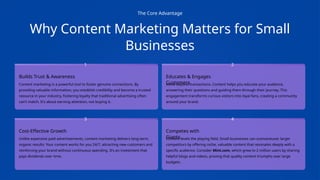
Why Content Marketing Matters for Small
Businesses
1
Builds Trust & Awareness
Content marketing is a powerful tool to foster genuine connections. By
providing valuable information, you establish credibility and become a trusted
resource in your industry, fostering loyalty that traditional advertising often
can't match. It's about earning attention, not buying it.
2
Educates & Engages
Customers
Move beyond transactions. Content helps you educate your audience,
answering their questions and guiding them through their journey. This
engagement transforms curious visitors into loyal fans, creating a community
around your brand.
3
Cost-Effective Growth
Unlike expensive paid advertisements, content marketing delivers long-term,
organic results. Your content works for you 24/7, attracting new customers and
reinforcing your brand without continuous spending. It’s an investment that
pays dividends over time.
4
Competes with
Giants
Content levels the playing field. Small businesses can outmaneuver larger
competitors by offering niche, valuable content that resonates deeply with a
specific audience. Consider Mint.com, which grew to 2 million users by sharing
helpful blogs and videos, proving that quality content triumphs over large
budgets.
What Exactly Is Content Marketing?
Content marketing is a strategic approach focused on creating and distributing valuable,
relevant, and consistent content to attract and retain a clearly defined audience—and,
ultimately, to drive profitable customer action.
• It's about solving problems, not just selling products. Think of yourself as an expert
resource for your audience.
• It builds relationships over time by educating, informing, or inspiring your potential
customers.
• It’s a long-term strategy that yields sustainable growth and builds a loyal customer
base.
Laying the Foundation: Audience &
Goals
Define Your
Audience
Before you create any content, understand
who you're talking to. Develop detailed buyer
personas: semi-fictional representations of
your ideal customers based on market
research and real data about your existing
customers. What are their demographics,
interests, challenges, and goals?
Identify Their Problems
Your content should offer solutions. What
questions do your potential customers
frequently ask? What challenges do they face
that your products or services can address?
The more you align your content with their
needs, the more valuable it becomes.
Set SMART Goals
Content marketing isn't just about posting. It
needs purpose. Set Specific, Measurable,
Achievable, Relevant, and Time-bound goals.
Are you aiming for increased brand
awareness, higher website engagement,
more leads, or direct sales? Each goal will
influence your content strategy.
Consider a tire shop creating DIY videos for car enthusiasts or safety blogs for families preparing for road trips. They're solving different
problems for distinct segments of their audience.
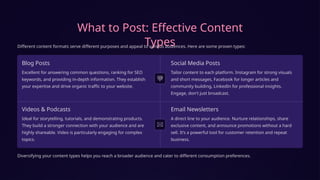
What to Post: Effective Content
Types
Different content formats serve different purposes and appeal to various audiences. Here are some proven types:
Blog Posts
Excellent for answering common questions, ranking for SEO
keywords, and providing in-depth information. They establish
your expertise and drive organic traffic to your website.
Social Media Posts
Tailor content to each platform. Instagram for strong visuals
and short messages, Facebook for longer articles and
community building, LinkedIn for professional insights.
Engage, don't just broadcast.
Videos & Podcasts
Ideal for storytelling, tutorials, and demonstrating products.
They build a stronger connection with your audience and are
highly shareable. Video is particularly engaging for complex
topics.
Email Newsletters
A direct line to your audience. Nurture relationships, share
exclusive content, and announce promotions without a hard
sell. It’s a powerful tool for customer retention and repeat
business.
Diversifying your content types helps you reach a broader audience and cater to different consumption preferences.
Quality Over Quantity: Make Every Post
Count
In content marketing, more is not always better. One meticulously
researched, high-quality piece of content that genuinely serves your
audience will always outperform ten rushed, low-value posts.
• Focus on strategic content that aligns with your SEO goals and directly
addresses your audience's needs.
• Every piece of content should have a clear purpose and provide
tangible value.
Maximize your efforts by repurposing content across multiple channels.
A blog post can become a series of social media graphics, a podcast
episode, or a video script.
Consider the example of Birchbox. Their strategy isn't about constant
new content, but short, useful blog posts that are frequently updated,
ensuring their existing content remains relevant and valuable.
Plan for Success
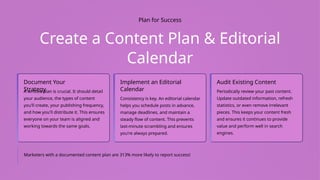
Create a Content Plan & Editorial
Calendar
Document Your
Strategy
A written plan is crucial. It should detail
your audience, the types of content
you'll create, your publishing frequency,
and how you'll distribute it. This ensures
everyone on your team is aligned and
working towards the same goals.
Implement an Editorial
Calendar
Consistency is key. An editorial calendar
helps you schedule posts in advance,
manage deadlines, and maintain a
steady flow of content. This prevents
last-minute scrambling and ensures
you're always prepared.
Audit Existing Content
Periodically review your past content.
Update outdated information, refresh
statistics, or even remove irrelevant
pieces. This keeps your content fresh
and ensures it continues to provide
value and perform well in search
engines.
Marketers with a documented content plan are 313% more likely to report success!
Promote & Distribute Your Content
Effectively
Target Your Platforms: Don't try to be everywhere at once.
Focus your efforts on the 2-3 platforms where your target
audience is most active. Quality engagement on a few
channels is better than scattered presence on many.
Include Clear Calls to Action (CTAs): Guide your readers on
what to do next. Whether it's to "Subscribe to our newsletter,"
"Share this post," or "Shop now," clear CTAs maximize the
impact of your content.
Engage with Your Audience: Content marketing is a two-way
street. Respond to comments, answer questions, and
participate in discussions. This builds community and
reinforces your brand's approachability.
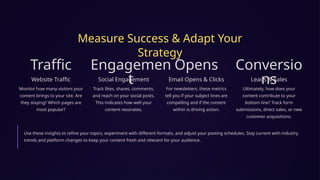
Measure Success & Adapt Your
Strategy
Traffic
Website Traffic
Monitor how many visitors your
content brings to your site. Are
they staying? Which pages are
most popular?
Engagemen
t
Social Engagement
Track likes, shares, comments,
and reach on your social posts.
This indicates how well your
content resonates.
Opens
Email Opens & Clicks
For newsletters, these metrics
tell you if your subject lines are
compelling and if the content
within is driving action.
Conversio
ns
Leads & Sales
Ultimately, how does your
content contribute to your
bottom line? Track form
submissions, direct sales, or new
customer acquisitions.
Use these insights to refine your topics, experiment with different formats, and adjust your posting schedules. Stay current with industry
trends and platform changes to keep your content fresh and relevant for your audience.
Your Content Marketing Journey
Starts Now
Focus on Your Unique Expertise: What makes your
small business special? Share that authentic voice.
Build Trust Consistently: Through valuable, helpful
content, you’ll earn your audience's loyalty.
Small Steps, Big Growth: Start with a simple plan,
create quality posts, and engage genuinely. You
don't need a massive team or budget.
Lasting Relationships: Content marketing is your
most cost-effective path to building enduring
connections with your customers.