Contemporary Medical Issues and Islamic Jurisprudence: Ethical Conflicts and Youth Guidance
Explores the intersection of modern medical ethics and Islamic law, addressing cosmetic surgery, organ transplantation, bioethics, and youth challenges in maintaining faith and identity.
Contemporary Medical Issues and Islamic Jurisprudence: Ethical Conflicts and Youth Guidance
1.
ُارَعَتَو ُةَر ِّ
اصَعُمْلٱُةَّيِّبِّٱلط اَياَضَقْلٱ
ِّيِّم َ
َلْسِّْ
ٱْل ِّهْقِّفْلٱ َعَم اَهُض
CONTEMPORARY MEDICAL ISSUES CONFLICTS WITH
ISLAMIC JURISPRUDENCE (FIQH)
2.
BEING AN LECTUREORGANIZED BY
THE YOUTH GROUP OF REGIONAL COUNCIL OF NIGERIAN
MUSLIM ORGANIZATIONS (rcnmo Youth)
Saturday 2nd May, 2026
3.
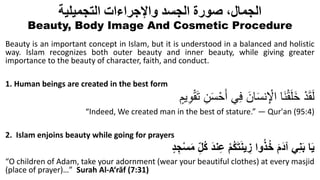
MEET THE FACILITATOR
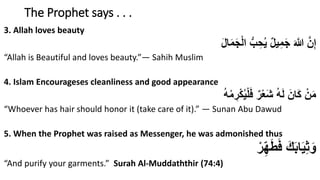
Dr.ABDUL RASHEED MUH’D QASIM
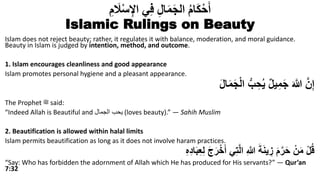
Deputy Imam Aonullah Mosque, Teachers Estate, Ogun State,
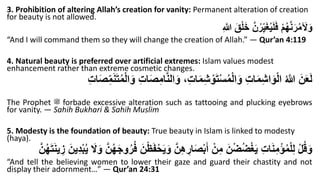
Nigeria
Founder Ma’had Qiraat Institute for Arabic and Islamic
Civilization
+234 - 8051700164, +234 - 7066867887
kazeemrasheed1440@gmail.com
4.
Introduction ….
In anage marked by rapid medical advancement and technological innovation, new
ethical questions continue to emerge, challenging long-established moral and legal
frameworks. The topic “ اَياَضَقْلٱ
ُةَّيِّبِّٱلط
ُةَر ِّ
اصَعُمْلٱ
اَهُضُارَعَتَو
َعَم
ْلٱ
ِّهْقِّف
ِّيِّم َ
َلْسِّْ
ٱْل
”
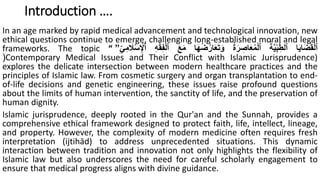
(Contemporary Medical Issues and Their Conflict with Islamic Jurisprudence)
explores the delicate intersection between modern healthcare practices and the
principles of Islamic law. From cosmetic surgery and organ transplantation to end-
of-life decisions and genetic engineering, these issues raise profound questions
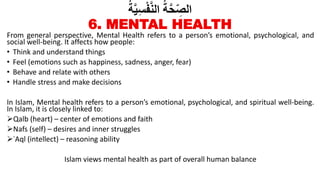
about the limits of human intervention, the sanctity of life, and the preservation of
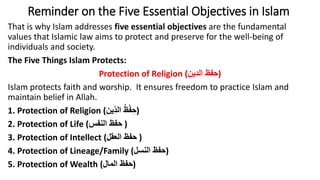
human dignity.
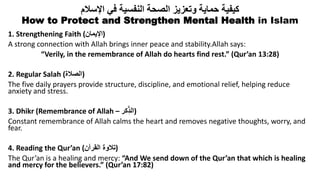
Islamic jurisprudence, deeply rooted in the Qur'an and the Sunnah, provides a
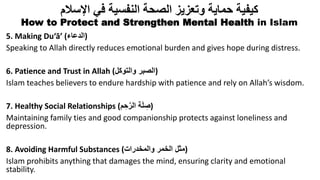
comprehensive ethical framework designed to protect faith, life, intellect, lineage,
and property. However, the complexity of modern medicine often requires fresh
interpretation (ijtihād) to address unprecedented situations. This dynamic
interaction between tradition and innovation not only highlights the flexibility of
Islamic law but also underscores the need for careful scholarly engagement to
ensure that medical progress aligns with divine guidance.
5.
Introduction ….
Modern bioethicalphenomena—such as euthanasia, organ
transplantation, assisted reproduction, and end-of-life care—pose
complex moral questions due to rapid scientific and technological
advancement. Islam approaches these issues through a normative ethical
framework derived from divine revelation (Quran and Sunnah) and juristic
reasoning. Islamic bioethics is neither rigid nor totally criticize science;
rather, it integrates moral upright, human dignity and accountability
before humanity and Allah.
Contemporary medical issues do not merely present scientific or clinical
challenges; they raise serious ethical, legal, and spiritual questions that
require careful evaluation within the framework of Islamic jurisprudence.
The perceived “conflict” is sometimes a direct contradiction and creates
tension between rapid medical progress and the timeless objectives of
Islamic law (Maqāṣid al-Sharī‘ah) especially among the youths.
6.
These conflicts arisewhen medical practice and
legal obligations intersect with religious and
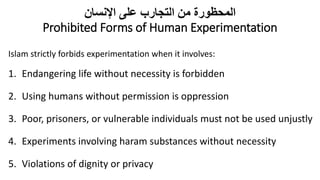
ethical norms. In Muslim societies—or where
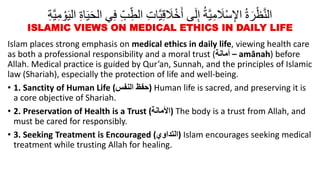
Muslims live under secular legal systems—
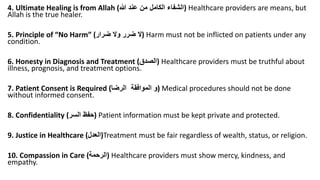
tensions may emerge between state law,
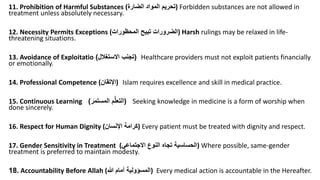
medical standards, and Islamic jurisprudence
(Sharīʿah). Islamic law provides a moral-legal
framework that seeks to protect life, dignity,
and justice while accommodating medical
necessity and public interest WITH THE AIM OF
SAVING LIVES AND HUMANITY.
7.
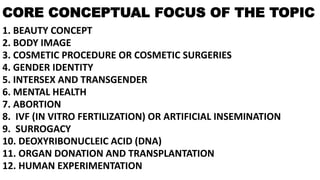
CORE CONCEPTUAL FOCUSOF THE TOPIC
1. BEAUTY CONCEPT
2. BODY IMAGE
3. COSMETIC PROCEDURE OR COSMETIC SURGERIES
4. GENDER IDENTITY
5. INTERSEX AND TRANSGENDER
6. MENTAL HEALTH
7. ABORTION
8. IVF (IN VITRO FERTILIZATION) OR ARTIFICIAL INSEMINATION
9. SURROGACY
10. DEOXYRIBONUCLEIC ACID (DNA)
11. ORGAN DONATION AND TRANSPLANTATION
12. HUMAN EXPERIMENTATION
8.
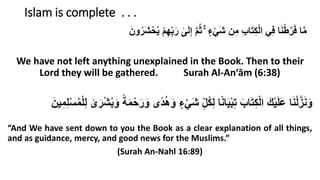
Islam is complete. . .
َشْحُي ْمِّهِّبَر ٰ
ىَلِّإ َّمُث ۚ ٍءْيَش نِّم ِّباَتِّكْلا يِّف اَنْطَّرَف اَّم
َونُر
We have not left anything unexplained in the Book. Then to their
Lord they will be gathered. Surah Al-An‘ām (6:38)
ُهَو ٍءْيَش ُِّلكِّل اًناَيْبِّت َابَتِّكْلا َكْيَلَع اَنْلَّزَنَو
َينِّمِّلْسُمْلِّل ٰ
ىَرْشُبَو ًةَمْحَرَو ًىد
“And We have sent down to you the Book as a clear explanation of all things,
and as guidance, mercy, and good news for the Muslims.”
(Surah An-Nahl 16:89)
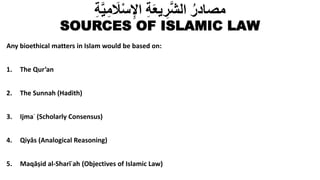
9.
ِةَّيِم َ
َلْسِاإل ِةَعيِ
َّرشال ُمصادر
SOURCES OF ISLAMIC LAW
Any bioethical matters in Islam would be based on:
1. The Qur’an
2. The Sunnah (Hadith)
3. Ijmaʿ (Scholarly Consensus)
4. Qiyās (Analogical Reasoning)
5. Maqāṣid al-Sharīʿah (Objectives of Islamic Law)
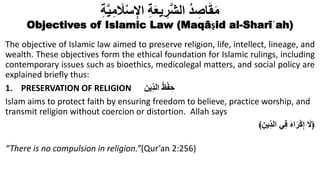
10.
ِةَّيِم َ
َلْسِاإل ِةَعيِ
َّرشال ُد ِ
اصَقَم
Objectives of Islamic Law (Maqāṣid al-Sharīʿah)
The objective of Islamic law aimed to preserve religion, life, intellect, lineage, and
wealth. These objectives form the ethical foundation for Islamic rulings, including
contemporary issues such as bioethics, medicolegal matters, and social policy are
explained briefly thus:
1. PRESERVATION OF RELIGION ينِّالد ُظْف ِّح
Islam aims to protect faith by ensuring freedom to believe, practice worship, and
transmit religion without coercion or distortion. Allah says
﴾ِّينِّالد يِّف َهاَرْكِّإ َ
﴿َل
“There is no compulsion in religion.”(Qur’an 2:256)
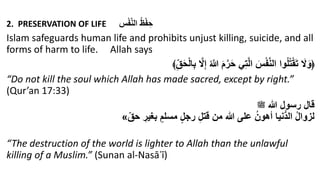
11.
2. PRESERVATION OFLIFE سْفَّنال ُظْف ِّح
Islam safeguards human life and prohibits unjust killing, suicide, and all
forms of harm to life. Allah says
﴾ِّقَحْلاِّب َّ
َلِّإ ُ َّ
َّللا َمَّرَح يِّتَّلا َ
سْفَّنال واُلُتْقَت َ
َلَ﴿و
“Do not kill the soul which Allah has made sacred, except by right.”
(Qur’an 17:33)
هللا رسول قال
ﷺ
«حق ِّ
بغير ٍمسلم ٍلرج ِّلقت من هللا على ُأهون ُّنيادال ُللزوا
“The destruction of the world is lighter to Allah than the unlawful
killing of a Muslim.” (Sunan al-Nasāʾī)
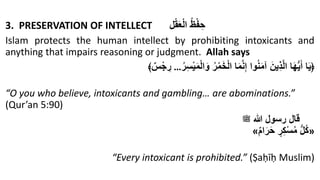
12.
3. PRESERVATION OFINTELLECT لْقَعْلا ُظْف ِّح
Islam protects the human intellect by prohibiting intoxicants and
anything that impairs reasoning or judgment. Allah says
ُرِّسْيَمْلاَو ُرْمَخْلا اَمَّنِّإ واُنَمآ َينِّذَّلا اَهُّيَأ اَي﴿
…
﴾ ٌسْج ِّ
ر
“O you who believe, intoxicants and gambling… are abominations.”
(Qur’an 5:90)
هللا رسول قال
ﷺ
«ٌماَرَح ٍ
رِّكْسُم ُّلُك»
“Every intoxicant is prohibited.” (Ṣaḥīḥ Muslim)
13.
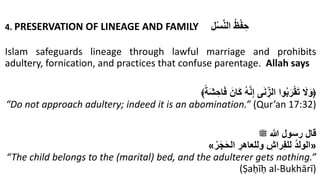
4. PRESERVATION OFLINEAGE AND FAMILY لْسَّنال ُظْف ِّح
Islam safeguards lineage through lawful marriage and prohibits
adultery, fornication, and practices that confuse parentage. Allah says
﴾ًَةش ِّاحَف َانَك ُهَّنِّإ ىَن ِّ
الز واُبَرْقَت َ
َلَ﴿و
“Do not approach adultery; indeed it is an abomination.” (Qur’an 17:32)
هللا رسول قال
ﷺ
«ُرَجَحال ِّ
وللعاهر ِّ
راشِّفلل ُد»الول
“The child belongs to the (marital) bed, and the adulterer gets nothing.”
(Ṣaḥīḥ al-Bukhārī)
14.
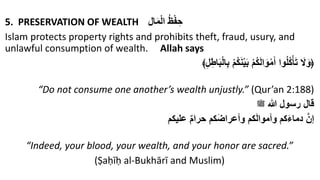
5. PRESERVATION OFWEALTH الَمْلا ُظْف ِّح
Islam protects property rights and prohibits theft, fraud, usury, and
unlawful consumption of wealth. Allah says
﴾ِّلِّاطَبْلاِّب ْمُكَنْيَب ْمُكَلاَوْمَأ واُلُكْأَت َ
َلَ﴿و
“Do not consume one another’s wealth unjustly.” (Qur’an 2:188)
هللا رسول قال
ﷺ
عليكم ٌمحرا كمَضوأعرا كمَلوأموا كمَءدما َّإن
“Indeed, your blood, your wealth, and your honor are sacred.”
(Ṣaḥīḥ al-Bukhārī and Muslim)
15.
Why This TopicIs Important for Today’s Muslim Youth?
This topic is important for today’s Muslim youth because it helps them
understand the Islamic perspective on beauty, body image, and cosmetic
procedures in a world influenced by social media and unrealistic standards.
Many young people face pressure to change their appearance, which can affect
self-esteem and faith. Studying this topic guides them toward moderation, self-
acceptance, and gratitude for Allah’s creation. It also clarifies what is permissible
and impermissible in cosmetic changes according to Islamic teachings,
promoting healthy identity and moral awareness. Thus, it will help our teeming
Muslim Youths to
1. Understand the Islamic view of beauty and appearance.
2. Promote self-acceptance as part of Allah’s creation.
3. Reduce pressure from social media beauty standards.
4. Be guided against harmful cosmetic practices.
5. Strengthen their self-esteem and confidence about their religion
16.
6. Clarify whatconfusing aspect of cosmetic procedures
either halal or haram.
7. Prevent them from imitation of unhealthy cultural trends.
8. Be encouraged on real modesty in appearance and
behaviour.
9. Avoid body dissatisfaction and depression.
10. Build strong awareness of inner beauty over physical
looks.
11. Support their mental and emotional well-being.
12. Be gratitude for Allah’s creation.
13. Promote balance between grooming and excesses.
14. Strengthen their Islamic identity in a modern society.
17.
التجميلية واإلجراءات الجسدصورة ،الجمال
Beauty, Body Image And Cosmetic Procedure
Beauty is an important concept in Islam, but it is understood in a balanced and holistic
way. Islam recognizes both outer beauty and inner beauty, while giving greater
importance to the beauty of character, faith, and conduct.
1. Human beings are created in the best form
يمِوْقَت ِنَسْحَأ يِف َانَسنِ ْ
اْل َانْقَلَخ ْدَقَل
“Indeed, We created man in the best of stature.” — Qur'an (95:4)
2. Islam enjoins beauty while going for prayers
ٍد ِّجْسَم ُِّلك َدنِّع ْمُكَتَني ِّ
ز واُذُخ َمَدآ يِّنَب اَي
“O children of Adam, take your adornment (wear your beautiful clothes) at every masjid
(place of prayer)…” Surah Al-A‘rāf (7:31)
18.
The Prophet says. . .
3. Allah loves beauty
َلاَمَجْلا ُّب ِّحُي ٌليِّمَج َ َّ
َّللا َّنِّإ
“Allah is Beautiful and loves beauty.”— Sahih Muslim
4. Islam Encourageses cleanliness and good appearance
ُهْم ِّ
رْكُيْلَف ٌرْعَش ُهَل َانَك ْنَم
“Whoever has hair should honor it (take care of it).” — Sunan Abu Dawud
5. When the Prophet was raised as Messenger, he was admonished thus
ْرِّهَطَف َكَباَيِّثَو
“And purify your garments.” Surah Al-Muddaththir (74:4)
19.
ِم َ
َلْسِاإل يِفِلاَمَجال ُماَكْحَأ
Islamic Rulings on Beauty
Islam does not reject beauty; rather, it regulates it with balance, moderation, and moral guidance.
Beauty in Islam is judged by intention, method, and outcome.
1. Islam encourages cleanliness and good appearance
Islam promotes personal hygiene and a pleasant appearance.
َلاَمَجْلا ُّب ِّحُي ٌليِّمَج َ َّ
َّللا َّنِّإ
The Prophet ﷺ said:
“Indeed Allah is Beautiful and الجمال يحب (loves beauty).” — Sahih Muslim
2. Beautification is allowed within halal limits
Islam permits beautification as long as it does not involve haram practices.
ِّهِّداَبِّعِّل َجَرْخَأ يِّتَّلا ِّ َّ
َّللا َةَني ِّ
ز َمَّرَح ْنَم ْلُق
“Say: Who has forbidden the adornment of Allah which He has produced for His servants?” — Qur’an
7:32
20.
3. Prohibition ofaltering Allah’s creation for vanity: Permanent alteration of creation
for beauty is not allowed.
ِّ َّ
َّللا َقْلَخ َّنُرِّيَغُيَلَف ْمُهَّنَرُم َ
َلَو
“And I will command them so they will change the creation of Allah.” — Qur’an 4:119
4. Natural beauty is preferred over artificial extremes: Islam values modest
enhancement rather than extreme cosmetic changes.
ِّتاَصِّامَّنالَو ،ِّتاَمِّش ْوَتْسُمْلاَو ِّتاَمِّشاَوْلا ُ َّ
َّللا َنَعَل
ِّتاَصِّمَنَتُمْلاَو
The Prophet ﷺ forbade excessive alteration such as tattooing and plucking eyebrows
for vanity. — Sahih Bukhari & Sahih Muslim
5. Modesty is the foundation of beauty: True beauty in Islam is linked to modesty
(haya).
َفْحَيَو َّنِّه ِّ
ارَصْبَأ ْنِّم َنْضُضْغَي ِّتاَنِّمْؤُمْلِّل ْلُقَو
َّنُهَتَني ِّ
ز َينِّدْبُي َ
َلَو َّنُهَجوُرُف َنْظ
“And tell the believing women to lower their gaze and guard their chastity and not
display their adornment…” — Qur’an 24:31
21.
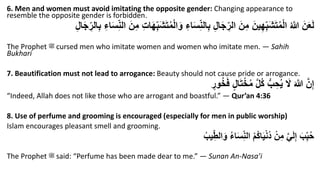
6. Men andwomen must avoid imitating the opposite gender: Changing appearance to
resemble the opposite gender is forbidden.
َشَتُمْلاَو ِّاءَسِّالنِّب ِّلاَج ِّ
الر َنِّم َينِّهَِّبشَتُمْلا ُ َّ
َّللا َنَعَل
ِّلاَج ِّ
الرِّب ِّاءَسِّالن َنِّم ِّتاَهِّب
The Prophet ﷺ cursed men who imitate women and women who imitate men. — Sahih
Bukhari
7. Beautification must not lead to arrogance: Beauty should not cause pride or arrogance.
ٍ
ورُخَف ٍلاَتْخُم َّلُك ُّب ِّحُي َ
َل َ َّ
َّللا َّنِّإ
“Indeed, Allah does not like those who are arrogant and boastful.” — Qur’an 4:36
8. Use of perfume and grooming is encouraged (especially for men in public worship)
Islam encourages pleasant smell and grooming.
ُيبِّالطَو ُءاَسِّالن ْمُكاَيْنُد ْنِّم َّيَلِّإ َبِّبُح
The Prophet ﷺ said: “Perfume has been made dear to me.” — Sunan An-Nasa’i
22.
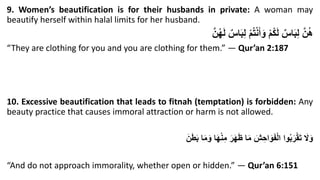
9. Women’s beautificationis for their husbands in private: A woman may
beautify herself within halal limits for her husband.
َّنُهَل ٌاسَبِّل ْمُتْنَأَو ْمُكَل ٌاسَبِّل َّنُه
“They are clothing for you and you are clothing for them.” — Qur’an 2:187
10. Excessive beautification that leads to fitnah (temptation) is forbidden: Any
beauty practice that causes immoral attraction or harm is not allowed.
َنَطَب اَمَو اَهْنِّم َرَهَظ اَم َ
ش ِّاحَوَفْلا واُبَرْقَت َ
َلَو
“And do not approach immorality, whether open or hidden.” — Qur’an 6:151
23.
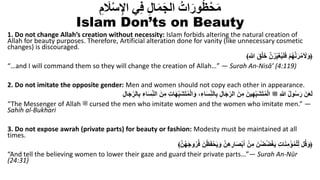
ِم َ
َلْسِاإل يِفِلاَمَجال ُاتَورُظْحَم
Islam Don’ts on Beauty
1. Do not change Allah’s creation without necessity: Islam forbids altering the natural creation of
Allah for beauty purposes. Therefore, Artificial alteration done for vanity (like unnecessary cosmetic
changes) is discouraged.
﴾ِّ َّ
َّللا َقْلَخ َّنُرِّيَغُيَلَف ْمُهَّنَرُم َ
َلَ﴿و
“…and I will command them so they will change the creation of Allah…” — Surah An-Nisā’ (4:119)
2. Do not imitate the opposite gender: Men and women should not copy each other in appearance.
ِّ َّ
َّللا ُلوُسَر َنَعَل
ﷺ
َسِّالن َنِّم ِّتاَهَِّبشَتُمْلاَو ،ِّاءَسِّالنِّب ِّلاَج ِّ
الر َنِّم َينِّهَِّبشَتُمْلا
ِّلاَج ِّ
الرِّب ِّاء
“The Messenger of Allah ﷺ cursed the men who imitate women and the women who imitate men.” —
Sahih al-Bukhari
3. Do not expose awrah (private parts) for beauty or fashion: Modesty must be maintained at all
times.
﴾َّنُهَجوُرُف َنْظَفْحَيَو َّنِّه ِّ
ارَصْبَأ ْنِّم َنْضُضْغَي ِّتاَنِّمْؤُمْلِّل لُقَ﴿و
“And tell the believing women to lower their gaze and guard their private parts…”— Surah An-Nūr
(24:31)
24.
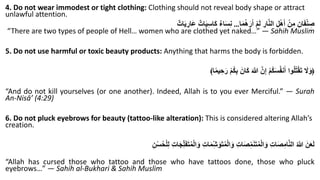
4. Do notwear immodest or tight clothing: Clothing should not reveal body shape or attract
unlawful attention.
اَمُهَرَأ ْمَل ِّ
ارَّنال ِّلْهَأ ْنِّم ِّانَفْن ِّ
ص
…
ٌاتَي ِّ
َارع ٌاتَيِّسَاك ٌءاَسِّن
“There are two types of people of Hell… women who are clothed yet naked…” — Sahih Muslim
5. Do not use harmful or toxic beauty products: Anything that harms the body is forbidden.
﴾اًمي ِّحَر ْمُكِّب ََانك َ َّ
َّللا َّنِّإ ْمُكَسُفنَأ واُلُتْقَت َ
َلَ﴿و
“And do not kill yourselves (or one another). Indeed, Allah is to you ever Merciful.” — Surah
An-Nisā’ (4:29)
6. Do not pluck eyebrows for beauty (tattoo-like alteration): This is considered altering Allah’s
creation.
ْسُحْلِّل ِّتاَجِّلَفَتُمْلاَو ِّتاَمِّشَوَتُمْلاَو ِّتاَصِّمَنَتُمْلاَو ِّتاَصِّامَّنال ُ َّ
َّللا َنَعَل
ِّن
“Allah has cursed those who tattoo and those who have tattoos done, those who pluck
eyebrows…” — Sahih al-Bukhari & Sahih Muslim
25.
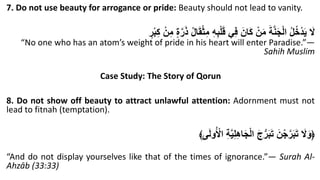
7. Do notuse beauty for arrogance or pride: Beauty should not lead to vanity.
ْبِّك ْنِّم ٍةَّرَذ ُلاَقْثِّم ِّهِّبْلَق يِّف َانَك ْنَم َةَّنَجْلا ُلُخْدَي َ
َل
ٍ
ر
“No one who has an atom’s weight of pride in his heart will enter Paradise.”—
Sahih Muslim
Case Study: The Story of Qorun
8. Do not show off beauty to attract unlawful attention: Adornment must not
lead to fitnah (temptation).
﴾ىَلوُ ْ
اْل ِّةَّيِّلِّهاَجْلا َجُّرَبَت َنْجَّرَبَت َ
َلَ﴿و
“And do not display yourselves like that of the times of ignorance.”— Surah Al-
Ahzāb (33:33)
26.
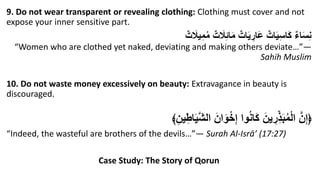
9. Do notwear transparent or revealing clothing: Clothing must cover and not
expose your inner sensitive part.
ٌت َ
يَلِّمُم ٌت َ
َلِّئاَم ٌاتَي ِّ
َارع ٌاتَيِّساَك ٌءاَسِّن
“Women who are clothed yet naked, deviating and making others deviate…”—
Sahih Muslim
10. Do not waste money excessively on beauty: Extravagance in beauty is
discouraged.
﴾ِّينِّاطَيَّشال َانَوْخِّإ واُناَك َين ِّ
رِّذَبُمْلا َّنِّإ﴿
“Indeed, the wasteful are brothers of the devils…”— Surah Al-Isrā’ (17:27)
Case Study: The Story of Qorun
27.
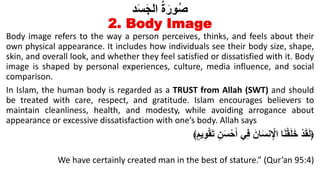
دَسَجال ُةَورُص
2. BodyImage
Body image refers to the way a person perceives, thinks, and feels about their
own physical appearance. It includes how individuals see their body size, shape,
skin, and overall look, and whether they feel satisfied or dissatisfied with it. Body
image is shaped by personal experiences, culture, media influence, and social
comparison.
In Islam, the human body is regarded as a TRUST from Allah (SWT) and should
be treated with care, respect, and gratitude. Islam encourages believers to
maintain cleanliness, health, and modesty, while avoiding arrogance about
appearance or excessive dissatisfaction with one’s body. Allah says
﴾ٍيمِّوْقَت ِّنَسْحَأ يِّف َانَسنِّْ
اْل اَنْقَلَخ ْدَقَل﴿
We have certainly created man in the best of stature.” (Qur’an 95:4)
28.
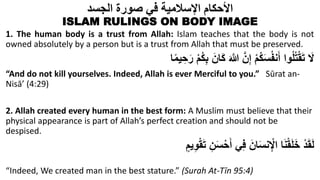
الجسد صورة فياإلسَلمية األحكام
ISLAM RULINGS ON BODY IMAGE
1. The human body is a trust from Allah: Islam teaches that the body is not
owned absolutely by a person but is a trust from Allah that must be preserved.
اًمي ِّحَر ْمُكِّب َانَك َ َّ
َّللا َّنِّإ ْمُكَسُفنَأ واُلُتْقَت َ
َل
“And do not kill yourselves. Indeed, Allah is ever Merciful to you.” Sūrat an-
Nisā’ (4:29)
2. Allah created every human in the best form: A Muslim must believe that their
physical appearance is part of Allah’s perfect creation and should not be
despised.
ٍيمِّوْقَت ِّنَسْحَأ يِّف َانَسنِّْ
اْل اَنْقَلَخ ْدَقَل
“Indeed, We created man in the best stature.” (Surah At-Tīn 95:4)
29.
3. Self-hatred orrejection of one’s body is discouraged” Constant dissatisfaction with
one’s natural appearance contradicts gratitude to Allah.
ُم ْوَقْلا َّ
َلِّإ ِّ َّ
َّللا ِّح ْوَّر نِّم ُسَأْيَي َ
َل ُهَّنِّإ ِّ َّ
َّللا ِّح ْوَّر نِّم واُسَأْيَت َ
َلَو
ونُرِّفاَكْلا
“And do not despair of the mercy (relief) of Allah. Indeed, no one despairs of the
mercy of Allah except the disbelieving people.”— Surah Yusuf (12:87)
4. Gratitude (shukur) for appearance is required: A Muslim should thank Allah for
their body and avoid complaining about creation.
ْمُكَّنَدي ِّ
زَ َ
ْل ْمُتْرَكَش نِّئَل
“If you are grateful, I will surely increase you (in blessings).” (Surah Ibrāhīm 14:7)
5. Changing the body is only allowed for necessity: Cosmetic changes are only
permissible when there is a medical or legitimate need, not for vanity.
• ِّةَكُلْهَّتال ىَلِّإ ْمُكِّيدْيَأِّب واُقْلُت َ
َلَو
“And do not throw yourselves into destruction (ruin) with your own hands. (Surah Al-
Baqarah 2:195)
30.
6. Harmful bodymodification is forbidden: Anything that causes harm to the
body, such as unsafe cosmetic procedures, is not allowed.
اًمي ِّحَر ْمُكِّب َانَك َ َّ
َّللا َّنِّإ ْمُكَسُفنَأ واُلُتْقَت َ
َلَو
“Do not throw yourselves into destruction…” (Surah Al-Baqarah 2:195)
7. Modesty must guide how one presents the body: Islam requires covering the
body properly and avoiding exposure that leads to fitnah.
ُف َنْظَفْحَيَو َّنِّه ِّ
ارَصْبَأ ْنِّم َنْضُضْغَي ِّتاَنِّمْؤُمْلِّل لُقَو
َّنُهَجوُر
“And tell the believing women to lower their gaze and guard their private
parts.” — Surah An-Nūr (24:31)
8. Arrogance about appearance is prohibited: A person should not feel superior
because of beauty or despise others because of appearance.
ٍ
ورُخَف ٍلاَتْخُم َّلُك ُّب ِّحُي َ
َل َ َّ
َّللا َّنِّإ
“No one who has an atom’s weight of pride will enter Paradise.” (Sahih Muslim)
31.
9. Body comparisonwith others is discouraged: Islam discourages envy and
dissatisfaction caused by comparing oneself with others.
ضْعَب ٰ
ىَلَع ْمُكَضْعَب ِّهِّب ُ َّ
َّللا َلَّضَف اَم ا ْوَّنَمَتَت َ
َلَو
“And do not wish for that by which Allah has made some of you exceed
others.”— Surah An-Ni sā’ (4:32)
10. True beauty in Islam is taqwā (God-consciousness): Physical appearance is
secondary; the real measure of beauty is righteousness and character.
ْمُكاَقْتَأ ِّ َّ
َّللا َدنِّع ْمُكَمَرْكَأ َّنِّإ
“Indeed, the most noble of you in the sight of Allah is the most righteous of you.”
(Surah Al-Hujurat 49:13)
32.
التجميلية الجراحات اوتجميلي إجراء
3. COSMETIC PROCEDURE OR COSMETIC SURGERIES
Cosmetic Procedure or Surgery refers to medical procedures performed to improve or
enhance a person’s physical appearance. It involves surgical or medical techniques used
to, Change body shape, Improve facial features, Remove wrinkles or signs of aging,
Enhance beauty. Cosmetic surgery is a medical procedure is done to improve
appearance rather than to treat illness or injury.
COSMETIC PROCEDURE OR SURGERIES IN ISLAM
Cosmetic (plastic) surgery in Islam is discussed under the principles of changing Allah’s
creation ( تغيير
خلق
هللا ) and the objectives of Islamic law, particularly preservation of life
and dignity. Islamic scholars generally divide cosmetic surgery into two categories:
• Reconstructive / Medical
• Purely Cosmetic / Beautification
33.
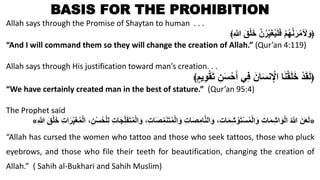
BASIS FOR THEPROHIBITION
Allah says through the Promise of Shaytan to human . . .
﴾ِّ َّ
َّللا َقْلَخ َّنُرِّيَغُيَلَف ْمُهَّنَرُم َ
َلَ﴿و
“And I will command them so they will change the creation of Allah.” (Qur’an 4:119)
Allah says through His justification toward man’s creation. . .
﴾ٍيمِّوْقَت ِّنَسْحَأ يِّف َانَسنِّْ
اْل اَنْقَلَخ ْدَقَل﴿
“We have certainly created man in the best of stature.” (Qur’an 95:4)
The Prophet said
« َو ،ِّتاَصِّمَنَتُمْلاَو ِّتاَصِّامَّنالَو ،ِّتاَمِّش ْوَتْسُمْلاَو ِّتاَمِّشاَوْلا ُ َّ
َّللا َنَعَل
ِّيَغُمْلا ،ِّنْسُحْلِّل ِّتاَجِّلَفَتُمْلا
ِّ َّ
َّللا َقْلَخ ِّتاَر »
“Allah has cursed the women who tattoo and those who seek tattoos, those who pluck
eyebrows, and those who file their teeth for beautification, changing the creation of
Allah.” ( Sahih al-Bukhari and Sahih Muslim)
34.
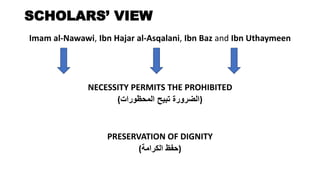
SCHOLARS’ VIEW
Imam al-Nawawi,Ibn Hajar al-Asqalani, Ibn Baz and Ibn Uthaymeen
NECESSITY PERMITS THE PROHIBITED
(المحظورات تبيح )الضرورة
PRESERVATION OF DIGNITY
(الكرامة )حفظ
35.
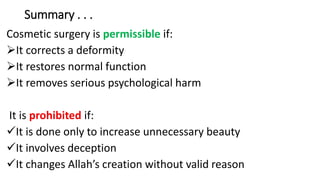
Summary . ..
Cosmetic surgery is permissible if:
➢It corrects a deformity
➢It restores normal function
➢It removes serious psychological harm
It is prohibited if:
✓It is done only to increase unnecessary beauty
✓It involves deception
✓It changes Allah’s creation without valid reason
36.
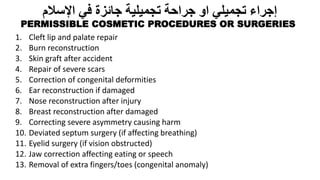
اإلسَلم في جائزةتجميلية جراحة او تجميلي إجراء
PERMISSIBLE COSMETIC PROCEDURES OR SURGERIES
1. Cleft lip and palate repair
2. Burn reconstruction
3. Skin graft after accident
4. Repair of severe scars
5. Correction of congenital deformities
6. Ear reconstruction if damaged
7. Nose reconstruction after injury
8. Breast reconstruction after damaged
9. Correcting severe asymmetry causing harm
10. Deviated septum surgery (if affecting breathing)
11. Eyelid surgery (if vision obstructed)
12. Jaw correction affecting eating or speech
13. Removal of extra fingers/toes (congenital anomaly)
37.
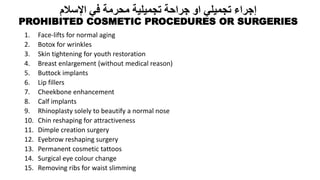
اإلسَلم في محرمةتجميلية جراحة او تجميلي إجراء
PROHIBITED COSMETIC PROCEDURES OR SURGERIES
1. Face-lifts for normal aging
2. Botox for wrinkles
3. Skin tightening for youth restoration
4. Breast enlargement (without medical reason)
5. Buttock implants
6. Lip fillers
7. Cheekbone enhancement
8. Calf implants
9. Rhinoplasty solely to beautify a normal nose
10. Chin reshaping for attractiveness
11. Dimple creation surgery
12. Eyebrow reshaping surgery
13. Permanent cosmetic tattoos
14. Surgical eye colour change
15. Removing ribs for waist slimming
38.
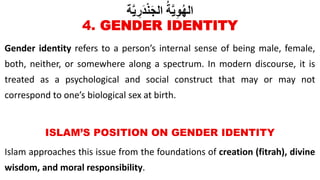
ةَّي ِ
َردْنَجال ُةَّيِوُهال
4.GENDER IDENTITY
Gender identity refers to a person’s internal sense of being male, female,
both, neither, or somewhere along a spectrum. In modern discourse, it is
treated as a psychological and social construct that may or may not
correspond to one’s biological sex at birth.
ISLAM’S POSITION ON GENDER IDENTITY
Islam approaches this issue from the foundations of creation (fitrah), divine
wisdom, and moral responsibility.
39.
ISLAM’S POSITION ONGENDER IDENTITY
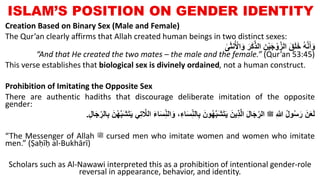
Creation Based on Binary Sex (Male and Female)
The Qur’an clearly affirms that Allah created human beings in two distinct sexes:
ٰ
ىَثنُ ْ
اْلَو َرَكَّذال ِّنْيَج ْوَّالز َقَلَخ ُهَّنَأَو
“And that He created the two mates – the male and the female.” (Qur’an 53:45)
This verse establishes that biological sex is divinely ordained, not a human construct.
Prohibition of Imitating the Opposite Sex
There are authentic hadiths that discourage deliberate imitation of the opposite
gender:
ِّ َّ
َّللا ُلوُسَر َنَعَل
ﷺ
َّ
الَل َءاَسِّالنَو ،ِّاءَسِّالنِّب َونُهَّبَشَتَي َِّينذَّلا َلاَج ِّ
الر
ِّلاَج ِّ
الرِّب َنْهَّبَشَتَي يِّت
.
“The Messenger of Allah ﷺ cursed men who imitate women and women who imitate
men.” (Ṣaḥīḥ al-Bukhārī)
Scholars such as Al-Nawawi interpreted this as a prohibition of intentional gender-role
reversal in appearance, behavior, and identity.
40.
نثىُخال
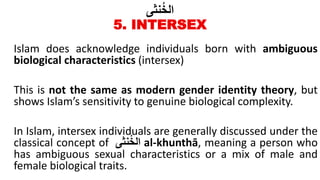
5. INTERSEX
Islam doesacknowledge individuals born with ambiguous
biological characteristics (intersex)
This is not the same as modern gender identity theory, but
shows Islam’s sensitivity to genuine biological complexity.
In Islam, intersex individuals are generally discussed under the
classical concept of نثىُخال al-khunthā, meaning a person who
has ambiguous sexual characteristics or a mix of male and
female biological traits.
41.
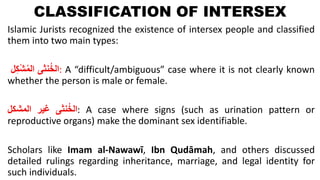
CLASSIFICATION OF INTERSEX
IslamicJurists recognized the existence of intersex people and classified
them into two main types:
نثىُخال
لِّكْشُمال : A “difficult/ambiguous” case where it is not clearly known
whether the person is male or female.
نثىُخال
غير
المشكل : A case where signs (such as urination pattern or
reproductive organs) make the dominant sex identifiable.
Scholars like Imam al-Nawawī, Ibn Qudāmah, and others discussed
detailed rulings regarding inheritance, marriage, and legal identity for
such individuals.
42.
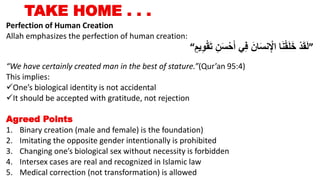
TAKE HOME .. .
Perfection of Human Creation
Allah emphasizes the perfection of human creation:
“ٍيمِّوْقَت ِّنَسْحَأ يِّف َانَسنِّْ
اْل اَنْقَلَخ ْدَقَل”
“We have certainly created man in the best of stature.”(Qur’an 95:4)
This implies:
✓One’s biological identity is not accidental
✓It should be accepted with gratitude, not rejection
Agreed Points
1. Binary creation (male and female) is the foundation)
2. Imitating the opposite gender intentionally is prohibited
3. Changing one’s biological sex without necessity is forbidden
4. Intersex cases are real and recognized in Islamic law
5. Medical correction (not transformation) is allowed
43.
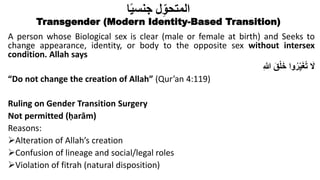
اًيجنس لِالمتحو
Transgender (ModernIdentity-Based Transition)
A person whose Biological sex is clear (male or female at birth) and Seeks to
change appearance, identity, or body to the opposite sex without intersex
condition. Allah says
ِّ َّ
َّللا َقْلَخ واُرِّيَغُت َ
َل
“Do not change the creation of Allah” (Qur’an 4:119)
Ruling on Gender Transition Surgery
Not permitted (ḥarām)
Reasons:
➢Alteration of Allah’s creation
➢Confusion of lineage and social/legal roles
➢Violation of fitrah (natural disposition)
44.
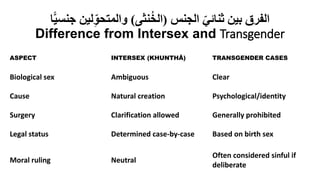
الجنس ثنائي بينالفرق
(
نثىُخال
)
جنسي لينِوالمتحو
ا
Difference from Intersex and Transgender
ASPECT INTERSEX (KHUNTHĀ) TRANSGENDER CASES
Biological sex Ambiguous Clear
Cause Natural creation Psychological/identity
Surgery Clarification allowed Generally prohibited
Legal status Determined case-by-case Based on birth sex
Moral ruling Neutral
Often considered sinful if
deliberate
45.
ُةَّيِسْفَّنال ُةَّح ِ
الص
6.MENTAL HEALTH
From general perspective, Mental Health refers to a person’s emotional, psychological, and
social well-being. It affects how people:
• Think and understand things
• Feel (emotions such as happiness, sadness, anger, fear)
• Behave and relate with others
• Handle stress and make decisions
In Islam, Mental health refers to a person’s emotional, psychological, and spiritual well-being.
In Islam, it is closely linked to:
➢Qalb (heart) – center of emotions and faith
➢Nafs (self) – desires and inner struggles
➢ʿAql (intellect) – reasoning ability
Islam views mental health as part of overall human balance
46.
Reminder on theFive Essential Objectives in Islam
That is why Islam addresses five essential objectives are the fundamental
values that Islamic law aims to protect and preserve for the well-being of
individuals and society.
The Five Things Islam Protects:
Protection of Religion (الدين )حفظ
Islam protects faith and worship. It ensures freedom to practice Islam and
maintain belief in Allah.
1. Protection of Religion (ينِّالد ُظْف ِّ)ح
2. Protection of Life (النفس حفظ )
3. Protection of Intellect (العقل حفظ )
4. Protection of Lineage/Family (النسل )حفظ
5. Protection of Wealth (المال )حفظ
47.
اإلسَلم في النفسيةالصحة وتعزيز حماية كيفية
How to Protect and Strengthen Mental Health in Islam
1. Strengthening Faith ()اْليمان
A strong connection with Allah brings inner peace and stability.Allah says:
“Verily, in the remembrance of Allah do hearts find rest.” (Qur’an 13:28)
2. Regular Salah ()الصَلة
The five daily prayers provide structure, discipline, and emotional relief, helping reduce
anxiety and stress.
3. Dhikr (Remembrance of Allah – ِّكر)الذ
Constant remembrance of Allah calms the heart and removes negative thoughts, worry, and
fear.
4. Reading the Qur’an (القرآن )تَلوة
The Qur’an is a healing and mercy: “And We send down of the Qur’an that which is healing
and mercy for the believers.” (Qur’an 17:82)
48.
اإلسَلم في النفسيةالصحة وتعزيز حماية كيفية
How to Protect and Strengthen Mental Health in Islam
5. Making Du‘ā’ ()الدعاء
Speaking to Allah directly reduces emotional burden and gives hope during distress.
6. Patience and Trust in Allah (والتوكل )الصبر
Islam teaches believers to endure hardship with patience and rely on Allah’s wisdom.
7. Healthy Social Relationships (م ِّحَّالر ةَل ِّ
)ص
Maintaining family ties and good companionship protects against loneliness and
depression.
8. Avoiding Harmful Substances (والمخدرات الخمر )مثل
Islam prohibits anything that damages the mind, ensuring clarity and emotional
stability.
49.
9. Gratitude ()الشكر
Focusingon blessings rather than problems improves mental well-being
and reduces negativity.
“If you are grateful, I will surely increase you.” (Qur’an 14:7)
10. Seeking Help and Counsel (المشورة )طلب
Islam encourages consulting knowledgeable and trusted people when
facing emotional or psychological struggles.
50.
ُاضَهْجِاإل
7. ABORTION
Abortion isthe intentional ending of a pregnancy, resulting in
the removal or loss of the fetus from the womb before it can
survive outside the uterus. It can be:
• Spontaneous abortion (miscarriage): natural loss of pregnancy
• Induced abortion: deliberate termination of pregnancy through
medical or other means
Islamic View on Abortion
Islam treats abortion as a serious moral and legal issue because it
involves the protection of human life. The general principle in
Islam is: Life is sacred and must be protected.
51.
ِم َ
َلْسِاإل يِفِينِنَجال ِوُمُن ُل ِاحَرَم
Stages of Fetal Development in Islam
Islamic rulings are based on a hadith describing fetal development:
40 days: drop of fluid (nutfah), 40 days: clot (ʿalaqah), 40 days: lump (mudghah). After
120 days, the soul (rūḥ) is breathed into the fetus (Sahih al-Bukhari & Muslim)
Ruling on Abortion
A. Before 120 Days
Majority scholarly view:
Abortion is generally not allowed except for valid reasons. Some scholars permit it in
serious necessity
Permissible cases may include:
Serious danger to the mother’s life
Severe fetal deformity confirmed by medical experts
Extreme hardship in some classical opinions (with conditions)
52.
Second Opinion .. .
B. After 120 Days
After the soul is believed to be breathed into the fetus:
Abortion is strictly prohibited (ḥarām)
It is considered closer to taking a human life
Exception
If the mother’s life is in real and immediate danger, saving her life is prioritized.
ِّقَحْلاِّب َّ
َلِّإ ُ َّ
َّللا َمَّرَح يِّتَّلا َ
سْفَّنال واُلُتْقَت َ
َلَو
“Do not kill the soul which Allah has forbidden except by right.” (Qur’an 6:151)
53.
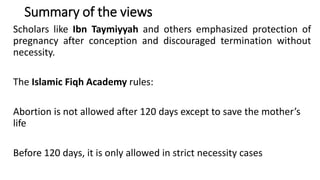
Summary of theviews
Scholars like Ibn Taymiyyah and others emphasized protection of
pregnancy after conception and discouraged termination without
necessity.
The Islamic Fiqh Academy rules:
Abortion is not allowed after 120 days except to save the mother’s
life
Before 120 days, it is only allowed in strict necessity cases
54.
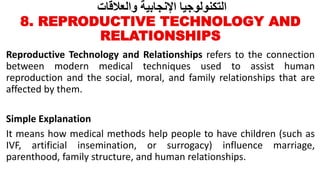
والعَلقات اإلنجابية التكنولوجيا
8.REPRODUCTIVE TECHNOLOGY AND
RELATIONSHIPS
Reproductive Technology and Relationships refers to the connection
between modern medical techniques used to assist human
reproduction and the social, moral, and family relationships that are
affected by them.
Simple Explanation
It means how medical methods help people to have children (such as
IVF, artificial insemination, or surrogacy) influence marriage,
parenthood, family structure, and human relationships.
55.
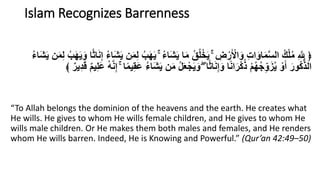
Islam Recognizes Barrenness
ُبَهَيۚ ُءَاشَي اَم ُقُلْخَي ۚ ِّ
ضْرَ ْ
اْلَو ِّتاَاوَمَّسال ُكْلُم ِّ َّ ِّ
ّلِل ﴿
ُءَاشَي نَمِّل ُبَهَيَو اًثاَنِّإ ُءَاشَي نَمِّل
َاشَي نَم ُلَعْجَيَو ۖ اًثاَنِّإَو اًناَرْكُذ ْمُهُجِّوَزُي ْوَأ َُوركُّذال
﴾ ٌيرِّدَق ٌميِّلَع ُهَّنِّإ ۚ اًميِّقَع ُء
“To Allah belongs the dominion of the heavens and the earth. He creates what
He wills. He gives to whom He wills female children, and He gives to whom He
wills male children. Or He makes them both males and females, and He renders
whom He wills barren. Indeed, He is Knowing and Powerful.” (Qur’an 42:49–50)
56.
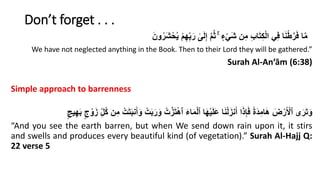
Don’t forget .. .
َونَُرشْحُي ْمِّهِّبَر ٰ
ىَلِّإ َّمُث ۚ ٍءْيَش نِّم ِّباَتِّكْلا يِّف اَنْطَّرَف اَّم
We have not neglected anything in the Book. Then to their Lord they will be gathered.”
Surah Al-An‘ām (6:38)
Simple approach to barrenness
ْتَبَرَو ْتَّزَتْهٱ َءاَمْلٱ اَهْيَلَع اَنْلَنزَأ اَذِّإَف ًةَدِّامَه َ
ضْرَ ْ
ٱْل ىَرَتَو
ٍيجِّهَب ٍج ْوَز ُِّلك نِّم ْتَتَبنَأَو
“And you see the earth barren, but when We send down rain upon it, it stirs
and swells and produces every beautiful kind (of vegetation).” Surah Al-Hajj Q:
22 verse 5
57.
االصطناعي التلقيح اوالمختبر في اإلخصاب
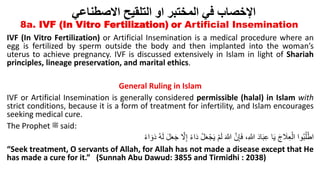
8a. IVF (In Vitro Fertilization) or Artificial Insemination
IVF (In Vitro Fertilization) or Artificial Insemination is a medical procedure where an
egg is fertilized by sperm outside the body and then implanted into the woman’s
uterus to achieve pregnancy. IVF is discussed extensively in Islam in light of Shariah
principles, lineage preservation, and marital ethics.
General Ruling in Islam
IVF or Artificial Insemination is generally considered permissible (halal) in Islam with
strict conditions, because it is a form of treatment for infertility, and Islam encourages
seeking medical cure.
The Prophet ﷺ said:
ُهَل َلَعَج ه
َّلِإ ًءاَد ْلَعْجَي ْمَل َ ه
َّللا هنِإَف ،ِ ه
َّللا َداَبِع اَي َج َ
َلِعْال واُبُلْاط
ًءا َوَد
“Seek treatment, O servants of Allah, for Allah has not made a disease except that He
has made a cure for it.” (Sunnah Abu Dawud: 3855 and Tirmidhi : 2038)
58.
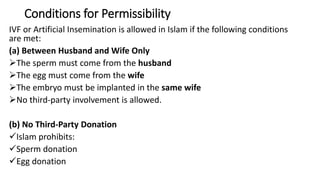
Conditions for Permissibility
IVFor Artificial Insemination is allowed in Islam if the following conditions
are met:
(a) Between Husband and Wife Only
➢The sperm must come from the husband
➢The egg must come from the wife
➢The embryo must be implanted in the same wife
➢No third-party involvement is allowed.
(b) No Third-Party Donation
✓Islam prohibits:
✓Sperm donation
✓Egg donation
59.
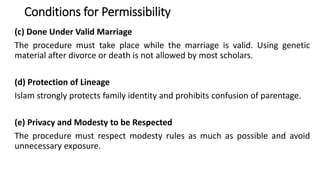
Conditions for Permissibility
(c)Done Under Valid Marriage
The procedure must take place while the marriage is valid. Using genetic
material after divorce or death is not allowed by most scholars.
(d) Protection of Lineage
Islam strongly protects family identity and prohibits confusion of parentage.
(e) Privacy and Modesty to be Respected
The procedure must respect modesty rules as much as possible and avoid
unnecessary exposure.
60.
البديلة األم أواألم استبدال
/
البدي باألم الصناعي التلقيح
لة
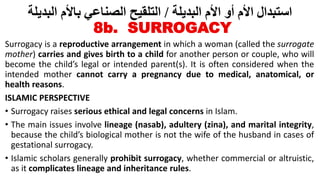
8b. SURROGACY
Surrogacy is a reproductive arrangement in which a woman (called the surrogate
mother) carries and gives birth to a child for another person or couple, who will
become the child’s legal or intended parent(s). It is often considered when the
intended mother cannot carry a pregnancy due to medical, anatomical, or
health reasons.
ISLAMIC PERSPECTIVE
• Surrogacy raises serious ethical and legal concerns in Islam.
• The main issues involve lineage (nasab), adultery (zina), and marital integrity,
because the child’s biological mother is not the wife of the husband in cases of
gestational surrogacy.
• Islamic scholars generally prohibit surrogacy, whether commercial or altruistic,
as it complicates lineage and inheritance rules.
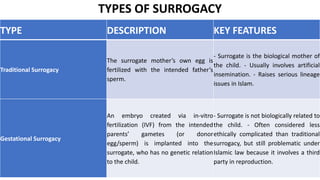
61.
TYPES OF SURROGACY
TYPEDESCRIPTION KEY FEATURES
Traditional Surrogacy
The surrogate mother’s own egg is
fertilized with the intended father’s
sperm.
- Surrogate is the biological mother of
the child. - Usually involves artificial
insemination. - Raises serious lineage
issues in Islam.
Gestational Surrogacy
An embryo created via in-vitro
fertilization (IVF) from the intended
parents’ gametes (or donor
egg/sperm) is implanted into the
surrogate, who has no genetic relation
to the child.
- Surrogate is not biologically related to
the child. - Often considered less
ethically complicated than traditional
surrogacy, but still problematic under
Islamic law because it involves a third
party in reproduction.
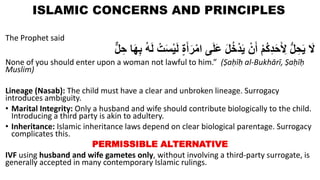
62.
ISLAMIC CONCERNS ANDPRINCIPLES
The Prophet said
َل ْتَسْيَل ٍةَأَرْام ىَلَع َلُخْدَي ْنَأ ْمُكِّدَحَ ِّ
ْل ُّل ِّحَي َ
َل
ل ِّح اَهِّب ُه
None of you should enter upon a woman not lawful to him.” (Ṣaḥīḥ al-Bukhārī, Ṣaḥīḥ
Muslim)
Lineage (Nasab): The child must have a clear and unbroken lineage. Surrogacy
introduces ambiguity.
• Marital Integrity: Only a husband and wife should contribute biologically to the child.
Introducing a third party is akin to adultery.
• Inheritance: Islamic inheritance laws depend on clear biological parentage. Surrogacy
complicates this.
PERMISSIBLE ALTERNATIVE
IVF using husband and wife gametes only, without involving a third-party surrogate, is
generally accepted in many contemporary Islamic rulings.
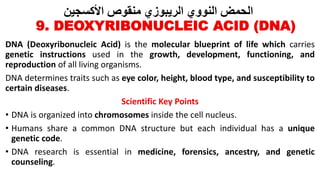
63.
األكسجين منقوص الريبوزيالنووي الحمض
9. DEOXYRIBONUCLEIC ACID (DNA)
DNA (Deoxyribonucleic Acid) is the molecular blueprint of life which carries
genetic instructions used in the growth, development, functioning, and
reproduction of all living organisms.
DNA determines traits such as eye color, height, blood type, and susceptibility to
certain diseases.
Scientific Key Points
• DNA is organized into chromosomes inside the cell nucleus.
• Humans share a common DNA structure but each individual has a unique
genetic code.
• DNA research is essential in medicine, forensics, ancestry, and genetic
counseling.
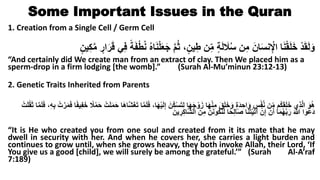
64.
Some Important Issuesin the Quran
1. Creation from a Single Cell / Germ Cell
ُهاَنْلَعَج َّمُث ،ٍينِّط نِّم ٍةَل َ
َلُس نِّم َانَسنِّْ
اْل اَنْقَلَخ ْدَقَلَو
ٍينِّكَّم ٍ
ارَرَق يِّف ًةَفْطُن
“And certainly did We create man from an extract of clay. Then We placed him as a
sperm-drop in a firm lodging [the womb].” (Surah Al-Mu’minun 23:12-13)
2. Genetic Traits Inherited from Parents
َلَف ،اَهْيَلِّإ َُنكْسَتِّل اَهَج ْوَز اَهْنِّم َقَلَخَو ٍةَد ِّاحَو ٍ
سْفَّن نِّم ُمكَقَلَخ ِّيذَّلا َوُه
ْمَح ْتَلَمَح اَهَّاشَغَت اَّم
َلَف ،ِّهِّب ْتَّرَمَف اًفيِّفَخ ً
َل
ْتَلُقَث اَّم
َين ِّ
رِّكَّاشال َنِّم َّنَنُوكَنَّل اًحِّلاَص اَنَتْيَتآ ْنِّإ نَأ اَمُهَّبَر َ َّ
َّللا اََوعَد
“It is He who created you from one soul and created from it its mate that he may
dwell in security with her. And when he covers her, she carries a light burden and
continues to grow until, when she grows heavy, they both invoke Allah, their Lord, ‘If
You give us a good [child], we will surely be among the grateful.’” (Surah Al-A’raf
7:189)
65.
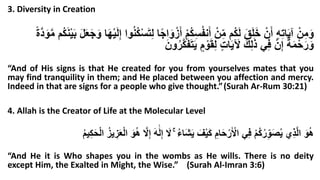
3. Diversity inCreation
َتِّل اًجاَوْزَأ ْمُكِّسُفنَأ ْنِّم ُمكَل َقَلَخ ْنَأ ِّهِّتاَيآ ْنِّمَو
َوَّم ُمكَنْيَب َلَعَجَو اَهْيَلِّإ واُنُكْس
ًةَّد
َونَُّركَفَتَي ٍم ْوَقِّل ٍتاَي َ
َل َكِّلَذ يِّف َّنِّإ ًةَمْحَرَو
“And of His signs is that He created for you from yourselves mates that you
may find tranquility in them; and He placed between you affection and mercy.
Indeed in that are signs for a people who give thought.”(Surah Ar-Rum 30:21)
4. Allah is the Creator of Life at the Molecular Level
ِّإ َهَٰلِّإ َ
َل ۚ ُءَاشَي َفْيَك ِّامَحْرَ ْ
اْل يِّف ْمُكُرِّوَصُي يِّذَّلا َوُه
ُميِّكَحْلا ُيز ِّ
زَعْلا َوُه َّ
َل
“And He it is Who shapes you in the wombs as He wills. There is no deity
except Him, the Exalted in Might, the Wise.” (Surah Al-Imran 3:6)
66.
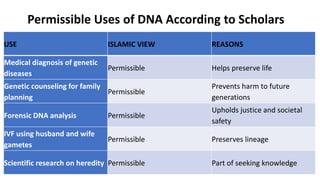
Permissible Uses ofDNA According to Scholars
USE ISLAMIC VIEW REASONS
Medical diagnosis of genetic
diseases
Permissible Helps preserve life
Genetic counseling for family
planning
Permissible
Prevents harm to future
generations
Forensic DNA analysis Permissible
Upholds justice and societal
safety
IVF using husband and wife
gametes
Permissible Preserves lineage
Scientific research on heredity Permissible Part of seeking knowledge
67.
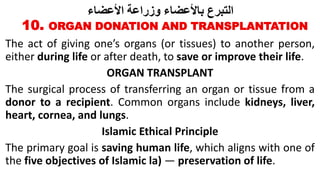
األعضاء وزراعة باألعضاءالتبرع
10. ORGAN DONATION AND TRANSPLANTATION
The act of giving one’s organs (or tissues) to another person,
either during life or after death, to save or improve their life.
ORGAN TRANSPLANT
The surgical process of transferring an organ or tissue from a
donor to a recipient. Common organs include kidneys, liver,
heart, cornea, and lungs.
Islamic Ethical Principle
The primary goal is saving human life, which aligns with one of
the five objectives of Islamic la) — preservation of life.
68.
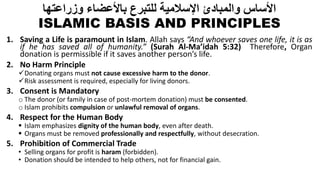
وزراعتها باألعضاء للتبرعاإلسَلمية والمبادئ األساس
ISLAMIC BASIS AND PRINCIPLES
1. Saving a Life is paramount in Islam. Allah says “And whoever saves one life, it is as
if he has saved all of humanity.” (Surah Al-Ma’idah 5:32) Therefore, Organ
donation is permissible if it saves another person’s life.
2. No Harm Principle
✓Donating organs must not cause excessive harm to the donor.
✓Risk assessment is required, especially for living donors.
3. Consent is Mandatory
o The donor (or family in case of post-mortem donation) must be consented.
o Islam prohibits compulsion or unlawful removal of organs.
4. Respect for the Human Body
▪ Islam emphasizes dignity of the human body, even after death.
▪ Organs must be removed professionally and respectfully, without desecration.
5. Prohibition of Commercial Trade
• Selling organs for profit is haram (forbidden).
• Donation should be intended to help others, not for financial gain.
69.
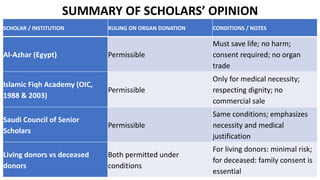
SUMMARY OF SCHOLARS’OPINION
SCHOLAR / INSTITUTION RULING ON ORGAN DONATION CONDITIONS / NOTES
Al-Azhar (Egypt) Permissible
Must save life; no harm;
consent required; no organ
trade
Islamic Fiqh Academy (OIC,
1988 & 2003)
Permissible
Only for medical necessity;
respecting dignity; no
commercial sale
Saudi Council of Senior
Scholars
Permissible
Same conditions; emphasizes
necessity and medical
justification
Living donors vs deceased
donors
Both permitted under
conditions
For living donors: minimal risk;
for deceased: family consent is
essential
70.
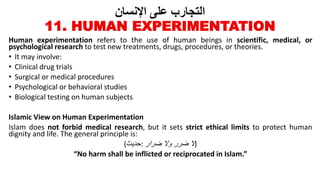
اإلنسان على التجارب
11.HUMAN EXPERIMENTATION
Human experimentation refers to the use of human beings in scientific, medical, or
psychological research to test new treatments, drugs, procedures, or theories.
• It may involve:
• Clinical drug trials
• Surgical or medical procedures
• Psychological or behavioral studies
• Biological testing on human subjects
Islamic View on Human Experimentation
Islam does not forbid medical research, but it sets strict ethical limits to protect human
dignity and life. The general principle is:
(حديث: ضرار وَّل ضرر َّل)
“No harm shall be inflicted or reciprocated in Islam.”
71.
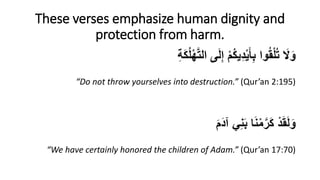
These verses emphasizehuman dignity and
protection from harm.
ِّةَكُلْهَّتال ىَلِّإ ْمُكيِّدْيَأِّب واُقْلُت َ
َلَو
“Do not throw yourselves into destruction.” (Qur’an 2:195)
َمَدآ يِّنَب اَنْمَّرَك ْدَقَلَو
“We have certainly honored the children of Adam.” (Qur’an 17:70)
72.
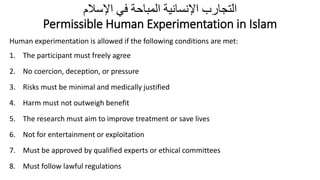
اإلسالم في المباحةاإلنسانية التجارب
Permissible Human Experimentation in Islam
Human experimentation is allowed if the following conditions are met:
1. The participant must freely agree
2. No coercion, deception, or pressure
3. Risks must be minimal and medically justified
4. Harm must not outweigh benefit
5. The research must aim to improve treatment or save lives
6. Not for entertainment or exploitation
7. Must be approved by qualified experts or ethical committees
8. Must follow lawful regulations
73.
اإلنسان على التجاربمن المحظورة
Prohibited Forms of Human Experimentation
Islam strictly forbids experimentation when it involves:
1. Endangering life without necessity is forbidden
2. Using humans without permission is oppression
3. Poor, prisoners, or vulnerable individuals must not be used unjustly
4. Experiments involving haram substances without necessity
5. Violations of dignity or privacy
74.
ِالط ِتَّايِق َ
الْخَأىَلِإ ُةَّيِم َ
الْسِاإل ُةَرْظَّنال
ِةَّيِم ْمَيال ِةاَيَيال يِف ِِّب
ISLAMIC VIEWS ON MEDICAL ETHICS IN DAILY LIFE
Islam places strong emphasis on medical ethics in daily life, viewing health care
as both a professional responsibility and a moral trust (أمانة – amānah) before
Allah. Medical practice is guided by Qur’an, Sunnah, and the principles of Islamic
law (Shariah), especially the protection of life and well-being.
• 1. Sanctity of Human Life (النفس )حفظ Human life is sacred, and preserving it is
a core objective of Shariah.
• 2. Preservation of Health is a Trust ()اْلمانة The body is a trust from Allah, and
must be cared for responsibly.
• 3. Seeking Treatment is Encouraged ()التداوي Islam encourages seeking medical
treatment while trusting Allah for healing.
75.
4. Ultimate Healingis from Allah (هللا عند من الكامل )الشفاء Healthcare providers are means, but
Allah is the true healer.
5. Principle of “No Harm” (ضرار وَل ضرر )َل Harm must not be inflicted on patients under any
condition.
6. Honesty in Diagnosis and Treatment ()الصدق Healthcare providers must be truthful about
illness, prognosis, and treatment options.
7. Patient Consent is Required (الرضا الموافقة )و Medical procedures should not be done
without informed consent.
8. Confidentiality (السر )حفظ Patient information must be kept private and protected.
9. Justice in Healthcare ()العدلTreatment must be fair regardless of wealth, status, or religion.
10. Compassion in Care ()الرحمة Healthcare providers must show mercy, kindness, and
empathy.
76.
11. Prohibition ofHarmful Substances (الضارة المواد )تحريم Forbidden substances are not allowed in
treatment unless absolutely necessary.
12. Necessity Permits Exceptions (المحظورات تبيح )الضرورات Harsh rulings may be relaxed in life-
threatening situations.
13. Avoidance of Exploitatio (
اَلستغَلل تجنب
) Healthcare providers must not exploit patients financially
or emotionally.
14. Professional Competence ()اْلتقان Islam requires excellence and skill in medical practice.
15. Continuous Learning (
المستمر مُّلالتع
) Seeking knowledge in medicine is a form of worship when
done sincerely.
16. Respect for Human Dignity (اْلنسان )كرامة Every patient must be treated with dignity and respect.
17. Gender Sensitivity in Treatment (اَلجتماعي النوع تجاه )الحساسية Where possible, same-gender
treatment is preferred to maintain modesty.
18. Accountability Before Allah (هللا أمام )المسؤولية Every medical action is accountable in the Hereafter.