1
CONCEPT OF HEALTH
DR BIBHAVA VIKRAMADITYA
MD 1ST
YEAR RESIDENT
DEPT OF SPM
19-09-2014
2
HEALTH
• Concepts of health
• Definition of health
• Dimensions of health
• Spectrum of health
• Determinants of health
• Ecology of health
• Responsibility of health
• Indicators of health
• Concept of Health Promotion
• Challenges for public health
• Indian approach to health
3
CONCEPTS OF HEALTH
• Medicine preoccupied with the study of
Disease and neglected the study of Health
• During past few decades there has been
reawakening that health is a fundamental
human right and a worldwide social goal
4
CHANGING CONCEPTS OF HEALTH
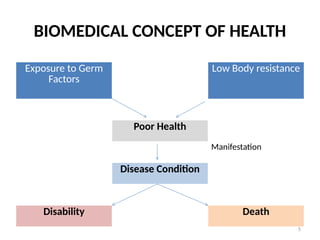
• BIOMEDICAL CONCEPTS OF HEALTH
Absence of Disease = health
Germ Theory of Disease
5
BIOMEDICAL CONCEPT OF HEALTH
Exposure to Germ
Factors
Low Body resistance
Poor Health
Manifestation
Disease Condition
Disability Death
6
CHANGING CONCEPTS OF HEALTH
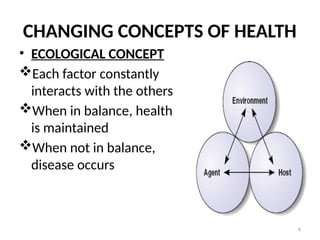
• ECOLOGICAL CONCEPT
Each factor constantly
interacts with the others
When in balance, health
is maintained
When not in balance,
disease occurs
7
CHANGING CONCEPTS OF HEALTH
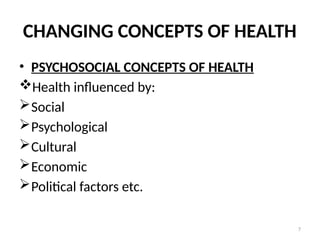
• PSYCHOSOCIAL CONCEPTS OF HEALTH
Health influenced by:
Social
Psychological
Cultural
Economic
Political factors etc.

8
CHANGING CONCEPTS OF HEALTH
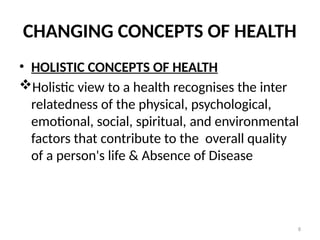
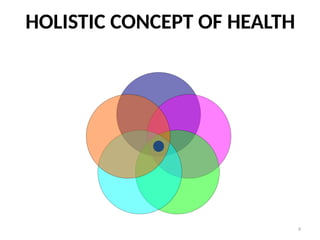
• HOLISTIC CONCEPTS OF HEALTH
Holistic view to a health recognises the inter
relatedness of the physical, psychological,
emotional, social, spiritual, and environmental
factors that contribute to the overall quality
of a person's life & Absence of Disease
9
HOLISTIC CONCEPT OF HEALTH
10
WHO DEFINITION
Ā· Health is defined as a state of optimal
physical,
mental, and social well-being and not merely
the absence of disease and infirmity
(Given in 1948 in preamble to its constitution)
11
DIMENSIONS OF HEALTH
• Physical Dimension
• Mental Dimensions
• Social Dimensions
• Spiritual Dimensions
• Emotional Dimensions
• Vocational Dimensions
12
PHYSICAL
• The ability to carry out daily tasks,
achieve fitness (e.g. pulmonary,
cardiovascular, gastrointestinal), maintain
adequate nutrition and proper body fat,
avoid abusing drugs and alcohol or using
tobacco products, and generally to
practice positive lifestyle habits.
13
MENTAL
• The ability to be at a sound state of mind.
14
SOCIAL
• The ability to interact successfully with people
and within the environment
15
SPIRITUAL
• The belief in some force (nature, science,
religion, or a higher power) that serves to
unite human beings and provide meaning and
purpose of life
16
EMOTIONAL
• The ability to manage stress and to express
emotions appropriately, Emotional wellness
involves the ability to recognize, accept, and
express feelings.
17
VOCATIONAL
• The ability to achieve a balance between work
and leisure time, A person's beliefs about
education, employment and home
influence personal satisfaction and
relationships with others.
18
SPECTRUM OF HEALTH
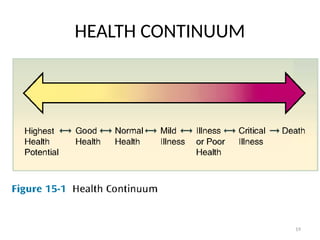
• HEALTH CONTINUUM
• This concept of a health continuum negates
the idea that wellness and illness are opposite
because they may occur simultaneously in the
same person in varying degrees
19
HEALTH CONTINUUM
20
DETERMINANTS OF HEALTH
• BIOLOGICAL DETERMINANTS
Genetic make up
21
DETERMINANTS OF HEALTH
• BEHAVIOURAL AND SOCIO-CULTURAL
CONDITIONS
 Life style
 personal habits :
Smoking
alcoholism
22
DETERMINANTS OF HEALTH
• ENVIRONMENT
 Internal
 External
Microenvironment
Macro environment
23
DETERMINANTS OF HEALTH
• SOCIO-ECONOMIC CONDITIONS
 Economic status
 Education
 Occupation
 Political system
24
DETERMINANTS OF HEALTH
• HEALTH AND FAMILY WELFARE SERVICES
 Immunization
 Safe water
 Pregnant and children welfare
 Equitably distributed
 Primary health care
25
DETERMINANTS OF HEALTH
• AGING OF THE POPULATION
 60 yr and above
 Increased chronic disease and disability
 Special geriatric care needed
26
DETERMINANTS OF HEALTH
• GENDER
 Women health
27
DETERMINANTS OF HEALTH
• OTHER FACTORS
 Food and Agriculture
 Rural development
 Education
 Industry etc.
28
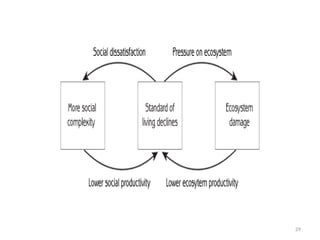
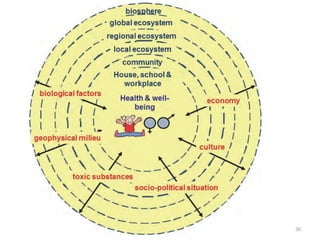
ECOLOGY OF HEALTH
• Mutual relationship between
Human and
Their environment
NATURAL
MAN MADE: culture and all its product
29
30
31
RESPONSIBILITY OF HEALTH
• Individual Responsibility
Self care in health
32
RESPONSIBILITY OF HEALTH
• Community Responsibility
 Emphasis shifted from health care for
the people to health care by the
people
33
RESPONSIBILITY OF HEALTH
• State Responsibility
State assumes responsibility of health and
welfare of its citizens
34
RESPONSIBILITY OF HEALTH
• International Responsibility
 Cooperation of governments, the people,
national and international organizations in
achieving health goals
35
INDICATORS OF HEALTH
What is Health Indicator?
• A measure that helps quantify the
achievement of a goal
Health Indicators, Part I
36
HOW ARE HEALTH INDICATORS USED?
•Indicators are powerful tools for monitoring
and communicating critical information about
population health.
• Indicators are used to support planning
(identify priorities, develop and target
resources, identify benchmarks) and track
progress toward broad community objectives.
Health Indicators, Part I
37
CHARACTERISTICS OF INDICATORS
IDEAL INDICATOR:
• Valid
• Reliable
• Sensitive
• Specific
• Feasible
• Relevant
Health Indicators, Part I
CONCEPT OF HEALTH PROMOTION
38
• It is any planned combination of health,
educational, economic, political, spiritual and
organizational initiative for actions to bring about
positive, behavioral, social or environmental
change conducive to improving the health of
individuals, groups, or communities.
• Process of enabling people to increase
control over and improve their health
Why we need Health Promotion?
39
• Promotes quality of life
• Reduce inequalities in health
• Reduces pressure on services
• ā€œAdds life to year, Adds year to lifeā€.
• ā€œHealth promotion is concerned with making
healthier choices, easier choicesā€.
• It is cost effective and efficient
40
CHALLENGES FOR PUBLIC HEALTH
• Poverty
• Inequality
• Public Demands
• Marginalizing Public Health Services
• Public Health Delivery
• Epidemiological Transition
• Climatic Change and Environmental Health
• New Psychosocial Issues
• Rapid Population Growth
41
INDIAN APPROACH TO HEALTH
• Health defined by WHO is very similar to
concepts of Ayurveda
Health can be defined as a state of an
individual in which his doshas , dhatus, agni
& malas are in equilibrium, at the same time
his manas, atma, sensory faculty are in a
state of well being and optimum efficiency.
42
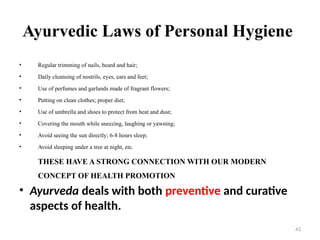
Ayurvedic Laws of Personal Hygiene
• Regular trimming of nails, beard and hair;
• Daily cleansing of nostrils, eyes, ears and feet;
• Use of perfumes and garlands made of fragrant flowers;
• Putting on clean clothes; proper diet;
• Use of umbrella and shoes to protect from heat and dust;
• Covering the mouth while sneezing, laughing or yawning;
• Avoid seeing the sun directly; 6-8 hours sleep;
• Avoid sleeping under a tree at night, etc.
THESE HAVE A STRONG CONNECTION WITH OUR MODERN
CONCEPT OF HEALTH PROMOTION
• Ayurveda deals with both preventive and curative
aspects of health.
43
BOOKS REFERRED
• PARK’S TEXTBOOK OF PSM 22ND
EDITION
• TEXTBOOK OF COMMUNITY MEDICINE –
SUNDERLAL
• COMMUNITY MEDICINE WITH RECENT
ADVANCES-A H SURYAKANTHA
• NATIONAL HEALTH PROGRAMS OF INDIA-
J.KISHORE’S
• INTERNET REFERENCE
THANK YOU
44