Comprehensive Video Game Marketing Strategies for Sustainable Growth and Player Engagement
Explore essential video game marketing tactics including audience research, positioning, community building, ASO, SEO, influencer partnerships, and paid acquisition to drive discovery, retention, and long-term success.
Comprehensive Video Game Marketing Strategies for Sustainable Growth and Player Engagement
1.
Video Game MarketingStrategies for
Growth
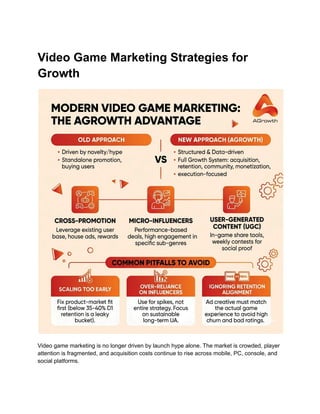
Video game marketing is no longer driven by launch hype alone. The market is crowded, player
attention is fragmented, and acquisition costs continue to rise across mobile, PC, console, and
social platforms.
2.
A strong gamestill matters, but quality alone does not guarantee discovery. Thousands of
games compete for visibility on Steam, mobile app stores, console marketplaces, YouTube,
TikTok, Twitch, Discord, Reddit, and creator-led communities. Without a structured marketing
system, even a polished title can struggle to build traction.
Modern video game marketing must connect product positioning, audience research, user
acquisition, community building, retention, monetization, and live-ops communication. The goal
is not only to generate installs or wishlists. The goal is to attract the right players, keep them
engaged, and turn early interest into long-term value.
For publishers and studios, marketing should be part of the game lifecycle from early
development to post-launch updates. The earlier the team validates the audience, positioning,
and core message, the easier it becomes to build a launch plan that is measurable and
scalable.
What Is Video Game Marketing?
Video game marketing is the process of promoting a game to the right audience through paid,
organic, community, creator, and platform-based channels.
It includes more than advertising. A complete game marketing strategy may involve:
Audience research.
Market positioning.
Trailers and creative assets.
App Store Optimization.
Steam page optimization.
Influencer partnerships.
Community management.
Paid user acquisition.
Discord and Reddit engagement.
Email and wishlist campaigns.
Content marketing.
Launch planning.
3.
Live-ops promotion.
Retention campaigns.
Thebest game marketing strategies are built around the player journey. A player may first see a
short video, then visit a store page, join a Discord server, watch a streamer, wishlist the game,
join a beta, and purchase during launch week.
Each step should be intentional.
Why Video Game Marketing Matters
Discovery Is More Competitive
Game discovery has become more fragmented. Players find games through short-form videos,
creators, Steam recommendations, app store rankings, community discussions, paid ads, and
search engines.
This means studios cannot depend on one discovery channel. A game may need TikTok for
awareness, Steam wishlists for launch velocity, Discord for retention, and creators for trust.
Marketing helps create the early signal that platforms need to recommend the game to more
players.
Acquisition Costs Are Rising
Paid user acquisition has become more expensive, especially in mobile gaming. Privacy
changes have also made tracking and attribution more complex. Buying users without strong
retention can quickly waste budget.
Before scaling paid ads, publishers should validate core metrics such as Day 1 retention, Day 7
retention, conversion rate, average revenue per user, and lifetime value.
If the product cannot retain players, paid acquisition will only expose the problem faster.
Community Drives Long-Term Value
Games are not one-time products. Many successful titles grow through updates, events,
user-generated content, creator ecosystems, and player communities.
A strong community can increase retention, improve feedback quality, support launch
momentum, and create organic word-of-mouth.
4.
Marketing should notstop at launch. It should support the game’s full lifecycle.
Data Improves Product Decisions
Marketing data can help product teams understand what players respond to. Creative testing,
store page experiments, trailer engagement, ad performance, and community feedback can
reveal which characters, mechanics, modes, or themes attract the strongest audience.
This creates a feedback loop between marketing and development. Strong teams use marketing
insights to refine product-market fit before global launch.
Core Video Game Marketing Strategies
1. Define a Clear Game Positioning
Before choosing channels, define what the game is and why players should care.
A strong positioning statement should answer:
What genre is the game?
Who is the ideal player?
What is the main emotional hook?
What makes the game different?
Which competitor audience can it attract?
Why should players try it now?
For example, a broad message like “an exciting RPG adventure” is too generic. A stronger
position may be “a tactical roguelike RPG for players who enjoy fast decisions, deep builds, and
short-session replayability.”
Clear positioning improves trailers, ads, store pages, influencer outreach, and community
messaging.
2. Build Audience Personas by Player Motivation
Game audiences are not defined only by age, gender, or location. Player motivation is often
more useful.
5.
Common gaming motivationsinclude:
Competition.
Progression.
Exploration.
Social connection.
Collection.
Story immersion.
Creativity.
Mastery.
Relaxation.
A competitive player may respond to ranked modes and skill-based mechanics. A story-driven
player may care more about characters, lore, and emotional stakes. A social player may value
co-op, guilds, or community events.
Understanding motivation helps the team choose the right creative angles and channels.
3. Optimize Store Pages for Conversion
Store pages are conversion assets. Whether the game is on Steam, the App Store, Google
Play, PlayStation Store, Xbox, or Nintendo eShop, the page must quickly explain the value of
the game.
Important store page elements include:
Clear title.
Strong short description.
High-impact capsule art or icon.
Gameplay-first screenshots.
Short preview video.
Feature bullets.
Genre keywords.
6.
Social proof.
Localization.
Review management.
Systemor device requirements.
The first few seconds of the trailer matter. Players should understand the genre, core loop, and
unique hook quickly. Cinematic trailers can build emotion, but gameplay clarity often drives
stronger conversion.
4. Use ASO for Mobile Games
App Store Optimization is critical for mobile game discovery and conversion. Store ranking and
install conversion can directly affect paid acquisition efficiency.
Key ASO elements include:
App title.
Subtitle.
Keyword field.
Icon.
Screenshots.
Preview video.
Ratings and reviews.
Localized listings.
Category selection.
A/B testing.
Visual localization is especially important. A screenshot style that works in the US may not
perform the same way in Southeast Asia, Japan, Korea, or MENA markets. Localization should
include visuals, copy, cultural cues, and monetization context.
5. Use SEO for Long-Term Organic Growth
SEO is often overlooked in game marketing, but it can generate durable traffic.
7.
Useful SEO contentincludes:
Game guides.
Beginner tutorials.
Character builds.
Level walkthroughs.
Patch note explainers.
Comparison articles.
Lore pages.
Wiki-style content.
“Games like” articles.
Strategy guides.
Players often search for solutions after they start playing. If the official website provides helpful
answers, the studio can capture traffic that would otherwise go to third-party wikis or forums.
SEO also supports pre-launch discovery through keywords such as “best strategy games,”
“upcoming roguelike games,” or “games like [competitor].”
6. Build Community Before Launch
Community should start before release, not after.
A pre-launch community helps validate positioning, gather feedback, build wishlists, test
messaging, and create launch momentum. Discord, Reddit, Steam Community, YouTube,
TikTok, and X can all support community development depending on the audience.
Useful community content includes:
Developer updates.
Behind-the-scenes clips.
Concept art.
Early gameplay footage.
Polls.
8.
Beta announcements.
Patch previews.
Q&Asessions.
Feedback threads.
Bug highlights.
The goal is to make players feel involved in the journey.
7. Use Short-Form Video for Awareness
Short-form video is one of the strongest channels for game discovery. TikTok, YouTube Shorts,
and Instagram Reels reward clear hooks, fast pacing, and instantly understandable gameplay
moments.
Effective short-form angles include:
One mechanic explained in 10 seconds.
A surprising gameplay moment.
A bug that became a feature.
A satisfying combo.
A before-and-after development clip.
A character reveal.
A challenge run.
A “why players love this” moment.
Videos should show gameplay quickly. If the first few seconds do not communicate value,
viewers may scroll away.
8. Partner with the Right Creators
Influencer marketing can work well, but only when creator fit is strong. Large creators are not
always the best option. Smaller creators with highly engaged audiences in a specific genre can
produce better results.
9.
For example, a4X strategy game should prioritize creators known for strategy depth. A cozy
farming game should work with creators who attract relaxed, lifestyle-driven audiences. A horror
game should focus on creators whose viewers enjoy reactions, tension, and narrative discovery.
Creator campaigns can include:
Sponsored videos.
Live streams.
Early access.
Beta keys.
Exclusive reveals.
Community challenges.
Performance-based bonuses.
Creator bundles.
The best creator campaigns feel natural. Creators should understand the game and explain why
their audience will care.
9. Use Cross-Promotion Where Possible
Studios with multiple games can use cross-promotion to reduce acquisition costs. Existing
players are often easier to convert if the new title matches their interests.
Cross-promotion tactics include:
In-game banners.
Rewarded placements.
Email announcements.
Launcher notifications.
Portfolio newsletters.
Community posts.
Limited-time rewards.
10.
The key isgenre fit. Promoting a hardcore strategy game to a casual puzzle audience may
create low conversion and poor retention.
10. Plan Paid User Acquisition Carefully
Paid ads can scale a game, but only after core metrics are stable. Scaling too early can waste
budget if retention, monetization, or store conversion is weak.
Before increasing spend, review:
Creative click-through rate.
Store page conversion rate.
Cost per install.
Day 1 retention.
Day 7 retention.
Average revenue per user.
Lifetime value.
Return on ad spend.
Tutorial completion rate.
Early churn points.
Paid campaigns should match the real game experience. Misleading ads may produce cheap
installs, but they usually reduce retention, damage reviews, and weaken long-term performance.
11. Use UGC to Create Social Proof
User-generated content can increase reach and credibility. Players trust other players,
especially when they see real gameplay moments.
Encourage UGC through:
Replay sharing.
Screenshot tools.
Photo mode.
11.
Community challenges.
Fan artcontests.
Build showcases.
Speedrun events.
Clip competitions.
Creator-friendly assets.
The easier it is for players to share content, the more likely they are to become part of the
marketing engine.
12. Treat Launch as a Campaign Season
A launch is not one day. It is a sequence.
A practical launch plan includes three stages:
Pre-launch: build awareness, collect wishlists, test messaging, work with creators, prepare
community channels, and gather early feedback.
Launch week: coordinate creators, paid ads, press, social content, community events, launch
discounts, and technical support.
Post-launch: promote updates, respond to feedback, fix friction points, run events, publish
guides, and maintain visibility.
Many games find their strongest audience months after launch. Long-term planning matters.
Common Video Game Marketing Mistakes
Scaling Ads Before Retention Is Ready
If early retention is weak, more traffic will not solve the problem. The team should fix
onboarding, core loop clarity, difficulty spikes, or monetization friction before scaling.
Depending Only on Influencers
Creators can create launch spikes, but they are not a complete marketing system. Influencer
campaigns should be combined with ASO, SEO, community, paid acquisition, and retention.
12.
Using Misleading Creative
Adsthat do not match the game may produce installs, but they often lead to poor retention and
negative reviews. Creative should highlight the strongest real gameplay moments.
Ignoring Store Page Testing
Many teams optimize ads but ignore store conversion. A better icon, screenshot set, trailer, or
description can lower acquisition cost and improve organic installs.
Spending Everything at Launch
A game needs post-launch support. Save budget for live-ops campaigns, updates, seasonal
events, new content, and creative testing after release.
Metrics That Matter in Game Marketing
Game marketers should focus on business and player-quality metrics, not only visibility metrics.
Important KPIs include:
Wishlists.
Store page conversion rate.
Cost per install.
Day 1 retention.
Day 7 retention.
Day 30 retention.
Average revenue per user.
Lifetime value.
Return on ad spend.
Tutorial completion rate.
Community growth.
Review score.
13.
Organic install share.
Churnrate.
Live-ops event participation.
Raw installs are not enough. A smaller campaign with higher retention and stronger lifetime
value can outperform a larger campaign with low-quality users.
Final Thoughts
Video game marketing is now a full growth system. It requires clear positioning, strong store
pages, community building, creator partnerships, content strategy, paid acquisition discipline,
and retention-focused planning.
The best studios do not wait until launch to start marketing. They validate the audience early,
test creative angles, build community, optimize store conversion, and align marketing with the
actual game experience.
A successful game marketing strategy does not only create awareness. It creates momentum,
improves player quality, supports long-term retention, and helps the game grow beyond launch
week.
Recommended Resources for Video Game Marketing
Strategies
Video Game Marketing Strategies — A practical guide to building scalable game marketing
systems across acquisition, community, retention, and launch planning.
https://agrowth.io/blogs/knowledge/video-game-marketing-strategies — A practical guide
to building scalable game marketing systems across acquisition, community, retention, and
launch planning.
14.
1. Version 3000Characters
Video Game Marketing Strategies for
Growth
Video game marketing is no longer only about creating hype before launch. Today, thousands of
games compete for attention across Steam, mobile app stores, consoles, TikTok, YouTube,
Twitch, Discord, Reddit, and creator communities. A strong game can still fail if players never
discover it or if the marketing message does not match the real gameplay experience.
A successful video game marketing strategy starts with clear positioning. Before choosing
channels, publishers need to define what the game is, who it is for, and why players should
care. A generic message like “an exciting adventure game” is too broad. A stronger position
focuses on genre, player motivation, core mechanic, and emotional hook.
Audience research is equally important. Players are not only divided by age or location. They
are driven by motivations such as competition, progression, creativity, exploration, story
immersion, mastery, and social connection. When marketers understand these motivations, they
can create better trailers, ads, store pages, and community content.
Store page optimization is one of the most important conversion levers. On Steam, App Store,
Google Play, and console marketplaces, the first impression matters. Icons, capsule art,
screenshots, preview videos, short descriptions, feature bullets, and reviews can directly affect
conversion rate. A/B testing these assets can improve paid acquisition efficiency and organic
discovery.
For mobile games, ASO is essential. App title, subtitle, keywords, screenshots, videos, ratings,
and localization all influence install conversion. Localization should go beyond translation.
Visuals, cultural references, and value propositions should fit each market.
SEO can also support long-term discovery. Game guides, character builds, wiki-style content,
patch note explainers, walkthroughs, and “games like” articles can capture search traffic from
players who are already interested in the genre.
Community building should start before launch. Discord, Reddit, Steam Community, TikTok,
YouTube, and X can help studios collect feedback, build wishlists, test messaging, and create
launch momentum. Behind-the-scenes clips, dev updates, polls, beta access, and gameplay
previews make players feel involved.
15.
Creator partnerships areanother strong channel. Instead of choosing creators only by follower
count, publishers should prioritize audience fit. A strategy game needs strategy creators. A
horror game needs creators who excel at reactions and narrative tension. Smaller niche
creators can often deliver better engagement than larger general influencers.
Paid acquisition can scale a game, but it should not be rushed. Before increasing spend, teams
should validate retention, store conversion, tutorial completion, lifetime value, and monetization
performance. If Day 1 and Day 7 retention are weak, paid ads will only expose the problem
faster.
The strongest game marketing strategies connect acquisition, conversion, community, and
retention. Launch is not a single day. It is a campaign season that includes pre-launch
awareness, launch-week execution, and post-launch updates.
Read more: https://agrowth.io/blogs/knowledge/video-game-marketing-strategies
Tags: #VideoGameMarketing #GameMarketing #GameLaunch #UserAcquisition #ASO
#GamingSEO #CommunityBuilding #InfluencerMarketing #GrowthMarketing
2. Version 1500 Characters
Video Game Marketing Strategies That
Scale
Video game marketing is no longer just about building launch hype. With thousands of games
competing across mobile stores, Steam, consoles, social platforms, and creator channels,
discovery has become one of the biggest challenges for publishers.
A strong strategy begins with positioning. Studios need to define the game’s genre, target
audience, core mechanic, emotional hook, and competitive difference. Clear positioning
improves trailers, ads, store pages, creator outreach, and community messaging.
Store page optimization is critical. Icons, screenshots, preview videos, descriptions, feature
bullets, and reviews directly affect conversion rate. For mobile games, ASO helps improve
visibility and install performance through keyword optimization, localization, screenshots, and
A/B testing.
Community should start before launch. Discord, Reddit, Steam Community, TikTok, YouTube,
and X can help build wishlists, gather feedback, and create early momentum. Dev updates,
gameplay clips, beta access, and behind-the-scenes content make players feel involved.
16.
Creator partnerships alsowork well when there is strong audience fit. Instead of choosing
influencers only by follower count, publishers should work with creators who understand the
game’s genre and player motivation.
Paid acquisition can scale growth, but only after retention and monetization are validated. If
players leave after the first session, more ad spend will not fix the funnel.
The best game marketing strategy connects positioning, ASO, SEO, community, creators, paid
acquisition, and post-launch retention into one lifecycle system.
Read more: https://agrowth.io/blogs/knowledge/video-game-marketing-strategies
3. Version 300 Characters
Video game marketing needs more than launch hype. Publishers should combine positioning,
ASO, SEO, creator partnerships, community building, paid acquisition, and retention to attract
the right players and grow beyond launch week.
Read more: https://agrowth.io/blogs/knowledge/video-game-marketing-strategies
4. Short Social Post
A great game does not automatically get discovered.
Players are scattered across Steam, mobile stores, TikTok, YouTube, Twitch, Discord, Reddit,
and creator communities.
That is why modern game marketing needs more than launch hype.
You need clear positioning, optimized store pages, creator partnerships, community building,
ASO, SEO, paid acquisition discipline, and post-launch retention.
The goal is not just installs.
The goal is players who stay.
Read more: https://agrowth.io/blogs/knowledge/video-game-marketing-strategies
5. Long Social Post
17.
Storytelling Style +Helpful Content
A studio spends years building a game.
The mechanics feel good.
The art direction is strong.
The trailer looks polished.
The team believes the game is ready.
Then launch week comes.
A few players arrive.
Some creators mention it.
A small spike happens.
Then traffic slows down.
This is where many game launches fail.
Not because the game is bad, but because the marketing system was not built early enough.
In today’s market, discovery is fragmented. Players find games through Steam, App Store,
Google Play, TikTok, YouTube, Twitch, Discord, Reddit, newsletters, creators, and search
results. A game needs more than one announcement to break through.
The first step is positioning.
What is the game?
Who is it for?
What player motivation does it serve?
What makes it different from similar titles?
Why should someone play it now?
Without clear positioning, trailers feel generic, ads become unfocused, and store pages fail to
convert.
The second step is store page optimization.
Your icon, capsule art, screenshots, short description, preview video, reviews, and feature
bullets all affect conversion. If players do not understand the game within seconds, they leave.
For mobile games, ASO becomes even more important because install conversion directly
affects acquisition efficiency.
The third step is community.
A community should not start after launch. It should begin during development. Discord, Reddit,
Steam Community, TikTok, YouTube, and X can help studios collect feedback, build wishlists,
test creative angles, and create emotional investment.
18.
The fourth stepis creator fit.
Influencer marketing works best when the creator’s audience matches the game’s genre and
motivation. A tactical strategy game needs strategy creators. A cozy game needs creators who
attract relaxed and lifestyle-focused players. A horror game needs creators who can turn
tension into watchable moments.
The fifth step is paid acquisition discipline.
Ads can scale a game, but only after core metrics are healthy. If retention is weak, scaling
spend only makes the leak bigger. Publishers should validate store conversion, tutorial
completion, Day 1 retention, Day 7 retention, lifetime value, and monetization before increasing
budget.
Launch is not one day.
It is a season.
Pre-launch builds awareness.
Launch week creates momentum.
Post-launch keeps players engaged through updates, events, guides, community content, and
live-ops campaigns.
The strongest game marketing strategies do not chase hype alone.
They build a full lifecycle system that attracts the right players, converts attention into action,
and keeps the community active after launch.
Read more: https://agrowth.io/blogs/knowledge/video-game-marketing-strategies