Comprehensive Understanding of Stress: Causes, Effects, and Coping Strategies
Explore stress definitions, classifications, effects across lifespan, physiological responses, and effective coping mechanisms including adaptation and nursing implications.
INTRODUCTION
Stress is auniversal phenomenon. All
people experience it. Stress affects the
whole person in all the human dimensions,
the perception of stress and the responses
to it are highly individualised, not only from
person to person, but also from one time
to another in the same person.
3.
DEFINITION
Stress is thenonspecific response of the
body to any demand for change – Selye.
Stress as that which occurs when “ an
individual perceives that the demands of
an external situation are beyond his or her
perceived ability to cope with them”
- Lazarus and Folkman
11.
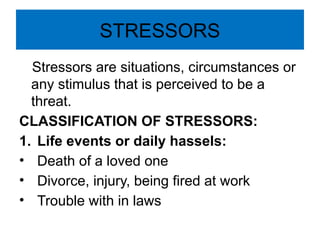
STRESSORS
Stressors are situations,circumstances or
any stimulus that is perceived to be a
threat.
CLASSIFICATION OF STRESSORS:
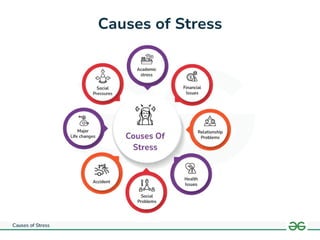
1. Life events or daily hassels:
• Death of a loved one
• Divorce, injury, being fired at work
• Trouble with in laws
12.
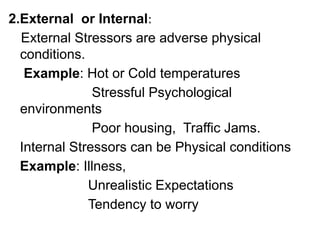
2.External or Internal:
ExternalStressors are adverse physical
conditions.
Example: Hot or Cold temperatures
Stressful Psychological
environments
Poor housing, Traffic Jams.
Internal Stressors can be Physical conditions
Example: Illness,
Unrealistic Expectations
Tendency to worry
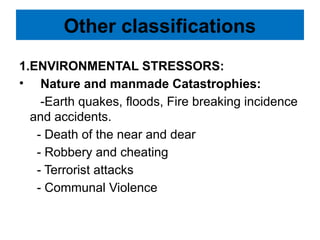
Other classifications
1.ENVIRONMENTAL STRESSORS:
•Nature and manmade Catastrophies:
-Earth quakes, floods, Fire breaking incidence
and accidents.
- Death of the near and dear
- Robbery and cheating
- Terrorist attacks
- Communal Violence
15.
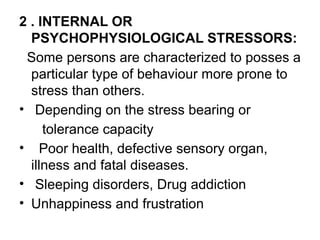
2 . INTERNALOR
PSYCHOPHYSIOLOGICAL STRESSORS:
Some persons are characterized to posses a
particular type of behaviour more prone to
stress than others.
• Depending on the stress bearing or
tolerance capacity
• Poor health, defective sensory organ,
illness and fatal diseases.
• Sleeping disorders, Drug addiction
• Unhappiness and frustration
16.
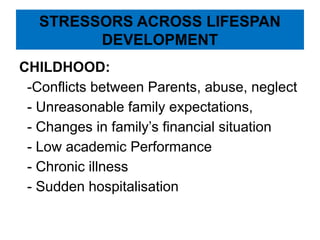
STRESSORS ACROSS LIFESPAN
DEVELOPMENT
CHILDHOOD:
-Conflictsbetween Parents, abuse, neglect
- Unreasonable family expectations,
- Changes in family’s financial situation
- Low academic Performance
- Chronic illness
- Sudden hospitalisation
17.
ADOLESCENCE:
- Coping withacademic pressures
- Lack of acceptance by peers
- Increased arguments with friends
- Accepting their own physical changes
- Relationship with opposite sex
- Leaving home for higher studies
18.
ADULTHOOD:
- Starting acareer, Marriage
- Running a household independently
- Adjusting with in- laws, Parents
- Relocating, meeting deadlines in jobs,
Loan payments.
19.
MIDDLE AGE:
- Copingwith health problems
- Dealing with teenage children
- Marriage and career of children
- Taking care of aged parents
- Job burnout
- Mid-career changes
20.
OLD AGE:
- Failinghealth and stamina
- Relocating with children
- Living alone
- Living with reduced income
- Adjusting to retirement
- Loneliness
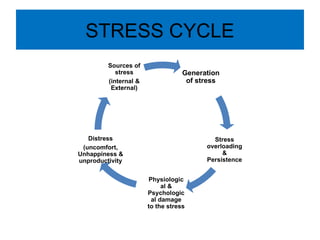
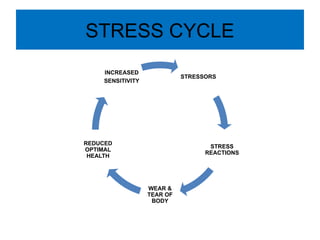
1.Stressors which canbe a problem at home, the work
place, with friends or anything that causes stress.
2. Stress Reactions:
If an individual perceives that he will not be able to
cope with the stressor, it results in negative reactions
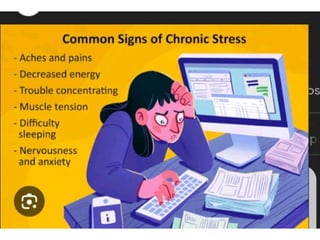
like anxiety, worry, low energy and lack of interest.
3.Wear and Tear of the body:
• The nervous system responds by releasing stress
hormones which prepares an individual to meet
emergency situation. It weakens the immune system.
• Pain, aches, fatigue a well a memory and
concentration problems are commonly seen at this
stage.
24.
4.Reduced optimal health:
ContinuingStress will leads to Reduced
optimal health
- Common Symptoms (physical):
• High BP,
• Digestive Problems
• Skin problems, Asthma, depression
• Cancer
25.
5. Increased Sensitivity:
•The stressed individual feels exhausted
physically and emotionally and this will
increase his sensitivity to stress, when
minor matters can become overwhelming.
• Thus the vicious cycle of stress begins
operating.
26.
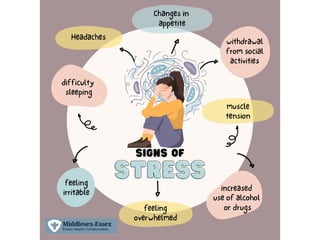
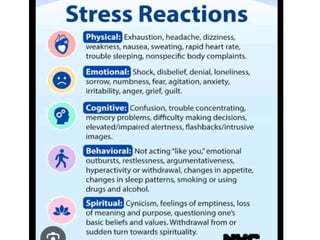
IMMEDIATE EFFECTS OFSTRESS
(i) Behavioural changes:
- Nervousness, Panic reactions,
Exhaustion, Paralysed thinking
- Alcohol consumption
- Restlessness, Sleep disorders
(ii) Physiological changes:
- Increased in muscular tension
- Abnormal changes in heart beat and BP
- Problem related to digestion
27.
(iii) Emotional Changes:
-Victim of the outburst of anger, fear,
jealousy and hatredness.
- High state of anxiety, restlessness and
depression.
- Problems related to lack of interest in
love making and social intimacy.
(iv) Cognitive Changes:
- Increased distractibility
- Decreased concentration
29.
ADAPTATION-Hans Selye’s theory
•In the 1930s, 1940s,and 1950s Hans Selye
enlarged on cannon’s fight – or – flight hypothesis
to describe the general adaptation syndrome
( GAS),
• A three – stage reaction to stress.
• The GAS describes how the body responds to
stressors through the –
- Alarm reaction
- Resistance stage
- Exhaustion stage.
30.
• Alarm reaction:
-During the alarm reaction rising hormone
levels result in increased blood glucose levels,
epinephrine and nor epinephrine amounts, heart
rate, blood flow to muscles, oxygen intake, and
mental alertness.
-In addition, the pupils of the eyes dilate to
produce a greater visual field. This change in
body systems prepares an individual for fight or
flight and may last from 1 minute to many hours.
If the stressor poses an extreme threat to life or
remains for a long time, the person progress to
the second stage, resistance.
31.
Resistance stage:
-During theresistance stage the body
stabilizes and responds in an opposite
manner to the alarm reaction.
-Hormone levels, heart rate, blood
pressure and cardiac output return to
normal and the body repairs any damage
that may have occurred.
- If the stressor remains, and there is no
adaptation the person enters the third
stage, exhaustion
32.
Exhaustion stage:
-This occurswhen the body no longer the
effects of the stressor and when the energy
necessary to maintain adaptation is depleted.
-The physiological response is intensified,
but the person’s energy level is compromised,
and adaptation to the stressor diminishes.
-The body is unable to defend itself against
the impact of the event, physiological
regulation diminishes, and if the stress
continues, death may result.
33.
COPING
Stress requires notonly bodily adaptation,
but also adaptation at the mental level.
-Coping is expending conscious effort to master,
reduce or tolerate stress.
-Coping defined as “ ongoing cognitive and
behavioural efforts to manage specific internal
or external demands that are appraised as
taxing or exceeding the resources of the person.
34.
TYPES OF COPING
•ACCORDING TO GENERAL STRATEGIES:
1.Direct Action response
Example: Manipulating, escaping from stressor
2.Information Seeking(trying to understand better)
3. Inhibition of action (doing nothing)
4. Intra psychic or Palliative Coping(individual reappraises the
situation- by defense mechanism or changes in environment)
5.Turning to help from others and emotional support
35.
2.SPECIFIC STRATEGIES:
1. Appraisalfocused Strategies:
It occurs when the person modifies the way
he / she thinks.
Example: Using positive appraisal or reframing
a situation to see it in a positive light.
2. Problem focused Coping:
It is aimed at changing or eliminating the
source of stress.
Example: seeking information or social
support, Learning new skills to manage the
problem.
36.
3.Emotion focused strategies:
Theseare directed at managing or
reducing emotional distress.
Example:
- Releasing pent up emotions
- Watching TV
- Exercises
37.
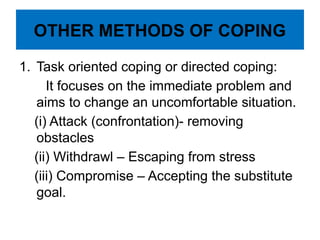
OTHER METHODS OFCOPING
1. Task oriented coping or directed coping:
It focuses on the immediate problem and
aims to change an uncomfortable situation.
(i) Attack (confrontation)- removing
obstacles
(ii) Withdrawl – Escaping from stress
(iii) Compromise – Accepting the substitute
goal.
38.
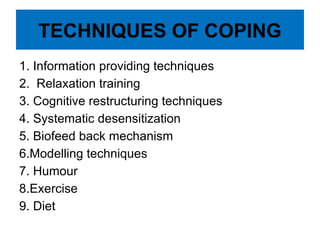
TECHNIQUES OF COPING
1.Information providing techniques
2. Relaxation training
3. Cognitive restructuring techniques
4. Systematic desensitization
5. Biofeed back mechanism
6.Modelling techniques
7. Humour
8.Exercise
9. Diet
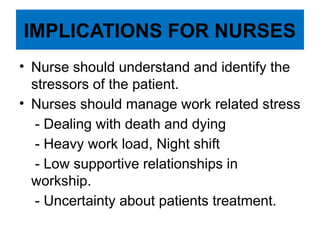
IMPLICATIONS FOR NURSES
•Nurse should understand and identify the
stressors of the patient.
• Nurses should manage work related stress
- Dealing with death and dying
- Heavy work load, Night shift
- Low supportive relationships in
workship.
- Uncertainty about patients treatment.
41.
• Nurses areable to recognise the signs
and symptoms of stress and identify the
coping mechanisms.
• Nurse can encourage the patient to use
the adaptive coping strategies and
adaptive healthy lifestyle choices.