Comprehensive Understanding of Disaster Management: Concepts, Risks, and Development Nexus
Explore disaster concepts, hazard types, vulnerability, risk assessment, disaster management cycle, and the integration of disaster risk reduction into development planning for resilient communities.
Comprehensive Understanding of Disaster Management: Concepts, Risks, and Development Nexus
1.
K.S.RANGASAMY COLLEGE OFTECHNOLOGY
(Autonomous)
www.ksrct.ac.in
www.ksrct.ac.in
K.S.RANGASAMY COLLEGE OF TECHNOLOGY
(Autonomous)
Dr. A. RAMESH KUMAR
Department of Mechatronics Engineering
Understanding Disasters
Concepts, Hazards, Vulnerability, Risk & Disaster
Management
60 MY 004 Disaster Management
2.
Course Outline
Understanding Disasters– Topics Covered
Part A: Concepts & Definitions
Disaster, Hazard, Vulnerability, Risk, and Capacity
Hazard Types, Identification & Mapping
Disaster Risk Equation | Community Resilience
Part B: Disaster and Development
Disaster–Development Nexus | DRR Mainstreaming
Disaster Management Cycle | Institutional Framework
Early Warning Systems | Build Back Better (BBB)
3.
What is aDisaster?
Definitions of Key Concepts
Disaster – A serious disruption of a community's functioning causing
widespread human, material, or environmental losses that exceed the
community's ability to cope. [UNDRR]
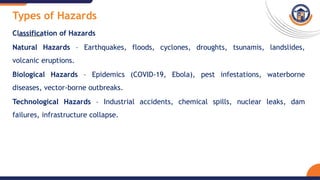
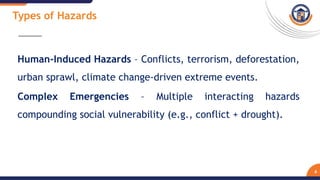
Hazard – A potentially damaging physical event, phenomenon, or human
activity that may cause loss of life, injury, or economic disruption.
4.
4
Vulnerability – Conditionsdetermined by physical, social,
economic, and environmental factors that increase
susceptibility to hazard impacts.
Risk – Probability of harmful consequences resulting from the
interaction of hazards and vulnerable conditions.
Capacity – Combination of strengths, attributes, and resources
to manage and reduce disaster risks effectively.
What is a Disaster?
Hazard Identification &Mapping
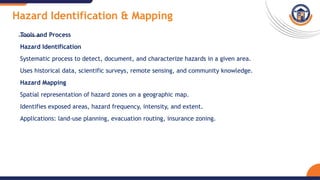
Tools and Process
Hazard Identification
Systematic process to detect, document, and characterize hazards in a given area.
Uses historical data, scientific surveys, remote sensing, and community knowledge.
Hazard Mapping
Spatial representation of hazard zones on a geographic map.
Identifies exposed areas, hazard frequency, intensity, and extent.
Applications: land-use planning, evacuation routing, insurance zoning.
8.
Concept of Vulnerability
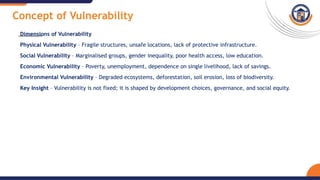
Dimensionsof Vulnerability
Physical Vulnerability – Fragile structures, unsafe locations, lack of protective infrastructure.
Social Vulnerability – Marginalised groups, gender inequality, poor health access, low education.
Economic Vulnerability – Poverty, unemployment, dependence on single livelihood, lack of savings.
Environmental Vulnerability – Degraded ecosystems, deforestation, soil erosion, loss of biodiversity.
Key Insight – Vulnerability is not fixed; it is shaped by development choices, governance, and social equity.
9.
Factors Influencing Vulnerability
RootCauses and Dynamic Pressures
Root Causes
Unequal power structures, limited access to resources, political marginalization.
Dynamic Pressures
Rapid urbanization, population growth, environmental degradation, weak governance.
Unsafe Conditions
Fragile livelihoods, unplanned settlements, lack of DRR policies, low preparedness.
Framework – Pressure and Release (PAR) Model explains how root causes translate to disaster risk.
10.
Concept of Risk& Components
Understanding Disaster Risk
Risk Definition – The probability of harmful consequences arising from hazard–vulnerability
interaction.
Components of Risk
(1) Hazard – Nature, intensity, frequency, and location of the threatening event.
(2) Exposure – Elements (people, assets) located in hazard zones.
(3) Vulnerability – Degree of susceptibility to hazard impacts.
(4) Coping Capacity – Ability to resist, absorb, and recover from impacts.
11.
Disaster Risk Equation
TheFundamental Risk Formula
Risk = (Hazard x Vulnerability) / Capacity
Interpretation:
Higher Hazard intensity increases risk proportionally.
Higher Vulnerability amplifies the impact of hazards.
Greater Capacity (resources + preparedness) reduces risk.
Practical Use
Guides risk reduction investments: reduce vulnerability OR build capacity.
Used in national disaster risk assessments and DRR planning frameworks.
12.
Capacity & CopingCapacity
Community Strengths and Resources
Capacity – All strengths, attributes, and resources available to manage and reduce disaster risk.
Physical Capacity – Infrastructure, early warning systems, emergency equipment.
Social Capacity – Social cohesion, community networks, local leadership, volunteerism.
Economic Capacity – Financial reserves, insurance, diversified livelihoods.
Institutional Capacity – Strong governance, clear DRR policies, trained response teams.
Coping Capacity – Immediate ability to manage adverse conditions using available resources.
13.
Community Resilience &Adaptive Capacity
Building Back Stronger Communities
Resilience Definition – Ability of a system/community to anticipate, absorb, adapt, and recover from hazard
effects. [UNDRR]
Three Pillars of Resilience
(1) Absorptive – Withstanding shocks without major disruption.
(2) Adaptive – Adjusting to changing risk conditions.
(3) Transformative – Changing structures to reduce future risk.
Adaptive Capacity – Capacity to adjust to potential damage, exploit opportunities, or respond to consequences.
Building Resilience: community DRR training, local response plans, inclusive governance.
14.
Risk Assessment &Risk Reduction
From Analysis to Action
Risk Assessment
Process of identifying hazard characteristics, exposure, vulnerability, and capacity.
Tools: Probabilistic Risk Models, GIS-based mapping, historical loss databases.
Disaster Risk Reduction (DRR)
Systematic approach to identify, assess, and reduce disaster risks.
Sendai Framework (2015–2030) – Global blueprint for DRR with 4 priorities:
(1) Understanding risk (2) Governance (3) Investment (4) Preparedness
15.
Part B: Disaster& Development
Overview of Topics
Topics Covered in Part B
Relationship between Disaster and Development
Impact of Disasters on Sustainable Development Goals (SDGs)
Development Activities that Increase Disaster Risk
Mainstreaming DRR into Development Planning
Disaster Management – Concepts and Cycle
Institutional Frameworks | Stakeholder Roles
Early Warning Systems | Build Back Better
16.
Disaster & Development:The Nexus
Bidirectional Relationship
How Disasters Affect Development
Destroy infrastructure, wipe out economic gains, displace populations.
Reverse progress on poverty reduction, health, and education.
How Development Affects Disasters
Poor development choices (e.g., unplanned urbanization) create new risks.
Good development (e.g., resilient infrastructure) reduces disaster impact.
Key Principle – Disaster risk is embedded in development decisions; sustainable development must
incorporate DRR.
17.
Impact of Disasterson Sustainable Development
SDGs at Risk
Economic Impact – Loss of GDP, destruction of assets, disruption of trade and supply chains.
Social Impact – Deaths, displacement, trauma, damage to schools and hospitals.
Environmental Impact – Pollution, ecosystem loss, soil degradation, species extinction.
SDG Linkages
SDG 1 (No Poverty), SDG 3 (Health), SDG 11 (Sustainable Cities) directly affected.
Disasters can erase decades of development gains in a single event.
18.
Development Activities IncreasingDisaster Risk
Risk-Generating Practices
Unplanned Urbanization – Construction in flood plains, steep slopes; poor drainage; overcrowded
settlements.
Deforestation – Removes natural protection; increases flood, landslide, and erosion risk.
Industrial Expansion – Chemical industries near populations without safety protocols.
Coastal Development – Destruction of mangroves and wetlands increases storm surge vulnerability.
Infrastructure Without DRR – Roads, dams, and buildings designed without hazard-resistant
standards.
19.
Mainstreaming DRR inDevelopment Planning
Integrating Risk Reduction into Policy
Mainstreaming DRR – Embedding disaster risk considerations into all sectoral development policies and
programs.
Key Sectors for Integration
Urban Planning – Hazard-sensitive zoning laws and building codes.
Agriculture – Drought-resistant crops; flood-tolerant practices.
Health – Disaster-resilient hospitals; emergency response protocols.
Education – Disaster-safe schools; DRR curriculum integration.
Framework – Sendai Framework Priority 4 promotes DRR mainstreaming at all governance levels.
20.
Concept & Objectivesof Disaster Management
What is Disaster Management?
Definition – Organized process of planning, organizing, and implementing measures before, during, and after
disasters.
Objectives of Disaster Management
(1) Save lives and reduce human suffering.
(2) Minimize economic and environmental losses.
(3) Ensure rapid and effective recovery.
(4) Reduce future vulnerability through risk reduction.
Guiding Principle – Shift from reactive response to proactive risk reduction.
21.
Disaster Management Cycle
FourPhases of the DM Cycle
1. Mitigation – Actions to eliminate or reduce disaster probability/impact. (e.g., flood embankments, building
codes)
2. Preparedness – Planning, training, and equipping communities to respond effectively. (e.g., drills,
stockpiling)
3. Response – Immediate actions during/after disaster: search & rescue, relief, medical aid, evacuation.
4. Recovery – Short-term relief and long-term reconstruction: livelihood restoration, infrastructure rebuilding.
Cycle Principle – Each phase feeds into the next; lessons from recovery inform future mitigation planning.
22.
Institutional Framework forDisaster Management
Governance Structure in India
National Level
NDMA (National Disaster Management Authority) – Policy, coordination, and guidelines.
NDRF (National Disaster Response Force) – Specialized response teams.
State Level
SDMA (State DMA) – State-specific plans and coordination.
SDRF (State Disaster Response Force) – State response units.
District Level
DDMA (District DMA) – Local implementation, community-level preparedness.
23.
Role of Government,NGOs & Community
Multi-Stakeholder Approach
Government Role
Policy formulation, legal framework, resource mobilization, infrastructure, early warning systems.
NGO Role
Community outreach, capacity building, relief distribution, advocacy, grassroots DRR programs.
Community Participation
Local knowledge for risk assessment; first responders in disaster events.
Community-Based DRR (CBDRR) – Empowers local communities to assess risk, plan, and act.
24.
Disaster Preparedness &Early Warning Systems
Being Ready Before Disaster Strikes
Disaster Preparedness
Development of response plans, training drills, stockpiling, evacuation planning.
Community awareness campaigns and mock exercises.
Early Warning Systems (EWS)
Monitoring – Continuous observation of hazard indicators (rainfall, seismic, cyclone track).
Warning – Timely dissemination of alerts via SMS, sirens, media, apps.
Response – Pre-defined actions triggered by alert levels.
Example – India Meteorological Department (IMD) cyclone warnings saved thousands in Odisha (2013).
25.
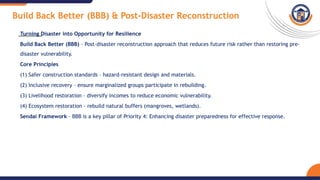
Build Back Better(BBB) & Post-Disaster Reconstruction
Turning Disaster into Opportunity for Resilience
Build Back Better (BBB) – Post-disaster reconstruction approach that reduces future risk rather than restoring pre-
disaster vulnerability.
Core Principles
(1) Safer construction standards – hazard-resistant design and materials.
(2) Inclusive recovery – ensure marginalized groups participate in rebuilding.
(3) Livelihood restoration – diversify incomes to reduce economic vulnerability.
(4) Ecosystem restoration – rebuild natural buffers (mangroves, wetlands).
Sendai Framework – BBB is a key pillar of Priority 4: Enhancing disaster preparedness for effective response.
26.
Summary & KeyTakeaways
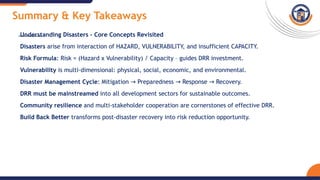
Understanding Disasters – Core Concepts Revisited
Disasters arise from interaction of HAZARD, VULNERABILITY, and insufficient CAPACITY.
Risk Formula: Risk = (Hazard x Vulnerability) / Capacity – guides DRR investment.
Vulnerability is multi-dimensional: physical, social, economic, and environmental.
Disaster Management Cycle: Mitigation Preparedness Response Recovery.
→ → →
DRR must be mainstreamed into all development sectors for sustainable outcomes.
Community resilience and multi-stakeholder cooperation are cornerstones of effective DRR.
Build Back Better transforms post-disaster recovery into risk reduction opportunity.
27.
K.S.RANGASAMY COLLEGE OFTECHNOLOGY
(Autonomous)
Tiruchengode – 637 215. Namakkal Dt. Tamil Nadu. India
www.ksrct.ac.in /ksrct1994
Thank You !