Comprehensive Techniques for Controlling Gaseous Pollutants in Industrial Emissions
Overview of absorption, adsorption, condensation, incineration, and biofiltration methods for effective gaseous pollutant control in various industries, highlighting advantages, disadvantages, and operational details.
⦿ The mostcommon method for controlling
gaseous pollutants is the addition of add-on
control devices to recover or destroy a
pollutant.
⦿ There are four commonly
used technologies for gaseous
pollutants:
◾ Absorption,
◾ Adsorption,
◾ Condensation, and
◾ Incineration (combustion)
contro
l
3.
⦿ The removalof one or
more selected components
from a gas mixture by
absorption is probably the most
important operation in the
control of gaseous
pollutant emissions.
⦿ Absorption is a process in which
a gaseous pollutant is dissolved
in a liquid.
⦿ Water is the most commonly
used absorbent liquid.
⦿ As the gas stream passes
through the liquid, the liquid
absorbs the gas, in much the
same way that sugar is
absorbed in a glass of water
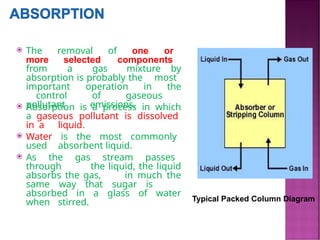
when stirred. Typical Packed Column Diagram
4.
⦿ Absorbers areoften referred to as scrubbers, and there
are various types of absorption equipment.
⦿ The principal types of gas absorption equipment
include spray towers, packed columns, spray
chambers, and venture scrubbers.
⦿ In general, absorbers can achieve removal
efficiencies
grater than 95 percent.
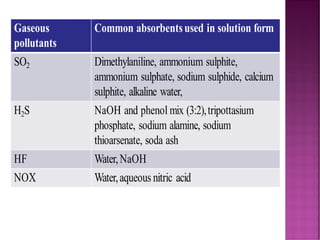
⦿ Absorbents used to remove SO2, H2S, SO3, F and oxides of
nitrogen.
⦿ One potential problem with absorption is the
generation of waste-water, which converts an air
pollution problem to a water pollution problem.
6.
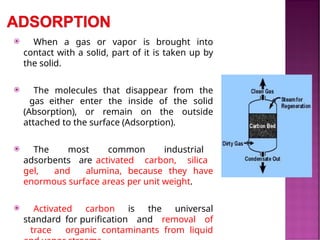
⦿ When agas or vapor is brought into
contact with a solid, part of it is taken up by
the solid.
⦿ The molecules that disappear from the
gas either enter the inside of the solid
(Absorption), or remain on the outside
attached to the surface (Adsorption).
⦿ The most common industrial
adsorbents are activated carbon, silica
gel, and alumina, because they have
enormous surface areas per unit weight.
⦿ Activated carbon is the universal
standard for purification and removal of
trace organic contaminants from liquid
7.
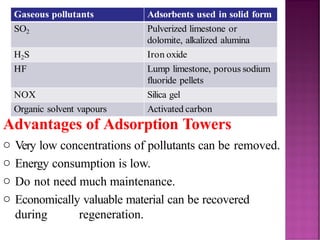
Advantages of AdsorptionTowers
o Very low concentrations of pollutants can be removed.
o Energy consumption is low.
o Do not need much maintenance.
o Economically valuable material can be recovered
during regeneration.
8.
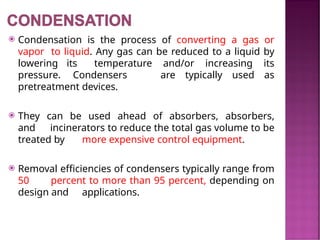
⦿ Condensation isthe process of converting a gas or
vapor to liquid. Any gas can be reduced to a liquid by
lowering its temperature and/or increasing its
pressure. Condensers are typically used as
pretreatment devices.
⦿ They can be used ahead of absorbers, absorbers,
and incinerators to reduce the total gas volume to be
treated by more expensive control equipment.
⦿ Removal efficiencies of condensers typically range from
50 percent to more than 95 percent, depending on
design and applications.
9.
⦿ Incineration usedto control the emissions of
organic compounds from process industries.
⦿ This control technique refers to the rapid
oxidation combination
of
material in
the
of a substance through the
oxygen with a combustible
presence of heat.
⦿ When combustion is complete, the gaseous
stream is converted to carbon dioxide and water
vapor.
⦿ Equipment used to control waste gases
by combustion can be divided in three categories:
◾ Direct combustion or flaring,
◾ Thermal incineration and
◾ Catalytic incineration.
10.
⦿ Direct combustoris a device in which air
and all the combustible waste gases
react at the burner. Complete
combustion must occur
instantaneously since there is no
residence chamber.
⦿ A flare can be used to control almost
any emission stream containing volatile
organic compounds. Studies conducted
by EPA have shown that the
destruction efficiency of a flare is about
98 percent.
11.
Thermal incinerator general
case
Inthermal incinerators the combustible waste gases
pass over or around a burner flame into a residence
chamber where oxidation of the waste gases is
completed.
Thermal incinerators can destroy gaseous
pollutants at efficiencies of greater than 99 percent
when operated correctly.
12.
Catalytic
incinerator
Catalytic incinerators arevery similar to thermal
incinerators. The main difference is that after passing
through the flame area, the gases pass over a catalyst
bed.
A catalyst promotes oxidation at lower temperatures,
thereby reducing fuel costs. Destruction efficiencies
greater than 95 percent are possible using a catalytic
incinerator.
13.
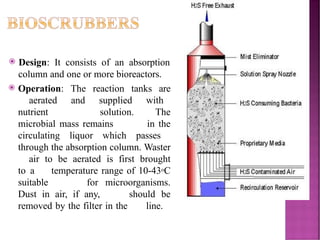
⦿ Design: Itconsists of an absorption
column and one or more bioreactors.
⦿ Operation: The reaction tanks are
aerated and supplied with
nutrient solution. The
microbial mass remains in the
circulating liquor which passes
through the absorption column. Waster
air to be aerated is first brought
to a temperature range of 10-43oC
suitable for microorganisms.
Dust in air, if any, should be
removed by the filter in the line.
14.
⦿ Use: Appliedin the food industry, in rendering plants,
livestock farming, foundries.
⦿ Advantages: it is suitable for water soluble
hydrocarbons. Use of activated carbon in the absorber
improves mass transfer, buffer capacity and
immobilization of microorganisms.
⦿ Disadvantages: require a lot of skilled attention.
Emission of microorganisms is considered to be the
risk involved.
⦿ Status: considered to be of concern by the food
industry and pharmaceutical industry.
15.
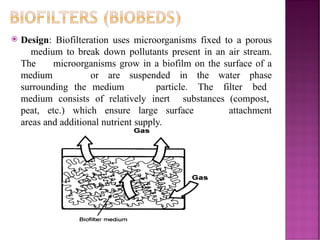
⦿ Design: Biofilterationuses microorganisms fixed to a porous
medium to break down pollutants present in an air stream.
The microorganisms grow in a biofilm on the surface of a
medium or are suspended in the water phase
surrounding the medium particle. The filter bed
medium consists of relatively inert substances (compost,
peat, etc.) which ensure large surface attachment
areas and additional nutrient supply.
16.
⦿ Operation: Contaminatedair is humidified and
passed
through a packed bed and pollutant transfers into a thin
biofilm and degrade the pollutant. They are systems that use a
combination of processes: absorption, adsorption,
degradation and desorption of gas phase contaminants.
⦿ Conditions: Microorganisms used are mesophilic,
Temperature 15-400C, moisture 40-60% and gas contact time
10-30 sec
o Use: used in treating malodorous compounds and water
soluble Volatile organic compounds (VOCs) Industries
employing this technology include food and animal
products, pharmaceuticals, wood products, paint and
coating applications, resin manufacturing. Compounds
treated are typically mixed VOCs and sulfur compounds,
including hydrogen sulfide.
17.
Advantages: simple designto construct and operate and offer
a cost effective solution provided the pollutant is
biodegradable within a moderate time frame. There is no
secondary pollution
Disadvantages: high loading and degradation rate,
humidification is problematic. Chlorinated hydrocarbons can
not be removed by biofilters as dechlorination
acidification of packing material.
It is most accepted technique among three techniques
cause