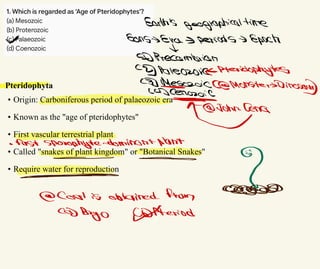
Pteridophyta
• Origin: Carboniferousperiod of palaeozoic era
• Known as the "age of pteridophytes"
• First vascular terrestrial plant
• Called "snakes of plant kingdom" or "Botanical Snakes"
• Require water for reproduction
Earth's geographicaltime
* Eonsy Era - periods -
> Epoch
↓
Precambrian
c2PaleozoiPteridophytes
MonsterDinosa
←
&John Cena
∞
· first Sporophyte-dominantplant
← -
?
⇐
& Coal is obtained from do
C BuyO pteriod
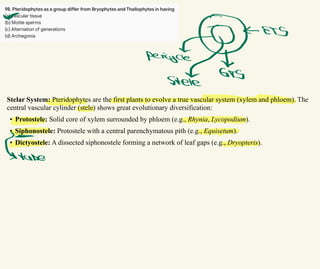
Stelar System: Pteridophytesare the first plants to evolve a true vascular system (xylem and phloem). The
central vascular cylinder (stele) shows great evolutionary diversification:
• Protostele: Solid core of xylem surrounded by phloem (e.g., Rhynia, Lycopodium).
• Siphonostele: Protostele with a central parenchymatous pith (e.g., Equisetum).
• Dictyostele: A dissected siphonostele forming a network of leaf gaps (e.g., Dryopteris).
r
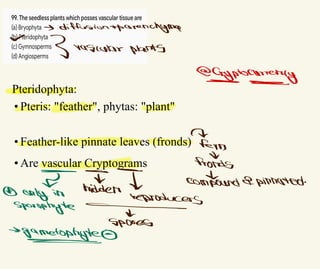
Oters
perigad
S
tube
5.
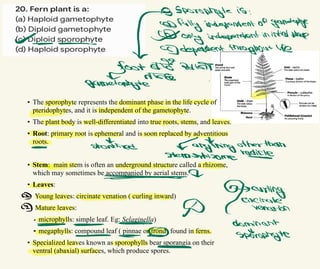
• The sporophyterepresents the dominant phase in the life cycle of
pteridophytes, and it is independent of the gametophyte.
• The plant body is well-differentiated into true roots, stems, and leaves.
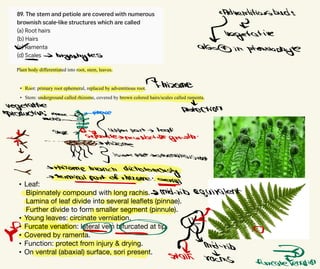
• Root: primary root is ephemeral and is soon replaced by adventitious
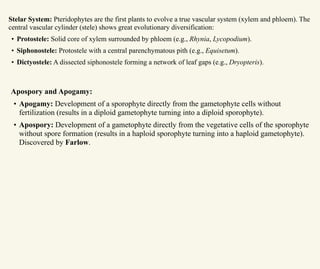
roots.
• Stem: main stem is often an underground structure called a rhizome,
which may sometimes be accompanied by aerial stems.
• Leaves:
Young leaves: circinate venation ( curling inward)
Mature leaves:
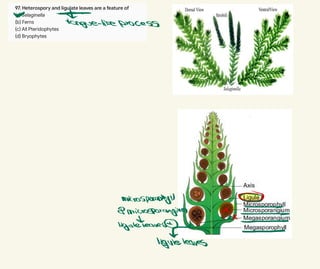
microphylls: simple leaf. Eg: Selaginella)
megaphylls: compound leaf ( pinnae or frond) found in ferns.
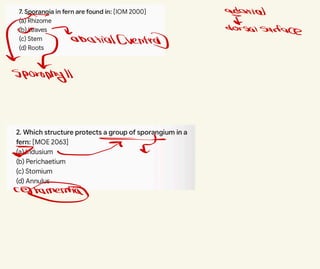
• Specialized leaves known as sporophylls bear sporangia on their
ventral (abaxial) surfaces, which produce spores.
⑨ Sporphyte is :
fullyindependent of gametophyte
[
← #only independentinintial phase
dependent throughout life
footd
gemetophyte
^
小
∝ …
* stout
lived anything
otherthan
stemtutizome
le
a
염 * % curling
circimate
Venation
.
승
車
← dominant
&
θ N
女
sporophyre
-
>>
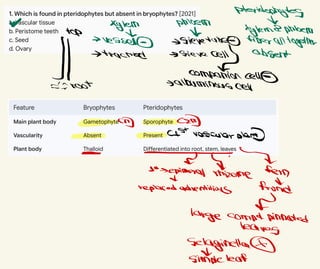
6.
Peridophytes
∞ Xylem phioemt
top * tylemi phloem
-
Vesseld ⑨
Sievetube Liberalltogether
ㅓ -
>trastried -sieve
cally absent
companion celle
éfrost -albuminous cell
ㄻ CaD
cast vascular plan)
羊
Tiern
to
sepimeral unizome
replaced adventitious tfrond
고
large compe pinnated
leaves
Selaginella
∝
simpleleaf
7.
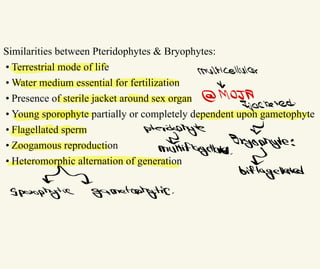
Similarities between Pteridophytes& Bryophytes:
• Terrestrial mode of life
• Water medium essential for fertilization
• Presence of sterile jacket around sex organ
• Young sporophyte partially or completely dependent upon gametophyte
• Flagellated sperm
• Zoogamous reproduction
• Heteromorphic alternation of generation
multicellutar
*
& MOJA
↑
jacketed.
{
Ateridophyte
ょ Bryophyte:
multiflagellate
고
biflagellated
Sporophytic Gametophytis.
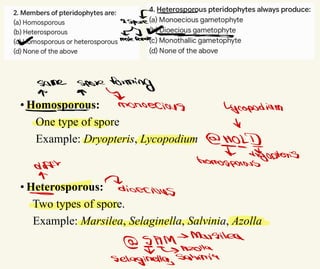
8.
• Homosporous:
One typeof spore
Example: Dryopteris, Lycopodium
• Heterosporous:
Two types of spore.
Example: Marsilea, Selaginella, Salvinia, Azolla
S ←
aspore
*
[2 =
∞ malefemale
some
spire
forming
∞
= >
monoecious Lysopodium
↓
QMOLD
Tayopteris
difft homospurous
∞
-
Eiserious
& SAM- Marsilea
& Azella
Selaginella,salvimia
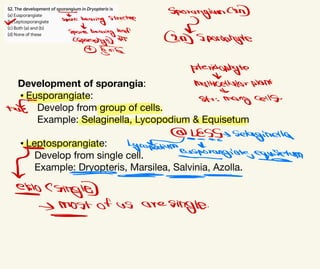
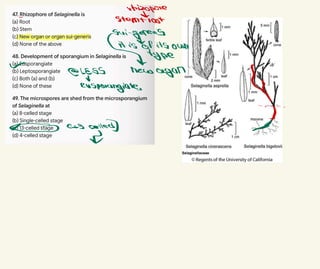
Development of sporangia:
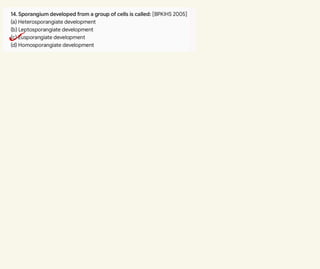
•Eusporangiate:
Develop from group of cells.
Example: Selaginella, Lycopodium & Equisetum
• Leptosporangiate:
Develop from single cell.
Example: Dryopteris, Marsilea, Salvinia, Azolla.
SporangiumCan
∞
Tre bearing structure
고
↓
Spire bearingleaf
csporophyl) at [m) Sporiphyte
_
⑤ Gca
ptevidophyte
Do
Multicellular plant
∝
&
Str :
many Cells-
rune
ESSSelaginella
Lycopodium
Ʃ
ensporangiate
,equisetum
_
∞
-
osingle
-
> most of us are
single.
-
11.
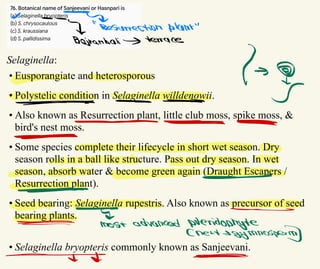
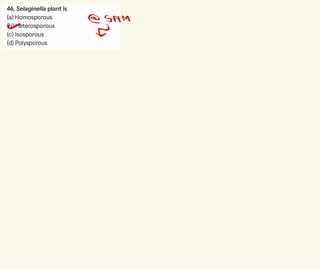
Selaginella:
• Eusporangiate andheterosporous
• Polystelic condition in Selaginella willdenowii.
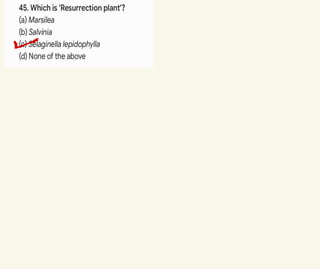
• Also known as Resurrection plant, little club moss, spike moss, &
bird's nest moss.
• Some species complete their lifecycle in short wet season. Dry
season rolls in a ball like structure. Pass out dry season. In wet
season, absorb water & become green again (Draught Escapers /
Resurrection plant).
• Seed bearing: Selaginella rupestris. Also known as precursor of seed
bearing plants.
• Selaginella bryopteris commonly known as Sanjeevani.
µ ←
법
-
K
Resurrection plant"
Bajrambali- > terrace
? ⑨
¤ -
>
ー
-
-
- ∞
^
←
-
Z
-
- Most advanced pteridophyte
Crestsgymnospend
# *
Sexual Reproduction (byspores):
• Dryopteris: homosporous & leptosporangiate.
Sori:
• superficial & marginal on either side of rachis of pinnule on
ventral (abaxial) / undersurface.
• Brown at maturity (green in young leaves).
• Protected by kidney-shaped membrane / shield
indusium
• Basis of naming Dryopteris—> male shield fern
exspirangiateslegsa
upperepidermis
clesf])
Flower epiteriig
Sig
:
Sorus
CMOLD Tklo
(singl)e
σ
^
-
> sporangium
∞ 고
亠 groun of
sporangium!
sorug
고
group! Sorii.
Placenta:
• Cushion-shaped vasculartissue where
sporangia develop & is attached.
• Water gland at base of stalk.
• Help keep sori moist until maturity.
Sporangia contain:
• Stalk: Multicellular.
• Capsule:
Oval & biconvex.
Single layered jacket or wall.
Enclose 12 to 16 diploid mother cells.
Meiosis
48-64 haploid spores
√ No
-of diploid sporemother cell
교
12
to 16
d
meiosis
48-64 Spores
upptrepidermis
cles]
⇐
← o
Flower epidermig
-2 surface
ventral
water gland lost Sig:
Sorus
α
water
scarcity
o
huptire
dispersed by wind
.
小
29.
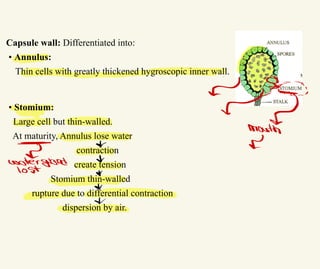
Capsule wall: Differentiatedinto:
• Annulus:
Thin cells with greatly thickened hygroscopic inner wall.
• Stomium:
Large cell but thin-walled.
At maturity, Annulus lose water
contraction
create tension
Stomium thin-walled
rupture due to differential contraction
dispersion by air.
…
S
α 울
문
小
Mout
s
Watergland ↓
lost ↓
、
30.
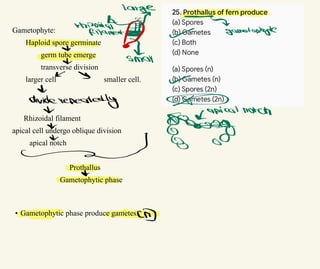
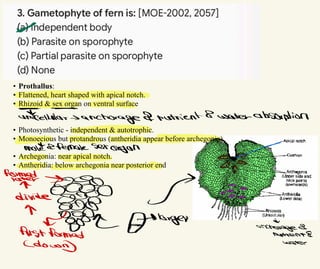
Gametophyte:
Haploid spore germinate
germtube emerge
transverse division
larger cell smaller cell.
Rhizoidal filament
apical cell undergo oblique division
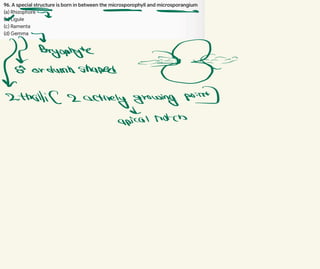
apical notch
Prothallus
Gametophytic phase
• Gametophytic phase produce gametes.
large
∝
Tamatophyte
∝ small
&
√
dividerepeatedly x
α
*
」
mca
ncte
N
ㄻ
31.
• Prothallus:
• Flattened,heart shaped with apical notch.
• Rhizoid & sex organ on ventral surface
• Photosynthetic - independent & autotrophic.
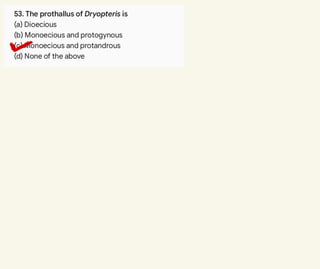
• Monoecious but protandrous (antheridia appear before archegonia).
• Archegonia: near apical notch.
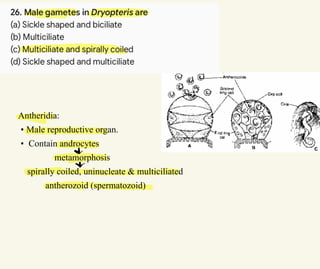
• Antheridia: below archegonia near posterior end
*
*>
unigellular -
>
anchorage nutrient waterabsorption
malfemale Sex
organ
w
·
formed
^ ·
·la
n λ
anchorageR
nutriemtR
Sowny
Water
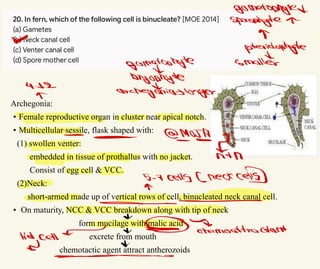
Archegonia:
• Female reproductiveorgan in cluster near apical notch.
• Multicellular sessile, flask shaped with:
(1) swollen venter:
embedded in tissue of prothallus with no jacket.
Consist of egg cell & VCC.
(2)Neck:
short-armed made up of vertical rows of cell, binucleated neck canal cell.
• On maturity, NCC & VCC breakdown along with tip of neck
form mucilage with malic acid
excrete from mouth
chemotactic agent attract antherozoids
gametophyted
sporsphyte i
∞
θ
pteridophyte
gametophyte smaller
bryophyte
4-
12
& anchegonialonger
-
≠
- &MOJA
超
∅
nan
5 .7 cells (recksel
l
δ
-
-
↓
Gaas
lidcellI ∝ * chemoattractant
고 ∞
^
35.
Sporophytic body: initiallydependent upon gametophytic body
draws nutrition through foot
Later independent.
Antherozoid + Egg → Diploid zygote (first cell of sporophytic phase).
Secretes thin wall around it
oospore
undergo holoblastic development.
_
广
fertilization C2JN
CD CD
α
↓ ·
杀
while
embryo embryonic
involved in formation development
of blastomere
^
*
germ layer -whole new
baby
C ]
∝
36.
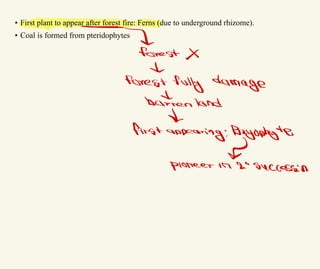
• First plantto appear after forest fire: Ferns (due to underground rhizome).
• Coal is formed from pteridophytes
二
マ
forest X
forest fully damage
α
barrenland
first
appearing: Bryophyte
고
Pioneer in
"succession
37.
Stelar System: Pteridophytesare the first plants to evolve a true vascular system (xylem and phloem). The
central vascular cylinder (stele) shows great evolutionary diversification:
• Protostele: Solid core of xylem surrounded by phloem (e.g., Rhynia, Lycopodium).
• Siphonostele: Protostele with a central parenchymatous pith (e.g., Equisetum).
• Dictyostele: A dissected siphonostele forming a network of leaf gaps (e.g., Dryopteris).
Apospory and Apogamy:
• Apogamy: Development of a sporophyte directly from the gametophyte cells without
fertilization (results in a diploid gametophyte turning into a diploid sporophyte).
• Apospory: Development of a gametophyte directly from the vegetative cells of the sporophyte
without spore formation (results in a haploid sporophyte turning into a haploid gametophyte).
Discovered by Farlow.
38.
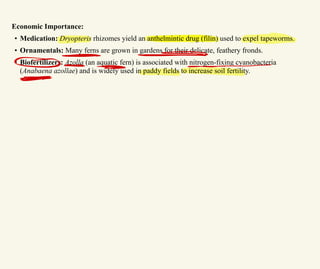
Economic Importance:
• Medication:Dryopteris rhizomes yield an anthelmintic drug (filin) used to expel tapeworms.
• Ornamentals: Many ferns are grown in gardens for their delicate, feathery fronds.
• Biofertilizers: Azolla (an aquatic fern) is associated with nitrogen-fixing cyanobacteria
(Anabaena azollae) and is widely used in paddy fields to increase soil fertility.
丕 ^
∞ -
>
> ー
⇐



![Sexual Reproduction (by spores):
• Dryopteris: homosporous & leptosporangiate.
Sori:
• superficial & marginal on either side of rachis of pinnule on
ventral (abaxial) / undersurface.
• Brown at maturity (green in young leaves).
• Protected by kidney-shaped membrane / shield
indusium
• Basis of naming Dryopteris—> male shield fern
exspirangiateslegsa
upperepidermis
clesf])
Flower epiteriig
Sig
:
Sorus
CMOLD Tklo
(singl)e
σ
^
-
> sporangium
∞ 고
亠 groun of
sporangium!
sorug
고
group! Sorii.](https://image.slidesharecdn.com/pteridophytesfinal-260809114610-1232f0bf/85/Comprehensive-Study-of-Pteridophytes-Structure-Reproduction-and-Evolution-26-320.jpg)
![Placenta:
• Cushion-shaped vascular tissue where
sporangia develop & is attached.
• Water gland at base of stalk.
• Help keep sori moist until maturity.
Sporangia contain:
• Stalk: Multicellular.
• Capsule:
Oval & biconvex.
Single layered jacket or wall.
Enclose 12 to 16 diploid mother cells.
Meiosis
48-64 haploid spores
√ No
-of diploid sporemother cell
교
12
to 16
d
meiosis
48-64 Spores
upptrepidermis
cles]
⇐
← o
Flower epidermig
-2 surface
ventral
water gland lost Sig:
Sorus
α
water
scarcity
o
huptire
dispersed by wind
.
小](https://image.slidesharecdn.com/pteridophytesfinal-260809114610-1232f0bf/85/Comprehensive-Study-of-Pteridophytes-Structure-Reproduction-and-Evolution-28-320.jpg)
![Sporophytic body: initially dependent upon gametophytic body
draws nutrition through foot
Later independent.
Antherozoid + Egg → Diploid zygote (first cell of sporophytic phase).
Secretes thin wall around it
oospore
undergo holoblastic development.
_
广
fertilization C2JN
CD CD
α
↓ ·
杀
while
embryo embryonic
involved in formation development
of blastomere
^
*
germ layer -whole new
baby
C ]
∝](https://image.slidesharecdn.com/pteridophytesfinal-260809114610-1232f0bf/85/Comprehensive-Study-of-Pteridophytes-Structure-Reproduction-and-Evolution-35-320.jpg)