Comprehensive Study of Pteridophytes: Life Cycle, Classes, and Reproduction
1.
PTERIDOPHYTES
Sporophyte stageis more conspicuous than
the gametophyte stage in the life cycle of
pteridophytes
There is the presence of prothallus which is an
advancement over the bryophytes
Presence of vascular bundles is also an
advancement over the bryophytes
Independence of the sporophyte on the
gametophyte also show advancement
2.
The 4classes of pteridophytes include –,
Pteropsida, Lycopsida, Psilotopsida and
Sphenopsida
Psilotopsida includes only two living genera,
Psilotum and Tmesipteris.
The members of the class show close
resemblance in fundamental characteristics to
the Silurian and Devonian members
Rhyniopsida (e.g Rhynia, Cooksonia),
Zostero- phyllopsida (e.g, Zosterophyllum)
Trimero- phytopsida (e.g. Trimerophyton, Psilophyton).
3.
Sphenopsida:
Thisclass is represented by only one living genus
(Equisetum) and about 18 extinct forms (e.g.,
Calamites, Annularia etc.).
This group originated during the Devonian period
of Palaeozoic Era,
attained their maximum deve
lopment in the
Carboniferous period.
Sub
sequently, the group became less prevalent
and presently represented by just a single genus
(Equisetum).
4.
We shalconsider Two classes
Pteropsida – Nephrolepis sp, Dryopteris
sp
Lycopsida – Selaginella sp
5.
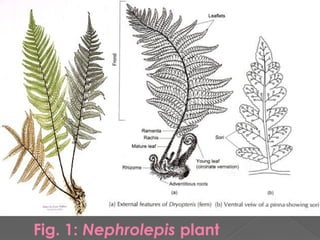
Division –Pteridophyte
Class – Pteropsida (Filicinae)
Order – Filicales
Family – Polypodiaceae
Genus – Nephrolepis
Species – Nephrolepis sp
Nephrolepis survives in both tropical and temperate
regions but more in shaded areas.
They are terrestrial, aquatic, epiphytic and also
xerophytic
The Nephrolepis plant itself is the sporophyte phase
The independent prothallus is the gametophyte
The sporophytebear spores and reproduce
asexually
The plant (sporophyte) has true roots, stems and
leaves including vascular bundles
It produces one type of spore – homosporous
Others are heterosporous eg the aquatic types
Has short stems and underground stems call
rhizomes
Underground rhizomes could make them
perenials forming new leaves every year
The leaves on the rachis could be opposite or
alternate
8.
They havechloroplast – photosynthetic
The leaves are sporophyllous – bear spores
and have stomata
The roots are primary roots and adventitious in
nature, slender and extensive
The front section of the leaf – Abaxial and the
back side - Adaxial
Brown spots (sorus) on the adaxial part of the
leaf contain sporangium which contain
spores
9.
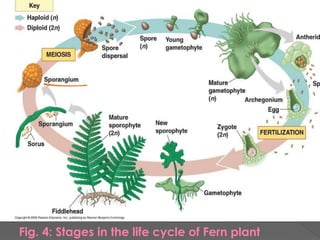
Reproduction
Archisporal cellsare the primitive cells that give
rise to the cells from which spores are derived.
Archisporal cells undergo mitotic division to form
the spore mother cells
Spore mother cells undergo meoitic division to
form spores
The spore is the first stage of the gametophyte
phase.
The stomium burst and release the spores which
eventually germinate to form the prothallus
10.
From theprothallus grows out the antheridium
(male sex cell) and archegonium (female sex
cell)
Prothallus has chloroplast hence
photosynthetic
Sporophyll is the spore bearing leaf
Division –Pteridophyte
Class – Lycopsida
Order – Selaginellales (Lycopsidales)
Family – Selaginellaceae
Genus – Selaginella
Species – Selaginella sp
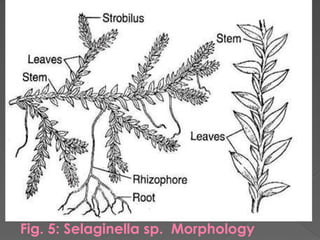
Selaginella is also found in the tropics and
temperate zones mostly in moist areas
It grows dichotomously with some stems
forming rhizomes
13.
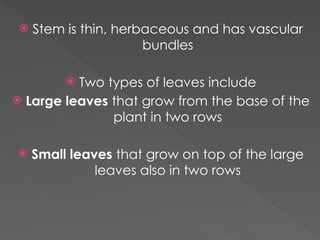
Stem isthin, herbaceous and has vascular
bundles
Two types of leaves include
Large leaves that grow from the base of the
plant in two rows
Small leaves that grow on top of the large
leaves also in two rows
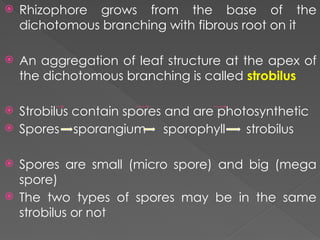
Rhizophore growsfrom the base of the
dichotomous branching with fibrous root on it
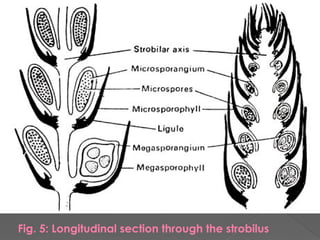
An aggregation of leaf structure at the apex of
the dichotomous branching is called strobilus
Strobilus contain spores and are photosynthetic
Spores sporangium sporophyll strobilus
Spores are small (micro spore) and big (mega
spore)
The two types of spores may be in the same
strobilus or not
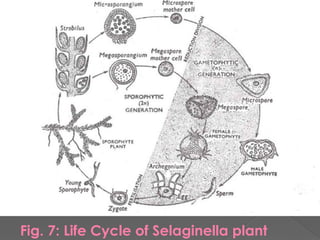
Reproduction
The strobilusis more mature at the base
Cell initials form at the central portion of the
strobilus and differentiate into micro and mega
sporangium through mitosis.
Spore mother cells are eventually formed in
them – still at the sporopyte stage
In the mega sporangium, 15 of the 16 mega
spores die and the remaining one undergo
meiosis to form four spores – gametophyte
starts
18.
In themicro sporangium the 16 mother cells
undergo meiosis to give 64 spores
At maturity spores fall off and germinate into
male and female prothallus
Micro spores produce male gametes and mega
spores produce female gametes
Female starts germination while still in the mega
sporangium but complete growth outside
Antherozoids formed in the antheridium are
biflagillated for swimming
19.
After fertilizationzygote forms and begin the
sporophyte phase
Appearance of two spores in Selaginella is an
advancement of over Nephrolepis
The plant is the sporophyte stage since the
spores germinate while still in the sporophyll
Gametophyte eventually depends on
sporophyte for food