Comprehensive Study of Calamites: Morphology, Distribution, and Reproduction
Detailed exploration of Calamites including their geological distribution, morphology, internal structure, reproductive methods, and classification into sub-genera and cone types.
Geological & GeographicalDistribution
The Genus appeared in the upper Devonian and declined early in the Triassic.
The Genus has been reported from Britain, Coal ball in Eastern Kentucky,
North America etc.
3.
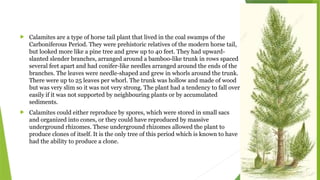
Calamites area type of horse tail plant that lived in the coal swamps of the
Carboniferous Period. They were prehistoric relatives of the modern horse tail,
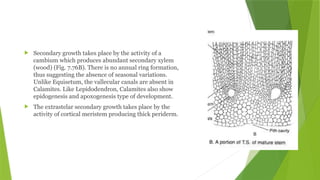
but looked more like a pine tree and grew up to 40 feet. They had upward-
slanted slender branches, arranged around a bamboo-like trunk in rows spaced
several feet apart and had conifer-like needles arranged around the ends of the
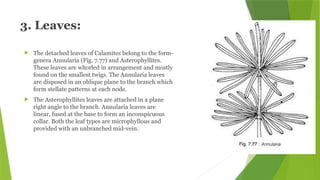
branches. The leaves were needle-shaped and grew in whorls around the trunk.
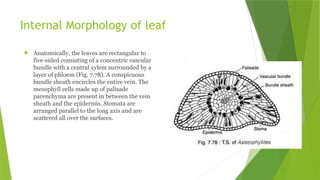
There were up to 25 leaves per whorl. The trunk was hollow and made of wood
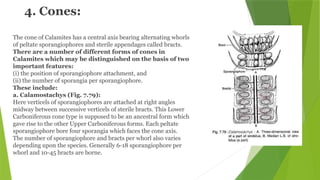
but was very slim so it was not very strong. The plant had a tendency to fall over
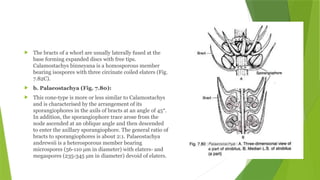
easily if it was not supported by neighbouring plants or by accumulated
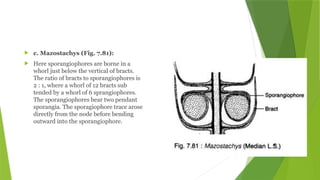
sediments.
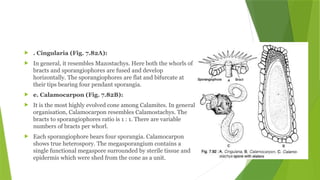
Calamites could either reproduce by spores, which were stored in small sacs
and organized into cones, or they could have reproduced by massive
underground rhizomes. These underground rhizomes allowed the plant to
produce clones of itself. It is the only tree of this period which is known to have
had the ability to produce a clone.
4.
Habit of Calamites:
The name Catamites was first proposed by Suckow (1784) and later in 1828,
Brongniart established its relationship with Equisetum. Catamites was a tall
tree that attained a height of about 33 ft (10 m). The plant had a stout under
ground rhizome with a number of aerial shoots. The rhizome differentiated into
nodes and internodes and had a whorl of adventitious roots at the nodes.
Aerial shoots arose from the upper surface of the rhizome. At a certain distance
these aerial shoots also produced adventitious roots indicating that some
portion of these aerial shoots grew under the soil surface. Erect shoot became
sharply constricted at the point of their attachment to the rhizome. Aerial
shoots showed prominent nodes and internodes and had whorls of branches at
each node.
5.
Sub-Genera of Calamites:
The pattern of bran
ching was variable.
Thus, five sub-genera of Catamites have
been recognised, based on their branching
pattern.
These include:
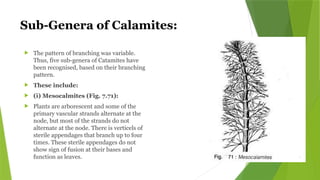
(i) Mesocalmites (Fig. 7.71):
Plants are arborescent and some of the
primary vascular strands alternate at the
node, but most of the strands do not
alternate at the node. There is verticels of
sterile appendages that branch up to four
times. These sterile appendages do not
show sign of fusion at their bases and
function as leaves.
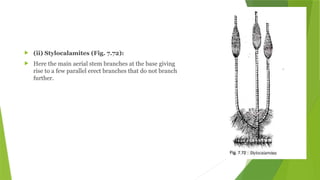
6.
(ii) Stylocalamites(Fig. 7.72):
Here the main aerial stem branches at the base giving
rise to a few parallel erect branches that do not branch
further.
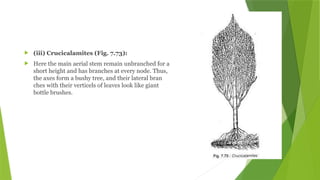
7.
(iii) Crucicalamites(Fig. 7.73):
Here the main aerial stem remain unbranched for a
short height and has branches at every node. Thus,
the axes form a bushy tree, and their lateral bran
ches with their verticels of leaves look like giant
bottle brushes.
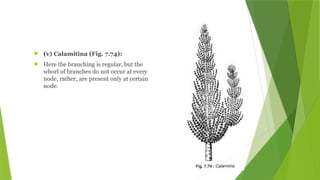
8.
(v) Calamitina(Fig. 7.74):
Here the branching is regular, but the
whorl of branches do not occur at every
node, rather, are present only at certain
node.
9.
Stem: Internal
Thestem form-genus is called Catamites which was
initially applied to fragments of pith costs. The surface of
the stem had longitudinal ridges and furrows like
Equisetum.
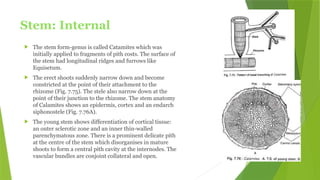
The erect shoots suddenly narrow down and become
constricted at the point of their attach
ment to the
rhizome (Fig. 7.75). The stele also narrow down at the
point of their junction to the rhizome. The stem anatomy
of Calamites shows an epidermis, cortex and an endarch
siphonostele (Fig. 7.76A).
The young stem shows differentia
tion of cortical tissue:
an outer sclerotic zone and an inner thin-walled
parenchymatous zone. There is a prominent delicate pith
at the centre of the stem which disorganises in mature
shoots to form a central pith cavity at the inter
nodes. The
vascular bundles are conjoint collateral and open.
10.
Secondary growthtakes place by the acti
vity of a
cambium which produces abundant secondary xylem
(wood) (Fig. 7.76B). There is no annual ring formation,
thus suggesting the absence of seasonal variations.
Unlike Equisetum, the vallecular canals are absent in
Calamites. Like Lepidodendron, Calamites also show
epidogenesis and apoxogenesis type of development.
The extrastelar secondary growth takes place by the
activity of cortical meristem pro
ducing thick periderm.
11.
2. Roots -External or Internal
The adventitious roots of Calamites are referred as Astromyelon. Internally,
there is parenchymatous pith. The primary stele compri
ses of a ring of exarch
bundles. The important internal feature of root is the absence of carinal
canal. In rare instances, cortical lacuna is present which reminds the
vallecular canal of Equisetum. Secondary growth has also been reported in
Astromyelon.
12.
3. Leaves:
Thedetached leaves of Calamites belong to the form-
genera Annularia (Fig. 7.77) and Asterophyllites.
These leaves are whorled in arrangement and mostly
found on the smallest twigs. The Annularia leaves
are disposed in an oblique plane to the branch which
form stellate patterns at each node.
The Asterophyllites leaves are attached in a plane
right angle to the branch. Annularia leaves are
linear, fused at the base to form an inconspicuous
collar. Both the leaf types are microphyllous and
provided with an unbranched mid-vein.
13.
Internal Morphology ofleaf
Anatomically, the leaves are rectangular to
five-sided consisting of a concentric vascular
bundle with a central xylem surrounded by a
layer of phloem (Fig. 7.78). A conspicuous
bun
dle sheath encircles the entire vein. The
meso
phyll cells made up of palisade
parenchyma are present in between the vein
sheath and the epi
dermis. Stomata are
arranged parallel to the long axis and are
scattered all over the surfaces.
14.
4. Cones:
The coneof Calamites has a central axis bearing alternating whorls
of peltate sporangiophores and sterile appendages called bracts.
There are a number of different forms of cones in
Calamites which may be distinguished on the basis of two
important features:
(i) the position of sporangiophore attachment, and
(ii) the number of sporangia per sporangiophore.
These include:
a. Calamostachys (Fig. 7.79):
Here verticels of sporangiophores are attached at right angles
midway between successive verticels of sterile bracts. This Lower
Carboniferous cone type is supposed to be an ancestral form which
gave rise to the other Upper Carboniferous forms. Each peltate
sporangiophore bore four sporangia which faces the cone axis.
The number of spo
rangiophore and bracts per whorl also varies
depending upon the species. Generally 6-18 sporangiophore per
whorl and 10-45 bracts are borne.
15.
The bractsof a whorl are usually laterally fused at the
base forming expanded discs with free tips.
Calamostachys binneyana is a homo
sporous member
bearing isospores with three circinate coiled elaters (Fig.
7.82C).
b. Palaeostachya (Fig. 7.80):
This cone-type is more or less similar to Calamostachys
and is characterised by the arrangement of its
sporangiophores in the axils of bracts at an angle of 45°.
In addition, the sporangiophore trace arose from the
node ascended at an oblique angle and then descended
to enter the axillary sporangiophore. The general ratio of
bracts to sporangiophores is about 2:1. Palaeostachya
andrewsii is a heterosporous member bearing
microspores (56-110 µm in diameter) with elaters- and
megaspores (235-345 µm in diameter) devoid of elaters.
16.
c. Mazostachys(Fig. 7.81):
Here sporangio
phores are borne in a
whorl just below the verti
cal of bracts.
The ratio of bracts to sporangio
phores is
2 : 1, where a whorl of 12 bracts sub
tended by a whorl of 6 sprangiophores.
The spo
rangiophores bear two pendant
sporangia. The sporagiophore trace arose
directly from the node before bending
outward into the sporangiophore.
17.
. Cingularia(Fig. 7.82A):
In general, it resembles Mazostachys. Here both the whorls of
bracts and sporangiophores are fused and devel
op
horizontally. The sporangiophores are flat and bifurcate at
their tips bearing four pendant sporangia.
e. Calamocarpon (Fig. 7.82B):
It is the most highly evolved cone among Calamites. In gene
ral
organisation, Calamocarpon resembles Calamostachys. The
bracts to sporangiophores ratio is 1 : 1. There are variable
numbers of bracts per whorl.
Each sporangiophore bears four spo
rangia. Calamocarpon
shows true heterospory. The megasporangium contains a
single function
al megaspore surrounded by sterile tissue and
epidermis which were shed from the cone as a unit.