Comprehensive Strategies for Plant Biosecurity and Quarantine Management
Explore plant biosecurity's role in protecting ecosystems, food security, and agriculture through pest surveillance, quarantine, rapid response, and regulatory measures.
Comprehensive Strategies for Plant Biosecurity and Quarantine Management
1.
BIO-SECURITY AND PLANTHEALTH: PLANT QUARANTINE
Dr. Nandadulal
Sannigrahi,
Associate Professor,
Department of Botany,
Nistarini college, Purulia
D.B. Road, Purulia,
INDIA (W.B)
2.
PLANT BIOSECURITY
Plantsare at the core of terrestrial life and produce oxygen, sequester
carbon, and provide food, fiber, and medicine.
The Food and Agriculture Organization (FAO) estimates that plant
diseases and pests cause up to 40% of global food crop losses
annually, significantly impacting food security and agricultural
economies,
Plant bio-security affects the entire food web, from soil
microorganisms to apex predators, including humans. Healthy plants
support biodiversity by providing habitats and food sources for
various species, thus maintaining ecosystem stability
Healthy plants are essential for ecological balance, food security, and
human well-being, making plant bio-security, the measures to
safeguard and enhance plant health and life,
Effective plant bio-security measures, including pest surveillance and
quarantine, are necessary to protect plant bio-security,
Ensuring plant bio-security through sustainable practices helps
maintain the ecosystem services vital for life on Earth,
Ensuring plant bio-security is not just an agricultural priority but a
global imperative.
BIOSECURITY-WHY?
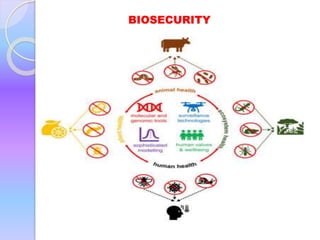
The bio-securityis essential for the following issues to be addressed-
The strategies and integrated approach comprising of policy and
regulatory approaches to analyze and manage in the domain of food
safety, animal and plant life along with hidden environmental risks and
threats,
Covers the following issues introduction of plant pests, animals pests
along with the diseases,
Introduction and management of invasive alien species and genotypes,
Introduction and release of genetically modified organisms, plants and
others in the domain of biotechnology and genetic engineering attributes,
A holistic concept to the relevance of sustainable agriculture, food safety
and biodiversity and environmental protection,
To prevent and conserve the sustainable plant life to explore the plant
related products and their issues,
The ecosystem services to be encouraged for the restoration of habitat
and other environmental related issues.
5.
PLANT BIOSECURITY
Plantbio-security is vital for biodiversity, and for the sustainable the
economy in the domains o natural resources,
Effective government policies and regulations are essential for
preventing the spread of plant pests and diseases, aligning with One
Health principles and other One Health disciplines.
Continuous and effective pest surveillance ensures early detection and
rapid response to outbreaks, supporting both plant bio-security and
broader ecosystem services.
Other bio-security measures, including control, containment,
quarantine and eradication, are essential for maintaining pest-free
areas, promoting sustainable agriculture, and strengthening global
health outcomes.
Bio-security is the call of the time to address the threats emerge from
the plant sources in the diverse fields for the purpose of human health
and economy.
BIOSECURITY
Bio-security, whichliterally means safety of living things, is a
programme designed to prevent the exposure of birds to disease
causing organisms by reducing introduction and spread of pathogens
into and between the farms. Bio-security in a broader sense
encompasses isolation, traffic control sanitation, vaccination,
serological monitoring of diseases and air quality etc. which will aid
in prevent the entry and control the pathogens in and around the farm.
Bio-security is the cheapest and at the same time most effective
means of disease control available without, which no disease
prevention programme will work well.
Bio-security is a defensive health plan and hygienic procedure that
can help to keep your farm disease free.
Bio-security is therefore is one of the integrated part of farm
operations. As the poultry operation becomes more and more
efficient, however, they also become a threat to themselves and their
neighbors and the concentration of more birds in limited space.
8.
BIOSECURITY
Poultry farmersshould take time to eliminate as many disease causing
organisms as possible.
Therefore, it is better to wait a little longer before introducing new
flock than to hurry and risk infection of new flock.
The most effective form of protection against disease, especially for
poultry under modern production techniques is bio-security i.e.
excluding disease from the farm environment and this holds the key
to successful and profitable farming.
Bio-security, medication/ vaccination and good management of farm
are three sides of disease control triangle.
Bio-security is the key element in the triangle of disease control.
Bio-security may be different types- Conceptual, structural,
operational,
9.
FACTORS INFLUENCING BIOSECURITY
Globalization – the call of the time as the earth has become global
village almost in all respects,
New agricultural production and food processing industries extension,
Increased trade in food and agricultural products,
Legal obligations for signatories of relevant international agreements,
Increasing travel and movement of people across the boarders,
Advances in communications and global access to bio-security
information,
Greater public attention to biodiversity , the environment and impact
of agriculture and impact of both ,
Shift from country independence to country interdependence for
effective bio-security,
Scarcity of technical and operational resources,
High dependence of some countries on food imports,
10.
NEED OF BIOSECURITYIN TRADE & EXCHANGE
The bio-security is one of the most important issues in the domain of
the import and export of live stocks and their products in the cross-
boarder issues. The following matters must be addressed in this
regard as follows:
The hosts may be carriers of the different types of invisible threats,
The inert materials in connection with the trade and commerce such
as packaging may carry organisms during this cross-boarder import
and export practices by man made practices,
Insect vectors and birds may be responsible in this domain,
Air currents may carry long distance transport of the different
elements associated with the bio-security concern,
May be deliberate, illegal introduction during the different issues as
bio-weapons in the different parameters.
11.
KEY COMPONENTS OFBIOSECURITY
Pest surveillance and monitoring
Regular monitoring and surveillance programs are essential for the early
detection of pest outbreaks. Advanced technologies, such as remote
sensing and molecular diagnostics, enhance the ability to efficiently
identify and track pest populations. For example, drones and satellite
imagery can help monitor large agricultural areas for signs of pest
activity.
Moreover, monitoring pests in Australia, particularly through
environmental DNA (eDNA) methods, can enhance bio-security efforts
by detecting invasive species that threaten biodiversity and agriculture,
This involves monitoring and early detection of plant pests and pathogens
to prevent their establishment and spread. Effective surveillance
programs are critical for identifying emerging threats and enabling rapid
responses,
Bio-security measures involves the early detection of the different
intruders in the plants and enables to address them for effective
management practices to achieve long term benefits in the domain to
endure bio-security.
12.
KEY COMPONENTS OFBIOSECURITY
Rapid response
When a pest or disease is detected, a rapid response is critical to
contain and eradicate the threat. This involves coordinated efforts
between government agencies, researchers, and farmers,
Preparedness for pest and disease outbreaks involves planning for
rapid containment and eradication efforts. Effective emergency
response can minimize the impact of bio-security breaches,
Rapid bio-security response is vital to mitigate the risks of invasive
species such as the fire ant (Solenopsis invicta) in Australia,
The detection of fire ants in Queensland triggered immediate
containment measures, including quarantines and treatment zones, to
prevent their spread and protect agriculture,
Thus, the rapid response against the pests to make the minimum lost of
plant products both qualitative and quantitative is the key element in
this regard,
It can ensure plant health along with the management of health risks of
the users.
13.
KEY COMPONENTS OFBIOSECURITY
Quarantine and border controls
The most effective way to protect plant bio-security is to prevent pests and
diseases from entering new areas.
This involves stringent border controls, sanitary and phyto-sanitary
measures, including quarantine and treatment, and public awareness
campaigns to educate about the risks of moving plants and plant products.
Measures may be needed to prevent the introduction and spread of pests
and diseases across borders. Quarantine regulations restrict the movement
of plants and plant products that may harbor harmful organisms,
Government policies and international agreements play a vital role in
enforcing plant bio-security. Regulatory frameworks establish the legal
basis for quarantine measures, pest management, and global trade
standards,
Quarantine and border controls in the different countries are pivotal in
preventing the introduction and spread of harmful pests and diseases that
could threaten the country’s agricultural and natural environments.
These measures include rigorous inspection protocols, treatment
requirements, and the management of import permits to ensure
compliance with bio-security standards.
.
14.
KEY COMPONENTS OFBIOSECURITY
Risk assessment and management
Assessing the risks associated with plant pests and diseases is
essential for prioritizing resources and implementing targeted bio-
security measures. Risk management strategies include developing
contingency plans and response protocols,
After a pest or disease has crossed the border, post-border
management involves containment, eradication, and long-term
management to mitigate its impact,
These assessments guide the development of risk management
strategies, including import conditions, surveillance programs, and
emergency response plans.
Effective risk management involves collaboration between
government, industry, and research organizations to minimize the
likelihood of pest introductions and ensure rapid action in case of
outbreaks of the different diseases,
15.
KEY COMPONENTS OFBIOSECURITY
Integrated pest management (IPM)
IPM is an eco-friendly approach that combines biological, cultural,
physical, and chemical tools to manage pests. By emphasizing
sustainable and scientifically sound practices, IPM reduces reliance
on chemical pesticides, thus protecting the environment,
IPM in Australia involves a holistic approach to managing pest
populations by combining biological, cultural, physical, and chemical
control methods. This strategy aims to minimize the use of chemical
pesticides and reduce their environmental impact while effectively
managing pest threats to agriculture and natural ecosystems,
IPM strategies are employed to reduce the risk of pest outbreaks
while minimizing environmental impacts,
IPM initiatives promoting sustainable farming practices and using
advanced technologies for monitoring and early intervention support
the adoption of IPM in plant bio-security.
16.
KEY COMPONENTS OFBIOSECURITY
Pest surveillance: a pillar of plant bio-security
Pest surveillance systematically collects, analyses, and interprets data on
pest populations. A proactive approach enables early detection and rapid
response to pest outbreaks. Effective surveillance is essential for
establishing, maintaining and verifying pest-free areas and supporting
the global trade of agricultural products. It can offer the following
benefits-
i. Early detection and control-Early detection allows for timely
interventions, preventing pests from establishing and spreading. Early
detection is one of the most significant benefits of pest surveillance,
ii. Informed decision-making-Surveillance data provide a basis for
making informed decisions about pest management strategies. By
understanding pest dynamics, authorities can implement targeted
control measures that are both effective and environmentally sound,
iii. Risk assessment and management-Surveillance helps assess the risk
posed by potential pest invasions, enabling the development of risk
management plans. These plans include contingency measures to
address possible outbreaks, thus enhancing bio-security preparedness
17.
PLANT QUARENTINE
Quarantinecan be defined “as a legal restriction to prevent the entrance
and establishment of a plant disease or insect pest in an area where the
pest or disease dose no exist”.
Plant quarantine measures aim at providing protection to the agriculture of
a country or region against the likely ravages of alien pests/pathogens
should they get introduced and established. These measures are of
particular importance and relevance to countries like India whose
economy is largely based on agriculture.
Quarantine not only helps to ward off the threats of exotic pests, but also
aim to eliminate and prevent further spread of pests/pathogens (both
indigenous and introduced) with restricted distribution within the country
(domestic quarantine).
Plant quarantine may, therefore, be defined as 'Rules and regulations
promulgated by governments to regulate the introduction of plants,
planting materials, plant products, soil, living organisms, etc. with a view
to prevent inadvertent introduction of exotic pests, weeds and pathogens
harmful to the agriculture or the environment of a country/region, and if
introduced, to prevent their establishment and further spread'.
Plant quarantine is thus designed as a safeguard against harmful
pests/pathogens exotic to a country or a region.
18.
TYPES OF QUARANTINE
The Quarantine measures can be different as per the need as well as
the boundary where it is being executed. The following five main
quarantine can be classified to get a wide spectrum:
International quarantine- Legislation to prevent the introduction of
new pests and weeds from foreign countries
Domestic quarantine- Legislation to prevent the spread of already
established pests, diseases, and weeds from one part of the country to
another.
Farmer’s quarantine-Legislation to enforce farmers to apply
effective control measures to prevent damage by already established
pests.
Food quarantine- Legislation to prevent the adulteration and
misbranding of insecticides and determine their permissible residue
tolerance levels in food stuffs.
Quarantine for pest control operations-Legislation to regulate the
activities of people engaged in pest control operations and application
of hazardous insecticides.
19.
KEY ACTIVITIES OFQUARENTINE
To ensure the global and local agricultural safety, the following
measure are adopted subjected to change from the rules and
regulations by the concerned country.
Pest risk analysis (PRA)- this mainly deals with the evaluation of the
pest which has threat on the likelihood consequences my take place
during the import of specific agricultural products along with their
packaging,
Inspection and Certification- it mainly deals with the examining
consignments at ports of entry and to provide phytosanitary
certification to ensure exports meet international health standards,
Post-entry quarantine- minimum 40 days isolation of the export
products to ensure them as disease free following the international
protocols.
The regulatory framework at the government levels, testing & research
along with permits and safety clearance of the export goods must
mandatory in this regard.
THANKS FOR YOURVISIT
ACKNOWLEDGEMENTS:
a. Google for images,
b. Different websites for enriching the course content,
c. Science Direct pages,
d. Plant diseases, insects and pests- NCBI-NH,
e. https://www.bgci.org/our-work/saving-plants/plant-health-and-
biosecurity/
f. https://food.ec.europa.eu/plants/plant-health-and-biosecurity_en
g. www.nature.com
h. https://www.rbge.org.uk/science-and-conservation/conservation-
science/plant-biosecurity/plant-health-biosecurity-in-the-natural-
environment.
i. Many more websites for references.
DISCLAIMER: This presentation has been designed to address the
academic fraternity without any financial interest. This is absolutely
free to use . The author does not claim any kind of financial benefits
from this content