Comprehensive Quality Control and Ethics in Medical Laboratory Science
Explore quality control, assurance, and management in medical labs, focusing on pre-analytical, analytical, and post-analytical phases, error prevention, safety, and professional ethics in clinical testing.
Importance of Laboratorytest in Clinical Medicine
The results obtained from laboratory analyses are used to:
Diagnose
Prescribe treatment
Monitor the health or progress of the patient
Since such importance is placed upon test results, they must
be as accurate as possible
Level of accuracy required: An accuracy level of 99% may
at first glance appear acceptable, but the resulting 1% error
can become quite large in a system where many events
occur, such as laboratory testing.
4.
Negative Consequences OfLaboratory Errors
If inaccurate results are provided, the consequences can
be very significant, including:
Unnecessary treatment
Treatment complications
Failure to provide the proper treatment
Delay in correct diagnosis
Additional and unnecessary diagnostic testing
Death
Litigation.
5.
Quality management/External quality
Assurance
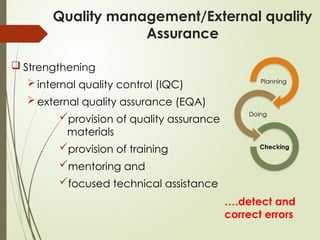
Strengthening
internal quality control (IQC)
external quality assurance (EQA)
provision of quality assurance
materials
provision of training
mentoring and
focused technical assistance
Planning
Doing
Checking
….detect and
correct errors
6.
Quality Control
Quality:Quality is defined as conformance with the
requirements and satisfactions of the needs and
expectations of users or customers. Laboratory quality can
be defined as accuracy, reliability and timeliness of
reported test results.
Quality Control: QC is defined as “a set of procedures for
continuously assessing laboratory work and the emergent
results”.
7.
Goal
Detect, evaluate, andcorrect errors due to test system
failure, environmental conditions or operator
performance, before patient results are reported.
8.
Quality Assurance
Isdefined as overall program that ensures that final results
reported by the laboratory are correct.
All the control measures taken from: test ordering,
acquisition, processing, analysis and reporting of a
laboratory test result.
An error in any of steps affects the quality of result and
causes the laboratory to fall short of its quality goals.
9.
Total Quality Management(TQM)
A quality management system can be defined as
coordinated activities to direct and control an organization
with regard to quality.
TQM views the organization as a support structure rather
than as a command structure.
As a support structure, the most immediate processes
required for delivery of service are those of frontline
employees and to empower them to identify and solve
problems in their own work processes.
10.
Total Quality Management
TQMcomprises of 12 essential components
1. Organization
2. Personnel
3. Equipment
4. Purchasing and inventory
5. Process control
6. Information management
7. Documents and records
11.
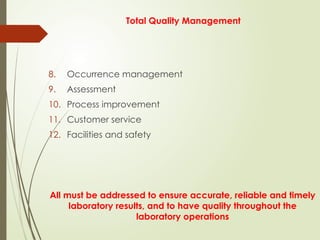
Total Quality Management
8.Occurrence management
9. Assessment
10. Process improvement
11. Customer service
12. Facilities and safety
All must be addressed to ensure accurate, reliable and timely
laboratory results, and to have quality throughout the
laboratory operations
13.
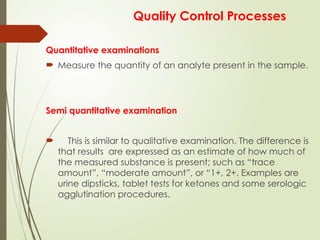
Quality Control Processes
Quantitativeexaminations
Measure the quantity of an analyte present in the sample.
Semi quantitative examination
This is similar to qualitative examination. The difference is
that results are expressed as an estimate of how much of
the measured substance is present; such as “trace
amount”, “moderate amount”, or “1+, 2+. Examples are
urine dipsticks, tablet tests for ketones and some serologic
agglutination procedures.
14.
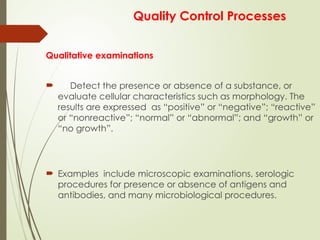
Quality Control Processes
Qualitativeexaminations
Detect the presence or absence of a substance, or
evaluate cellular characteristics such as morphology. The
results are expressed as “positive” or “negative”; “reactive”
or “nonreactive”; “normal” or “abnormal”; and “growth” or
“no growth”.
Examples include microscopic examinations, serologic
procedures for presence or absence of antigens and
antibodies, and many microbiological procedures.
15.
The Quality AssuranceCycle
1. Pre-analytical phase
2. Analytical phase
3. Post –analytical phase
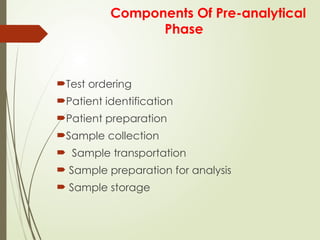
Pre-analytical phase: Includes all procedures from the moment a clinician
has formulated his request to the point when the sample is ready for
analysis.
Pre-analytical errors 77.1% analytical 7.9% and post-analytical 15%
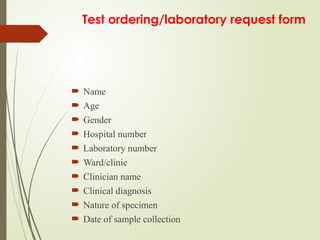
Test ordering/laboratory requestform
Name
Age
Gender
Hospital number
Laboratory number
Ward/clinic
Clinician name
Clinical diagnosis
Nature of specimen
Date of sample collection
18.
Patient identification
Theperson collecting the sample must accurately identify the patient. This
might be done by questioning the patient or an accompanying family member.
In case of medico legal purposes, patient’s photograph may be taken.
Samples from the ward/clinic
19.
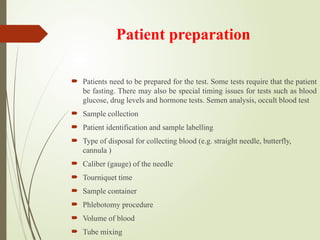
Patient preparation
Patientsneed to be prepared for the test. Some tests require that the patient
be fasting. There may also be special timing issues for tests such as blood
glucose, drug levels and hormone tests. Semen analysis, occult blood test
Sample collection
Patient identification and sample labelling
Type of disposal for collecting blood (e.g. straight needle, butterfly,
cannula )
Caliber (gauge) of the needle
Tourniquet time
Sample container
Phlebotomy procedure
Volume of blood
Tube mixing
20.
Sample collection
Sampletransportation
Length and environmental condition
Sample preparation for analysis
Length, speed and temperature of centrifugation
Preparing aliquots
Pre-analytical errors
Inappropriatetest request: The estimations of inappropriate laboratory
tests vary from 11% to 70% for clinical biochemistry and hematology
tests, 5% to 95% for urine screens and microbiology, and 17.4% to 55% for
cardiac enzymes and thyroid tests
Missing sample and/or test request: Wrong/missing identification: Mistakes
in patient identification before specimen collection is responsible for up to
25% of all pre-analytical errors.
Undue clotting
Wrong container
23.
Pre-analytical errors
Contaminationfrom infusion route
Insufficient sample
Inappropriate blood to anticoagulant ratio
Insufficient mixing of the sample
Inappropriate centrifugation conditions
Inappropriate and storage conditions
24.
Analytical Phase
Standardization
Calibrator
Reagent
Test conditions
Quality control
Internal quality control
Control samples
Levey Jennings Chart
External quality assurance
25.
Post Analytical Phase
Recording and reporting test results
Interpretation
Range of normal values
Turnaround time
Report to the right user
26.
Who DeterminesIf A Patient Needs Blood Transfusion And The
Number Units?
Who Determines If A Patient Is A Sickle Cell Patient?
Who Determines If A Patient Needs Dialysis?
Who Determines The Right Antibiotics That Will Cure An Infection?
Who Determines If A Patient Needs radiotherapy ?.
Safety
Ensuring safe workplacesfor laboratory
workers.
Training lab workers and putting in place
procedures for medical waste
management.
29.
Bio-safety guidelines:
Allspecimens (blood, urine, sputum, etc) are potentially hazardous
Protective gloves and a lab gown
Eating, drinking, or smoking in the lab.
Foods, Fruits and drinks in the lab refrigerator.
Wearing open toe footwear in the lab.
Spills must be cleaned with an appropriate disinfectant
Decontaminate all instruments and materials with an appropriate
disinfectant.
Disposing of all waste appropriately , including test kits