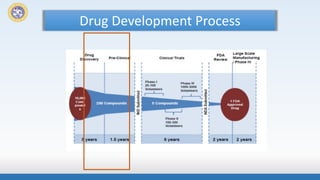
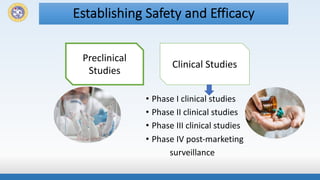
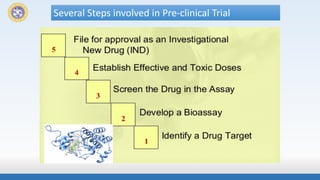
Establishing Safety andEfficacy
• Phase I clinical studies
• Phase II clinical studies
• Phase III clinical studies
• Phase IV post-marketing
surveillance
Preclinical
Studies
Clinical Studies
7.
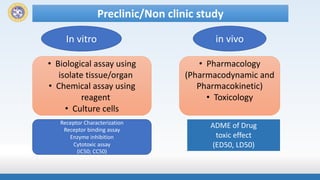
ADME of Drug
toxiceffect
(ED50, LD50)
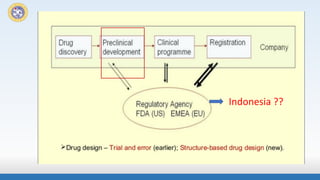
Preclinic/Non clinic study
In vitro in vivo
• Biological assay using
isolate tissue/organ
• Chemical assay using
reagent
• Culture cells
• Pharmacology
(Pharmacodynamic and
Pharmacokinetic)
• Toxicology
Receptor Characterization
Receptor binding assay
Enzyme inhibition
Cytotoxic assay
(IC50; CC50)
9.
Aims of PreclinicalStudies
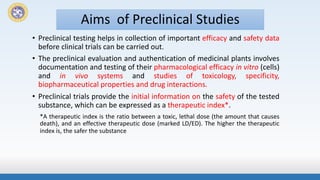
• Preclinical testing helps in collection of important efficacy and safety data
before clinical trials can be carried out.
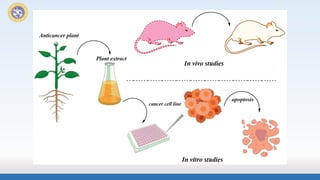
• The preclinical evaluation and authentication of medicinal plants involves
documentation and testing of their pharmacological efficacy in vitro (cells)
and in vivo systems and studies of toxicology, specificity,
biopharmaceutical properties and drug interactions.
• Preclinical trials provide the initial information on the safety of the tested
substance, which can be expressed as a therapeutic index*.
*A therapeutic index is the ratio between a toxic, lethal dose (the amount that causes
death), and an effective therapeutic dose (marked LD/ED). The higher the therapeutic
index is, the safer the substance
10.
The objections ofPreclinical study
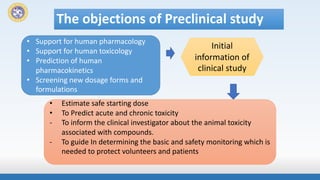
• Support for human pharmacology
• Support for human toxicology
• Prediction of human
pharmacokinetics
• Screening new dosage forms and
formulations
Initial
information of
clinical study
• Estimate safe starting dose
• To Predict acute and chronic toxicity
- To inform the clinical investigator about the animal toxicity
associated with compounds.
- To guide In determining the basic and safety monitoring which is
needed to protect volunteers and patients
Component in preclinicalstudy
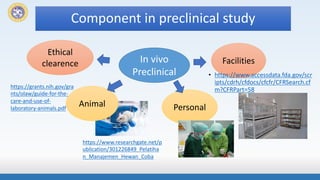
In vivo
Preclinical
Animal Personal
Facilities
https://www.researchgate.net/p
ublication/301226849_Pelatiha
n_Manajemen_Hewan_Coba
• https://www.accessdata.fda.gov/scr
ipts/cdrh/cfdocs/cfcfr/CFRSearch.cf
m?CFRPart=58
Ethical
clearence
https://grants.nih.gov/gra
nts/olaw/guide-for-the-
care-and-use-of-
laboratory-animals.pdf
13.
GLP for NonClinical studies
• https://www.accessdata.fda.gov/scripts/cdrh/cfdocs/cfcfr/CFRSearch.cfm?CFRPar
t=58
These regulations set the minimum basic requirements for:
• study conduct
• personnel
• facilities
• equipment
• written protocols
• operating procedures
• study reports
• and a system of quality assurance oversight for each study to help assure
the safety of FDA-regulated product
14.
Animal Study
The philosophyof ethics during preclinical testing can be summarized
with the concept of the 3R’s: Replacement, Reduction and Refinement.
• Replacement – in practice means to replace in vivo experiments with
model tests in vitro and in situ, where applicable.
• Reduction is the effort to minimize the number of animal subjects
used for the tests, providing that the group will be large enough to
obtain a statistical analysis.
• Refinement means that animal’s distress and discomfort is minimized
before, during and after the test.
15.
Care and studywith animal
1. Nutrition-fasting
2. Breeds and Strains
2. Handling and Restraint
3. Housing
4. Environment Conditions
5. Physical and Physiological Parameters
6. Identification, Bleeding, Anesthesia, and Euthanasia
Methods
Handling and Restraint
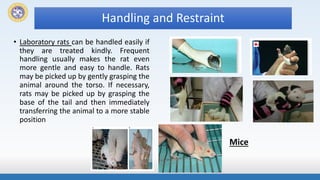
•Laboratory rats can be handled easily if
they are treated kindly. Frequent
handling usually makes the rat even
more gentle and easy to handle. Rats
may be picked up by gently grasping the
animal around the torso. If necessary,
rats may be picked up by grasping the
base of the tail and then immediately
transferring the animal to a more stable
position
Mice
18.
Housing
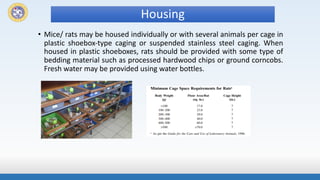
• Mice/ ratsmay be housed individually or with several animals per cage in
plastic shoebox-type caging or suspended stainless steel caging. When
housed in plastic shoeboxes, rats should be provided with some type of
bedding material such as processed hardwood chips or ground corncobs.
Fresh water may be provided using water bottles.
19.
Environmental Conditions
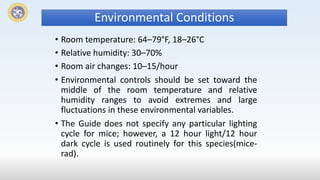
• Roomtemperature: 64–79°F, 18–26°C
• Relative humidity: 30–70%
• Room air changes: 10–15/hour
• Environmental controls should be set toward the
middle of the room temperature and relative
humidity ranges to avoid extremes and large
fluctuations in these environmental variables.
• The Guide does not specify any particular lighting
cycle for mice; however, a 12 hour light/12 hour
dark cycle is used routinely for this species(mice-
rad).
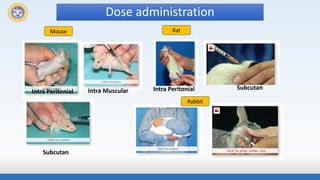
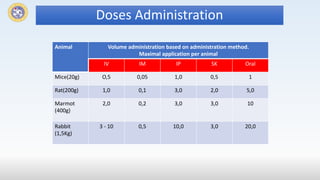
Doses Administration
Animal Volumeadministration based on administration method.
Maximal application per animal
IV IM IP SK Oral
Mice(20g) O,5 0,05 1,0 0,5 1
Rat(200g) 1,0 0,1 3,0 2,0 5,0
Marmot
(400g)
2,0 0,2 3,0 3,0 10
Rabbit
(1,5Kg)
3 - 10 0,5 10,0 3,0 20,0
22.
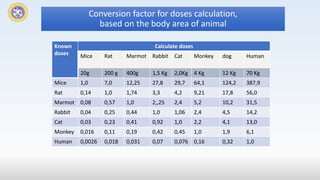
Conversion factor fordoses calculation,
based on the body area of animal
Known
doses
Calculate doses
Mice Rat Marmot Rabbit Cat Monkey dog Human
20g 200 g 400g 1,5 Kg 2,0Kg 4 Kg 12 Kg 70 Kg
Mice 1,0 7,0 12,25 27,8 29,7 64,1 124,2 387,9
Rat 0,14 1,0 1,74 3,3 4,2 9,21 17,8 56,0
Marmot 0,08 0,57 1,0 2,,25 2,4 5,2 10,2 31,5
Rabbit 0,04 0,25 0,44 1,0 1,06 2,4 4,5 14,2
Cat 0,03 0,23 0,41 0,92 1,0 2,2 4,1 13,0
Monkey 0,016 0,11 0,19 0,42 0,45 1,0 1,9 6,1
Human 0,0026 0,018 0,031 0,07 0,076 0,16 0,32 1,0
23.
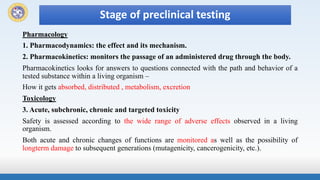
Stage of preclinicaltesting
Pharmacology
1. Pharmacodynamics: the effect and its mechanism.
2. Pharmacokinetics: monitors the passage of an administered drug through the body.
Pharmacokinetics looks for answers to questions connected with the path and behavior of a
tested substance within a living organism –
How it gets absorbed, distributed , metabolism, excretion
Toxicology
3. Acute, subchronic, chronic and targeted toxicity
Safety is assessed according to the wide range of adverse effects observed in a living
organism.
Both acute and chronic changes of functions are monitored as well as the possibility of
longterm damage to subsequent generations (mutagenicity, cancerogenicity, etc.).
24.
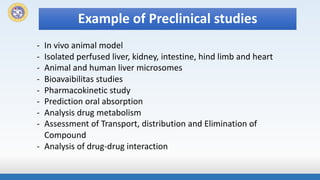
Example of Preclinicalstudies
- In vivo animal model
- Isolated perfused liver, kidney, intestine, hind limb and heart
- Animal and human liver microsomes
- Bioavaibilitas studies
- Pharmacokinetic study
- Prediction oral absorption
- Analysis drug metabolism
- Assessment of Transport, distribution and Elimination of
Compound
- Analysis of drug-drug interaction
25.
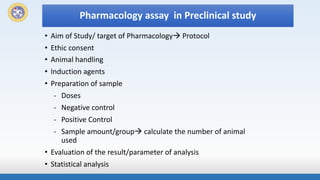
Pharmacology assay inPreclinical study
• Aim of Study/ target of Pharmacologyà Protocol
• Ethic consent
• Animal handling
• Induction agents
• Preparation of sample
- Doses
- Negative control
- Positive Control
- Sample amount/groupà calculate the number of animal
used
• Evaluation of the result/parameter of analysis
• Statistical analysis
26.
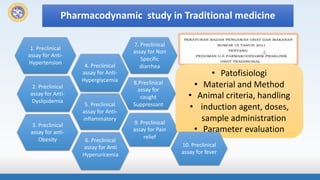
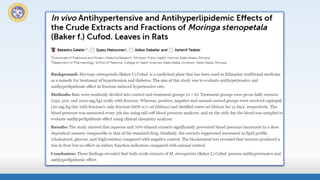
Pharmacodynamic study inTraditional medicine
1. Preclinical
assay for Anti-
Hypertension
3. Preclinical
assay for anti-
Obesity
2. Preclinical
assay for Anti-
Dyslipidemia
6. Preclinical
assay for Anti
Hyperuricemia
4. Preclinical
assay for Anti-
Hyperglycemia
7. Preclinical
assay for Non
Specific
diarrhea
5. Preclinical
assay for Anti-
inflammatory
8.Preclinical
assay for
caught
Suppressant
9. Preclinical
assay for Pain
relief
• Patofisiologi
• Material and Method
• Animal criteria, handling
• induction agent, doses,
sample administration
• Parameter evaluation
10. Preclinical
assay for fever
Safety testing inanimals
• A number of safety tests are performed on animals,
prior to clinical trials in humans, in order to select
the most suitable lead chemical and dosage form for
drug development.
• The safety tests will conduct by toxicities assay.
31.
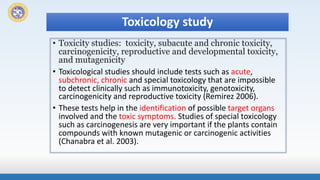
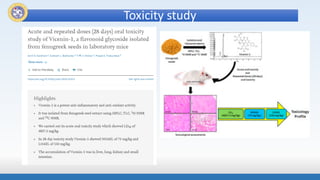
Toxicology study
• Toxicitystudies: toxicity, subacute and chronic toxicity,
carcinogenicity, reproductive and developmental toxicity,
and mutagenicity
• Toxicological studies should include tests such as acute,
subchronic, chronic and special toxicology that are impossible
to detect clinically such as immunotoxicity, genotoxicity,
carcinogenicity and reproductive toxicity (Remirez 2006).
• These tests help in the identification of possible target organs
involved and the toxic symptoms. Studies of special toxicology
such as carcinogenesis are very important if the plants contain
compounds with known mutagenic or carcinogenic activities
(Chanabra et al. 2003).
32.
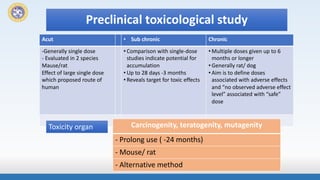
Preclinical toxicological study
Acut• Sub chronic Chronic
-Generally single dose
- Evaluated in 2 species
Mause/rat
Effect of large single dose
which proposed route of
human
• Comparison with single-dose
studies indicate potential for
accumulation
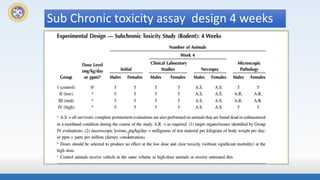
• Up to 28 days -3 months
• Reveals target for toxic effects
• Multiple doses given up to 6
months or longer
• Generally rat/ dog
• Aim is to define doses
associated with adverse effects
and “no observed adverse effect
level” associated with “safe”
dose
Carcinogenity, teratogenity, mutagenity
- Prolong use ( -24 months)
- Mouse/ rat
- Alternative method
Toxicity organ
33.
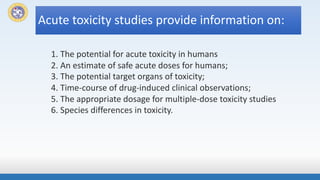
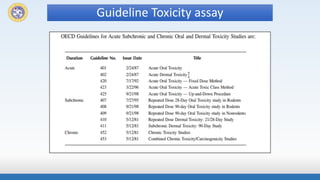
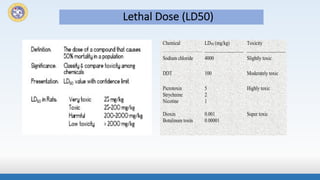
Acute toxicity studiesprovide information on:
1. The potential for acute toxicity in humans
2. An estimate of safe acute doses for humans;
3. The potential target organs of toxicity;
4. Time-course of drug-induced clinical observations;
5. The appropriate dosage for multiple-dose toxicity studies
6. Species differences in toxicity.
Acute Toxicity Studies
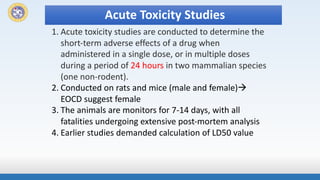
1.Acute toxicity studies are conducted to determine the
short-term adverse effects of a drug when
administered in a single dose, or in multiple doses
during a period of 24 hours in two mammalian species
(one non-rodent).
2. Conducted on rats and mice (male and female)à
EOCD suggest female
3. The animals are monitors for 7-14 days, with all
fatalities undergoing extensive post-mortem analysis
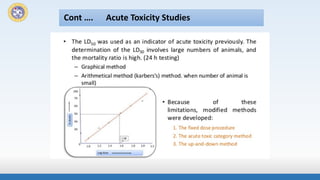
4. Earlier studies demanded calculation of LD50 value
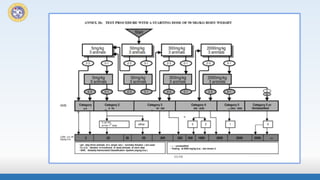
Fixed doses procedure
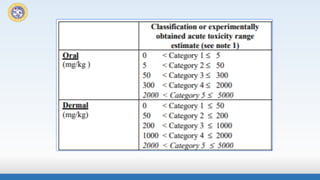
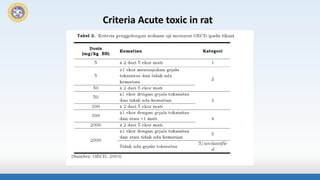
-Threeanimals are used for each step. The dose level to be used as the
starting dose is selected from one of four fixed levels, 5, 50, 300 and
2000 mg/kg body weight.
- The starting dose level should be that which is most likely to produce
mortality in some of the dosed animals.
-The volume of doses should not normally exceed 1 ml/100g of body
weight; however in the case of aqueous solutions, 2 ml/100g body
weight can be considered
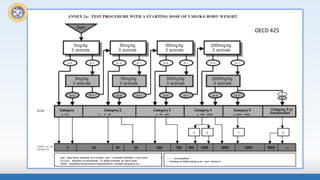
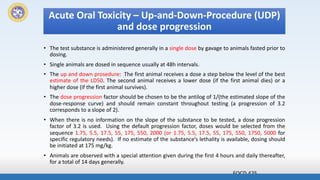
Acute Oral Toxicity– Up-and-Down-Procedure (UDP)
and dose progression
• The test substance is administered generally in a single dose by gavage to animals fasted prior to
dosing.
• Single animals are dosed in sequence usually at 48h intervals.
• The up and down prosedure: The first animal receives a dose a step below the level of the best
estimate of the LD50. The second animal receives a lower dose (if the first animal dies) or a
higher dose (if the first animal survives).
• The dose progression factor should be chosen to be the antilog of 1/(the estimated slope of the
dose-response curve) and should remain constant throughout testing (a progression of 3.2
corresponds to a slope of 2).
• When there is no information on the slope of the substance to be tested, a dose progression
factor of 3.2 is used. Using the default progression factor, doses would be selected from the
sequence 1.75, 5.5, 17.5, 55, 175, 550, 2000 (or 1.75, 5.5, 17.5, 55, 175, 550, 1750, 5000 for
specific regulatory needs). If no estimate of the substance’s lethality is available, dosing should
be initiated at 175 mg/kg.
• Animals are observed with a special attention given during the first 4 hours and daily thereafter,
for a total of 14 days generally.
EOCD 425
41.
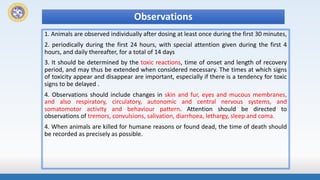
Observations
1. Animals areobserved individually after dosing at least once during the first 30 minutes,
2. periodically during the first 24 hours, with special attention given during the first 4
hours, and daily thereafter, for a total of 14 days
3. It should be determined by the toxic reactions, time of onset and length of recovery
period, and may thus be extended when considered necessary. The times at which signs
of toxicity appear and disappear are important, especially if there is a tendency for toxic
signs to be delayed .
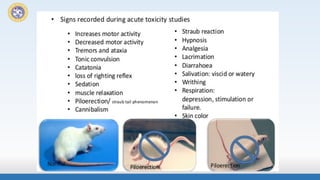
4. Observations should include changes in skin and fur, eyes and mucous membranes,
and also respiratory, circulatory, autonomic and central nervous systems, and
somatomotor activity and behaviour pattern. Attention should be directed to
observations of tremors, convulsions, salivation, diarrhoea, lethargy, sleep and coma.
4. When animals are killed for humane reasons or found dead, the time of death should
be recorded as precisely as possible.
42.
Result and Data
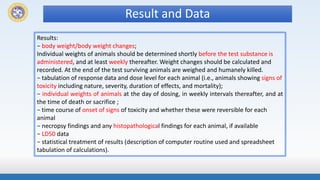
Results:
−body weight/body weight changes;
Individual weights of animals should be determined shortly before the test substance is
administered, and at least weekly thereafter. Weight changes should be calculated and
recorded. At the end of the test surviving animals are weighed and humanely killed.
− tabulation of response data and dose level for each animal (i.e., animals showing signs of
toxicity including nature, severity, duration of effects, and mortality);
− individual weights of animals at the day of dosing, in weekly intervals thereafter, and at
the time of death or sacrifice ;
− time course of onset of signs of toxicity and whether these were reversible for each
animal
− necropsy findings and any histopathological findings for each animal, if available
− LD50 data
− statistical treatment of results (description of computer routine used and spreadsheet
tabulation of calculations).
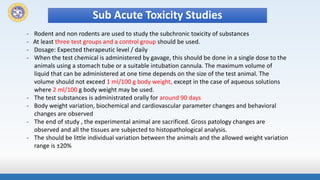
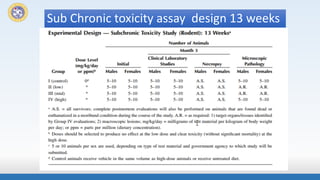
Sub Acute ToxicityStudies
- Rodent and non rodents are used to study the subchronic toxicity of substances
- At least three test groups and a control group should be used.
- Dosage: Expected therapeutic level / daily
- When the test chemical is administered by gavage, this should be done in a single dose to the
animals using a stomach tube or a suitable intubation cannula. The maximum volume of
liquid that can be administered at one time depends on the size of the test animal. The
volume should not exceed 1 ml/100 g body weight, except in the case of aqueous solutions
where 2 ml/100 g body weight may be used.
- The test substances is administrated orally for around 90 days
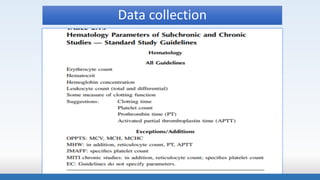
- Body weight variation, biochemical and cardiovascular parameter changes and behavioral
changes are observed
- The end of study , the experimental animal are sacrificed. Gross patology changes are
observed and all the tissues are subjected to histopathological analysis.
- The should be little individual variation between the animals and the allowed weight variation
range is ±20%
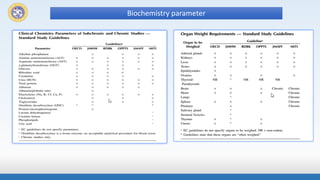
Doses
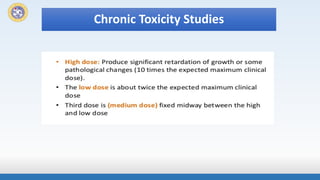
• Sub chronicand Chronic Studies
ADI: Acceptable Daily Intake (established for food additives/residues and
published by the EPA).
NOEL: No observed effect level. Dose at which no effect is seen. NOAEL:
No observed adverse effect level. Dose at which no adverse (toxic) effect
is seen.
• Chronic Studies
MTD: Maximum Tolerated Dose. Highest dose that can be tolerated
without significant lethality from causes other than tumors. (A
frequently cited criterion for EPA studies is that the MTD for chronic
studies with pesticides is a dose which produces an approximate 10–15%
decrement in body weight gain.)
HTD: Highest dose tested. Highest dose that can be expected to yield
results relevant to humans. This is a proposed new dose which would be
selected based on an evaluation of results of sub chronic studies.
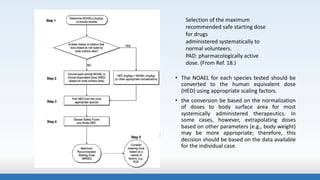
53.
Selection of themaximum
recommended safe starting dose
for drugs
administered systematically to
normal volunteers.
PAD: pharmacologically active
dose. (From Ref. 18.)
• The NOAEL for each species tested should be
converted to the human equivalent dose
(HED) using appropriate scaling factors.
• the conversion be based on the normalization
of doses to body surface area for most
systemically administered therapeutics. In
some cases, however, extrapolating doses
based on other parameters (e.g., body weight)
may be more appropriate; therefore, this
decision should be based on the data available
for the individual case.
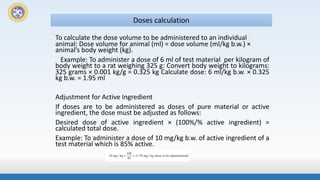
To calculate thedose volume to be administered to an individual
animal: Dose volume for animal (ml) = dose volume (ml/kg b.w.) ×
animal’s body weight (kg).
Example: To administer a dose of 6 ml of test material per kilogram of
body weight to a rat weighing 325 g: Convert body weight to kilograms:
325 grams × 0.001 kg/g = 0.325 kg Calculate dose: 6 ml/kg b.w. × 0.325
kg b.w. = 1.95 ml
Adjustment for Active Ingredient
If doses are to be administered as doses of pure material or active
ingredient, the dose must be adjusted as follows:
Desired dose of active ingredient × (100%/% active ingredient) =
calculated total dose.
Example: To administer a dose of 10 mg/kg b.w. of active ingredient of a
test material which is 85% active.
Doses calculation
Limitations of preclinicalstudies
1. Suitable pharmacological models have not yet been developed for many common diseases with
unknown, or multi-factorial origins (Hamburger and Hostettmann 1991).
2. Some compounds which show good activity in vitro may be metabolized in vivo into inactive
metabolites. Alternatively, extracts may only show in vivo activity due to the metabolism of
inactive compounds into active forms (Farnsworth 1993).
3. The pharmacological investigation of drug interactions in multi-compound preparations is
difficult due to the presence of constituents from several plants where some plants may show less
specific activity and some plants may have been added to reduce the toxicity of the more
therapeutically effective plants (Taylor et al. 2001).
4. Some of the most common side effects are difficult to recognize in animal models e.g. nausea,
nervousness, lethargy, heartburn, headache, depression, stiffness, etc.
5. Extrapolation of in vitro dose to in vivo animal models and humans is difficult.
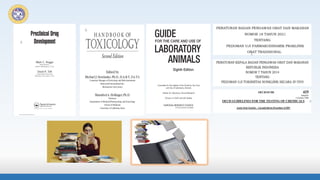
References
1. WHO, GeneralGuidelines for Methodologies on Research and Evaluation of Traditional Medicine,
2000
2. Mark C. Rogge, David R, Preclinical Drug Development, Toylor nd Francis, 2005.
3. Evaluation of drug candidate for Preclinical Development: Pharmacokinetics, metabolism,
Pharmaceutics and Toxicology, Wiley, 2010
4. Peraturan BPOM, No 7 tahun 2014, Pedoman Uji Toksisitas Non Klinik in Vivo
5. Peratutan BPOM, No 18 tahun 2021. Uji Farmakodinamaik PraKlinik pada Obat Tradisional
6. EOCD Guideline for testing of Chemical, 2001
7. EOCD 425, Acute oral toxicity,
8. Michel j derelanko et al. Handbook of Toxicology, 2002