Comprehensive Pharmacology of Neurodegenerative and CNS Disorders
Detailed overview of drugs used in Parkinson's, Alzheimer's, CNS stimulants, nootropics, and opioid analgesics including mechanisms, uses, and side effects.
Comprehensive Pharmacology of Neurodegenerative and CNS Disorders
1.
PREPARED BY
Prof. ASHISHN. UMALE
M. PHARM IN PHARMACOLOGY
ASSISTANT PROFESSOR
SHRADDHA INSTITUTE OF PHARMACY, WASHIM-
444505
PHARMACOLOGY-I
2.
Drugs Used inParkinson’s Disease
Introduction
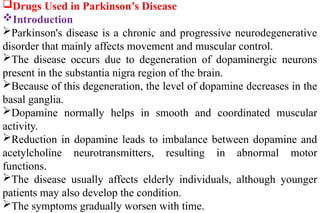
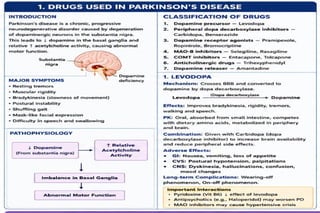
Parkinson's disease is a chronic and progressive neurodegenerative
disorder that mainly affects movement and muscular control.
The disease occurs due to degeneration of dopaminergic neurons
present in the substantia nigra region of the brain.
Because of this degeneration, the level of dopamine decreases in the
basal ganglia.
Dopamine normally helps in smooth and coordinated muscular
activity.
Reduction in dopamine leads to imbalance between dopamine and
acetylcholine neurotransmitters, resulting in abnormal motor
functions.
The disease usually affects elderly individuals, although younger
patients may also develop the condition.
The symptoms gradually worsen with time.
3.
Major Symptoms ofParkinson’s Disease
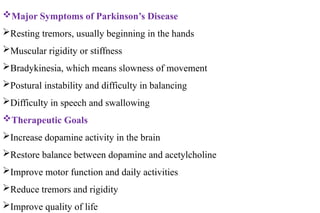
Resting tremors, usually beginning in the hands
Muscular rigidity or stiffness
Bradykinesia, which means slowness of movement
Postural instability and difficulty in balancing
Difficulty in speech and swallowing
Therapeutic Goals
Increase dopamine activity in the brain
Restore balance between dopamine and acetylcholine
Improve motor function and daily activities
Reduce tremors and rigidity
Improve quality of life
1. Levodopa
Introduction
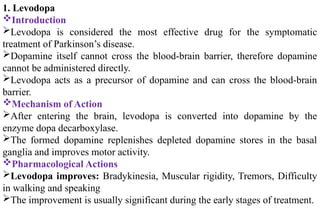
Levodopa isconsidered the most effective drug for the symptomatic
treatment of Parkinson’s disease.
Dopamine itself cannot cross the blood-brain barrier, therefore dopamine
cannot be administered directly.
Levodopa acts as a precursor of dopamine and can cross the blood-brain
barrier.
Mechanism of Action
After entering the brain, levodopa is converted into dopamine by the
enzyme dopa decarboxylase.
The formed dopamine replenishes depleted dopamine stores in the basal
ganglia and improves motor activity.
Pharmacological Actions
Levodopa improves: Bradykinesia, Muscular rigidity, Tremors, Difficulty
in walking and speaking
The improvement is usually significant during the early stages of treatment.
6.
Pharmacokinetics
Administered orally, Absorbedfrom the small intestine, Competes with
dietary amino acids for absorption, Crosses the blood-brain barrier,
Metabolized both in peripheral tissues and brain
Combination with Carbidopa
Carbidopa is usually administered with levodopa because it inhibits
peripheral metabolism of levodopa.
This increases the amount of levodopa reaching the brain and reduces
peripheral side effects such as nausea and vomiting.
Uses
Idiopathic Parkinson’s disease
Post-encephalitic Parkinsonism
Adverse Effects
Gastrointestinal Effect:- Nausea, Vomiting, Loss of appetite
Cardiovascular Effects:- Postural hypotension, Palpitations
CNS Effects :- Dyskinesia, Hallucinations, Confusion, Mood changes
7.
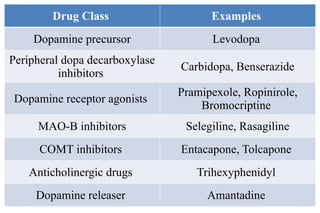
2. Dopamine Agonists
Examples:Pramipexole, Ropinirole, Bromocriptine
Mechanism of Action
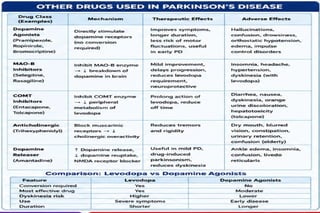
These drugs directly stimulate dopamine receptors in the brain
without requiring conversion into dopamine.
Advantages
Longer duration of action than levodopa
Lower risk of motor fluctuations
Useful in younger patients
Uses
Early-stage Parkinson’s disease
Combination therapy with levodopa
Adverse Effects:- Hallucinations, Confusion, Drowsiness,
Orthostatic hypotension, Edema, Impulse control disorders
8.
3. MAO-B Inhibitors
Examples:Selegiline, Rasagiline
Mechanism of Action
Monoamine oxidase-B enzyme is responsible for degradation of dopamine in the
brain.
These drugs inhibit MAO-B enzyme and therefore increase dopamine concentration
Therapeutic Effects
Mild improvement in symptoms
Delays progression of symptoms
Reduces levodopa requirement
Side Effects:- Insomnia, Headache, Hypertension, Dyskinesia
4. COMT Inhibitors
Examples: Entacapone, Tolcapone
Mechanism of Action
Catechol-O-methyl transferase enzyme metabolizes levodopa in peripheral tissues.
COMT inhibitors block this metabolism and prolong levodopa action.
Clinical Importance
These drugs are mainly used as adjunct therapy with levodopa.
Side Effects:- Diarrhea, Nausea, Dyskinesia, Hepatotoxicity
9.
5. Anticholinergic Drugs
Example:Trihexyphenidyl
Mechanism of Action
These drugs block muscarinic receptors and reduce cholinergic overactivity in
the basal ganglia.
Effects
Particularly useful for reducing tremors and rigidity.
Side Effects:- Dry mouth, Blurred vision , Constipation , Urinary retention,
6. Amantadine
Mechanism of Action
Amantadine increases dopamine release and inhibits dopamine reuptake. It also
blocks NMDA receptors.
Uses
Mild Parkinson’s disease
Drug-induced Parkinsonism
Adjunct with levodopa
Side Effects:- Ankle edema, Insomnia, Confusion, Livedo reticularis
12.
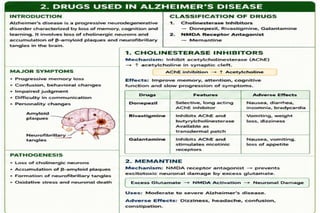
Drugs Used inAlzheimer’s Disease
Introduction
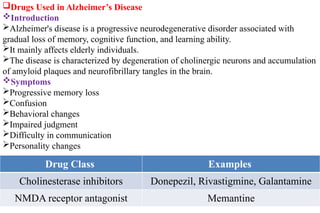
Alzheimer's disease is a progressive neurodegenerative disorder associated with
gradual loss of memory, cognitive function, and learning ability.
It mainly affects elderly individuals.
The disease is characterized by degeneration of cholinergic neurons and accumulation
of amyloid plaques and neurofibrillary tangles in the brain.
Symptoms
Progressive memory loss
Confusion
Behavioral changes
Impaired judgment
Difficulty in communication
Personality changes
Drug Class Examples
Cholinesterase inhibitors Donepezil, Rivastigmine, Galantamine
NMDA receptor antagonist Memantine
13.
1. Cholinesterase Inhibitors
Mechanismof Action
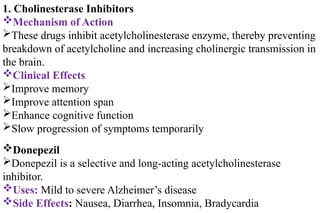
These drugs inhibit acetylcholinesterase enzyme, thereby preventing
breakdown of acetylcholine and increasing cholinergic transmission in
the brain.
Clinical Effects
Improve memory
Improve attention span
Enhance cognitive function
Slow progression of symptoms temporarily
Donepezil
Donepezil is a selective and long-acting acetylcholinesterase
inhibitor.
Uses: Mild to severe Alzheimer’s disease
Side Effects: Nausea, Diarrhea, Insomnia, Bradycardia
14.
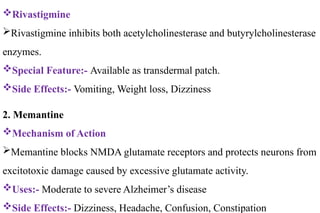
Rivastigmine
Rivastigmine inhibits bothacetylcholinesterase and butyrylcholinesterase
enzymes.
Special Feature:- Available as transdermal patch.
Side Effects:- Vomiting, Weight loss, Dizziness
2. Memantine
Mechanism of Action
Memantine blocks NMDA glutamate receptors and protects neurons from
excitotoxic damage caused by excessive glutamate activity.
Uses:- Moderate to severe Alzheimer’s disease
Side Effects:- Dizziness, Headache, Confusion, Constipation
16.
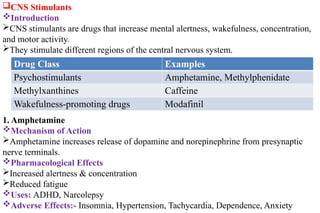
Drug Class Examples
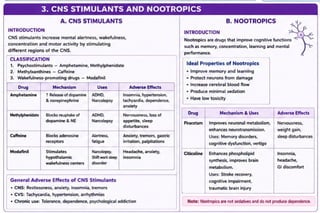
PsychostimulantsAmphetamine, Methylphenidate
Methylxanthines Caffeine
Wakefulness-promoting drugs Modafinil
CNS Stimulants
Introduction
CNS stimulants are drugs that increase mental alertness, wakefulness, concentration,
and motor activity.
They stimulate different regions of the central nervous system.
1. Amphetamine
Mechanism of Action
Amphetamine increases release of dopamine and norepinephrine from presynaptic
nerve terminals.
Pharmacological Effects
Increased alertness & concentration
Reduced fatigue
Uses: ADHD, Narcolepsy
Adverse Effects:- Insomnia, Hypertension, Tachycardia, Dependence, Anxiety
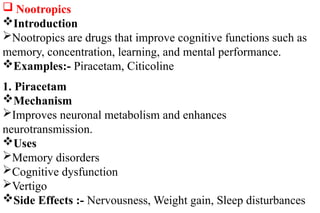
Nootropics
Introduction
Nootropics aredrugs that improve cognitive functions such as
memory, concentration, learning, and mental performance.
Examples:- Piracetam, Citicoline
1. Piracetam
Mechanism
Improves neuronal metabolism and enhances
neurotransmission.
Uses
Memory disorders
Cognitive dysfunction
Vertigo
Side Effects :- Nervousness, Weight gain, Sleep disturbances
20.
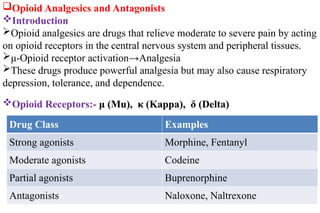
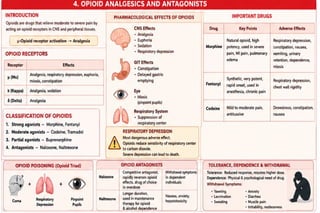
Opioid Analgesics andAntagonists
Introduction
Opioid analgesics are drugs that relieve moderate to severe pain by acting
on opioid receptors in the central nervous system and peripheral tissues.
μ-Opioid receptor activation→Analgesia
These drugs produce powerful analgesia but may also cause respiratory
depression, tolerance, and dependence.
Opioid Receptors:- μ (Mu), κ (Kappa), δ (Delta)
Drug Class Examples
Strong agonists Morphine, Fentanyl
Moderate agonists Codeine
Partial agonists Buprenorphine
Antagonists Naloxone, Naltrexone
21.
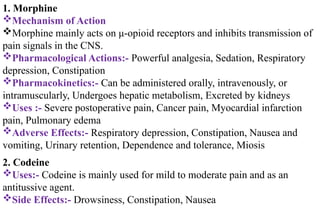
1. Morphine
Mechanism ofAction
Morphine mainly acts on μ-opioid receptors and inhibits transmission of
pain signals in the CNS.
Pharmacological Actions:- Powerful analgesia, Sedation, Respiratory
depression, Constipation
Pharmacokinetics:- Can be administered orally, intravenously, or
intramuscularly, Undergoes hepatic metabolism, Excreted by kidneys
Uses :- Severe postoperative pain, Cancer pain, Myocardial infarction
pain, Pulmonary edema
Adverse Effects:- Respiratory depression, Constipation, Nausea and
vomiting, Urinary retention, Dependence and tolerance, Miosis
2. Codeine
Uses:- Codeine is mainly used for mild to moderate pain and as an
antitussive agent.
Side Effects:- Drowsiness, Constipation, Nausea
22.
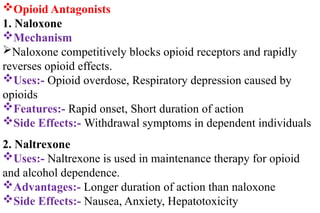
Opioid Antagonists
1. Naloxone
Mechanism
Naloxonecompetitively blocks opioid receptors and rapidly
reverses opioid effects.
Uses:- Opioid overdose, Respiratory depression caused by
opioids
Features:- Rapid onset, Short duration of action
Side Effects:- Withdrawal symptoms in dependent individuals
2. Naltrexone
Uses:- Naltrexone is used in maintenance therapy for opioid
and alcohol dependence.
Advantages:- Longer duration of action than naloxone
Side Effects:- Nausea, Anxiety, Hepatotoxicity