Comprehensive Pediatric Surgery Anesthesia and Care Guidelines
Overview of anesthesia types, complications, and pediatric surgical care including preoperative preparation, postoperative management, and vital sign monitoring for children undergoing surgery.
Comprehensive Pediatric Surgery Anesthesia and Care Guidelines
1.
Samarkand state medicaluniversity
Department of Pediatric Surgery №2
The concept of anesthesia, its types and complications.
Rules for measuring body temperature, pulse and blood
pressure of patients. Basic principles of preparing
children for surgery. Care of children with surgical
diseases in the preoperative and postoperative periods.
The value of postoperative procedures and
manipulations performed by the doctor. Care of
patients with intestinal and urinary fistulas.
2.
Lesson plan
1. Basicprinciples of preparing children for surgery.
2. What is anesthesia, its types and complications.
3. Care of children with surgical diseases in the postoperative
periods.
4. The value of postoperative procedures and manipulations
performed by the doctor.
5. Care of patients with intestinal and urinary fistulas
6. Rules for measuring body temperature, pulse and blood
pressure of patients.
.
3.
Basic principles ofpreparing children for surgery.
I. Preoperative Assessment
II. Psychological and Emotional Preparation
III. Nutritional and Fasting Guidelines
IV. Infection Prevention and Hygiene
V. Medication Management
VI. Safety Measures and Consent Process
VII. Postoperative Planning and Parental Guidance
4.
I. Preoperative Assessment
•Medical History and Physical Examination: A thorough
evaluation of the child's medical history, including previous
illnesses, allergies, and any underlying conditions (e.g.,
congenital heart disease, asthma, or coagulation disorders).
• Laboratory and Diagnostic Tests: Blood tests (CBC,
coagulation profile), imaging (X-ray, ultrasound, MRI if
necessary), and cardiac evaluations.
• Anesthetic Evaluation: Consultation with an anesthesiologist to
determine the appropriate anesthesia plan and to address any
potential airway or respiratory complications.
5.
II. Psychological andEmotional Preparation
• Age-Appropriate Communication: Explaining the procedure
using simple, understandable language tailored to the child’s
cognitive level.
• Parental Involvement: Educating and involving parents to help
reduce anxiety and provide emotional support.
• Preoperative Visit: Familiarizing the child with the hospital
environment, surgical team, and medical equipment to ease
anxiety.
• Psychological Support: Engaging child life specialists,
therapists, or play therapy to alleviate fear and stress.
6.
III. Nutritional andFasting Guidelines
• Preoperative Fasting (Nil per os - NPO): Adhering to fasting
guidelines to reduce the risk of aspiration during anesthesia:
• Clear liquids: Up to 2 hours before surgery.
• Breast milk: Up to 4 hours before surgery.
• Formula milk and light meals: Up to 6 hours before surgery.
• Heavy meals: At least 8 hours before surgery.
• Nutritional Optimization: Ensuring the child is well-nourished
before surgery to promote better recovery and wound healing.
7.
IV. Infection Preventionand Hygiene
• Preoperative Bathing: Using antiseptic soap to reduce skin microbial load.
• Hand Hygiene and Sterilization: Educating parents and caregivers on
infection control measures.
• Antibiotic Prophylaxis: Administering antibiotics as per guidelines for
high-risk procedures to prevent surgical site infections
V. Medication Management
• Continuation or Discontinuation of Medications: Reviewing chronic
medications (e.g., anticoagulants, corticosteroids, antihypertensives) and
adjusting as necessary.
• Preoperative Sedation: Administering anxiolytics if needed to minimize
stress and improve cooperation.
• Pain Management Plan: Establishing a multimodal analgesia strategy
(opioids, NSAIDs, regional anesthesia) to manage postoperative pain
effectively.
8.
VI. Safety Measuresand Consent Process
• Informed Consent: Obtaining legal and ethical consent from parents or
guardians after discussing risks, benefits, and alternatives.
• Patient Identification and Marking: Confirming patient details,
procedure type, and surgical site to prevent wrong-site surgery.
• Preoperative Checklist: Utilizing standardized checklists (e.g., WHO
Surgical Safety Checklist) to ensure all safety protocols are followed.
VII. Postoperative Planning and Parental Guidance
• Recovery and Pain Management: Educating parents on what to expect
post-surgery, including pain control, wound care, and potential
complications.
• Follow-Up Schedule: Scheduling postoperative visits for monitoring
healing and addressing any concerns.
• Rehabilitation and Physical Therapy: If necessary, planning for
rehabilitation to optimize functional recovery.
9.
What is anesthesia,its types and complications.
• ANESTHESIOLOGY is a branch of medical science that focuses
on studying and applying methods to protect the human body from
the extraordinary effects of surgery and other critical conditions. It
also involves restoring and correcting impaired functions of the
body that have led to life-threatening critical states.
• The main objectives of anesthesiology include protecting the body
from the harmful effects of surgery (trauma), ensuring pain relief
during surgery, preventing neurovegetative reactions, correcting
and, if necessary, supporting respiratory functions through
prosthetics, managing hemodynamics, and addressing metabolic
disorders.
10.
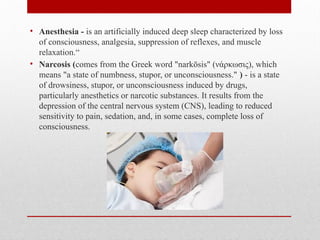
• Anesthesia -is an artificially induced deep sleep characterized by loss
of consciousness, analgesia, suppression of reflexes, and muscle
relaxation.“
• Narcosis (comes from the Greek word "narkōsis" (νάρκωσις), which
means "a state of numbness, stupor, or unconsciousness." ) - is a state
of drowsiness, stupor, or unconsciousness induced by drugs,
particularly anesthetics or narcotic substances. It results from the
depression of the central nervous system (CNS), leading to reduced
sensitivity to pain, sedation, and, in some cases, complete loss of
consciousness.
11.
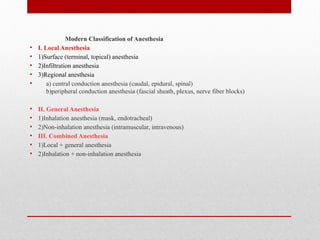
Modern Classification ofAnesthesia
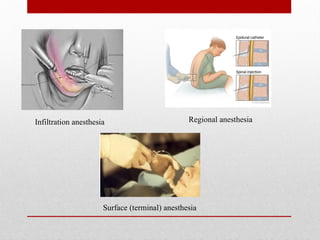
• I. Local Anesthesia
• 1)Surface (terminal, topical) anesthesia
• 2)Infiltration anesthesia
• 3)Regional anesthesia
• a) central conduction anesthesia (caudal, epidural, spinal)
b)peripheral conduction anesthesia (fascial sheath, plexus, nerve fiber blocks)
• II. General Anesthesia
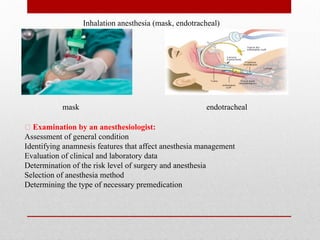
• 1)Inhalation anesthesia (mask, endotracheal)
• 2)Non-inhalation anesthesia (intramuscular, intravenous)
• III. Combined Anesthesia
• 1)Local + general anesthesia
• 2)Inhalation + non-inhalation anesthesia
12.
• Modern Classificationof Anesthesia
• I. Local Anesthesia - is a medical technique used to temporarily block pain
sensation in a specific area of the body without affecting the patient's
consciousness. It is commonly used in minor surgical procedures, dental
treatments, and diagnostic interventions.
• 1)Surface (terminal, topical) anesthesia- Applied directly to the skin or
mucous membranes (e.g., lidocaine gel, benzocaine spray).
• 2)Infiltration anesthesia - is a type of local anesthesia where an
anesthetic solution is injected directly into the tissues to block nerve
conduction in a specific area. This method is commonly used in minor
surgical, dental, and dermatological procedures.
• 3)Regional anesthesia- is a type of anesthesia that blocks pain
sensation in a specific region of the body by injecting local anesthetics near
nerves or nerve groups. Unlike general anesthesia, it allows the patient to
remain awake while providing complete pain relief in the targeted area.
a) Central Conduction Anesthesia (caudal, epidural, spinal)
b)Peripheral Conduction Anesthesia (fascial sheath, plexus, nerve fiber blocks)
13.
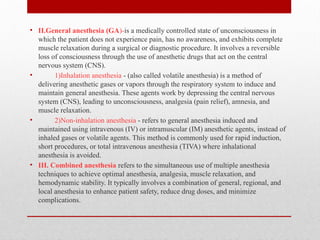
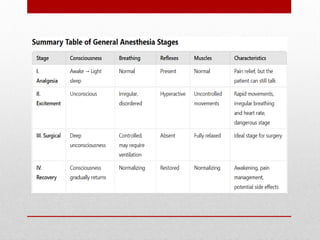
• II.General anesthesia(GA)-is a medically controlled state of unconsciousness in
which the patient does not experience pain, has no awareness, and exhibits complete
muscle relaxation during a surgical or diagnostic procedure. It involves a reversible
loss of consciousness through the use of anesthetic drugs that act on the central
nervous system (CNS).
• 1)Inhalation anesthesia - (also called volatile anesthesia) is a method of
delivering anesthetic gases or vapors through the respiratory system to induce and
maintain general anesthesia. These agents work by depressing the central nervous
system (CNS), leading to unconsciousness, analgesia (pain relief), amnesia, and
muscle relaxation.
• 2)Non-inhalation anesthesia - refers to general anesthesia induced and
maintained using intravenous (IV) or intramuscular (IM) anesthetic agents, instead of
inhaled gases or volatile agents. This method is commonly used for rapid induction,
short procedures, or total intravenous anesthesia (TIVA) where inhalational
anesthesia is avoided.
• III. Combined anesthesia refers to the simultaneous use of multiple anesthesia
techniques to achieve optimal anesthesia, analgesia, muscle relaxation, and
hemodynamic stability. It typically involves a combination of general, regional, and
local anesthesia to enhance patient safety, reduce drug doses, and minimize
complications.
Inhalation anesthesia (mask,endotracheal)
mask endotracheal
✅ Examination by an anesthesiologist:
Assessment of general condition
Identifying anamnesis features that affect anesthesia management
Evaluation of clinical and laboratory data
Determination of the risk level of surgery and anesthesia
Selection of anesthesia method
Determining the type of necessary premedication
17.
• "Premedication –the introduction of medications before
surgery in order to reduce the likelihood of intra- and
postoperative complications.“
• Tasks:
• Decreased emotional arousal
• Neurovegetative stabilization
• Reduced response to external stimuli
• Creating optimal conditions for the action of anesthetics
• Prevention of allergic reactions to drugs used in anesthesia
• Reduced glandular secretion
18.
• ✅ PossibleComplications:
• Laryngitis, tracheobronchitis
• Obstruction of the respiratory tract (tongue retraction, inhalation of teeth
or prostheses)
• Lung atelectasis
• Pneumonia
• Cardiovascular dysfunction (collapse, tachycardia, arrhythmias up to
fibrillation and circulatory arrest)
• Traumatic complications of intubation (injuries to the larynx, pharynx,
trachea)
• Gastrointestinal motility disorders (nausea, vomiting, regurgitation,
aspiration, intestinal paresis)
• Urinary retention
• Hypothermia
• Brain edema
19.
Care of childrenwith surgical diseases in the postoperative periods.
• Postoperative care in pediatric patients must be tailored to their
unique anatomical and physiological characteristics. The primary
goals are to stabilize the patient, manage pain effectively, prevent
complications, and promote optimal recovery.
• Postoperative care in pediatric patients requires a
multidisciplinary approach. Close monitoring of vital signs,
effective pain management, infection prevention, nutritional
support, and psychological care are critical for optimal recovery.
Adherence to international protocols in pediatric intensive care,
surgery, and anesthesiology ensures patient safety and successful
rehabilitation.
20.
The value ofpostoperative procedures and manipulations
performed by the doctor.
• I. Immediate Postoperative Management (0–24 Hours)
1)Airway, Breathing, and Circulation (ABC Assessment),
2)Pain Management, 3)Hemodynamic
Monitoring and Fluid Management, 4)Prevention of Postoperative
Complications
• II. Early Postoperative Period (24–72 Hours) 1)Wound
Care and Infection Prevention, 2)Gastrointestinal
Recovery, 3)Mobilization and Physiotherapy
• III. Intermediate Postoperative Period (Day 4–7)
1)Transition to Oral Medications,
2)Monitoring for Late-Onset Complications,
3)Nutritional Optimization
• IV. Late Postoperative Phase (Day 7 and Beyond).
1)Wound Healing and Scar Management,
2)Functional Rehabilitation,
3)Follow-up and Long-Term Surveillance
21.
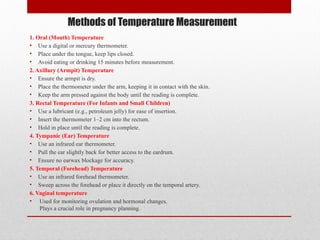
Methods of TemperatureMeasurement
1. Oral (Mouth) Temperature
• Use a digital or mercury thermometer.
• Place under the tongue, keep lips closed.
• Avoid eating or drinking 15 minutes before measurement.
2. Axillary (Armpit) Temperature
• Ensure the armpit is dry.
• Place the thermometer under the arm, keeping it in contact with the skin.
• Keep the arm pressed against the body until the reading is complete.
3. Rectal Temperature (For Infants and Small Children)
• Use a lubricant (e.g., petroleum jelly) for ease of insertion.
• Insert the thermometer 1–2 cm into the rectum.
• Hold in place until the reading is complete.
4. Tympanic (Ear) Temperature
• Use an infrared ear thermometer.
• Pull the ear slightly back for better access to the eardrum.
• Ensure no earwax blockage for accuracy.
5. Temporal (Forehead) Temperature
• Use an infrared forehead thermometer.
• Sweep across the forehead or place it directly on the temporal artery.
6. Vaginal temperature
• Used for monitoring ovulation and hormonal changes.
Plays a crucial role in pregnancy planning.
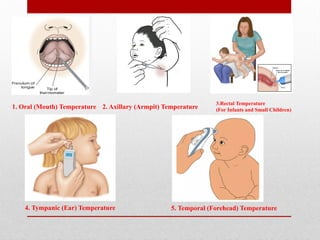
1. Oral (Mouth)Temperature 2. Axillary (Armpit) Temperature
3.Rectal Temperature
(For Infants and Small Children)
4. Tympanic (Ear) Temperature 5. Temporal (Forehead) Temperature
24.
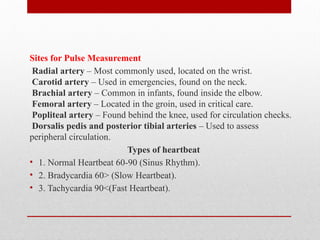
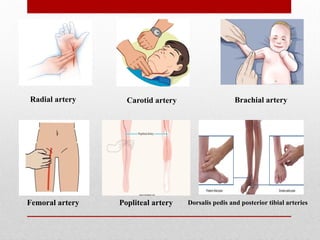
Sites for PulseMeasurement
Radial artery – Most commonly used, located on the wrist.
Carotid artery – Used in emergencies, found on the neck.
Brachial artery – Common in infants, found inside the elbow.
Femoral artery – Located in the groin, used in critical care.
Popliteal artery – Found behind the knee, used for circulation checks.
Dorsalis pedis and posterior tibial arteries – Used to assess
peripheral circulation.
Types of heartbeat
• 1. Normal Heartbeat 60-90 (Sinus Rhythm).
• 2. Bradycardia 60> (Slow Heartbeat).
• 3. Tachycardia 90<(Fast Heartbeat).
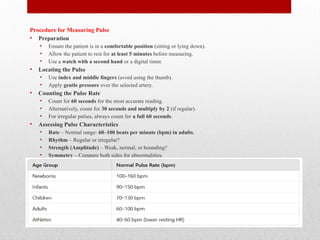
Procedure for MeasuringPulse
• Preparation
• Ensure the patient is in a comfortable position (sitting or lying down).
• Allow the patient to rest for at least 5 minutes before measuring.
• Use a watch with a second hand or a digital timer.
• Locating the Pulse
• Use index and middle fingers (avoid using the thumb).
• Apply gentle pressure over the selected artery.
• Counting the Pulse Rate
• Count for 60 seconds for the most accurate reading.
• Alternatively, count for 30 seconds and multiply by 2 (if regular).
• For irregular pulses, always count for a full 60 seconds.
• Assessing Pulse Characteristics
• Rate – Normal range: 60–100 beats per minute (bpm) in adults.
• Rhythm – Regular or irregular?
• Strength (Amplitude) – Weak, normal, or bounding?
• Symmetry – Compare both sides for abnormalities.
27.
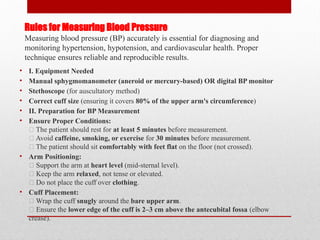
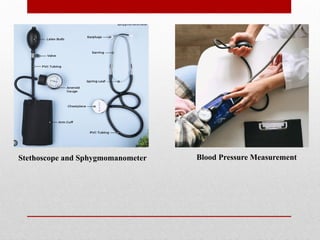
Rules for MeasuringBlood Pressure
Measuring blood pressure (BP) accurately is essential for diagnosing and
monitoring hypertension, hypotension, and cardiovascular health. Proper
technique ensures reliable and reproducible results.
• I. Equipment Needed
• Manual sphygmomanometer (aneroid or mercury-based) OR digital BP monitor
• Stethoscope (for auscultatory method)
• Correct cuff size (ensuring it covers 80% of the upper arm's circumference)
• II. Preparation for BP Measurement
• Ensure Proper Conditions:
✅ The patient should rest for at least 5 minutes before measurement.
✅ Avoid caffeine, smoking, or exercise for 30 minutes before measurement.
✅ The patient should sit comfortably with feet flat on the floor (not crossed).
• Arm Positioning:
✅ Support the arm at heart level (mid-sternal level).
✅ Keep the arm relaxed, not tense or elevated.
✅ Do not place the cuff over clothing.
• Cuff Placement:
✅ Wrap the cuff snugly around the bare upper arm.
✅ Ensure the lower edge of the cuff is 2–3 cm above the antecubital fossa (elbow
crease).
28.
• III. BloodPressure Measurement Methods
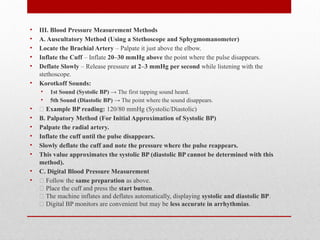
• A. Auscultatory Method (Using a Stethoscope and Sphygmomanometer)
• Locate the Brachial Artery – Palpate it just above the elbow.
• Inflate the Cuff – Inflate 20–30 mmHg above the point where the pulse disappears.
• Deflate Slowly – Release pressure at 2–3 mmHg per second while listening with the
stethoscope.
• Korotkoff Sounds:
• 1st Sound (Systolic BP) → The first tapping sound heard.
• 5th Sound (Diastolic BP) → The point where the sound disappears.
• ✅ Example BP reading: 120/80 mmHg (Systolic/Diastolic)
• B. Palpatory Method (For Initial Approximation of Systolic BP)
• Palpate the radial artery.
• Inflate the cuff until the pulse disappears.
• Slowly deflate the cuff and note the pressure where the pulse reappears.
• This value approximates the systolic BP (diastolic BP cannot be determined with this
method).
• C. Digital Blood Pressure Measurement
• ✅ Follow the same preparation as above.
✅ Place the cuff and press the start button.
✅ The machine inflates and deflates automatically, displaying systolic and diastolic BP.
✅ Digital BP monitors are convenient but may be less accurate in arrhythmias.
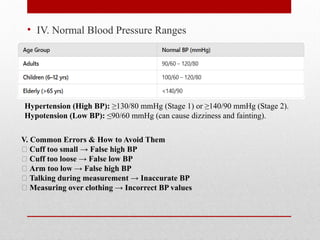
• IV. NormalBlood Pressure Ranges
Hypertension (High BP): ≥130/80 mmHg (Stage 1) or ≥140/90 mmHg (Stage 2).
Hypotension (Low BP): ≤90/60 mmHg (can cause dizziness and fainting).
V. Common Errors & How to Avoid Them
🚫 Cuff too small → False high BP
🚫 Cuff too loose → False low BP
🚫 Arm too low → False high BP
🚫 Talking during measurement → Inaccurate BP
🚫 Measuring over clothing → Incorrect BP values